A plant’s life can first be understood as a cycle
A plant’s life is not always as easy to read as an animal’s birth, growth, and aging. Often we simply notice a plant sprouting, growing leaves, flowering, or fading. But these changes can be placed inside a life cycle.
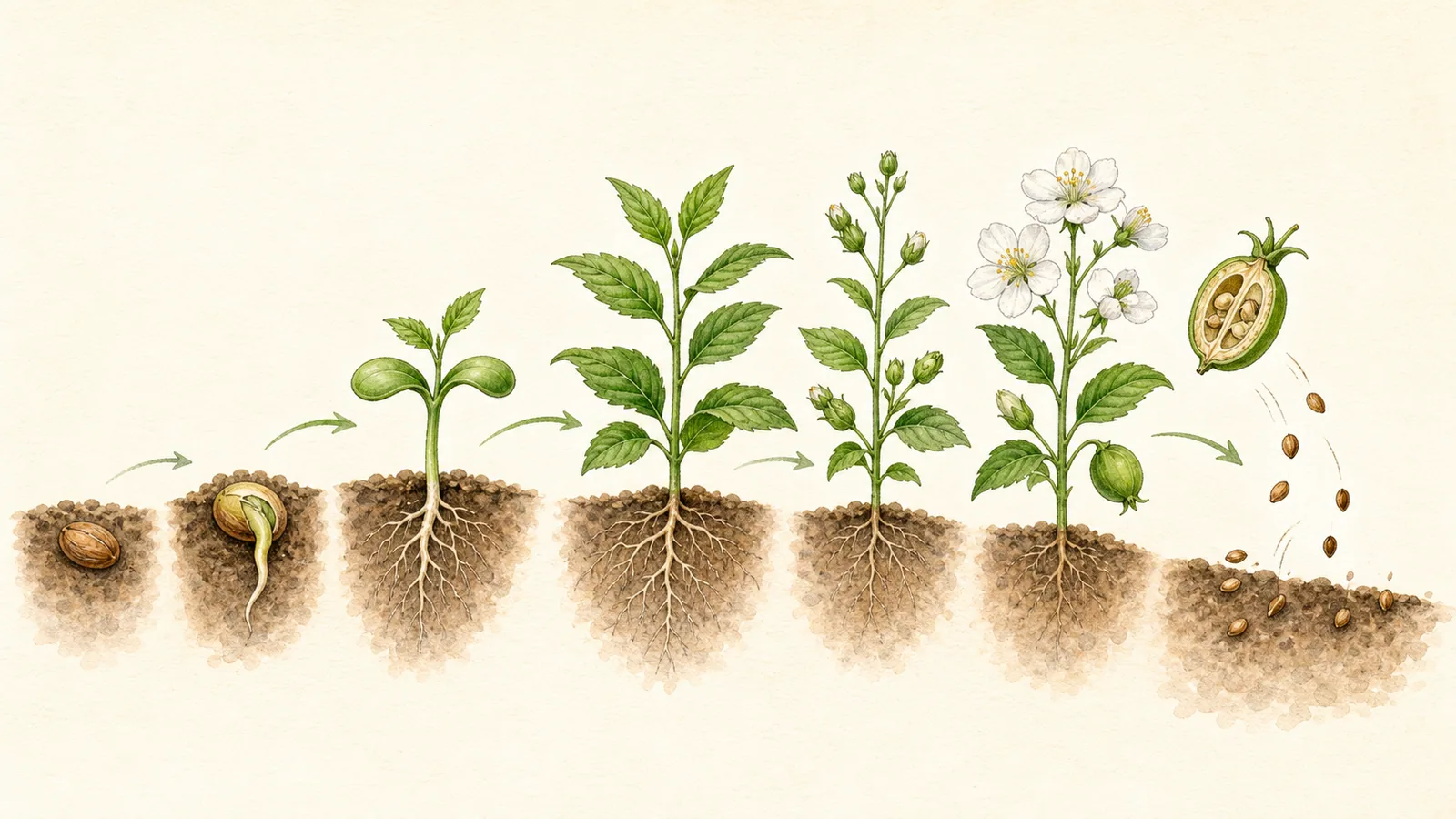
For common flowering plants, the life cycle can first be understood like this: a seed germinates under suitable conditions; the seedling grows roots, stems, and leaves; the mature plant flowers; after pollination and fertilization, fruits and seeds may form; new seeds leave the parent plant and may begin another cycle.
This is an entry model, not a rule for every plant. Ferns, mosses, and other non-flowering plants do not reproduce through flowers and fruits. Perennial plants also do not necessarily die after producing seeds.
Roots and leaves are built first, so the plant can move forward
The early part of the life cycle often begins with germination. After the seed takes up water, the embryo restarts growth. In many plants, the radicle emerges first and begins the root system. Roots help the seedling anchor itself and contact water and minerals.
The seedling then produces a stem and leaves. This stage looks small, but it is critical. Leaves gradually receive light and make sugars and other organic materials through photosynthesis. Roots, stems, and leaves support the plant as it grows larger.
When a plant is mainly growing roots, stems, and leaves rather than focusing on flowering, this can be understood as vegetative growth. It is not a waiting room before the “real” life cycle. It is the stage where the plant builds the body it may later use for flowering, fruiting, storage, or continued growth.
Juvenile and adult phases describe developmental stages. Vegetative traits, flowering competence, and actual flowering do not always change together. Read “How Are Juvenile and Adult Plant Phases Different?” for a closer comparison.
Flowers, fruits, and seeds pass the plant to the next generation
For many flowering plants, flowering marks a reproductive stage. A flower is not only a beautiful structure. It may contain stamens, pistils, ovules, and other parts involved in seed formation.
Pollination is the movement of pollen from an anther to a stigma. Fertilization is the union of sperm cells from pollen with egg cells in the ovule. These are not the same event. Pollination can happen without fertilization succeeding.
If fertilization succeeds, the ovule can develop into a seed. In many flowering plants, the ovary develops into a fruit. Fruits often protect seeds or help them move away from the parent plant. Seeds can be carried by wind, water, animals, gravity, or other mechanisms. If a seed reaches suitable conditions, the cycle can begin again.
Different plants do not follow the same rhythm
Even among flowering plants, life cycle timing can vary greatly. A common entry-level distinction is annual, biennial, and perennial.
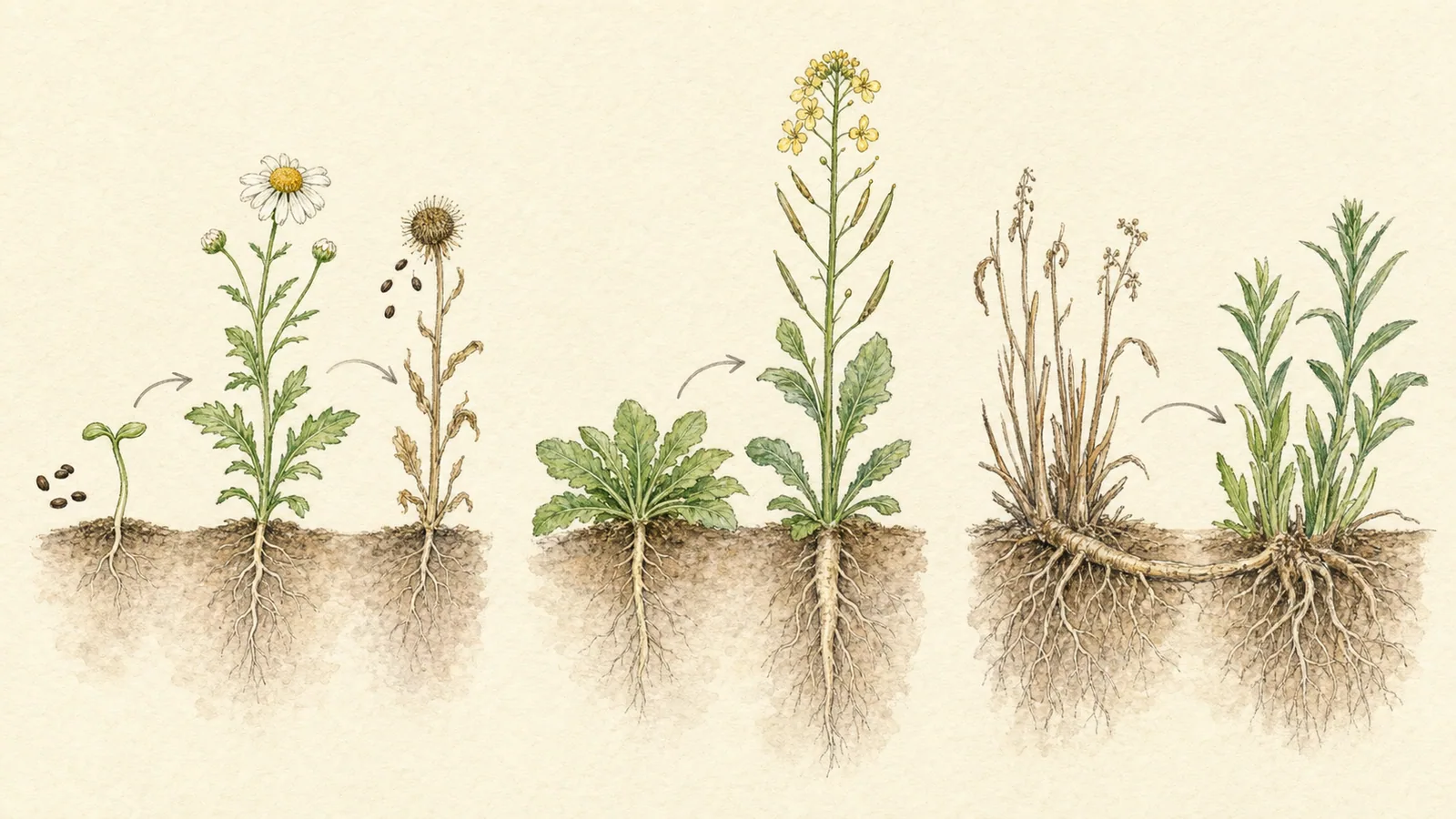
Annual plants often complete germination, growth, flowering, seed production, and death within one growing season. Many bedding flowers and short-season crops can be understood with this rhythm.
Biennial plants usually take two years or two growing seasons from germination to flowering, seed production, and death. The first year often focuses on leaves, roots, and stored resources. The second year often brings flowering and seed production.
Perennial plants can live for many years. Some herbaceous perennials keep underground or basal structures through a dormant season, then produce new growth again. They may flower and fruit repeatedly.
In everyday observation, ask which stage the plant is in
When looking at a pot plant, garden plant, or schoolyard plant, it is not always useful to ask first, “What is wrong with it?” Sometimes the better first question is, “Which life cycle stage is it in?”
After sowing, the main observations may be whether seeds germinate and whether seedlings establish roots and leaves. When a plant grows leaves vigorously but does not flower, it may still be in vegetative growth, or it may not yet have the conditions that support flowering. After flowering, a lack of fruit or seed may relate to pollination, fertilization, plant type, or environment.
The life cycle is not a diagnostic chart. It is a time map. It helps place germination, leaf growth, flowering, fruiting, seed dispersal, and dormancy into one story.
Common confusions
- ✕ Flowering is the endpoint of plant growth.
- ✓ For flowering plants, flowering is one stage in a reproductive process.
- ✕ Seeds are only the end of the life cycle.
- ✓ Seeds often represent the starting point of the next generation.
- ✕ Every plant dies after making seeds.
- ✓ Many annuals do, but perennials may continue living or regrow after dormancy.
- ✕ All plants make flowers and fruits.
- ✓ Ferns, mosses, and other plants have different life cycles.
- ✕ Pollination and fertilization are the same thing.
- ✓ Pollination is pollen reaching the stigma. Fertilization is the union of reproductive cells.
Frequently Asked Questions
Does every plant life start from a seed?
No. This article uses seeds of common flowering plants as the entry model. Some plants can reproduce through cuttings, division, underground stems, or other vegetative methods. Non-flowering plants such as ferns have different processes.
What is the difference between a seedling and a mature plant?
A seedling is a young plant soon after germination, with roots, stems, and leaves still being established. A mature plant usually has a more developed body and may be able to enter reproductive stages.
Why do plants flower?
For many flowering plants, flowers are reproductive structures involved in pollination, fertilization, and seed formation. Not all plants flower, so this article mainly discusses common flowering plants.
Are pollination and fertilization the same?
No. Pollination is the movement of pollen to a stigma. Fertilization is the union of sperm and egg cells. Pollination can occur without fertilization succeeding.
How are fruits and seeds related?
In many flowering plants, fertilized ovules develop into seeds, and the ovary develops into a fruit. Fruits often protect seeds or help them disperse.
Do all plants die after producing seeds?
No. Annual plants often die after seed production. Perennial plants may live for many years and repeatedly grow, flower, fruit, or enter dormancy.
How do ferns have a life cycle without flowers?
Ferns do not reproduce through flowers and fruits. They use spores and a different life cycle pattern. That is a more advanced topic; this article only notes that flowering-plant models should not be forced onto every plant.
Related Terms
- Life cycle: the process from a living organism’s beginning through growth, reproduction, and the next generation.
- Germination: the stage when a seed embryo resumes active growth, often with radicle emergence.
- Seedling: a young plant soon after germination.
- Vegetative growth: growth focused on roots, stems, and leaves.
- Pollination: movement of pollen from anther to stigma.
- Fertilization: union of sperm and egg cells.
- Annual: a plant that often completes its life cycle within one growing season.
- Perennial: a plant that can live for many years.
Read Next
Evidence
References
These sources were used to check the plant-science concepts and gardening context in this article.