A seed coat protects what is inside a seed
That thin “skin” around a seed is its seed coat. It surrounds the embryo and stored resources, like a protective covering for a young plant that has not started growing yet. A seed coat can help reduce drying, physical damage, and some harm from outside organisms. It also affects how water and gases move into and out of the seed.
The point is not “the harder, the better.” A seed coat has to balance protection with the ability to take in water and exchange gases when conditions are suitable. Seed coats differ widely in thickness, color, surface texture, and permeability, so the appearance of one seed cannot be used as a rule for all plants.
Where is the seed coat?
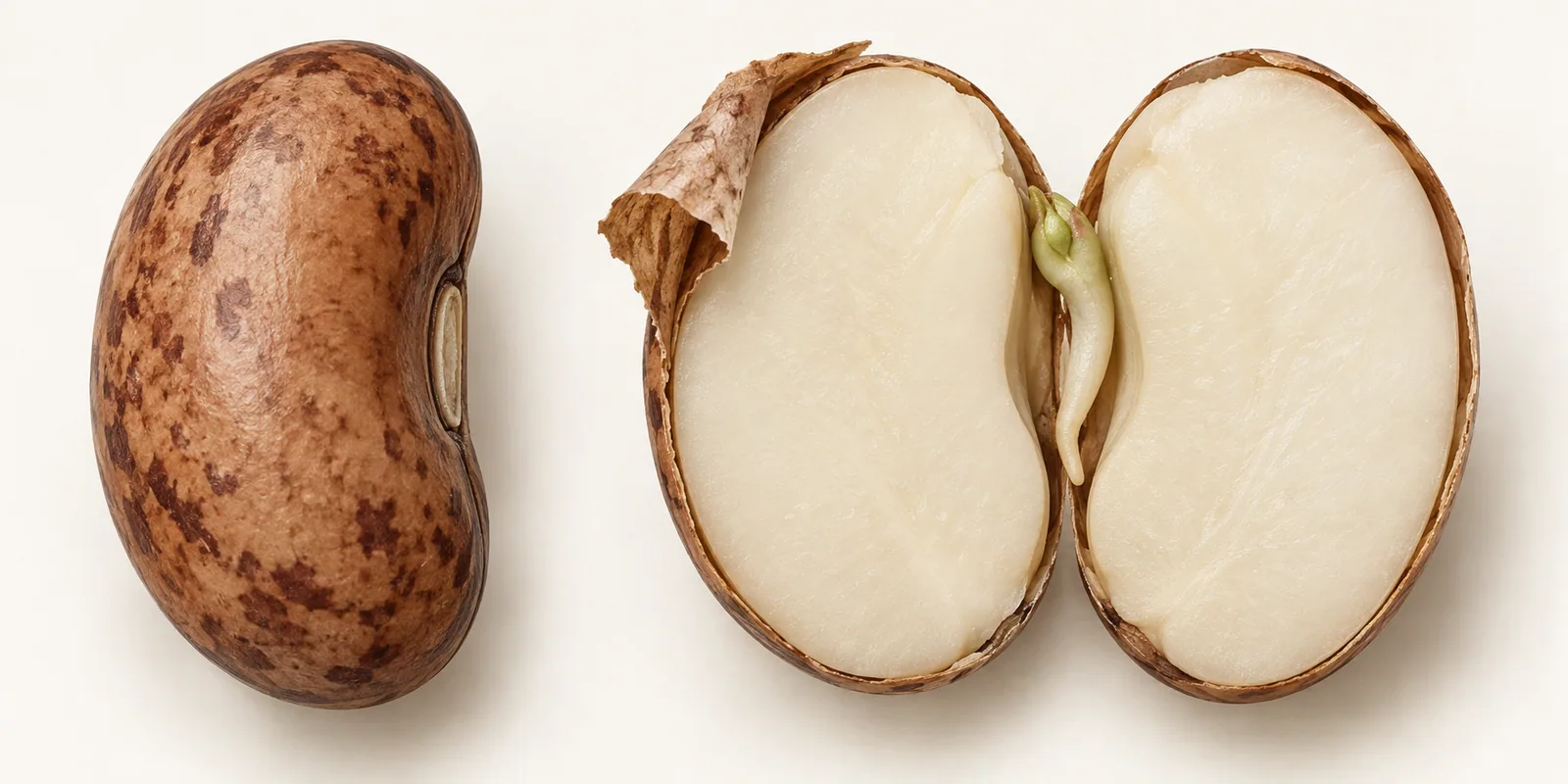
For a beginner, it helps to think of a seed as having three broad parts: an outer seed coat, an embryo inside, and stored resources that support early growth. The embryo is the early form of the next plant. Those stored resources may be held mainly in the cotyledons or in the endosperm, depending on the plant. The seed coat is the outer covering around these inner structures.
Plant biology texts often use testa as a term for the seed coat. In a typical seed with two ovule coverings, the outer integument usually forms the testa and the inner integument forms the tegmen. Some seeds have only one integument, and mature layers may not be easy to separate. These terms help describe variation; they are not labels that force every seed to match one standard cross-section.
What does a seed coat do?
It protects the embryo and stored resources
The embryo has not yet become a plant that can make large amounts of its own organic materials. Cotyledons or endosperm may hold resources that support the earliest stage of growth. The seed coat forms an outer barrier, giving these inner structures some protection while the seed is dry, being moved, or waiting for suitable conditions.
The degree of protection depends on the plant, the stage of development, and the details of the outer layers. Some coats are thin and flexible; others are thick and closely packed. Either can protect the inside without forming a perfect seal against water, gases, or outside organisms. In some species, seed-coat tissues also contribute to wings, hairs, or fleshy appendages involved in dispersal.
It influences water loss and exchange with the outside
Many mature seeds can remain relatively dry for a period of time. Yet when germination begins, the embryo needs water and oxygen. The seed coat is therefore not simply a sealed outer layer. It is an interface between the seed and its surroundings.
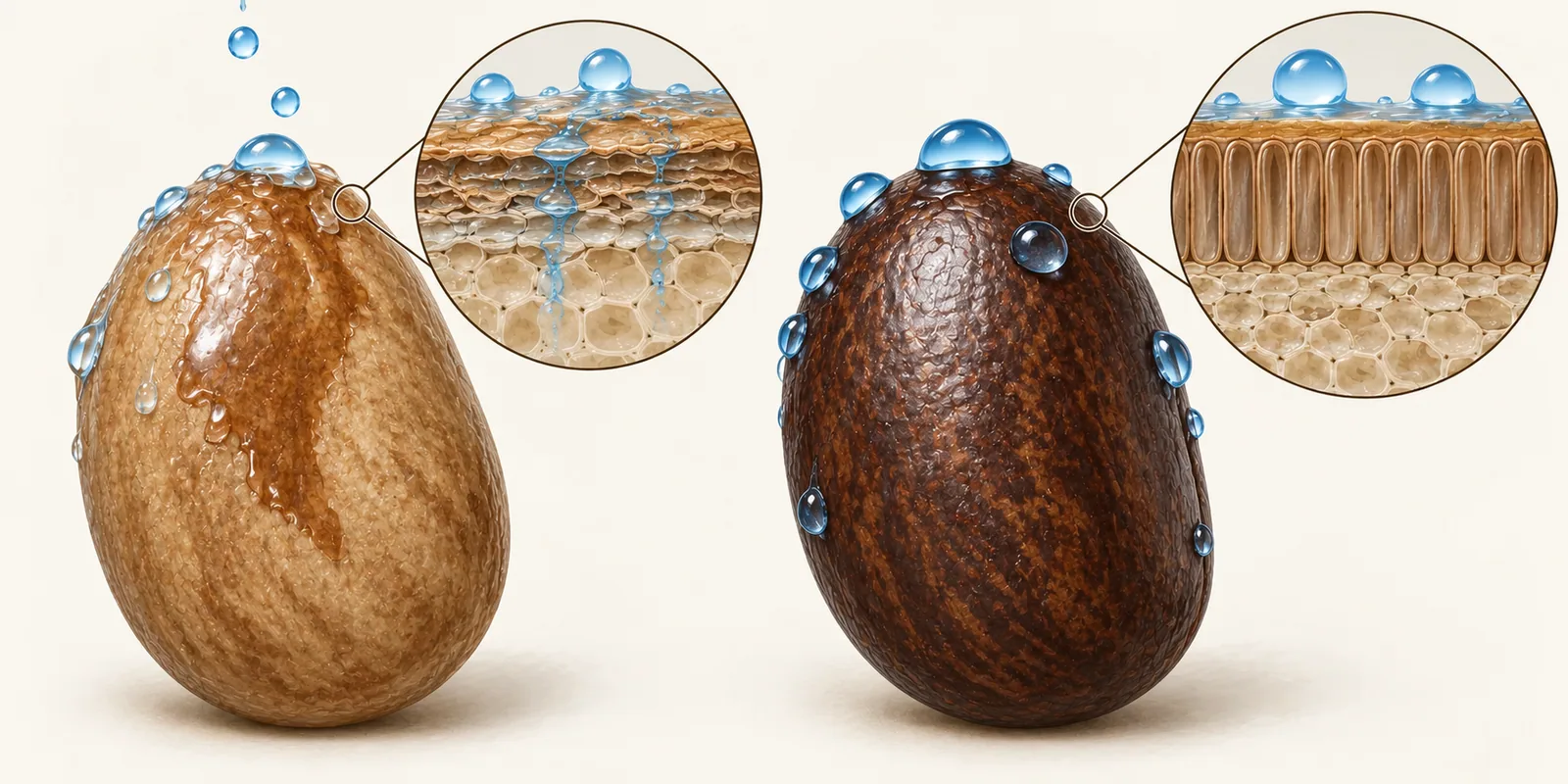
Different seeds have different pores, seams, or specialized openings. Water and gases may pass through at different rates, and exchange can be concentrated at particular regions in some species. Hardness is a mechanical property, whereas permeability describes whether water or gases can cross a layer. The two can be related, but one cannot substitute for the other. Water impermeability has to be tested by whether the seed actually imbibes and swells, not inferred from color, thickness, or touch alone.
It helps seeds germinate when conditions are suitable
The seed coat can protect a seed while also becoming one external limit on the start of germination. This can help a seed avoid beginning growth after every brief contact with water, when the seedling might soon face drying or cold conditions again.
This kind of waiting is related to dormancy, but a seed coat is not the only possible cause. The embryo’s internal state, plant hormones, and environmental signals may also be involved. A seed that has not germinated cannot be explained by its outer covering alone.
Why are some seed coats hard?
Seed-coat hardness is often related to the thickness and arrangement of outer cells and to the properties of their cell walls. Some seeds have a tightly packed, palisade-like layer of thick-walled cells called macrosclereids. A surface cuticle, waxes, and other water-resistant materials can work with this tissue to limit water entry. Thickness is only one factor and cannot determine permeability by itself.
Seed-coat hardness can also be an evolved trait related to how seeds persist through dry periods, wait for the right season, and withstand movement or dispersal. Over long periods of evolution and adaptation, plants have developed many such strategies in different environments.
A hard seed coat does not always lead to dormancy, and dormancy is not always related to a hard seed coat. Only some plants have physical dormancy caused by a water-impermeable seed or fruit covering. Other kinds of dormancy can involve the embryo’s physiology or multiple constraints and cannot all be assigned to the coat.
How does a hard seed coat relate to germination?
Early germination often begins with water uptake. A dry seed absorbs water and swells; this physical process is called imbibition. Internal activity can then resume, and, when the embryo begins to grow, the radicle may break through the seed coat. Radicle emergence is a clearer sign of germination than swelling alone.
If the outer layer is less permeable to water, the seed may take longer to reach the moisture level needed to restart the embryo. In some physically dormant seeds, a specialized region called a water gap opens or shifts, allowing water to enter along a particular route. Its position and opening mechanism vary among plant groups, and it is not a standard feature of every seed or every hard-looking coat.
Even when water can enter, germination may still depend on oxygen, a suitable temperature, light conditions for some plants, the seed’s dormancy state, and its remaining viability. A seed that swells without producing a radicle does not automatically show that the seed coat is defective. Understanding the seed coat gives us useful observation clues, not a diagnosis for one seed.
To connect this sequence to a wider map, start with What Are the Parts of a Seed?, then read How Does a Seed Germinate? and What Conditions Do Seeds Need to Germinate?. For the difference between dormancy and failed germination, see Why Do Seeds Go Dormant? Is Dormancy the Same as Germination Failure?.
Seed coat and fruit wall
Another source of confusion is the hard covering that we can see or touch. It is not always the seed coat.
The seed coat mainly develops from the integuments around the ovule. The pericarp, or fruit wall, mainly develops from the ovary wall and belongs to the fruit. In a peanut, the hard outer shell is mainly fruit tissue, while the thin colored skin attached to the seed is the seed coat. A corn kernel is a caryopsis: the pericarp adheres tightly to the seed, while the mature seed coat is largely reduced to remnants. The visible outer layer is therefore mainly fruit tissue.
When you see a small, dry, hard unit, take a closer look and ask: is the unit itself a seed, or a fruit enclosing one? What Is the Difference Between a Fruit and a Seed? explains this boundary, while How Does an Ovule Become a Seed? follows the developmental origin of the seed coat.
Observe seed coats in everyday life
In a classroom, on a balcony, or in a garden, focus on visible changes rather than trying to label every outer layer from appearance alone.
- With a naturally split or already germinating bean-like seed and a magnifying glass, look for the outer skin, the two cotyledons, and the radicle. The cotyledons belong to the embryo; they are not another layer of the seed coat.
- In a cut corn kernel or a reliable teaching diagram, look for the large endosperm, the embryo at the side, and the outer region where the fruit wall and remaining seed coat are closely attached. This helps correct the idea that all of a grain’s outer covering is simply seed coat.
- A dry-to-wet-to-radicle sequence can be used as an observation timeline: first the dry outer layer, then water uptake and swelling, then visible radicle emergence. It is a way to notice different stages, not a recipe with a universal soaking time, temperature, ratio, or treatment.
Record three observations separately: whether the covering looks or feels hard, whether the seed actually imbibes and swells, and whether the radicle has emerged. This connects outer protection, exchange, and renewed embryo growth without turning the appearance of one seed into a rule for every plant.
Common confusions
- ✕ The seed coat is just a useless shell.
- ✓ The seed coat can protect the embryo and stored resources and can affect water and gas exchange.
- ✕ The harder the seed coat, the healthier the seed.
- ✓ Hardness is a difference in outer structure; it cannot by itself show seed viability or quality.
- ✕ If a seed does not germinate, its seed coat must be too hard.
- ✓ Seed-coat permeability, dormancy, embryo condition, oxygen, temperature, water, and other plant-specific factors can all matter.
- ✕ A hard seed coat is completely waterproof.
- ✓ Some hard coats make water entry more difficult, but hardness and permeability are not identical properties.
- ✕ Every seed has a water gap that eventually opens.
- ✓ A water gap is a specialized region in some physically dormant seed or fruit coverings, not a universal seed structure.
- ✕ A peanut shell and the thin skin on a peanut seed are the same layer.
- ✓ The shell is mainly fruit wall, while the thin skin attached to the seed is the seed coat.
- ✕ A seed has germinated as soon as it swells.
- ✓ Swelling is an early water-uptake change; radicle emergence is a clearer sign of germination.
Frequently Asked Questions
What does a seed coat develop from?
In flowering plants, the seed coat mainly develops from the integuments around the ovule. It is not the embryo, and it is not the ovary wall. The ovary wall mainly becomes the pericarp, or fruit wall. The number and visibility of seed-coat layers vary among plants.
Is a seed coat always hard?
No. Some seed coats are thin and flexible, some are thick and hard, and many fall somewhere in between. Thickness, hardness, surface texture, and permeability all vary with the plant.
Can a hard seed coat stop a seed from germinating?
A lower-permeability covering can slow water uptake. Physical dormancy is more specific: a water-impermeable seed or fruit covering prevents imbibition until the covering becomes permeable. That does not mean every hard seed coat stops germination. Germination also depends on other dormancy mechanisms, embryo viability, oxygen, temperature, light for some plants, and other species-specific conditions.
Why does a seed coat split during germination?
As the seed takes up water, internal tissues swell and the embryo may begin to elongate. The seed coat can then split at a region that is easier to open, allowing the radicle or another young plant part to emerge. The location and pattern of splitting differ among plants.
How can you tell a seed coat from a fruit wall?
The seed coat surrounds the seed and mainly develops from the ovule’s integuments. The fruit wall, or pericarp, belongs to the fruit and mainly develops from the ovary wall. In some fruits and grains the two layers are tightly attached, so they are not easy to distinguish by sight.
Does a seed coat affect how water enters?
Yes, but the degree of influence varies among plants. Some seed coats allow water to pass relatively easily, while tightly arranged outer cells or water-resistant layers can slow uptake. A coat that looks hard is not automatically completely impermeable.
Does every seed have a water gap?
No. A water gap is a specialized region in the seed or fruit covering of some plants with physical dormancy. Once it opens, water can enter. Its location and form differ among plant groups, and a micropyle, hilum, or ordinary crack should not automatically be called a water gap.
Are testa and tegmen the same as seed coat?
In everyday plant-science explanations, testa is often used as another name for the seed coat. More strictly, in a typical seed with two integuments, the outer one forms the testa and the inner one forms the tegmen. Some seeds have one integument, and mature layers may not remain easy to distinguish.
If a seed swells in water, has the seed coat stopped working?
No. Swelling shows that water has entered and the seed has expanded, but the seed coat may still protect the inside. Radicle emergence is a clearer sign that the embryo has begun to grow. The timing of water uptake and visible germination differs among plants.
Related Terms
- Seed coat: The protective outer covering of a seed.
- Testa: A term often used for the seed coat; in a typical two-integument seed, it more strictly refers to the outer seed-coat layer.
- Tegmen: The inner seed-coat layer formed from the inner integument in a typical two-integument seed.
- Integument: A tissue layer around an ovule that contributes to the seed coat.
- Ovule: The structure in a flower whose surrounding tissues contribute to a seed after reproduction.
- Pericarp: The fruit wall, mainly formed from the ovary wall.
- Endocarp: The inner layer of the pericarp; it can be a hard fruit-wall layer in some fruits.
- Embryo: The early plant inside a seed.
- Radicle: The embryonic root that becomes the beginning of the root system.
- Plumule: The young shoot region of the embryo, connected with future leaves and above-ground growth.
- Cotyledon: A part of the embryo that may store, absorb, or transfer resources during early growth.
- Endosperm: A storage or nutritive tissue that can support the embryo or young seedling.
- Imbibition: The physical process in which a dry seed absorbs water and swells.
- Physical dormancy: A dormancy condition in which a water-impermeable seed or fruit covering prevents imbibition until the covering becomes permeable.
- Hardseededness: A term often used in scientific literature for seeds whose outer covering resists water entry; it is not the same test as a coat feeling mechanically hard.
- Macrosclereid: A thick-walled, palisade-like cell found in some water-impermeable coverings associated with physical dormancy; its presence or thickness alone does not diagnose permeability.
- Cuticle: A water-resistant outer layer that can contribute to the properties of a seed covering.
- Micropyle: A small region associated with the ovule opening; in some seeds, gas exchange or water movement may be concentrated near such regions.
- Hilum: A visible scar or mark showing where a seed was attached to its parent structure.
- Water gap: A specialized region in the covering of some physically dormant seeds that can open and allow water to enter.
Related Reading
Evidence
References
These sources were used to check the plant-science concepts and gardening context in this article.
View sources and further reading (12)
- cambridge.org — 46FBC9C2A3AE137FE5AD15F47BDE26B4
- open.lib.umn.edu — 9 1 seed morphology
- open.lib.umn.edu — 9 2 seed physiology
- pmc.ncbi.nlm.nih.gov — PMC4193196
- propg.ifas.ufl.edu — 06 seedsdormancy exogenous.html
- scholars.uky.edu — functional morpho anatomy of water gap complexes in physically do
- pmc.ncbi.nlm.nih.gov — PMC8252473
- pmc.ncbi.nlm.nih.gov — PMC11174410
- doi.org — mcaf027
- pmc.ncbi.nlm.nih.gov — PMC11480657
- besjournals.onlinelibrary.wiley.com — 1365 2435.14269
- lod.nal.usda.gov — 186294