
Here, “spreading leaves” means that rosette leaves angle farther outward and lie flatter than they did on the same plant before, making the whole rosette look more open. This describes leaf position, not wider spacing between leaves or longer stem sections. These changes can occur together. Low light can contribute to outward, flatter leaves in some rosette succulents, while water status can change leaf fullness; natural shape also varies by plant, so appearance alone does not identify the cause.
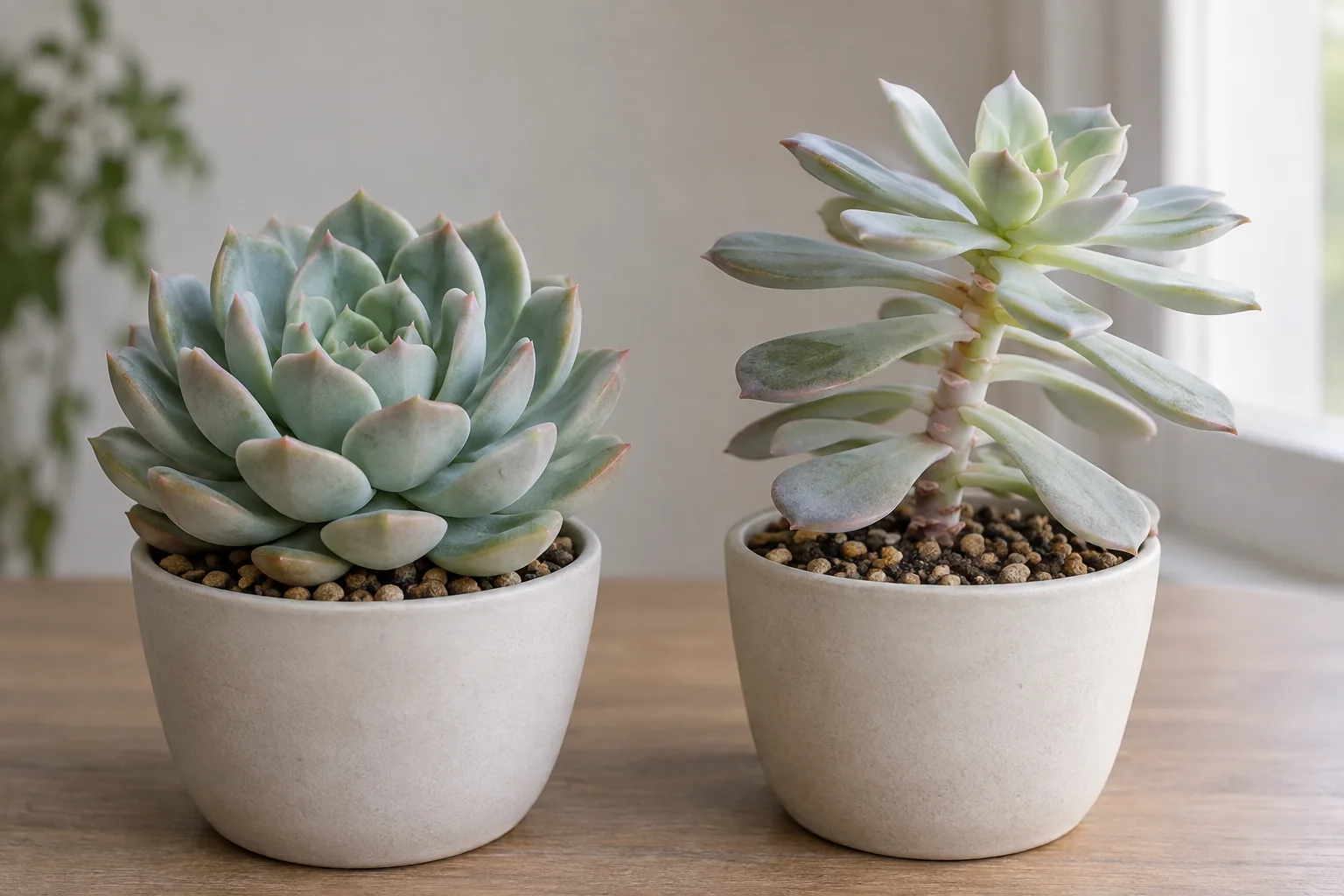
“Spreading out” can describe different changes
When a rosette looks more open, first separate leaf position, spacing between leaves, and stem length.
- Leaves spreading outward: Compared with the plant’s earlier growth, rosette leaves angle outward and lie flatter. This can happen without a visibly lengthening stem. Iowa State University Extension notes that some rosette-forming succulents open and flatten their leaves under low light, possibly to collect more light.
- Stretched new growth: A newer stem may become thinner, with leaves or leaf scars farther apart. Longer, weaker growth is often called leggy growth or etiolation in horticulture. Internodes—the sections of stem between nodes—can lengthen, but this clue applies only when the plant has visible stem sections.
- A plant leaning toward light: If the newest growth consistently bends toward a window or lamp, the direction of the light may be influencing its growth. This is different from asking how much light the plant receives overall. See why plants bend toward light.
- A different overall outline: Older lower leaves may dry up and fall away, exposing more stem. Offsets may form around the base, some succulents trail naturally, and a flower stalk may rise from the center of a rosette. These changes can make a plant look more open without being the same as stretched leafy growth.
More than one pattern can appear at once. The useful first step is to identify what actually changed rather than treating every open shape as etiolation.
Water status can change how full leaves look, but it is not a general rule that less water makes every rosette tighter or that more water spreads its leaves. Underwatered succulents may develop wrinkled, thinner, or drying leaves; that loss of fullness is different from the spacing between leaves.
There are specific exceptions. A study of houseleek (Sempervivum tectorum) observed the inner young leaves folding around the growing point during prolonged, severe drought, then reopening after rewatering. This is a response to extreme stress in one species, not a pattern to assume for all succulents. Compare leaf wrinkling, leaf direction, and the spacing or length of newer growth separately.
Succulents do not all have the same shape
“Succulent” describes plants with water-storing tissues; it does not name one plant family with one growth habit. Some succulents naturally form open, flat rosettes. Others grow along longer stems, form clusters of offsets, or trail. Their shape and light needs vary, so it helps to learn about the diversity of succulent plants before comparing one type with another.
For example, lower leaves on an Echeveria may gradually dry and fall away, leaving more of the stem visible. Other succulents produce offsets around the base or grow with a trailing habit. A flower stalk can extend above the rosette too; the stalk is not the same as a stretched leafy stem. These normal growth patterns can change the plant’s outline over time.
How low light may affect a rosette succulent
A plant cannot move itself to a brighter place, but new growth can develop differently as light conditions change. With limited light, stems may become longer and leaves more widely spaced. Some rosette-forming succulents may also open or flatten their leaves. The exact appearance varies by plant, so no single shape applies to every succulent.
Compare the newer leaves and stems with older growth. If the newest part is more open, thinner, or paler, low light is one condition to consider—especially if the plant was recently moved farther from a window or became shaded. A room that looks bright to people does not tell you exactly how much light reaches the leaves; window direction, distance, shade, and season all matter.
Leaf color alone is not enough to identify low light. New growth may look paler in limited light, while excessive light can also bleach or scorch leaves. Consider whether the color change is on new or older leaves, whether it appears in patches, and whether the plant’s exposure recently changed.
Compare new growth, the plant’s usual form, and its light
Looking at a plant’s own growth over time is usually more useful than comparing it with a single “ideal” photo.
- Compare old and new growth. Are newer leaves more spread out or flatter? Are new stem sections thinner, with more space between leaves? Has the plant’s color or direction changed too?
- Review recent light changes. Has the plant moved farther from a window, become shaded by nearby plants, or had a change in window coverings or season?
- Consider the plant’s usual habit. Succulents include many different kinds of plants. Some forest-growing succulents are suited to bright, filtered light, so strong direct sun is not a universal rule.
If you move a succulent from a dimmer spot to a brighter one, increase its exposure gradually. A plant that has been in low light for a long time may develop sunburn when moved suddenly into intense direct sun. An open rosette alone is not a reason to place every succulent in the strongest sunlight.
Common mix-ups
-
An open rosette always means low light.
Not necessarily. Leaf position can be a low-light clue, but natural growth habit, plant type, and age also affect shape. Compare newer growth with the plant’s earlier form. -
Flattened leaves and etiolation are the same thing.
They describe different observations. Leaves may spread or flatten; etiolation describes stretched, often weaker new growth. Both can occur together. -
All succulents need long hours of strong direct sun.
Succulents differ in their natural habitats and light needs. A sudden increase in intense sun can scorch leaves. -
An older open rosette or long stem will always become compact again.
Responses vary by plant and growing conditions. Watch how later growth develops rather than assuming already formed stems will shorten.
Frequently Asked Questions
Does an opening succulent rosette always mean the plant needs more light?
No. Limited light can be one reason a rosette opens, but succulents naturally vary in leaf arrangement and shape. Compare newer growth with the same plant’s older growth, then consider whether its light conditions have changed.
Can water make succulent leaves look tighter or more spread out?
Water status affects leaf fullness, and underwatered leaves may become wrinkled, but rosette tightness alone is not a reliable water clue. One study recorded the inner young leaves of Sempervivum tectorum folding during extreme drought; this is a species-specific response, not a rule for all succulents. Low light can also make some rosettes open and flatten. Compare leaf fullness, leaf direction, and the spacing of new growth as separate observations.
How is a spreading rosette different from etiolation?
A spreading rosette describes leaves becoming more outward-facing or flatter. Etiolation describes stretched, often thinner new growth with longer stem sections or more space between leaves. They can occur together, but they are separate clues. For a broader explanation of leggy plant growth, see the related article.
Why is my succulent leaning toward a window?
New growth that consistently leans toward one side may be responding to light coming mainly from that direction. This describes the direction of light, not necessarily the total amount the plant receives. Look at stem length and leaf spacing as separate clues.
Do pale leaves mean a succulent is not getting enough light?
Not by themselves. Limited light can be associated with paler new growth, but intense light can also bleach or scorch leaves. Check whether the color change is on new or older leaves, whether it is patchy, and whether exposure has changed.
Do all succulents need direct sunlight?
No. “Succulent” includes many kinds of plants with different growth habits and light needs. Some rosette-forming succulents and some forest-growing succulents have different light preferences. Identify the plant when possible and consider the conditions it has been growing in.
Can I put a succulent in strong sun as soon as I move it to a brighter place?
Avoid a sudden, large increase in exposure. A succulent coming from a dimmer place can develop sunburn in intense direct sun. Gradual adjustment reduces the shock of a major change in light.
Will a succulent’s rosette become compact again after it has opened?
Not always. Some types may adjust to lower-light conditions over time, while others may not regain their earlier shape. Plant type and growing conditions matter. Watch the leaves and stems that develop later; do not assume older growth will return to its previous form.
Related terms
- Rosette: A growth form in which leaves radiate from a short central stem or growing point.
- Internode: The section of a stem between two nodes. Longer internodes can leave more space between leaves.
- Etiolation: Stretched, often weak growth associated with limited light; in horticulture, the term is also commonly used for a leggy appearance.
- Phototropism: A directional growth response in which a shoot grows toward or away from light.
- Offset: A smaller shoot that forms beside or near the base of a parent plant.
- Succulence: The presence of thickened tissues that store water. This trait does not mean all succulent plants belong to one group or share the same growing needs.
Read Next
Evidence
References
These sources were used to check the plant-science concepts and gardening context in this article.
View sources and further reading (11)
- yardandgarden.extension.iastate.edu — common problems and issues succulents
- marylandgrows.umd.edu — why light levels are important for indoor plant growth
- extension.umn.edu — lighting for indoor plants
- extension.umd.edu — lighting indoor plants
- open.lib.umn.edu — 4 2 plant hormones
- extension.umaine.edu — 5059e
- rhs.org.uk — growing guide
- ucanr.edu — succulents
- ucanr.edu — echeveria and sempervivum and graptopetalum oh my
- plants.ces.ncsu.edu — mexican rosettes
- academic.oup.com — 8221054