A red leaf is a clue, not a diagnosis
Some plant leaves turn red, purple-red, or reddish brown. That does not automatically mean the plant is sick, and it does not automatically mean you did something wrong. Leaf color comes from several pigments working together. When chlorophyll is abundant, many leaves look green. When red-purple anthocyanins become more visible, or when chlorophyll declines and no longer masks other pigments, a leaf may look red.
So the first question is not “Which single problem is this?” A better first question is: where is the red color showing up? Is it on new leaves or old leaves? Is the whole plant naturally red, or did the color change recently? Did it happen in fall, after cooler nights, near a bright window, outdoors in strong light, or only on one side of the plant?
Those context clues tell you more than the color alone.
Anthocyanins can make red and purple tones more visible
Leaves contain more than chlorophyll. Chlorophyll is the green pigment closely tied to photosynthesis. Carotenoids often make yellow and orange colors more visible. Anthocyanins are pigments often associated with red, purple, and blue-purple colors.
Anthocyanins are water-soluble pigments found in many plant tissues. They are not limited to flowers or fruits; they can also appear in leaves. When anthocyanins increase in a leaf, or when chlorophyll decreases enough for other colors to show through, red-purple tones become easier for us to see.
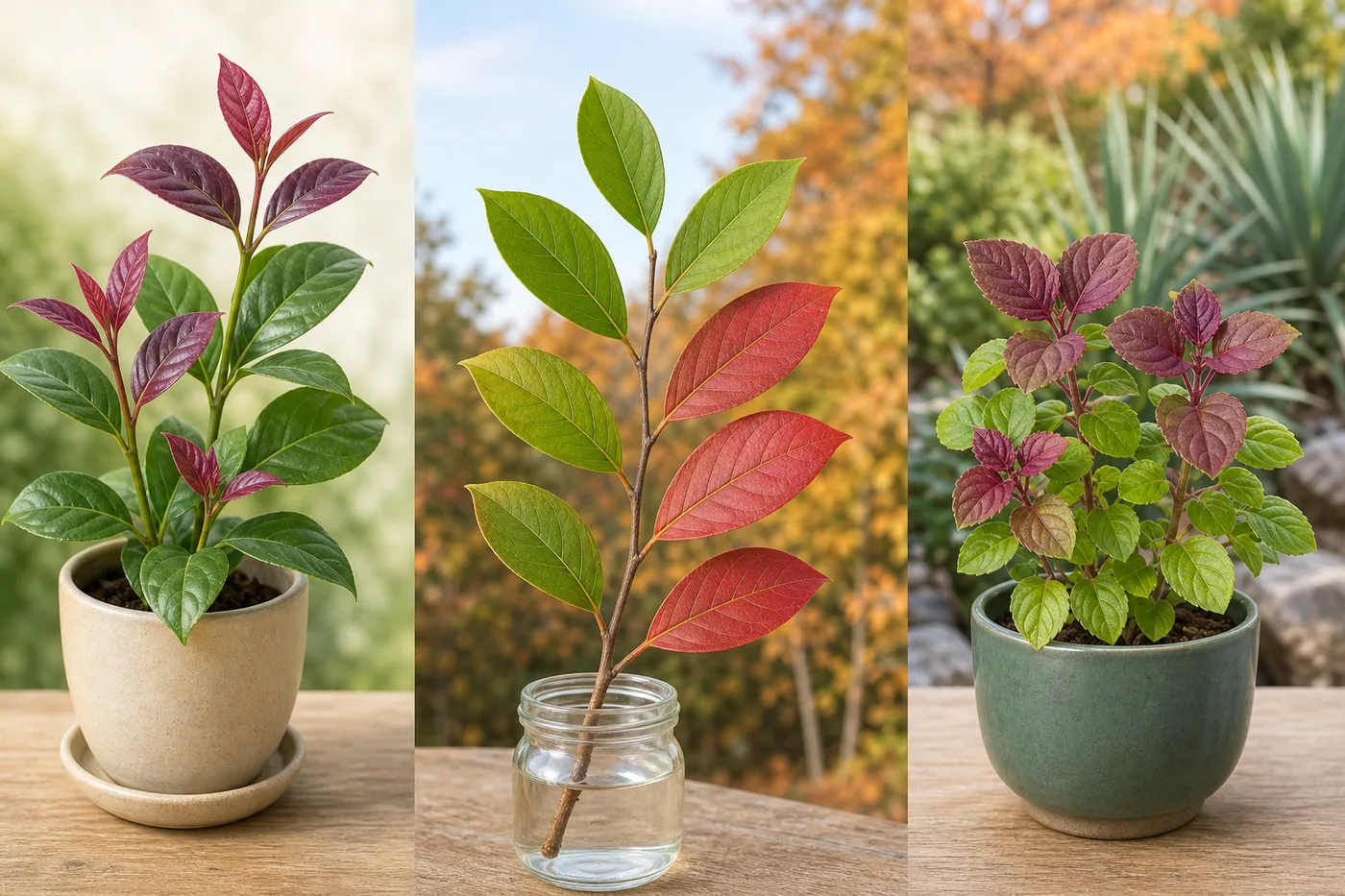
But “anthocyanins are present” does not mean “the plant is in trouble.” Some plants naturally produce reddish young leaves. Some trees turn red in autumn as chlorophyll declines. Some ornamental cultivars are bred or selected for red, purple, or variegated foliage.
Young leaves, autumn leaves, and red-leaved cultivars mean different things
Red leaves are easy to misread because several different situations can look similar from a distance.
Young red leaves are common in some foliage plants, woody plants, and seedlings. A young leaf is still developing. Its chlorophyll level, thickness, and pigment balance may differ from a mature leaf. In some plants, the young leaf gradually turns greener as it expands and produces more chlorophyll.
Autumn red leaves are a different situation. As day length, temperature, and the plant’s internal seasonal rhythm change, chlorophyll production slows and existing chlorophyll breaks down. Colors that were previously hidden by green may become visible. In some species, anthocyanins also accumulate in autumn leaves, making them look red or purple-red.
Red-leaved and purple-leaved ornamental plants are different again. For these plants, the leaf color is part of a cultivar trait and the normal appearance.
To compare these situations, start with leaf age, whether the color is consistent across the plant, and whether red color appears alongside other changes.

Bright light, cool temperatures, and stress can also be involved
Anthocyanins can also be part of a plant’s response to the environment. Research and horticultural observations associate anthocyanin accumulation with factors such as bright light, cool temperatures, wider day-night temperature differences, sugar accumulation, nutrient imbalance, drought, salt stress, and tissue injury. These are cross-plant associations, not a one-cause chart.
Leaf reddening can be a stress clue, but it is not a single diagnosis. For example, some young plants, including corn seedlings, may look purple after bright days and cool nights because anthocyanins, sugar accumulation, genetics, and temperature can interact. That example does not apply to every plant, and color alone cannot identify a specific nutrient deficiency or justify a fertilizer treatment.
In garden and houseplant observation, place the red color back into the whole plant and its recent environment:
- Is the red color only on new leaves, and do those leaves turn green as they mature?
- Is the red color strongest near a window, on the side facing stronger light, or on leaves receiving more direct light?
- Did the weather recently become cooler, or did the day-night temperature difference increase?
- Are there other symptoms such as wilting, scorched edges, spots, leaf drop, or stalled growth?
- Is this species or cultivar naturally red, purple, or variegated?
If the plant is otherwise steady, new leaves keep expanding, and there is no rapid collapse, spreading spots, rot, or heavy leaf drop, red color can often be observed as a leaf-color change. If red color appears together with fast wilting, dead tissue, spreading spots, or whole-plant decline, it should not be explained by leaf color alone. Look at water status, roots, light, temperature, and other whole-plant clues together.
How are red leaves different from yellow leaves?
Yellow leaves often make people think of chlorophyll loss or chlorosis (yellowing), but yellowing can also have many causes. Red leaves add another pigment clue: red-purple color may come from increased anthocyanins, or from chlorophyll declining enough that red-purple pigments become more visible.
The shared lesson is the same: do not conclude from color alone. With yellow leaves, you still need to ask whether the change is on old leaves or new leaves, across the whole leaf or between veins, and what the roots and potting mix look like. With red leaves, you also need to ask about new growth, season, light, temperature, cultivar traits, and the whole plant’s condition.
Leaf color is an entry point for observation. It is not the final answer by itself.
Common mix-ups
- ✕ Red leaves always mean the plant is sick.
- ✓ Red color may come from young growth, autumn color, bright light, cool temperatures, cultivar traits, or stress responses. Look at the whole plant and the environment, not just the color.
- ✕ Red or purple leaves always mean phosphorus deficiency or lack of fertilizer.
- ✓ Some nutrient or uptake problems can be associated with red-purple color, but color alone cannot identify a specific nutrient deficiency or justify a fertilizer treatment.
- ✕ A red leaf has no chlorophyll, so it cannot photosynthesize.
- ✓ A red leaf may still contain chlorophyll and carry out photosynthesis. Anthocyanins or other pigments can change its visible color.
- ✕ A red-leaved ornamental plant is automatically unhealthy.
- ✓ Some plants naturally have red, purple, or variegated leaves. In those plants, the color is part of the normal appearance.
Frequently Asked Questions
Do red leaves mean my plant is diseased?
Not necessarily. Red leaves can be normal young growth, autumn color, a cultivar trait, or a clue related to bright light, cool temperatures, or other stress. Check where the red color appears, how quickly it changed, the season, light, temperature, and the condition of the whole plant.
Will red new leaves turn green as they mature?
Some will. In some plants, young leaves show more red-purple color while they are still developing. As the leaves expand and chlorophyll increases, they gradually look greener. But this varies by plant. Some cultivars keep red or purple mature leaves.
Why do some leaves turn red in fall while others turn yellow?
As chlorophyll declines or breaks down in autumn, other pigments become easier to see. Yellow and orange colors are often linked with carotenoids. Red and purple-red colors are often linked with anthocyanins. Species, weather, and leaf condition all affect the final color.
Can bright light make leaves turn red?
In some plants, stronger light can be associated with more anthocyanin and redder or purpler leaves. That does not mean every plant should be moved into stronger sun, and it does not mean red leaves always equal sun damage. Whether the light is suitable depends on the plant, temperature, water status, and whether the leaves show scorching.
Should I fertilize an indoor plant as soon as its leaves turn red?
Do not fertilize only because the leaves turned red. First check whether the color is on new leaves, whether the plant sits near a bright window, whether temperatures recently dropped, and whether the plant is otherwise stable. If red color comes with smaller new leaves, stalled growth, or whole-plant decline, also check roots, potting mix, and watering patterns instead of using color alone to decide on fertilizer.
Are red leaves more serious than yellow leaves?
You cannot compare them that directly. Both are leaf-color clues. Yellow leaves often lead you to look at chlorophyll loss, old-leaf turnover, water, roots, and light. Red leaves often lead you to look at anthocyanins, new growth, season, light, cool temperatures, and cultivar traits. Seriousness depends on the speed of change and the whole plant’s condition.
Related terms
- Anthocyanins: water-soluble pigments that often give plant tissues red, purple, or blue-purple colors.
- Chlorophyll: the green pigment closely tied to photosynthesis in many leaves.
- Carotenoids: plant pigments often associated with yellow and orange colors that also participate in light-protective processes in photosynthetic tissues.
- Leaf senescence: the aging or exit phase of a leaf, when pigments and nutrient allocation change.
- Photoprotection: plant processes that help reduce damage under strong light or similar stress conditions.
- Ornamental foliage plant: a plant grown partly or mainly for leaf color, pattern, or texture.
Read next
Evidence
References
These sources were used to check the plant-science concepts and gardening context in this article.
View sources and further reading (11)
- openstax.org — 8 2 the light dependent reactions of photosynthesis
- openstax.org — 30 4 leaves
- fs.usda.gov — joy and science
- research.fs.usda.gov — 15618
- canr.msu.edu — purple leaves
- agry.purdue.edu — purplecorn.html
- wpcdn.web.wsu.edu — product 4372 sku FS209E.pdf
- hort.extension.wisc.edu — leaf color change autumn
- yardandgarden.extension.iastate.edu — science behind fall color
- pmc.ncbi.nlm.nih.gov — PMC1082902
- pmc.ncbi.nlm.nih.gov — PMC10671836