
Succulent plants are plants—but not one plant family
Yes, succulent plants are plants. However, “succulent plant” does not name one family, genus, species, or single branch of plant evolution.
It is a broad term for plants that have developed succulence: a form and function in which one or more organs contain specialized water-storage tissue. That tissue can occur in leaves, stems, roots, or more than one organ.
In other words, “succulent” describes a water-storing growth form, not a list of close relatives.
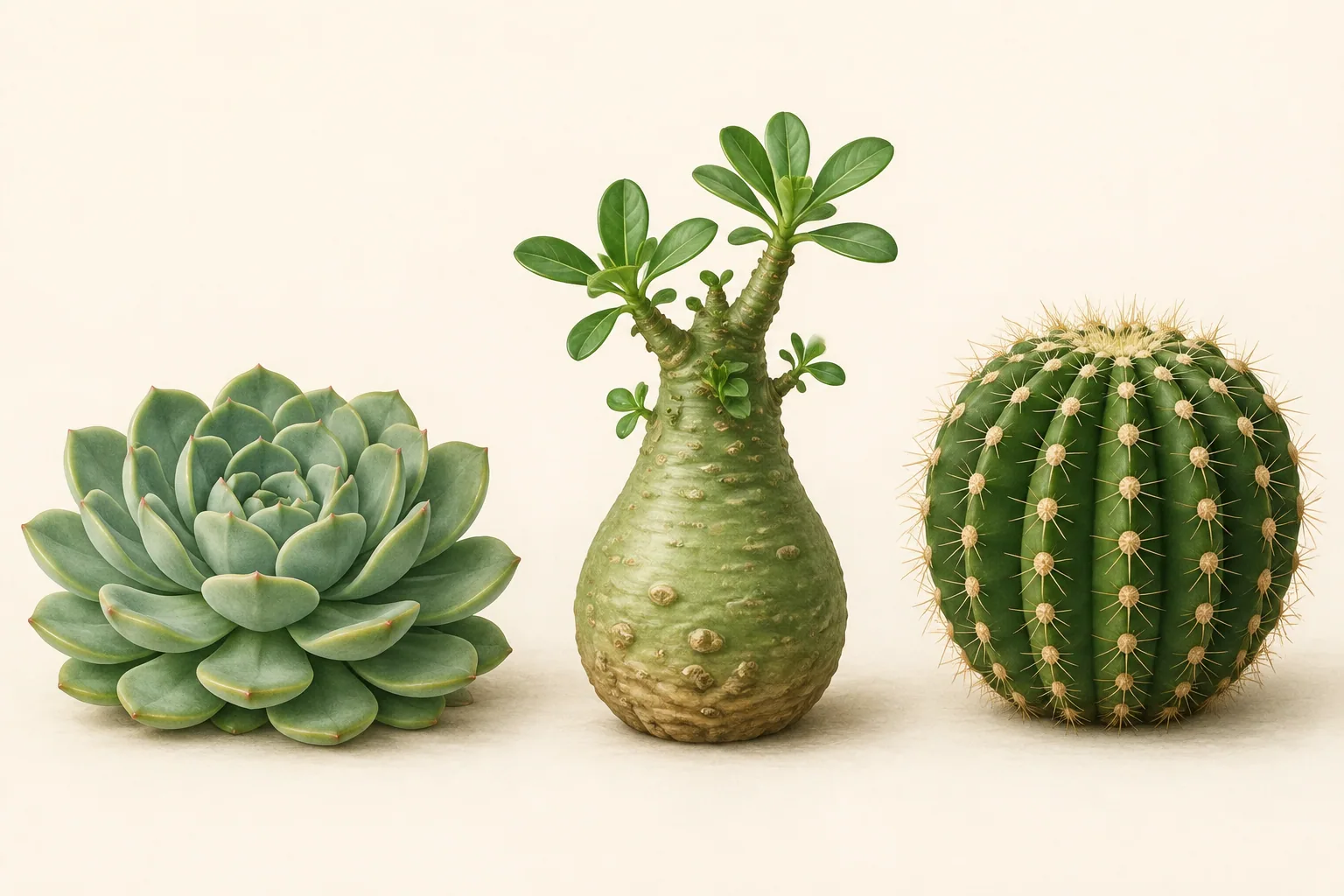
This is why jade-like rosettes, aloes, agaves, some euphorbias, and cacti can all look thick and fleshy while not necessarily being close relatives. Different plant lineages can independently evolve similar features when they face similar challenges, such as irregular rainfall or periods when water is not readily available. This pattern is called convergent evolution.
What does “succulent” actually describe?
In plant science, succulence describes a set of structural and functional traits. Some plant tissues contain and retain more water, making an organ thicker and fuller than it would otherwise be.
These tissues are not simply the result of a plant being temporarily well hydrated. Succulence usually involves long-term specialization in cells and tissues. The exact arrangement differs among plants. In some, water-storage tissue is concentrated in the leaves. In others, it is concentrated in the stem or below ground.
Some tissues can also continue photosynthesis while storing water. For example, a green succulent stem may act as both a water reservoir and a major light-catching organ. This is why one universal cross-section cannot represent every succulent plant.
Water storage provides a buffer when water availability changes. It does not mean that a plant never needs water. Succulent plants still carry out photosynthesis, respiration, growth, and reproduction, and they still respond to light, temperature, seasons, and the air conditions around their roots.
For a broader introduction to plant organs, see What are the basic organs of a plant?.
Look at which organ is thick: leaf, stem, or root
A useful first question is not “Does this plant look round?” but “Which organ is doing most of the visible water storage?”
Leaf succulents
In a leaf succulent, the leaves are the main visible water-storage organs. They may be thick, fleshy, and arranged in a tight rosette, with leaves spreading outward from a central growing point.
A rosette shape is a useful observation entry point, but it is not a complete identification method. Different plants can form rosettes for different reasons, and not every rosette-forming plant is a succulent.
Leaf succulents can also show other traits associated with water balance, such as a relatively protective cuticle or a reduced surface area. A plant leaf cuticle is one example of a surface feature that can affect water loss, but a cuticle is not the same thing as water-storage tissue.
Stem succulents
In a stem succulent, the stem becomes swollen, thick, or otherwise prominent. The stem may store water and, if it is green, also carry out much of the plant’s photosynthesis.
Many cacti are familiar examples. Their green stems can be ribbed, rounded, flattened, or column-like. The leaves are often reduced or no longer obvious, so the stem becomes the main visible body of the plant.
A swollen stem can also appear in non-cactus plants. For that reason, the shape of a stem should be considered together with other structural features. What do stems do? and Why do some stems get thicker? provide useful background for separating stem identity from stem appearance.
Root succulents
In a root succulent, water is stored mainly in underground roots or in a swollen region near the root–stem transition.
These structures may not be visible from above the pot. They can also be difficult to classify from appearance alone, especially when a swollen underground part could be connected to more than one organ. Reliable species information is needed before assigning a particular underground structure to a category; not every swollen underground part should automatically be called a root succulent.
Leaf, stem, and root succulence are not mutually exclusive labels. A plant may have thick leaves and a swollen stem, or it may emphasize different storage organs at different stages of growth.
Are cacti succulents?
Yes. Cacti are a group of succulent plants, but succulent plants are not all cacti.
Cacti belong to the formal plant family Cactaceae. Many cacti have swollen green stems that store water and carry out photosynthesis. Their leaves are usually reduced or not obvious.
A particularly important cactus feature is the areole. An areole is a specialized structure on the cactus surface. Spines, hairs, branches, or flowers may develop from or in association with areoles.
This is why an areole can be more informative than simply seeing “a thick stem with spines.” Some non-cactus plants, including certain euphorbias, can evolve a similar stem-succulent appearance. They may have ribs, spines, or swollen green stems without belonging to Cactaceae.
The key relationship is simple:
Cacti are succulents, but “succulent” does not mean “cactus.”
For a closer look at plant defensive structures, see What is the difference between thorns, spines, and prickles?.
Thick leaves do not prove CAM photosynthesis
Crassulacean acid metabolism (CAM) is a photosynthetic pathway associated with the timing of gas exchange and carbon uptake. In many CAM plants, stomata open more during the cooler part of the day, often at night, which can reduce water loss under some conditions. This is physiological context, not a feature that can be confirmed from thick leaves alone.
Many cacti and some agaves show CAM. Other succulent plants may use CAM, C3 photosynthesis, or forms that fall along a range between these pathways. CAM expression can also vary with the species, organ, developmental stage, and environment.
Therefore, a thick leaf or swollen stem cannot, by itself, prove that a plant uses CAM. Succulence and CAM can occur together, but they are not synonyms.
A useful learning order is:
- Identify the visible organ or organs that appear thick.
- Ask how water-storage tissue may be arranged.
- Use reliable information about the plant’s biology before discussing its photosynthetic pathway.
Do not assign one physiological formula to every plant simply because it is sold or described as a succulent. To continue into the basic process, see What is photosynthesis?.
What can you observe in a succulent plant?
Succulent plants are useful for practicing plant observation, but observation and diagnosis are different activities.
You can record:
- Whether most of the visible thickness is in the leaves, stem, root crown, or an underground region.
- Whether the leaves form a rosette, occur in pairs, or are reduced and difficult to see.
- Whether a green stem is also the plant’s main light-catching surface.
- Whether the surface has a waxy cuticle, hairs, ribs, spines, or recognizable areoles.
- Whether the plant’s growing medium contains coarse particles and visible air spaces.
- How light, airflow, and wet–dry changes vary at the plant’s location.
These observations can lead to useful questions:
- Where might this plant store water?
- Is the thick structure a leaf, stem, or root?
- Is a spine connected with an areole?
- Which parts of the plant are green and likely to contribute to photosynthesis?
They cannot, by themselves, establish a plant’s family, species, native environment, photosynthetic pathway, or the reason for a current change in appearance. Similar forms can arise in unrelated lineages, and plants from different habitats can have different seasonal rhythms.
When connecting a succulent plant to container growing, compare the concepts of transpiration, why roots need air, drainage, medium aeration, and indoor versus outdoor light. These comparisons are more informative than applying one universal rule such as “all succulents need the same amount of water and strong light.”
Common confusions
-
✕ Succulent plants are one formal plant classification, and they are all close relatives.
-
✓ “Succulent plant” is a broad term for succulence and water-storage traits found across multiple plant lineages.
-
✕ Cacti and succulent plants are unrelated categories.
-
✓ Cacti are one group of succulent plants, while many succulent plants are not cacti.
-
✕ Thick leaves or a swollen stem prove that a plant is a desert plant.
-
✓ Thick tissues are often associated with water storage and water-limited conditions, but succulent plants come from varied environments.
-
✕ Every succulent plant uses CAM photosynthesis.
-
✓ CAM occurs in some plants, and its expression can vary by species, organ, developmental stage, and environment.
-
✕ A thick, spiny stem can be identified as a cactus from appearance alone.
-
✓ Areoles are an important cactus clue, but some non-cactus plants can evolve similar stem-succulent forms.
Frequently Asked Questions
Are succulent plants really plants?
Yes. Succulent plants are plants. “Succulent plant” is a broad descriptive term for plants with succulence or specialized water-storage tissue, not the name of one species or family.
Is “succulent” a formal plant classification?
No. Succulence has evolved independently in multiple plant lineages, so succulent plants do not form one formal taxonomic group. To identify a plant’s family, genus, or species, use its full set of structural and taxonomic features rather than the word “succulent” alone.
Why do succulent plants have thick leaves or stems?
Thick leaves or swollen stems often contain water-storage tissue. This can provide a temporary buffer when water availability is uneven. Other traits, such as a protective cuticle, reduced leaves, hairs, or spines, may also occur, but the exact combination differs among plants.
Is a cactus a succulent plant?
Yes. Cacti belong to the family Cactaceae and are a group of succulent plants. Many cacti use swollen green stems for water storage and photosynthesis, and their areoles are an important structural clue.
Can I identify a cactus from a thick, spiny stem?
Not always. A thick green stem with spines is a useful observation, but it is not enough by itself. Areoles are a more specific cactus clue, and some non-cactus plants can develop similar-looking stem-succulent forms.
Do all succulent plants use CAM photosynthesis?
No. Many cacti and some other succulent plants use CAM, but succulence is not the same as CAM. A thick leaf or stem cannot prove a plant’s photosynthetic pathway. Reliable information about the particular plant is needed.
Are all succulent plants desert plants?
No. Succulent plants occur in different environments and can have different light, temperature, rainfall, and seasonal growth patterns. The word “succulent” does not provide one universal habitat or growing formula.
Why should I look at the plant organ before its overall shape?
A round or thick appearance is only a surface clue. Checking whether the main storage organ is a leaf, stem, or root connects the observation to basic plant anatomy and reduces the chance of confusing unrelated plants with similar forms.
Related terms
- Succulent plant: a plant with clear succulence or specialized water-storage tissue; the term does not identify one formal taxonomic group.
- Succulence: a set of structural and functional traits involving relatively thick, water-retaining organs or tissues.
- Water-storage tissue: plant tissue specialized for retaining water; its location and detailed structure vary among plants.
- Leaf succulent: a succulent growth form in which thick leaves are the main visible water-storage organs.
- Stem succulent: a succulent growth form in which a swollen or thick stem is the main visible water-storage organ.
- Root succulent: a succulent growth form in which water is stored mainly in roots or an underground region.
- Convergent evolution: the independent development of similar traits in different evolutionary lineages facing similar pressures.
- Cactaceae: the formal plant family that includes cacti.
- Areole: a specialized cactus surface structure associated with the development of spines, hairs, branches, or flowers.
- Crassulacean acid metabolism (CAM): a photosynthetic pathway involving a distinctive timing pattern for gas exchange and carbon uptake; it is not the definition of succulence.
Read Next
Evidence
References
These sources were used to check the plant-science concepts and gardening context in this article.