Start with where the droplets are and when they appear
Water droplets on leaves do not all have the same cause. They do not automatically mean the plant is “sweating,” and they do not automatically mean the pot has been overwatered.
Some droplets are liquid water pushed out through the plant, often called guttation. Some droplets are dew or condensation, formed when water vapor in the air turns into liquid on a cool leaf surface. Others are simply rain, misting residue, humidifier droplets, or water left after wiping leaves.
So the first question is practical: where are the droplets, and when do they show up? Larger beads at the leaf tip or margin point you toward one explanation. Fine droplets spread across the leaf surface point you toward another.
Larger droplets at leaf tips and margins may be guttation
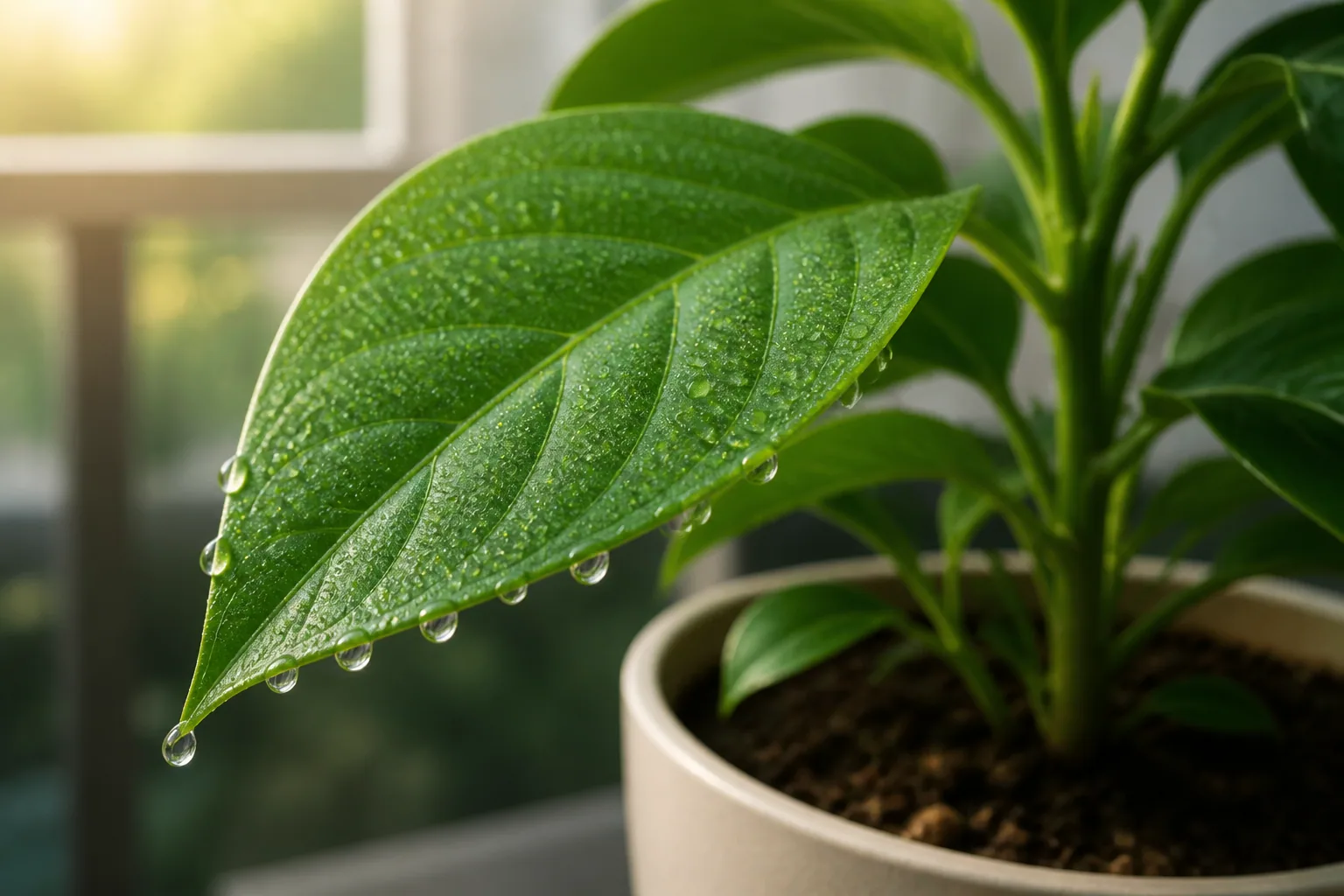
Guttation is the appearance of liquid water from specific parts of a leaf, often near the tip or margin. Many plant science sources describe hydathodes, small structures associated with liquid water release, in these areas.
Guttation is more likely when roots are taking up water, root pressure builds, and transpiration is low. That combination often occurs at night or early in the morning, especially when humidity is high, air movement is weak, and the potting mix is moist.
This does not mean every leaf droplet is guttation. Plant species differ, and the same plant can behave differently across seasons, pot moisture levels, air flow, and temperature. Treat guttation as a clue, not a complete diagnosis.
Fine droplets across the leaf surface are often dew or condensation
If tiny droplets are scattered across the leaf blade instead of concentrated at tips or margins, dew or condensation becomes a strong possibility.
The main actor here is the air. When humid air cools enough, water vapor can condense on surfaces, including leaves. In that case, the water did not have to come from inside the plant.
Morning balconies, window areas, cool nights, and humid still air can all encourage condensation on leaves. This is why a plant can show fine surface droplets even when the potting mix is not unusually wet.
Transpiration is usually not visible liquid drops
Transpiration is the loss of water vapor from plants, especially through stomata on leaves. When stomata open, carbon dioxide can enter the leaf for photosynthesis, and water vapor can also leave.
That matters here, but it is not the same as visible beads of liquid water. Transpiration usually involves water vapor, not round droplets sitting on the leaf surface. Visible liquid droplets need a more specific explanation: guttation, dew, rain, misting, or residue.
A more accurate beginner-level sentence is this: plant water transport, stomata, air humidity, and leaf temperature all influence whether water droplets appear.
Do not judge the whole plant from one droplet
For houseplants and balcony plants, leaf droplets are most useful as a reminder to look at the whole growing situation.
If larger droplets regularly appear at leaf tips in the morning, and the potting mix also stays wet for a long time, check watering rhythm, drainage, and air movement. The droplets alone do not equal root rot, but they may appear under the same conditions as high pot moisture and low transpiration.
If fine droplets cover the leaf surface, especially near a window or after a cool humid night, look at humidity, temperature changes, and air flow. A leaf that dries quickly is different from a leaf that stays wet for hours in still humid air.
The safer habit is to observe four things together: droplet position, timing, pot moisture, and the plant’s overall condition.
Common mix-ups
✕ Water droplets mean the plant is sweating.
✓ Plants do not sweat like animals. Visible droplets may be guttation, dew, rain, or misting residue. Transpiration is mostly water vapor loss.
✕ Leaf droplets always mean overwatering.
✓ Moist potting mix can be part of the situation, but droplets alone cannot diagnose watering problems.
✕ Droplets on the leaf surface and droplets at leaf tips mean the same thing.
✓ Larger tip or margin droplets fit a guttation pattern better. Fine droplets across the blade fit dew or condensation better.
Frequently Asked Questions
Should I wipe off morning droplets?
If droplets appear briefly in the morning and dry soon afterward, observation is usually enough. If leaves stay wet for a long time in still humid air, focus on better air movement and a watering rhythm that lets the potting mix dry appropriately.
Is guttation bad for the plant?
Guttation itself is not a disease name. It is often connected with root pressure, moist potting mix, low transpiration, and high humidity. If the plant otherwise looks healthy, occasional guttation is usually just an observation point. If it appears with yellowing leaves, soft tissue, or persistently wet mix, check the growing conditions as a whole.
Are droplets spread across the whole leaf guttation?
Not always. Fine droplets spread across the blade often fit dew or condensation better than guttation. Guttation is usually more concentrated near leaf tips, margins, or specific water-release points.
Why is there a pale mark after droplets dry?
This article does not judge toxicity or edibility. In a gardening context, pale marks after droplets dry may relate to minerals in water, dissolved material from the growing medium, or surface residue. For ornamental houseplants, avoid ingestion and use basic gentle cleaning when needed.
Does misting create better humidity?
Misting wets leaf surfaces briefly, but it does not necessarily create stable room humidity. If leaves stay wet and air movement is poor, misting can keep the leaf surface damp longer than intended. Humidity, light, air flow, and pot moisture all matter together.
Related Terms
- Guttation: liquid water appearing from specific leaf areas, often near tips or margins.
- Hydathode: a leaf structure associated with liquid water release.
- Root pressure: pressure that can help push water upward from the root system.
- Transpiration: water leaving the plant as vapor.
- Stomata: small pores involved in gas exchange and water vapor loss.
- Dew point: the air temperature condition at which water vapor begins to condense.
Read Next
- What is transpiration in plants?: understand water leaving leaves as vapor.
- What are stomata?: see how leaves exchange gases and lose water vapor.
- What is a balcony microclimate?: connect morning droplets with real growing conditions.
- Can potting mix be dry on top but moist inside?: avoid watering decisions based on surface clues alone.
Evidence
References
These sources were used to check the plant-science concepts and gardening context in this article.