The surface dries first, but the whole pot may not be dry
The surface of a potting mix can look and feel dry while the inside of the pot is still moist. The reason is simple: the top layer is closest to air, light, warmth, and airflow, so it loses water faster. The middle and lower parts of the pot are surrounded by potting mix, so water moves and evaporates more slowly there.
That is why touching only the surface can be misleading. Your finger is checking the outermost layer, while many of the plant’s active roots may be deeper in the container. For a potted plant, the more useful question is not only “Is the top dry?” but “What is the root zone like?”
Roots need water, but they also need air around them. A good container environment lets the potting mix hold some moisture while still leaving pore spaces for air and a path for extra water to drain away.
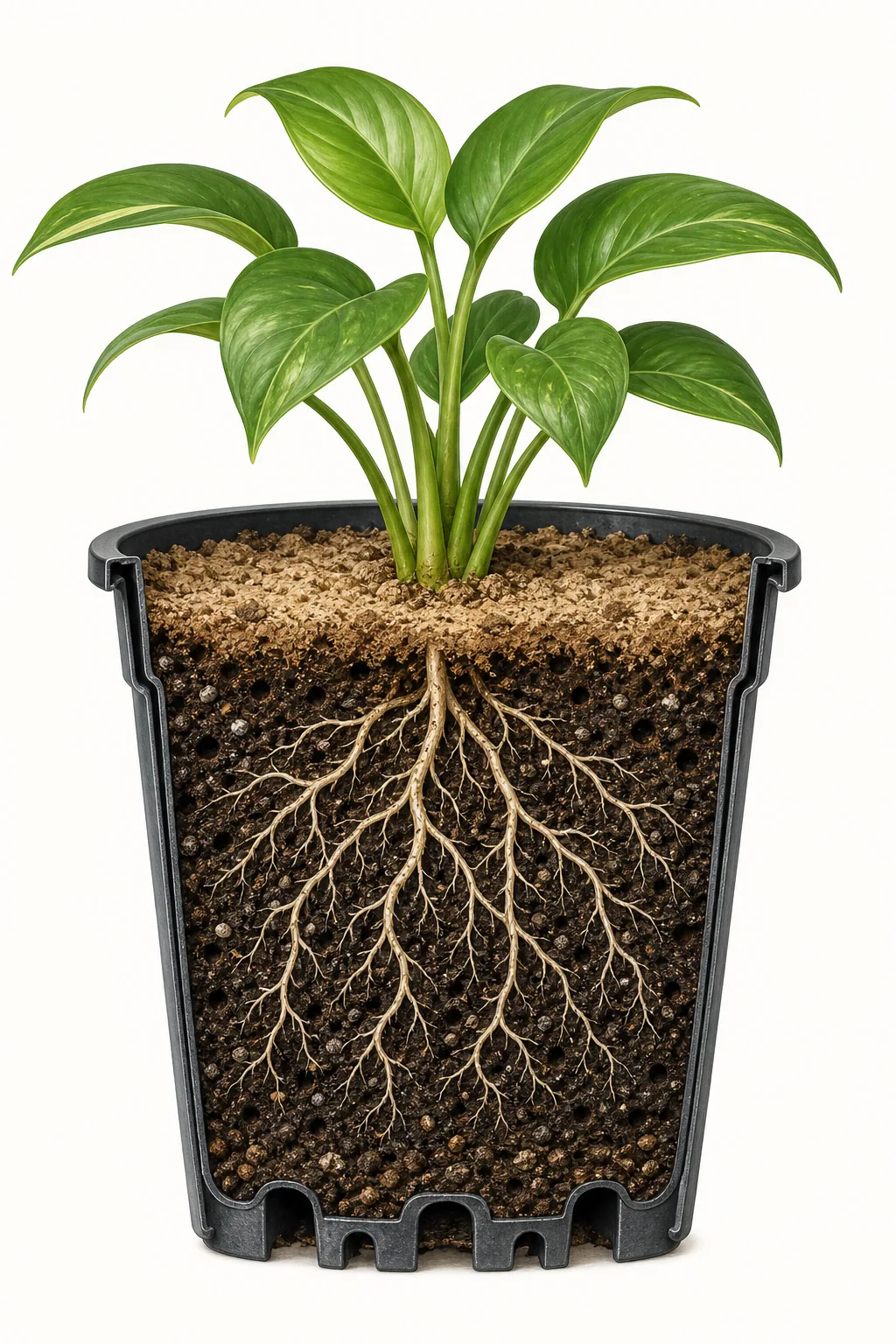
Moisture is not spread evenly through a pot
After watering, water moves downward through the pore spaces in the potting mix. Some extra water leaves through the drainage holes, but that does not mean every layer of the pot dries at the same speed.
Small pore spaces, particle surfaces, and organic materials in the mix can hold some water. The lower part of the container may also stay moist longer than the surface. This is especially noticeable in deeper pots, where there is more distance between the dry surface and the lower root zone.
In a shallow pot, a very fine-textured mix, or a compacted mix, water and air may move more slowly. The wetter part of the container may also sit closer to where many roots are growing.
So “dry on top” only describes the top layer. It does not automatically mean the whole pot needs water. At the same time, “moist inside” does not automatically mean something is wrong. The more important clues are how long moisture stays there, whether air can still move through the mix, and whether extra water can leave the container.
Pot material and potting mix change how fast things dry
Different containers dry in different ways. Plastic pots often dry more from the top downward because the sides do not release much water. Unglazed clay or other porous containers can also lose moisture through the sides.
Location matters too. A pot near a bright window, air conditioner, heater, fan, or warm indoor spot may dry faster at the surface. The same plant may behave differently in another room or during another season.
The potting mix itself also changes what you see. A fine, water-retentive mix may have a dry-looking surface while the inner layers remain quite moist. A coarse, airy mix may let water move through more quickly. As a mix ages, breaks down, or becomes compacted, it can lose air spaces and behave differently from when it was fresh.
These differences are why fixed watering schedules are often unreliable. “Once a week” or “every three days” sounds simple, but the real drying rate depends on light, temperature, airflow, season, pot type, potting mix, plant size, and root growth.
Root-zone clues are more useful than fixed days
You do not need to treat everyday watering as a precise diagnosis. A few low-risk observations can give a better picture of what is happening inside the pot.
- Pot weight: Notice how heavy the pot feels after a thorough watering, then compare it a few days later.
- Surface appearance: A lighter, looser surface suggests the top layer is drying, but it should not be the only clue.
- Deeper mix: Near the edge of the pot, gently check a little deeper with a clean wooden stick, bamboo skewer, or finger. Avoid pushing hard into the root mass.
- Drainage and saucer: If water sits in the saucer for a long time after watering, extra water may not be leaving the pot environment well.
- The plant itself: Leaves, buds, roots, and overall growth can add context, but one visible symptom should not be used as the only basis for judgment.
The goal is to shift attention from “Is today watering day?” to “What is this pot’s root zone probably like right now?” For container plants, surface moisture and root-zone moisture should be considered together.
Common confusions
- ✕ If the surface of the potting mix is dry, the whole pot must be dry.
- ✓ The surface only represents the outermost layer. The middle and lower potting mix may still hold moisture.
- ✕ If the inside of the pot is moist, the plant must have root rot.
- ✓ Moisture inside the pot is only a water clue. It is not, by itself, a disease or root-rot diagnosis.
- ✕ Watering once a week is always the safest approach.
- ✓ Watering intervals change with light, temperature, airflow, pot material, potting mix, season, and plant growth.
- ✕ If the surface looks dry, there is no need to check anything else.
- ✓ A better reading comes from combining surface condition, pot weight, deeper mix moisture, and drainage clues.
Frequently Asked Questions
If the surface of the potting mix is dry, should I water right away?
Not always. A dry surface only means the top layer has lost moisture. The middle and lower parts of the pot, including the root zone, may still be moist. It is better to also check pot weight, deeper mix moisture, and whether water is sitting at the bottom or in the saucer.
Why is my potted plant dry on top but wet below?
The top layer is exposed to air, light, warmth, and airflow, so it loses water faster. Lower layers are surrounded by potting mix, where water moves and evaporates more slowly. Some water can also remain in small pore spaces and on particle surfaces.
Is touching the surface with my finger accurate?
It is useful as a surface clue, but it does not represent the whole pot. Touching the top only tells you about a shallow outer layer, not necessarily the moisture level around the roots.
What does it mean if the pot still feels heavy?
A heavy pot often means the potting mix still contains a fair amount of water. But pot material, potting mix type, container size, and plant size all affect weight. Treat pot weight as one clue, not a final answer by itself.
Why not water on a fixed schedule?
Drying speed changes with season, light, temperature, airflow, pot type, potting mix, and root growth. The same plant may use water differently in summer and winter, or near a bright window compared with a darker indoor spot.
Why can a fine mix or shallow pot feel moist inside for longer?
Fine-textured or compacted potting mix can slow the movement of both water and air. In a shallow container, the wetter zone may also be closer to the main root area. This does not automatically mean there is a problem, but it is worth including in your observations.
Related terms
- Surface layer of the potting mix: The uppermost layer in a container, usually the part most exposed to air.
- Root zone: The area of the potting mix where roots are actively growing, absorbing water, and exchanging gases.
- Pore spaces: The spaces between particles in a potting mix. They may hold either water or air.
- Drainage: The ability of extra water to move out of the potting mix and container.
- Aeration: The movement and presence of air in the potting mix around roots.
- Saturated zone: An area where many pore spaces are filled with water, leaving less room for air.
Read next
Evidence
References
These sources were used to check the plant-science concepts and gardening context in this article.