
Phalaenopsis is a useful doorway into orchid structure
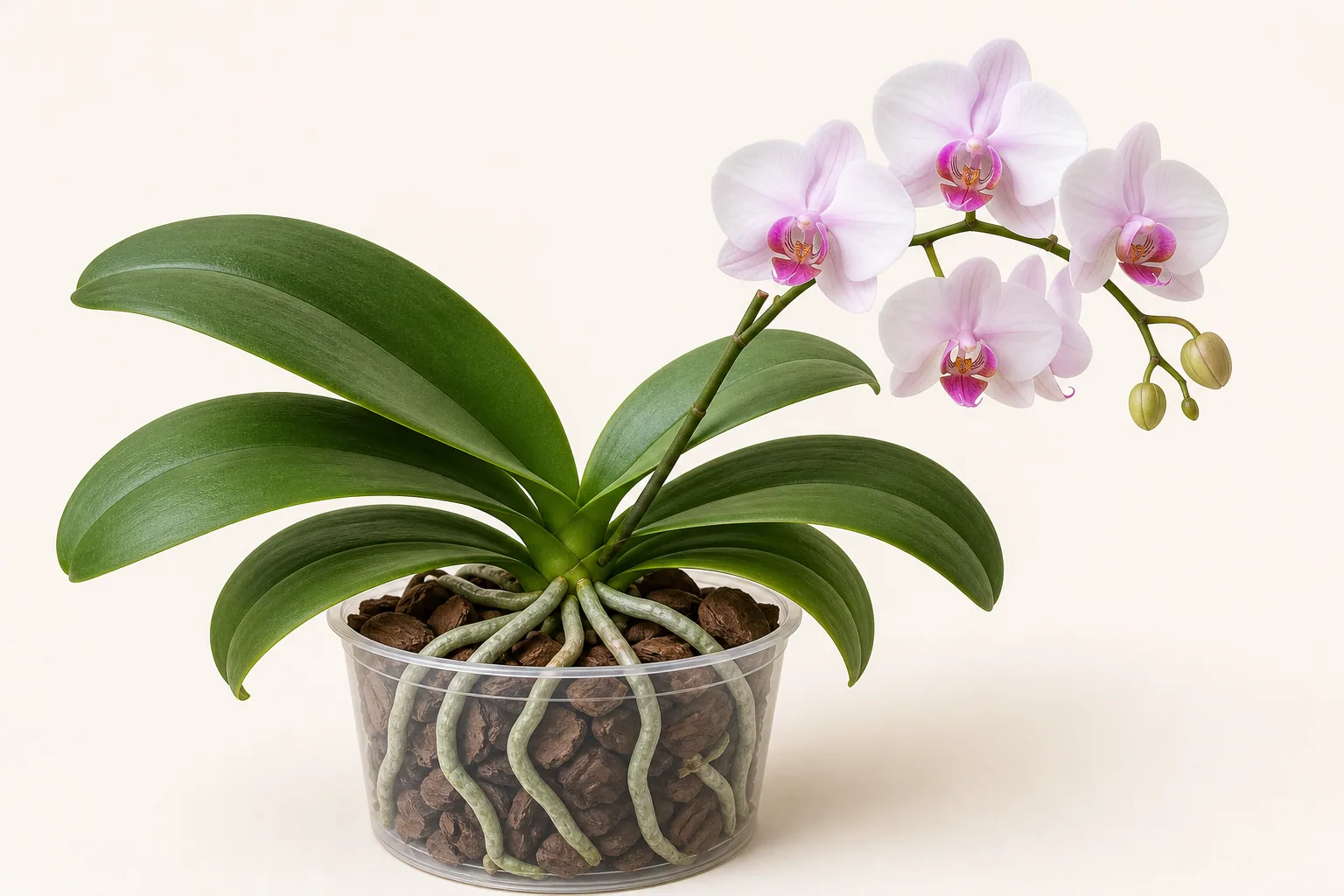
Phalaenopsis orchids are among the most familiar ornamental orchids. Many people recognize them by their broad, thick leaves, arched flower spikes, moth-like flowers, and thick roots that often sit above or outside the potting medium.
It is not the standard model for every potted plant
One key word helps explain Phalaenopsis: epiphytic. An epiphyte grows attached to another surface, such as bark or a branch, without being a parasite. It is not feeding from the host plant the way a parasite would.
Many Phalaenopsis orchids are discussed as epiphytic orchids. That changes how we should imagine their roots. They are not best understood as a dense mass of fine roots buried in ordinary garden soil. Their roots often contact air, attach to surfaces, and interact with water, humidity, and open air spaces.
Roots: thick, fleshy, and often exposed
Phalaenopsis roots are often the first part that confuses new growers. Thick silvery or green roots outside the pot are not automatically a problem, and they should not be read as a single diagnosis.
Many orchid aerial roots have a velamen layer. For a beginner, it is enough to think of velamen as a spongy outer covering that helps the root absorb and temporarily hold water while also protecting it in airy conditions. Dry roots often look silvery white. After wetting, the outer layer can become more translucent, making green living tissue easier to see.
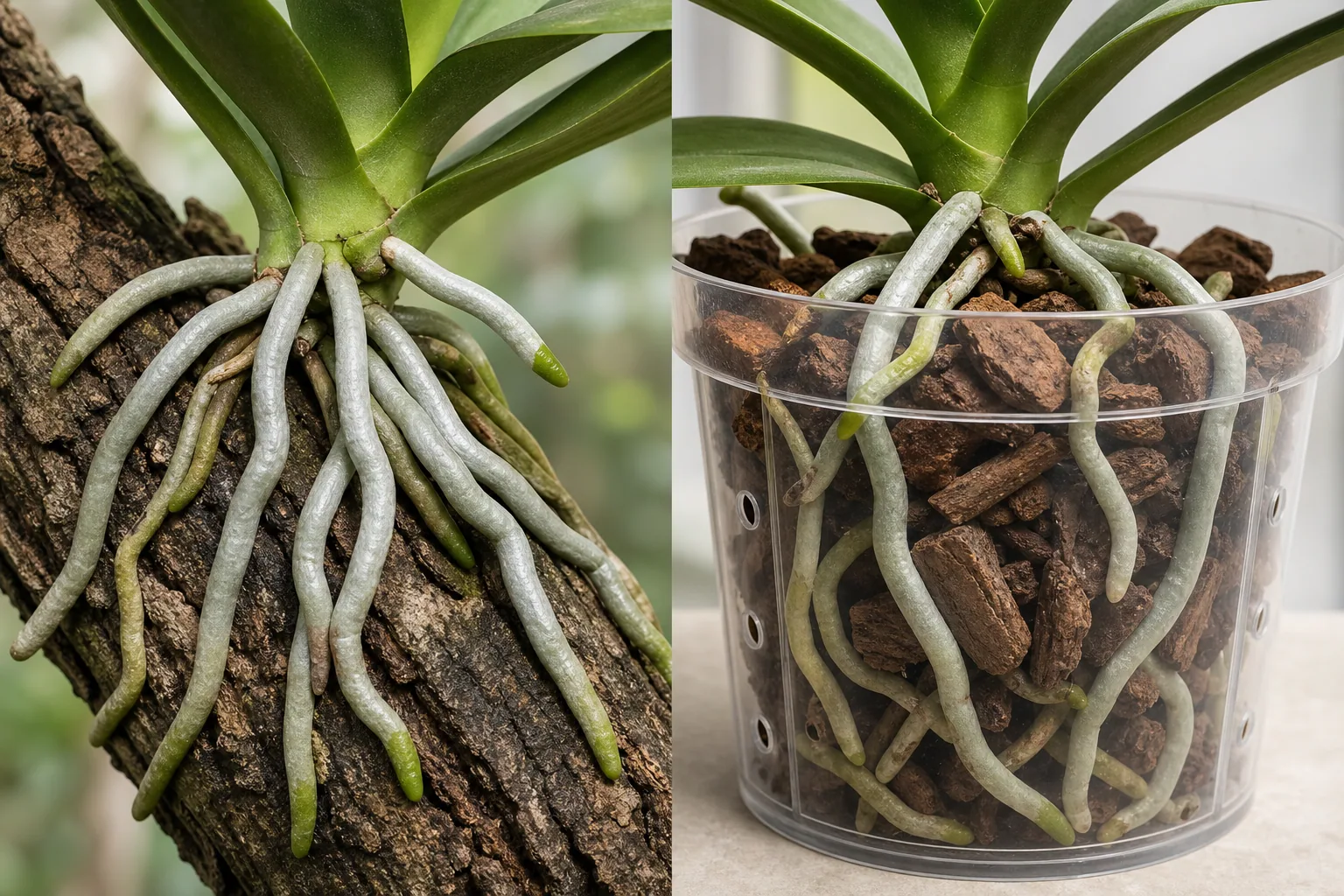
This connects directly to two foundation topics: roots need oxygen, and potting media affect aeration. Roots are not helped by water alone. The spaces around roots also matter. Bark, leca, sphagnum moss, and other orchid media are discussed because the root environment is different from that of many ordinary soil-grown potted plants.
Leaves: thick, low, and built for light capture
Phalaenopsis leaves are usually thick and leathery. They grow from a very short stem area and often appear in two ranks from the center of the plant. The stem is not obvious because it is short and partly hidden by leaf bases.
The basic role of leaves is still familiar plant science: they capture light and carry out photosynthesis, producing organic materials the plant can use. Phalaenopsis leaves are often long-elliptic to straplike, thick, leathery, and arranged from the compact center of the plant. Some species and cultivars also have variegated foliage, silver-green patterning, or contrasting leaf tones, so the leaves themselves can become part of the ornamental value.
Stem and flower spike: the stem is short, the spike carries the flowers
The stem of a Phalaenopsis is usually short and not as visible as the upright stem of a tomato, sunflower, or tree. Roots, leaves, and flower spikes all connect near this compact central area.
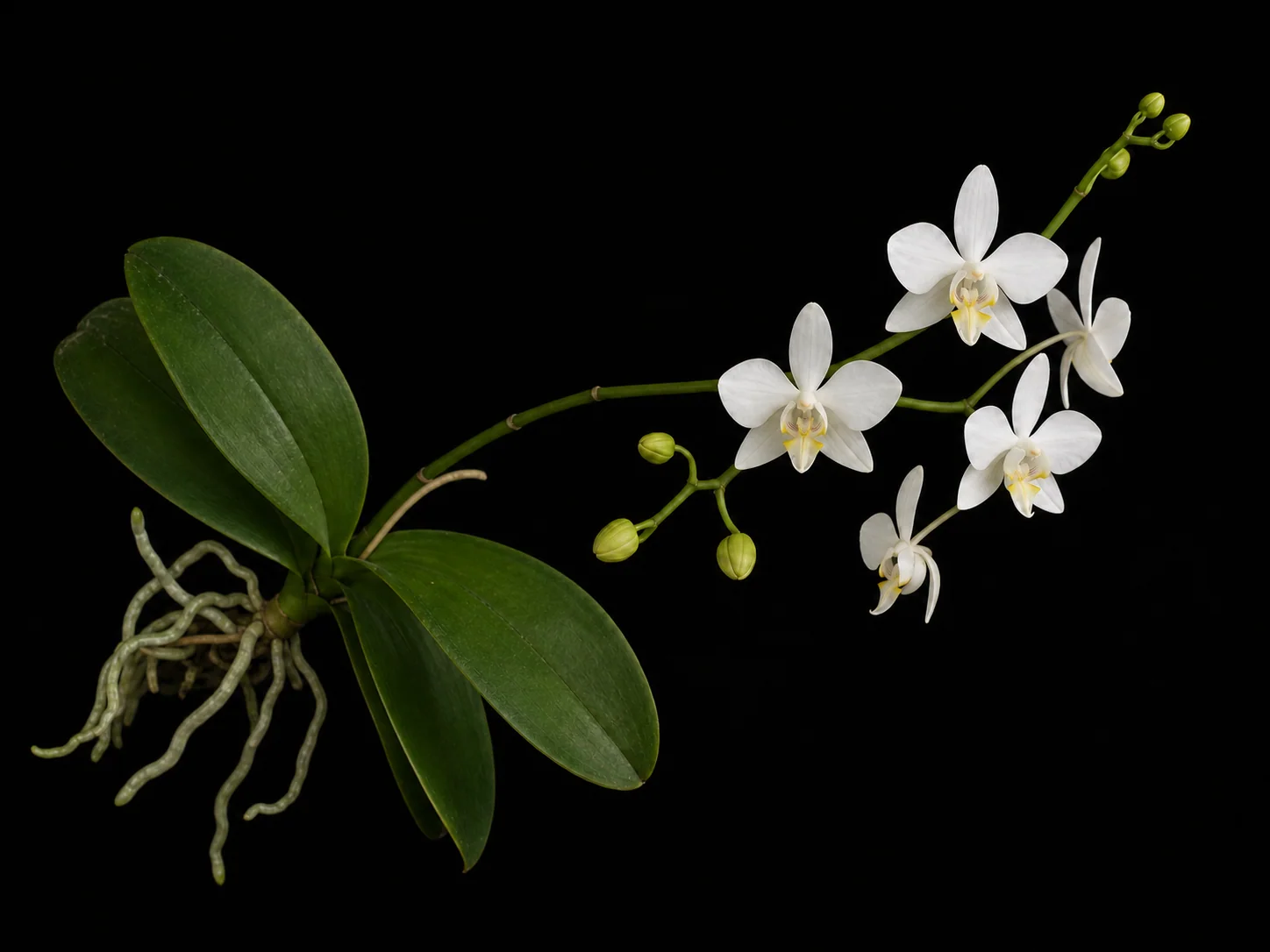
The long axis that rises or arches and carries buds and flowers is better understood as a flower spike or inflorescence axis, not as the main stem of the plant. Keeping those terms separate makes the plant form much easier to understand.
This also prepares readers for later concepts such as nodes, buds, and inflorescences. Plants do not all show the same body plan in the same obvious way.
For a closer comparison of stem structures, read about banana pseudostems and orchid pseudobulbs.
Flowers: moth-like, but still orchid flowers
Phalaenopsis flowers are often described as moth-like, which explains the common English name moth orchid. Botanically, the more important point is that they are orchid flowers with specialized structures.
For a beginner, three ideas are enough to start: the outer showy perianth parts, the central column, and the specialized lip. The lip is especially important in orchid observation because it often relates to pollinator interaction, flower shape, and identification.
This article stays at the entry level. Do not use Phalaenopsis flowers as the template for every flower. It is better to learn a general flower diagram first, then come back to orchids to see how flower parts can be modified.
An important horticultural crop
Phalaenopsis is not only a houseplant; it is also an important ornamental crop in international floriculture. NC State Extension describes moth orchids as the most popular and widely available orchids sold as houseplants, with commercial production centered in Taiwan and the Netherlands. Taiwan’s Ministry of Agriculture recorded Phalaenopsis exports exceeding US$100 million in 2012, and a recent Taiwan orchid export presentation reported orchid product value above US$200 million, with more than 90% exported.
These figures change with year, exchange rate, market, and statistical scope, so they should not be read as a fixed live market price. They show why Phalaenopsis is more than a niche potted flower: it connects breeding, tissue culture, greenhouse production, international trade, and the ornamental plant market.
Those topics can later connect to wild species, cultivars, breeding, selection, parents, hybrids, and traits. This basic article does not go into commercial production. It builds the map first: Phalaenopsis can connect plant structure, plant physiology, reproduction, potting environment, and the plant science behind horticultural practice.
Common Mix-Ups
- ✕ Exposed Phalaenopsis roots always mean something is wrong or the plant is thirsty.
- ✓ Exposed thick roots are often normal for Phalaenopsis. Root firmness, injury, rot, media, leaves, and environment all matter.
- ✕ Epiphytic plants are the same as parasitic plants.
- ✓ Epiphytes grow attached to other surfaces; that does not mean they feed from the host plant.
- ✕ Phalaenopsis should be grown like an ordinary soil-grown bedding plant.
- ✓ Many Phalaenopsis orchids need a more aerated root environment than dense garden soil provides.
- ✕ The flower spike is the main stem of the plant.
- ✓ The main stem is short and partly hidden; the long axis carrying buds and flowers is the flower spike or inflorescence axis.
- ✕ Phalaenopsis can represent all plants.
- ✓ It is a strong orchid example, but general topics such as germination or basic root-system comparison still need broader plant examples.
FAQ
Is Phalaenopsis the same as orchid?
No. Phalaenopsis is one familiar group within the orchid family. Orchids are extremely diverse, and many orchids have growth forms and flowers that look very different from Phalaenopsis.
Why is Phalaenopsis called moth orchid?
The common name moth orchid comes from the flower’s appearance. Many Phalaenopsis flowers suggest a moth or butterfly with open wings. It is a common name, not a precise taxonomic description.
Should I cut off roots that grow outside the pot?
Do not cut roots only because they are outside the pot. Exposed roots are common in Phalaenopsis. A better observation is whether the roots are firm, injured, shriveled, or rotten, and how the leaves, media, and environment look together.
Does Phalaenopsis need a clear pot?
Not always. A clear pot can make roots and media easier to observe, which is useful for Phalaenopsis. But it is not required for every plant, and it does not replace drainage and aeration principles.
What plant science topics can Phalaenopsis help explain?
It is useful for aerial roots, epiphytes, root aeration, thick leaves, short stems, flower spikes, orchid flower structure, ornamental horticulture, and cultivar concepts. For seed germination or basic root-system types, it should be paired with more general plant examples.
Related Terms
- Phalaenopsis: a familiar group of ornamental orchids, commonly called moth orchids.
- Epiphyte: a plant that grows attached to another surface without being parasitic.
- Aerial root: a root exposed to air or growing outside the main potting medium; its function depends on the plant.
- Velamen: the spongy outer layer found on many orchid aerial roots.
- Short stem: a compact stem with very short internodes, often hidden by leaf bases in Phalaenopsis.
- Flower spike: the axis that carries buds and flowers.
- Lip: a specialized petal in orchid flowers, often important for flower form and identification.
- Ornamental horticultural crop: a plant grown mainly for ornamental value, often involving cultivars, flower form, and production systems.
Read Next
Evidence and attribution
Sources and image rights
These sources were used to check the plant-science concepts and gardening context in this article.
View sources and further reading (7)
Image sources and rights
- Zhu Lee-owned image · Zhu-owned — The source PNG was prepared as WebP for delivery.