Why can red light at night change flowering?
Rice · a short-day experiment
Unbroken night
Red night break
Pr and Pfr are two states of the same phytochrome; Pfr can signal. Arrows show the favored direction; both states can coexist.
This is an experimental rice response. Long-day plants can respond differently.
Model notes and research
This phytochrome B (phyB) example illustrates the causal links between light, receptor states and plant responses, rather than measured proportions or protein structure. Animation speed is illustrative; actual responses also depend on intensity, temperature, the clock and developmental stage.
Ishikawa et al. (2009) found that red night breaks reduced Hd3a expression in rice, weakening the flowering signal; repeated treatment delayed flowering. The model distinguishes changes within one night from the later flowering outcome.
Photoperiod means how long the daily light and dark periods last
Photoperiod is the duration of light and darkness in a daily cycle. Photoperiodism is a plant’s response to that timing. Some plants flower more readily under long nights, others under short nights. This differs from light intensity and from the amount of photosynthesis a plant can carry out.
For people, day length and night length may feel like background calendar information. For plants, they can be useful seasonal signals. In many places, spring and summer bring longer days and shorter nights. Autumn and winter bring shorter days and longer nights. Many plants can use that pattern to adjust flowering, dormancy, winter bud formation, or vegetative growth.
Photoperiod is related to light, but it is not the same as photosynthesis. Photosynthesis explains how plants use light energy to make sugars and other organic compounds. Photoperiod describes the timing of light and darkness; photoperiodism is the plant’s response to that timing.
Photoperiod and photoperiodism are related, but not identical
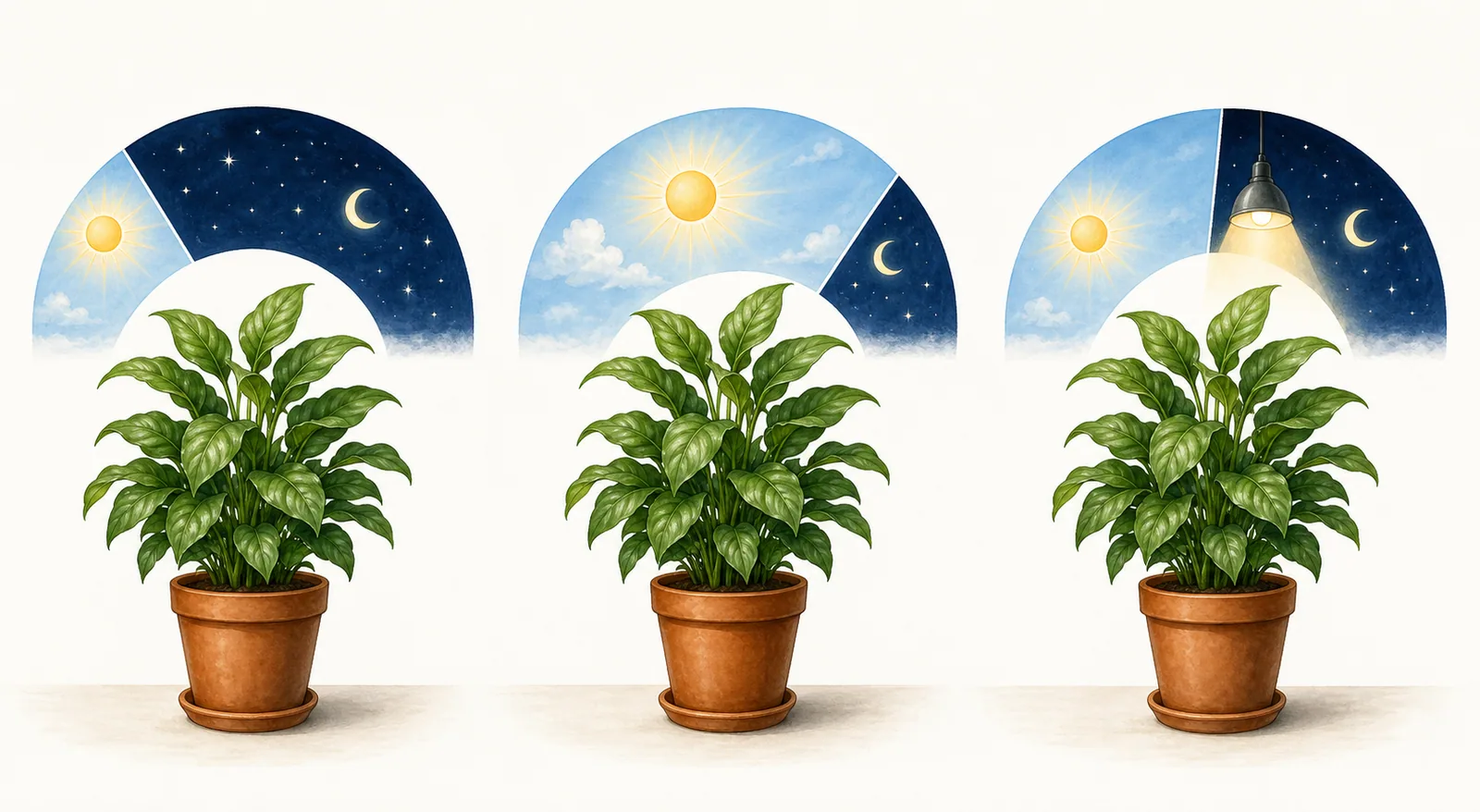
Photoperiod is the environmental condition: the length of the light period and the dark period. Photoperiodism is the biological response to that condition.
You can think of photoperiod as the clock face, and photoperiodism as what the plant does after reading that clock. Some plants flower more readily when nights become longer. Some flower more readily when nights become shorter. Some are much less controlled by day length.
Photoreceptors, the internal clock, and developmental signals work together in plant cells. Photoperiod provides timing information that plants integrate into growth and development.
Short-day, long-day, and day-neutral plants
These names describe flowering responses to day-night timing, rather than a preference for dim or strong light.
| Type | Typical flowering response | Other conditions still matter |
|---|---|---|
| Short-day | Flowering favored by long, uninterrupted nights | Enough light is still needed for growth |
| Long-day | Flowering favored by shorter nights or longer days | Stronger light is not always better |
| Day-neutral | Flowering is less controlled by day length | Temperature, maturity, water, and overall condition can still affect flowering |
Why night length often matters more than the name suggests
The term short-day plant makes it sound as if less daytime is the main point. In many classic photoperiod responses, the more important cue is the length of uninterrupted darkness. If light interrupts the night, the plant may experience the dark period as broken into pieces, and the response can change.
That is why some sources frame short-day plants as long-night plants and long-day plants as short-night plants. This wording helps prevent a common mistake: a short-day plant is not simply a plant that needs less useful light.
Phytochrome is one receptor that receives these light signals. It has two interconvertible states, Pr and Pfr. Daylight contains many wavelengths, including red and far-red. Red favors conversion from Pr to the signaling state Pfr; far-red favors the reverse. In phytochrome B (phyB), thermal reversion gradually reduces the Pfr share in darkness. Red light during the night strengthens phyB signaling again.
How does this affect flowering? In rice studies under short days, a red night break acts through phyB to suppress Hd3a gene expression, weakening the signal that promotes flowering. Repeated red night breaks over several days can delay flowering in rice.
The model first compares light signals within one night, then shows the flowering outcome after repeated night treatments. This is an experimental rice example; night lighting can instead promote flowering in some long-day plants. Photoreceptors, the internal clock and developmental signals work together, with species, cultivar and lighting time also shaping the response.
Photoperiod affects more than flowering
Photoperiod is most often discussed in connection with flowering because short-day, long-day, and day-neutral examples are easy to observe. But photoperiod responses are not limited to flowers.
In some plants, day-night length can also be connected with winter bud formation, dormancy, leaf drop timing, or vegetative growth. The reason is practical: plants cannot read a calendar, but they still need to adjust growth before or during seasonal change. Day length and night length change in a predictable annual pattern, so they can serve as reliable seasonal cues.
Temperature, water, and light intensity also matter, but they can fluctuate with short-term weather. Day-night length at a given location follows a steadier seasonal pattern. Many plants integrate photoperiod with other environmental and internal signals rather than relying on a single factor.
How this helps in everyday plant observation
If a plant keeps growing leaves but does not flower, it is not useful to shrink the answer to “the photoperiod is wrong.” A better approach is to place photoperiod among several observation questions. Is the plant mature enough? Is it a photoperiod-sensitive plant? Is its night period regularly interrupted by lighting? Does it receive enough usable light to support growth? Are temperature, water, roots, and mineral nutrition stable?
That slower explanation is closer to how plants actually work. Photoperiod helps explain flowering rhythms, but it should not become a one-size-fits-all shading or lighting prescription.
Horticulture and greenhouse production can manage day length and night length, but that involves plant species, cultivar, facilities, temperature, maturity, and target timing. For a general science article, understanding the concept is more useful than memorizing numbers that may not apply to the plant in front of you.
The growing point can begin forming a flower bud before a flower is visible. Flower bud differentiation explains that earlier developmental change.
Common confusions
- ✕ Photoperiod means light intensity.
- ✓ Photoperiod means the duration of light and darkness. Light intensity means how strong the light is.
- ✕ Photoperiod is the same as photosynthesis time.
- ✓ Photosynthesis uses light to make organic materials. Photoperiod is a timing signal based on day and night length.
- ✕ A short-day plant is a plant that does not need much sunlight.
- ✓ A short-day plant has a flowering response linked with short days or long nights. It still needs enough light for growth.
- ✕ Long-day plants will flower if they simply receive more and more light.
- ✓ Day length is only part of the signal set. Maturity, temperature, roots, water, plant type, and plant condition also matter.
- ✕ All plants use photoperiod to decide when to flower.
- ✓ Some plants respond strongly to photoperiod, some are closer to day-neutral, and many integrate several signals at once.
Frequently Asked Questions
Is photoperiod the same as light intensity?
No. Photoperiod is about how long the light and dark periods last. Light intensity is about how strong the light is. Plants may respond to both, but they are different signals.
Why are short-day plants often really about long nights?
Because many short-day plants are sensitive to the length of uninterrupted darkness. A short day usually comes with a long night, but if the night is interrupted by light, the plant may not experience one continuous long dark period.
Do all plants flower according to photoperiod?
No. Short-day and long-day plants are more sensitive to day-night length. Day-neutral plants are less controlled by day length. Even photoperiod-sensitive plants can still depend on maturity, temperature, total light, and plant condition.
Does photoperiod affect only flowering?
No. Photoperiod can also be connected with winter bud formation, dormancy, vegetative growth, or other seasonal responses in some plants. The details vary widely among species.
Can household lights at night affect plants?
They can, especially for photoperiod-sensitive plants that are forming flower buds or responding to seasonal cues. But not every plant responds strongly, and occasional room light may not create an obvious change.
Does a long-day plant flower just because it gets longer days?
No. The term long-day plant mainly describes a flowering response to long days or short nights. It does not mean stronger light or more hours always guarantee flowering. Plant maturity, temperature, water, roots, and overall condition still matter.
Are short-day and long-day plants separated by a 12-hour cutoff?
No. “Short” and “long” refer to a plant’s critical photoperiod, which varies among species and cultivars. Some plants require a suitable photoperiod to flower; in others, it mainly changes how quickly flowering occurs. Twelve hours is not a universal flowering switch.
Related Terms
- Photoperiod: the length of the light and dark periods in a daily cycle.
- Photoperiodism: a biological response to day-night length.
- Short-day plant: a plant that flowers more readily under short-day or long-night conditions.
- Long-day plant: a plant that flowers more readily under long-day or short-night conditions.
- Day-neutral plant: a plant whose flowering is less controlled by day length.
- Uninterrupted darkness: a dark period that is not broken by light.
- Phytochrome: an important photoreceptor system involved in red light, far-red light, and photoperiod responses.
- Florigen: a term often used for the flowering signal that can move from leaves toward the growing point; this is a more advanced plant physiology topic.
Read Next
Evidence
References
These sources were used to check the plant-science concepts and gardening context in this article.
View sources and further reading (9)
- milnepublishing.geneseo.edu — reproduction development and physiology
- journals.plos.org — article
- pubmed.ncbi.nlm.nih.gov — 27789798
- jstage.jst.go.jp — pdf
- openstax.org — 30 6 plant sensory systems and responses
- extension.oregonstate.edu — day length plays key role plant flowering
- extension.umn.edu — lighting indoor plants
- extension.illinois.edu — 2021 10 29 what makes plants bloom different times year
- frontiersin.org — full