What does phytochrome switching change?
Arabidopsis seedlings · shade avoidance
Pr and Pfr are two states of the same phytochrome; Pfr can signal. Arrows show the favored direction; both states can coexist.
Mechanism: reversible phytochrome switching and shade avoidance.
Model notes and research
This phytochrome B (phyB) example illustrates the causal links between light, receptor states and plant responses, rather than measured proportions or protein structure. Animation speed is illustrative; actual responses also depend on intensity, temperature, the clock and developmental stage.
Arabidopsis studies provide the seedling example. This stem region below the seed leaves is called the hypocotyl. Leaf shade lowers red relative to far-red, weakens phyB signaling and promotes further elongation. Returning to open daylight restrains further elongation; existing tissue does not shrink. Other photoreceptors also contribute in deep shade.
Plants do not see daylight, but they can read light signals
Plants do not have eyes, and they do not consciously see day and night. Here, “sense” means that cells convert light and darkness into biological signals. A better way to say it is that plants sense light. Many plant cells and tissues contain photoreceptors, or light-sensing systems, that respond to light color, intensity, direction, and duration.
When daylight arrives, some light receptors become active. When night lasts longer, those receptor states and the plant’s internal timing system shift. Through these signals, a plant can keep track of whether its environment is more like daytime, nighttime, or a changing season.
This is related to photosynthesis, but it is not the same question. Photosynthesis focuses on how plants use light energy to make organic materials. Day-night sensing means that plants can turn light and darkness into time information.

Photoreceptors act like different kinds of sensors
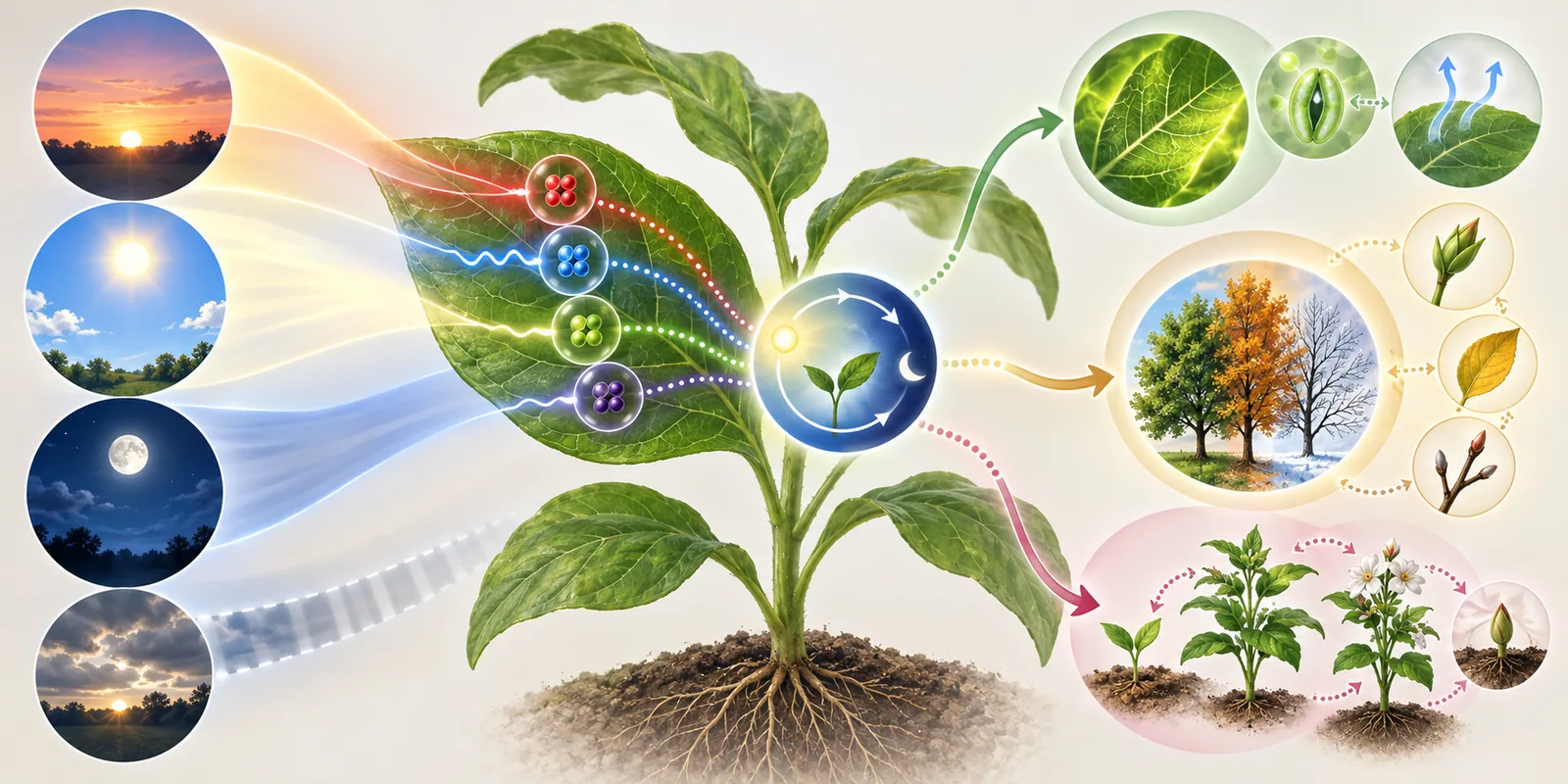
Plants do not sense only “bright” and “dark.” They use several photoreceptors, meaning light-receiving protein systems, to detect different parts of the light environment.
Phytochrome responds mainly to red and far-red light. Pr and Pfr are two states of phytochrome: red light favors conversion from Pr to Pfr, while far-red light favors the reverse. Illumination shifts the balance between the states rather than switching the entire population into one state.
Daylight is a mixture containing red, far-red and other wavelengths, rather than red light alone. The mix reaching a plant changes with its surroundings: shade from other leaves removes more red light, increasing the relative share of far-red.
These changes affect actual growth. The model uses phytochrome B (phyB) in Arabidopsis seedlings as an example. In open daylight, the red-light conversion effect predominates, shifting more phytochrome to Pfr. This strengthens the light signal and helps restrain seedling stem elongation. Leaf shade increases the relative far-red effect, shifting more phytochrome back to Pr and weakening its restraint on elongation. This is part of shade avoidance: subsequent elongation changes, while existing stem tissue does not shrink.
After dusk, phyB Pfr can gradually return to Pr through thermal reversion, at a rate influenced by temperature and cellular conditions. These light signals interact with the circadian clock and other signaling systems to regulate day-night responses.
Phototropins and cryptochromes are connected with blue-light responses. Phototropins can participate in responses such as growth toward light, chloroplast movement, and stomatal opening. Cryptochromes can provide blue-light input to plant circadian rhythms and timing responses, as well as some light-directed development and flowering responses. Neither receptor is the plant’s complete circadian clock.
You do not need to memorize every molecule. The useful idea is simpler: plants do not rely on one single light switch. They use several light-sensing systems together.
Plants also have their own roughly 24-hour physiological rhythms
Many living things have circadian rhythms, which are internal rhythms of about 24 hours. In humans, light and darkness affect sleep, body temperature, and alertness. In plants, light and darkness also connect with internal timing.
Plant rhythms can affect stomata, photosynthesis-related activity, nighttime use of stored materials, leaf or flower movement in some plants, and certain growth and development responses. This does not mean plants sleep like people. It means plant cells and tissues adjust activity according to time.
You can think of photoreceptors as input systems and the circadian clock as part of the timing system; they are not a one-to-one switch and they interact with other environmental signals. Natural daylight and night can entrain, or synchronize, the plant’s circadian clock with the environment. If light and dark periods are repeatedly disturbed, some plants may show changes in growth, flowering, or dormancy responses. The exact response varies among species, so these are possible functions rather than one fixed schedule for every plant.
Photoperiod helps plants track seasons
Day and night happen every day, but their lengths change through the year. In many places, spring and summer bring longer days and shorter nights. Autumn and winter bring shorter days and longer nights.
Plants can use this pattern as seasonal information. The daily arrangement of light and darkness is called photoperiod; the plant’s biological response to that arrangement is called photoperiodism.
Photoperiod does not simply mean “did the plant receive light today?” For many photoperiod-sensitive plants, the length of uninterrupted darkness is especially important, but no single dark-period model fits every plant or every response. Short-day plants often flower more readily when days are shorter and nights are longer, so many are more precisely described as long-night plants. Long-day plants often flower more readily or more quickly when days are longer and nights are shorter. Day-neutral plants are less controlled by day length and may depend more on age, temperature, total light amount, water, or overall plant condition.
So a short-day plant is not simply a plant that “likes less sun.” A long-day plant is not automatically a plant that needs stronger light. These names describe how flowering or development responds to day-night length, not how much light the plant needs for photosynthesis.
Light at night can matter for some plants
If a plant is sensitive to photoperiod, light at night may interrupt what the plant experiences as continuous darkness. In greenhouse terminology, this kind of mid-night light treatment is often called night interruption (a break in the dark period); the timing, light intensity, and spectrum vary by plant.
But this should not be turned into the rule “all plants must never be exposed to light at night.” Whether night light matters depends on the plant species or cultivar, growth stage, light intensity and spectrum, timing, distance, and duration. Many foliage houseplants may show no obvious response to occasional room light, while photoperiod-sensitive flowering plants are more likely to make repeated night lighting worth observing.
Treat night light as one environmental timing cue. It may affect some plants, but it is not a universal flowering switch or a guaranteed way to stop flowering.
Plants track seasons through more than temperature
Temperature also matters. Cool nights, low-temperature periods, heat, drought, and seasonal changes can all influence plant growth and flowering. But temperature can fluctuate suddenly. If plants used only temperature, a short warm spell or cold spell could be misleading.
Day length changes more predictably through the year. At the same location, the pattern of daylight and darkness follows the season. For many plants, photoperiod is therefore a useful seasonal cue.
Plants usually integrate several signals: day length, night length, temperature, water availability, and their own maturity. They do not rely on one factor alone.
This also helps explain indoor growing. A room that looks bright to people may not provide the same light amount, light quality, or day-night rhythm that a plant would receive outdoors. A windowsill, a deep indoor corner, a desk lamp at night, a grow light, and seasonal window light all send different signals.
Common confusions
- ✕ Plants sense day and night because they have eye-like organs.
- ✓ Plants do not have eyes. They use photoreceptors and internal rhythms to sense changes in light and darkness.
- ✕ Photosynthesis and day-night sensing are the same thing.
- ✓ Photosynthesis uses light to make organic materials. Day-night sensing uses light quality, darkness, and duration as information.
- ✕ Photoperiod and photoperiodism mean the same thing.
- ✓ Photoperiod is the daily pattern of light and darkness. Photoperiodism is the plant’s biological response to that pattern.
- ✕ A short-day plant is a plant that dislikes sunlight.
- ✓ “Short-day plant” describes a flowering response to short days or long nights. It does not mean the plant does not need enough light for photosynthesis.
- ✕ Turning on lights at night always harms plants.
- ✓ Night lighting can affect photoperiod-sensitive plants, but the effect depends on species or cultivar, timing, intensity, spectrum, distance, duration, and growth stage.
- ✕ Adjusting light schedules guarantees flowering.
- ✓ Photoperiod is only one flowering cue. Maturity, temperature, roots, water balance, mineral nutrition, and plant type also matter.
Frequently Asked Questions
How do plants know when daytime arrives if they do not have eyes?
Plants sense light through photoreceptors inside their cells. These systems respond to different wavelengths and durations of light. When daylight arrives, receptor states change, and the plant’s internal timing system can be reset.
Are photoreceptors the same as a plant’s circadian clock?
No. Photoreceptors receive light and darkness as outside signals. The circadian clock maintains an internal rhythm of about 24 hours and can be reset by those signals. They interact, but one photoreceptor is not the whole clock, and a single light change cannot predict one guaranteed plant response.
Are Pr and Pfr different types of phytochrome?
No. They are two interconvertible states of the same phytochrome. Red light favors Pr-to-Pfr conversion, and far-red light favors the reverse. Both states usually coexist, with their balance changing as the light spectrum changes. The phytochrome family itself includes different members, such as phyA and phyB.
Do plants need darkness at night?
Many plants need some period of darkness for normal day-night rhythm and certain physiological responses. But different plants vary widely. It is not accurate to say every plant needs the same number of dark hours.
Can turning on lights at night affect plants?
It can, especially for plants that are sensitive to photoperiod and are forming flower buds or responding to seasonal cues. Occasional light may not make an obvious difference, but repeated night lighting can make some plants experience a shorter period of uninterrupted darkness.
What are short-day and long-day plants?
Short-day plants usually flower more readily when days are short and nights are long, so many are also called long-night plants. Long-day plants usually flower more readily, or flower faster, when days are long and nights are short. Day-neutral plants are less controlled by day length. These labels describe flowering responses, not a plant’s basic preference for bright or dim light.
What is the difference between photoperiod and photosynthesis?
Photoperiod describes when light and darkness occur in the daily cycle. Photosynthesis is the process by which plants use light energy to make organic materials. A lamp may be too weak to support much photosynthesis yet still act as a timing signal for some photoreceptors, depending on the plant and the conditions.
Do plants use temperature or day length to track seasons?
Both can matter. Day length is a predictable seasonal signal, while temperature, water, and plant maturity can also affect growth, flowering, and dormancy.
Is a plant circadian rhythm the same as a human biological clock?
The broad idea is similar: both are roughly 24-hour internal rhythms influenced by light and darkness. But plants do not have brains or eyes. Their timing systems operate through plant cells and tissues and regulate plant-specific activities.
Related Terms
- Photoreceptor: a light-sensing protein system in plant cells.
- Phytochrome: a photoreceptor system involved mainly in red and far-red light responses; it can switch between Pr and Pfr states.
- Cryptochrome: a blue-light receptor involved in timing and other light responses.
- Phototropin: a blue-light receptor involved in responses such as growth toward light, chloroplast movement, and stomatal opening.
- Circadian rhythm: an internal rhythm of about 24 hours.
- Circadian clock: the internal timing system whose rhythm can be entrained by environmental cues.
- Photoperiod: the length of light and darkness within a daily cycle.
- Photoperiodism: a plant’s biological response to the photoperiod.
- Uninterrupted darkness: a dark period that is not broken by a light signal.
- Night-interruption lighting: light introduced during the night that breaks up a period of darkness in some photoperiod studies or greenhouse contexts.
- Short-day plant: a plant that flowers more readily under short-day or long-night conditions.
- Long-day plant: a plant that flowers more readily under long-day or short-night conditions.
- Day-neutral plant: a plant whose flowering is less controlled by day length.
Related reading
Evidence
References
These sources were used to check the plant-science concepts and gardening context in this article.
View sources and further reading (13)
- journals.plos.org — article
- journals.plos.org — article
- pubmed.ncbi.nlm.nih.gov — 27789798
- openstax.org — 30 6 plant sensory systems and responses
- frontiersin.org — full
- frontiersin.org — full
- jic.ac.uk — time is of the essence
- extension.purdue.edu — ho 253 w.pdf
- extension.umn.edu — lighting indoor plants
- extension.umd.edu — lighting indoor plants
- nature.com — s42003 024 06275 6
- extension.oregonstate.edu — day length plays key role plant flowering
- yardandgarden.extension.iastate.edu — important considerations providing supplemental lights