First, the goal is to match flowering with a needed window
When people say that growers “control flowering time,” the plain meaning is this: they do not want plants to bloom too early or too late. They want flowers to open near the time when people need them. In commercial horticulture, that may mean potted flowering plants, cut flowers, or bedding plants are ready for a holiday, market shipment, exhibition setup, retail window, or research need. In research and breeding, it may also mean bringing parent plants or treatment groups into bloom close enough for pollination, observation, and comparison.
In agriculture and horticulture, this belongs to the broader idea of production timing: adjusting when a crop or ornamental plant reaches a useful stage. The actual schedule also depends on cultivar choice, facilities, region, season, cost, and production scale.
The method is not to command the flower directly. It is to manage signals that plants already use. Plants do not read a calendar. Many plants respond to day length, night length, uninterrupted darkness, cool periods, total light, maturity, and their own internal condition. When those signals fit the plant’s biology, a bud or shoot tip may shift from leaf and stem growth toward flower bud formation. Later, those flower buds may develop into visible buds and open flowers.
So flowering time control is not a switch, and it cannot guarantee that every plant will bloom at the same time. It is closer to scheduling: growers begin with a target window, then manage the environmental and growth conditions that the plant can perceive.
Why do plants use light and darkness as timing clues?
Day and night change every day, and their length changes in a predictable seasonal pattern. For many plants, this pattern is a steadier seasonal clue than a short stretch of unusual weather.
A plant’s response to the length of light and dark periods is called a photoperiod response. In everyday gardening language, people often talk about short-day plants, long-day plants, and day-neutral plants. These names are easy to misunderstand. They are not saying that a plant simply likes less light or likes more light. They describe how flowering or development responds to the relationship between day and night.
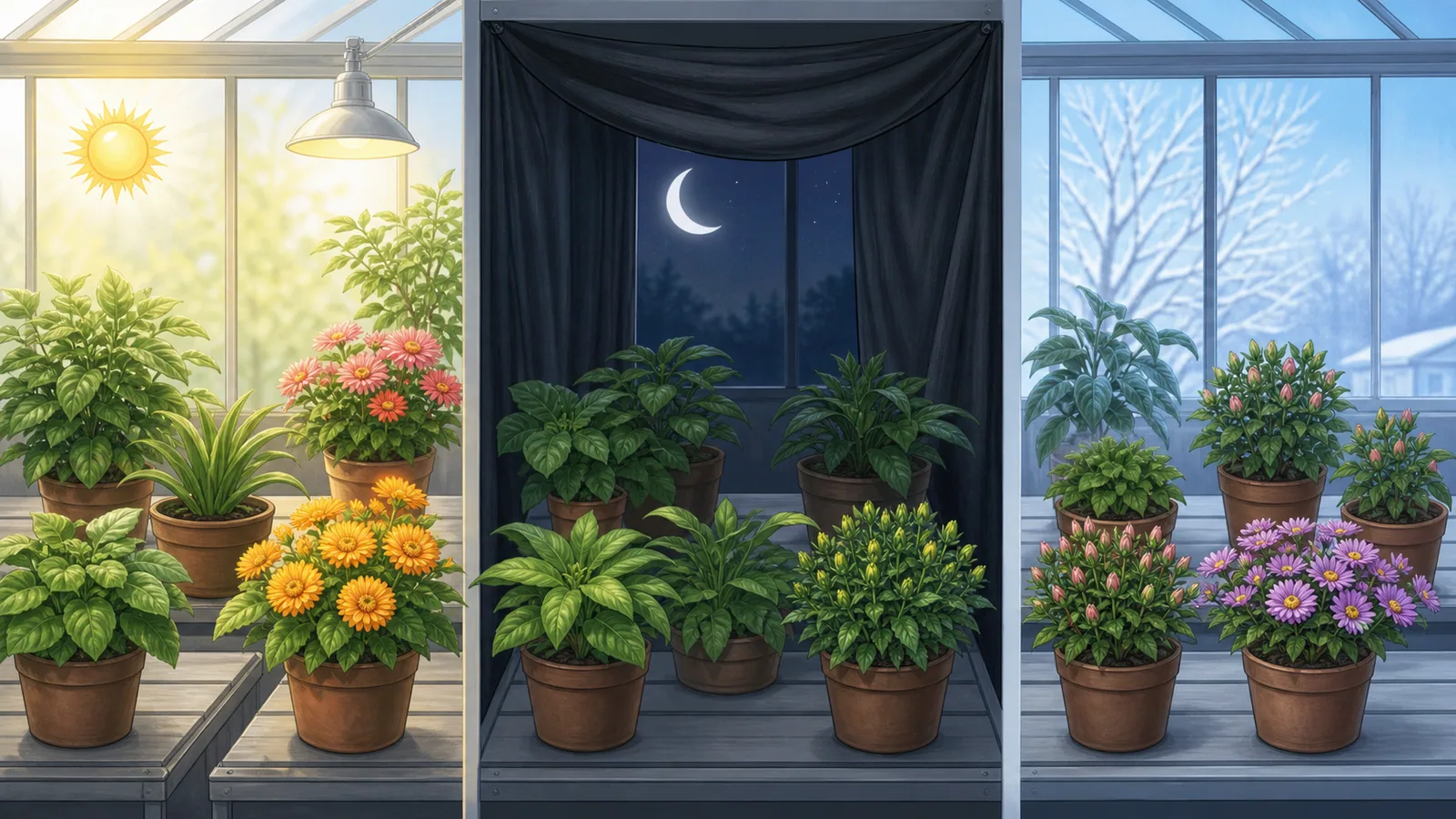
For many short-day plants, the more precise cue is a long, uninterrupted night. If that dark period is interrupted by light, the plant may read the night as shorter than it really was. Long-day plants often flower more readily or more quickly when nights are shorter and days are longer. Day-neutral plants are less controlled by day length, and their flowering may depend more on age, temperature, total light, growth rate, or plant condition.
This is why greenhouse and ornamental horticulture may use shading, supplemental lighting, or night lighting management. The core idea is not simply “give more light” or “give less light.” It is to change the daily rhythm that the plant perceives.
Cool periods can also be flowering signals
Some plants also use a period of cool conditions as a seasonal signal. Vernalization is a common example. In certain plants, exposure to a cool period gives the plant, or improves the plant’s ability, to flower later.
This point is easy to misunderstand. Vernalization does not mean that a brief chill makes flowers appear immediately. It is more like the plant has received the message that a winter or cool season has passed. After that, if day length, temperature, maturity, and growth conditions also fit, the plant may be more likely to form flower buds or continue toward flowering.
Plant differences are large. Some plants strongly require a cool period before flowering. Some flower more evenly or more quickly after cool exposure. Many others do not rely on this cue. That is why chilling temperatures, storage methods, and day-count instructions cannot be transferred from one plant to another.
Flower induction, flower bud formation, and flower opening are different stages
Flowering time control can make people focus only on the visible question: “When will the flowers open?” But several developmental stages come before that moment. The plant usually needs to be mature enough. At a shoot tip or other growing point, flower induction is the early shift from vegetative growth toward the flowering pathway. Flower bud formation describes the development of young flower structures. A bud may later become a visible flower bud, an unopened structure that can be recognized from outside; only after further development does flower opening occur.
Flower bud formation is a broader description of floral structures beginning to develop. Flower bud differentiation usually describes the continuing development of floral parts inside the bud. Depending on the plant and the source, the boundary between these terms can overlap. They are different points on one developmental path, not the same instant.

If we only look for open flowers, we miss the fact that important changes may have started much earlier. Horticultural scheduling has to estimate the whole path, not just wait until a flower bud is already visible.
This also explains why the same kind of plant may flower at very different times in different regions, seasons, greenhouses, homes, or classrooms. The plant may be receiving different combinations of day length, night length, temperature, total light, water conditions, root conditions, and growth-stage signals.
Why would people want flowers near a certain date?
In ornamental horticulture, flowering time often matters for displays, teaching, exhibitions, holiday crops, market windows, production timing, and research schedules. Potted flowering plants, bedding plants, cut flowers, teaching materials, research plants, and breeding materials may all be easier to supply, compare, or present when flowers appear within a planned window.
In research and breeding, synchronized flowering can be practical. If two parent plants bloom at completely different times, it becomes difficult to carry out pollination, compare offspring, or collect seeds. Bringing flowering periods closer together is not always about producing more flowers. Often it is about making the reproductive stage observable, comparable, and schedulable.
Even then, flowering time control does not guarantee every later step. Pollination, fertilization, fruit development, and seed development still depend on plant species, plant condition, environment, and the compatibility of the flowers involved.
What can home gardeners learn from this?
The practical lesson is not to memorize one number of light hours or one cold temperature. The better lesson is that flowering usually comes from several conditions working together.
If a plant keeps growing leaves but does not flower, start with low-risk observation. Is the plant mature enough? Does it receive enough usable light? Is it a species that responds strongly to day and night length? Is its night period being interrupted by regular lighting? Does it need a seasonal temperature change? Are the roots, water conditions, and mineral nutrition stable enough to support growth?
These questions are more reliable than searching for a single flower forcing trick.
Shading hours, lighting intensity, chilling duration, fertilizer formulas, and other operating details depend heavily on species, cultivar, growing facility, region, season, and production goal. Moving commercial scheduling methods directly into a home pot can easily create confusion.
Common misunderstandings
- ✕ Controlling flowering time means forcing a plant to bloom.
- ✓ More accurately, it means managing environmental signals that the plant can perceive, so flowering is more likely to fall near a planned window.
- ✕ Short-day plants are plants that need very little light.
- ✓ The term mainly describes flowering response to short days or long nights. It does not mean the plant no longer needs enough light for photosynthesis.
- ✕ Vernalization means chilling a plant will make it flower right away.
- ✓ Vernalization means some plants become more able to enter the flowering pathway after a cool period. Flowers still depend on later conditions.
- ✕ Flower induction, flower bud formation, a visible flower bud, and flower opening all mean the same thing.
- ✓ They refer to different parts of a developmental sequence. Internal flower development may begin before an external bud is visible, and flower opening comes later; the boundaries vary among species.
- ✕ Adjusting lights or temperature can guarantee synchronized bloom.
- ✓ Light and temperature are only part of the signal set. Maturity, roots, water, nutrition, genetics, species, and plant condition also matter.
Frequently Asked Questions
Is controlling flowering time the same as forcing flowers?
Not exactly. “Forcing” can make it sound as if there is a guaranteed button for bloom. Flowering time control means managing light, darkness, temperature, maturity, and other signals so a plant is more likely to move through flower induction, flower bud formation, and flower opening near a planned window.
Why are short-day plants often really about long nights?
Because in many photoperiod responses, the key signal is the length of uninterrupted darkness. A short-day plant often enters a flowering response under longer-night conditions. If light interrupts the night, the plant may perceive the dark period as shorter.
Can household lights at night affect flowering?
They can, but not every plant responds strongly. For photoperiod-sensitive plants that are near flower induction, regular night lighting is worth noticing. Many foliage plants or day-neutral plants may not show an obvious flowering response from occasional room lighting.
Why can holiday flowering plants arrive on the market at the same time?
Ornamental horticulture combines cultivar selection, plant maturity, light and dark management, temperature, and production scheduling to bring flowering closer to a target window. This is professional scheduling, not one simple trick, and it does not mean the same approach can be copied directly for every home plant.
If my plant is not flowering, should I adjust light or temperature first?
Do not rush to change one factor. First identify the plant and its maturity, then observe usable light, day-night rhythm, seasonal temperature changes, root condition, and watering stability. The absence of a visible bud alone cannot show whether internal reproductive development has begun, and different plants use different signals.
Related Terms
- Flowering time: The timing of flower bud formation, bud development, and flower opening.
- Photoperiod: The length relationship between light and darkness within a day.
- Short-day plant: A plant that flowers more readily under short-day or long-night conditions.
- Long-day plant: A plant that flowers more readily under long-day or short-night conditions.
- Day-neutral plant: A plant whose flowering is less controlled by day-length differences.
- Vernalization: A process in which some plants become more able to flower after a cool period.
- Flower induction: The early shift that leads a bud or growing point toward flower development.
- Flower bud differentiation: The continuing development in which floral parts form and develop inside a flower bud; its boundary with flower bud formation can vary by plant and source.
- Flower bud formation: A broad description of floral structures beginning to develop; its boundary with flower bud differentiation can vary by plant and source.
- Visible flower bud: An unopened bud that can be recognized from outside the plant.
- Flower opening: The later event in which the bud opens and the flower becomes visible.
- Scheduling: In horticulture, planning expected flowering time based on plant growth rate and environmental signals.
- Production timing: Planning when a crop or ornamental plant reaches a useful supply window; broader than flowering time alone.
Read Next
Evidence
References
These sources were used to check the plant-science concepts and gardening context in this article.
View sources and further reading (9)
- openstax.org — 30 6 plant sensory systems and responses
- openstax.org — 32 1 reproductive development and structure
- extension.oregonstate.edu — day length plays key role plant flowering
- canr.msu.edu — vernalization part 1
- extension.purdue.edu — ho 249 w.pdf
- canr.msu.edu — cyclic long day lighting
- ohceac.osu.edu — CEBPI Flowering Basics
- ucanr.edu — print
- authors.library.caltech.edu — 0czw2 ps302