
Some plant cuttings can grow roots because the cut piece is still living tissue, and some plant tissues can restart growth in new ways. A cutting does not root simply because it was cut. It roots only when the plant part, its growth points, and its surroundings allow new roots to form from places that were not roots before.
This article is not a propagation recipe. It explains the plant biology behind a familiar question: why can a separated piece of stem, leaf, or root sometimes rebuild the organs it is missing?
A cutting is more than a clipped piece
When a stem section is cut from a plant, it does not instantly become a lifeless stick. If its cells are still alive, it may still contain water, stored materials, vascular tissue, leaves, nodes, buds, and other structures. Those structures affect whether the piece can stay alive long enough to form new organs.
Plants are not fixed machines. Some tissues keep more developmental flexibility than others. In plain language, certain living cells can respond to signals, divide again, and take part in building new tissue.
That does not mean every plant cell can casually become a whole plant. Whether a cutting can root, make shoots, and become stable still depends on species, plant part, tissue condition, and environment.
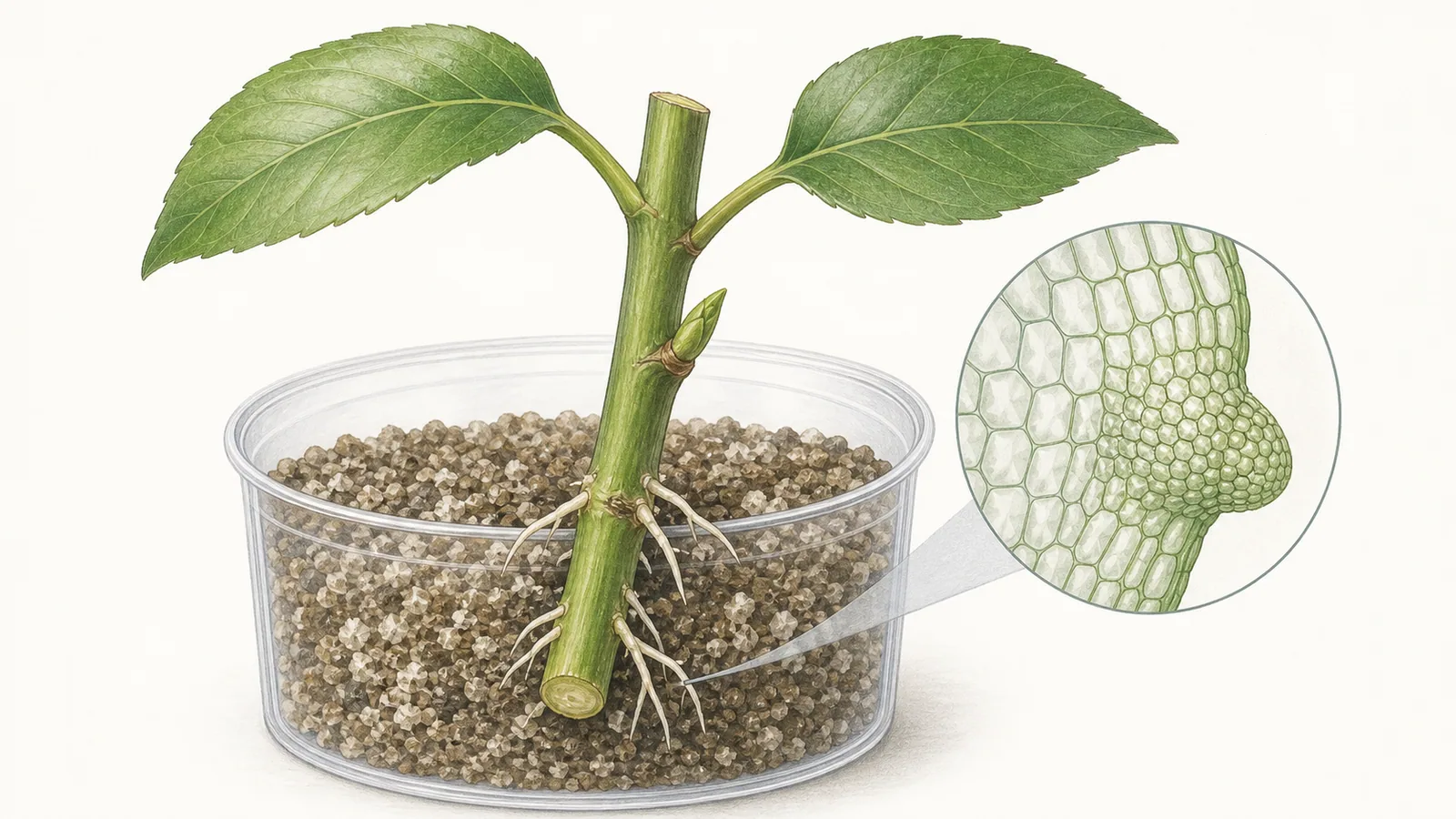
Adventitious roots start from unusual positions
A key term here is adventitious root.
An adventitious root is a root that forms from a non-root or unusual position, such as a stem, node region, leaf base, or cut surface. It is not a “bad” root. The term describes where the root begins.
After a stem cutting is separated from the parent plant, it no longer has the original underground root system. If the cutting is going to become independent, it needs new organs that can absorb water. In some plants, living tissue near the cut end, stem surface, or node region can form adventitious roots.
So the cut itself is not giving life to the plant. The plant already has the biological capacity, in certain positions and species, to build roots from non-root tissue.
Nodes and buds are often the missing clue
People often talk about nodes when they talk about cuttings. A node is a place on a stem where leaves, buds, or branches commonly occur. Near a node, there may be an axillary bud, a growth point that can develop into a new shoot, leaf, or flower.
This matters because forming roots and becoming a complete plant are not the same thing. Some leaves or petioles may form roots but still lack a growth point for a new shoot. In some foliage plants, a leaf without a node may root for a while but never grow into a full new plant.
It helps to separate two questions:
- Can this piece form new roots?
- Can it also form new shoots and a complete plant body?
The first question is about adventitious rooting. The second often involves nodes, buds, and the regenerative capacity of that species.
Wounding, auxin, and regeneration signals
A cut surface is not a magic switch, but it is a place where the plant begins to respond. The cutting must deal with water loss, wound repair, redistributed resources, and changing internal signals. If living cells near the wound remain active, they may take part in new tissue formation.
Auxin is often mentioned here. Auxin is a group of plant hormones involved in growth responses, cell elongation, differentiation, and several developmental processes. It is also closely connected with adventitious root formation.
But auxin is not a guarantee button. It is one part of a larger network of plant signals. If the cutting material is not suitable, has weakened tissue, loses water too quickly, lacks oxygen near the base, or begins to decay, rooting may stop before it becomes useful.
How does a cut stem grow new roots?
New roots are not stuck on from outside. They start from living cells inside the stem. Zoom in on the base of a cutting, one stage at a time.
A cutting is a piece of stem cut off so it can grow roots of its own. Away from the parent plant, its cells still hold water and stored food, and its leaves can still make sugars in the light, so its stem, leaves and buds stay alive. But it has no roots to take up water, and its leaves keep losing water. Cells at the cut are injured, and cells nearby start to respond to the wound.
Living tissue is what makes new roots possible
Reduced motion is on: choosing a step shows its final frame.
A conceptual model of a soft-stemmed cutting. Stages are not days; cells, tissues and roots are enlarged.
About this model and the evidence
- Where roots start varies
In soft-stemmed cuttings, adventitious roots usually start just outside and between the vascular bundles, often from phloem parenchyma cells. In woody cuttings they usually start around the cambium and phloem, though some start from rays, cells derived from the cambium, or xylem parenchyma. The drawing simplifies this to the cambium and phloem of a soft stem.
- Auxin’s role changes as rooting goes on
The early induction phase that starts rooting needs plenty of auxin. Later, too much auxin can slow the growth of root primordia, which is why the orange fades after stage 2. Wounding also triggers other signals, such as jasmonate and ethylene, and losing the roots lowers cytokinin, which comes mainly from roots. The details differ between plants and treatments.
- Some primordia are already there
Some willows, poplars and other plants already carry preformed (latent) root primordia in their stems, and these grow out after cutting. In many cuttings, root primordia form anew after cutting.
- Callus tissue is not a required step
A lump of callus tissue, a mass of new cells near a wound, sometimes forms at the base of a cutting, and roots can look as if they grow from it. In many easy-to-root plants, callus and roots form separately; the roots simply grow through or past it. Roots arising inside callus is more typical of some hard-to-root woody plants and of older material. This is not the same as letting a succulent cutting “callus over,” which means letting the cut surface dry.
- The few leaves that sprout
Where the new roots and buds appear differs between plants. African violet usually forms them near the cut end of the leaf stalk, and a buried midrib can produce new plants too; rex begonia forms them where the veins are cut; some Kalanchoe species form plantlets in the notches along the leaf edge; snake plant can be grown from short leaf sections. Roots are not limited to the cut either: buried parts of the stalk or blade can root too. With most plants, a single leaf grows only a few roots, or rots before any shoot appears.
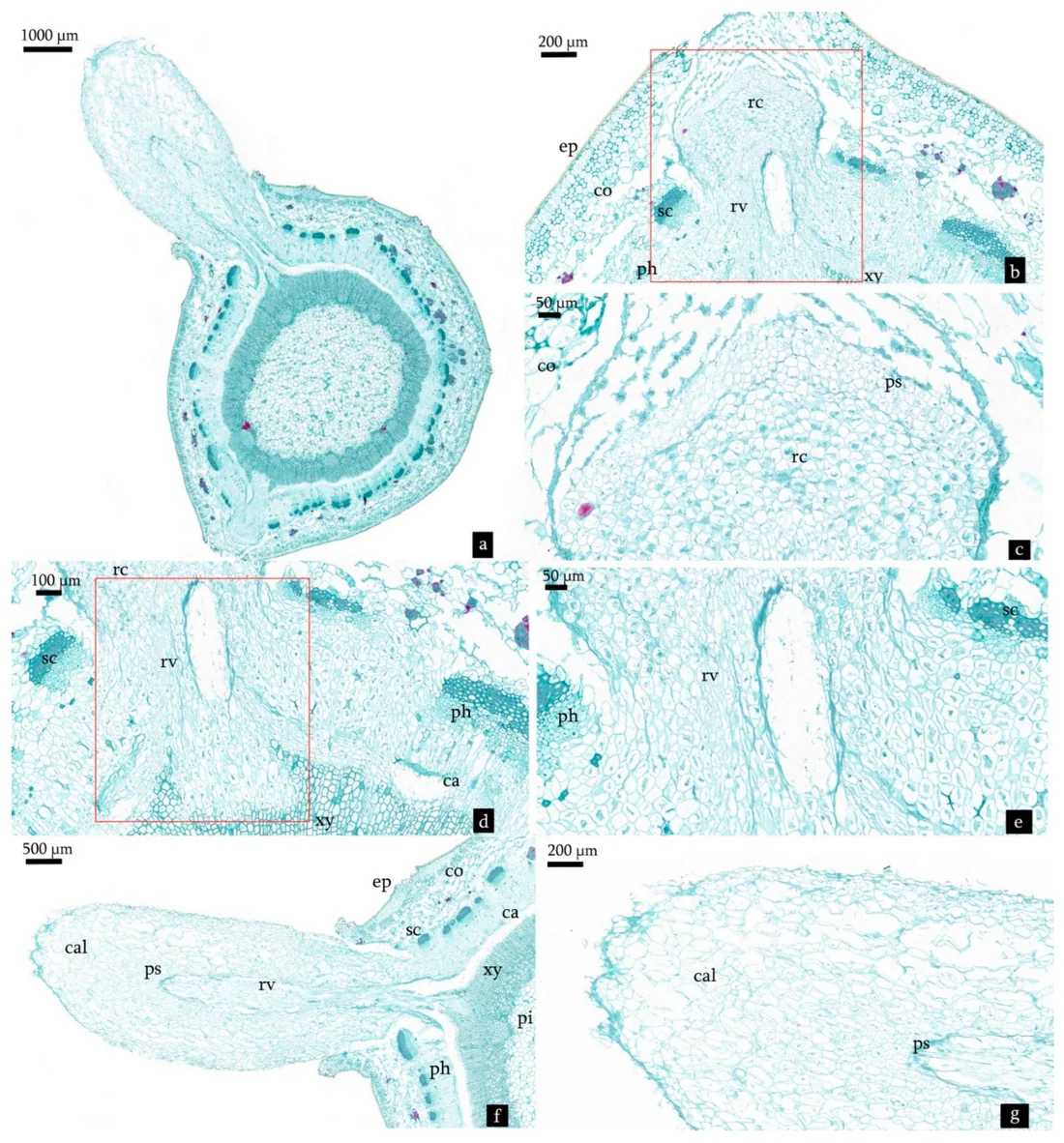
Why some pieces root and others do not
Plant species differ greatly in regenerative ability. Some stem cuttings root readily. Some need a specific position. Some leaves can produce new plantlets. Other leaves may root but never make a new shoot.
The difference often comes down to several factors:
- The species’ natural regenerative ability.
- Whether the piece includes a node, bud, or useful growth point.
- Whether living cells near the cut or vascular tissue can divide and differentiate.
- Whether leaves can keep basic metabolism going before the cutting dries out.
- Whether moisture and oxygen stay balanced while new roots form.
That is why “cut a piece” is not a universal formula. What works for one plant may not work for another, and what works for a stem with a node may not work for a single detached leaf.
How to read this in houseplants
In houseplants and balcony plants, this idea often appears in three observations.
The first is a stem-node cutting. You may see a stem piece with a node form white roots after some time, and later the bud begins to grow. In that case, the cutting is gradually rebuilding both a root system and a shoot system.
The second is a single leaf. Some plants can regenerate from leaves, but many cannot. If a leaf grows roots but never produces a new shoot, that can simply mean it lacks the growth point needed for a complete plant.
The third is the medium around the base. Newly forming adventitious roots also need oxygen. A base that stays wet but air-poor can stress living tissue near the cut surface. Understanding aeration is often more useful than memorizing a fixed rule.
Common confusions
- ✕ If a cutting grows roots, it is already a complete new plant.
- ✓ Rooting is one stage. A stable new plant also needs shoots, leaves, and enough structure to keep growing.
- ✕ Adventitious roots are abnormal roots.
- ✓ Adventitious roots are roots that start from non-root positions.
- ✕ Any leaf with roots can become a plant.
- ✓ Many leaves lack the growth point needed to make a new shoot.
- ✕ Auxin means guaranteed rooting.
- ✓ Auxin participates in growth and rooting signals, but it cannot override species, tissue condition, water balance, and oxygen needs.
Frequently Asked Questions
Are adventitious roots abnormal?
No. Adventitious roots are roots that start from places other than the typical root system, such as a stem, node area, leaf base, or cut surface.
Why do nodes matter in cuttings?
Nodes are stem positions where leaves, buds, or branches often occur. Many cuttings need a bud or growth point to make new shoots. A piece may root but still fail to become a complete plant if it lacks that shoot-forming tissue.
Why can a leaf root but not grow new leaves?
Root formation and shoot formation do not require exactly the same structures. Some leaves may form roots but lack the growth point needed for new shoots. Other plants have stronger regenerative tissue in leaves or leaf veins and can form new plantlets.
Do cuttings root first or shoot first?
There is no universal order. Some cuttings show roots first, some show bud activity first, and some stall. A stable new plant eventually needs both a functioning root system and a growing shoot system.
Why do new roots need air?
Living root cells and tissues near the cut surface respire, so they need oxygen. A wet but air-poor base can make rooting and survival more difficult.
Related Terms
- Adventitious root: a root that forms from a non-root position.
- Node: a stem position where leaves, buds, or branches often occur.
- Axillary bud: a bud near the angle between a leaf and stem.
- Meristematic tissue: plant tissue with cells that can keep dividing and make new tissue.
- Plant cell totipotency: an advanced concept meaning that plant cells can, under specific conditions, regain broader developmental potential. In this article, read it as limited developmental flexibility in some living cells, not as a promise that any cell in any cutting can become a plant.
- Auxin: a plant hormone group involved in growth responses.
- Vegetative propagation: propagation using stems, leaves, roots, or other vegetative organs.
Read Next
Evidence and attribution
Sources and image rights
These sources were used to check the plant-science concepts and gardening context in this article.
View sources and further reading (14)
- content.ces.ncsu.edu — 13 propagation
- openstax.org — 30 1 the plant body
- openstax.org — 30 6 plant sensory systems and responses
- extension.umn.edu — propagating monstera deliciosa
- mdpi.com — 925
- propg.ifas.ufl.edu — 14 cuttingterms stagesofrooting.html
- ucanr.edu — 373094.pdf
- pmc.ncbi.nlm.nih.gov — PMC3653114
- pmc.ncbi.nlm.nih.gov — PMC4734560
- pmc.ncbi.nlm.nih.gov — PMC6589513
- pmc.ncbi.nlm.nih.gov — PMC8174304
- rngr.net — some anatomical aspects of rooting quaking aspen
- sites.ualberta.ca — Hamann 1998.pdf
- extension.illinois.edu — 2015 06 04 propagating succulents and cacti
Image sources and rights
- Wang Y, Khan MA, Zhu Z, Hai T, Sang Z, Jia Z and Ma L (2022) Histological, Morpho-Physiological, and Biochemical Changes during Adventitious Rooting Induced by Exogenous Auxin in Magnolia wufengensis Cuttings. Forests 13(6):925, Figure 8, CC BY 4.0. · CC BY 4.0 — The source PNG was prepared as WebP for delivery.