
The short answer: count four floral whorls
“Complete” and “incomplete” do not rate a flower’s beauty, health, or quality. In a typical flower, start by looking for four major groups, often described as floral whorls: sepals, petals, stamens, and carpels. When all four are present in one flower, it is a complete flower. When one or more groups are missing, it is an incomplete flower.
This classification describes floral structure. It does not guarantee that a flower will be pollinated, fertilized, produce seeds, or develop fruit. An incomplete flower can still contain important reproductive structures.
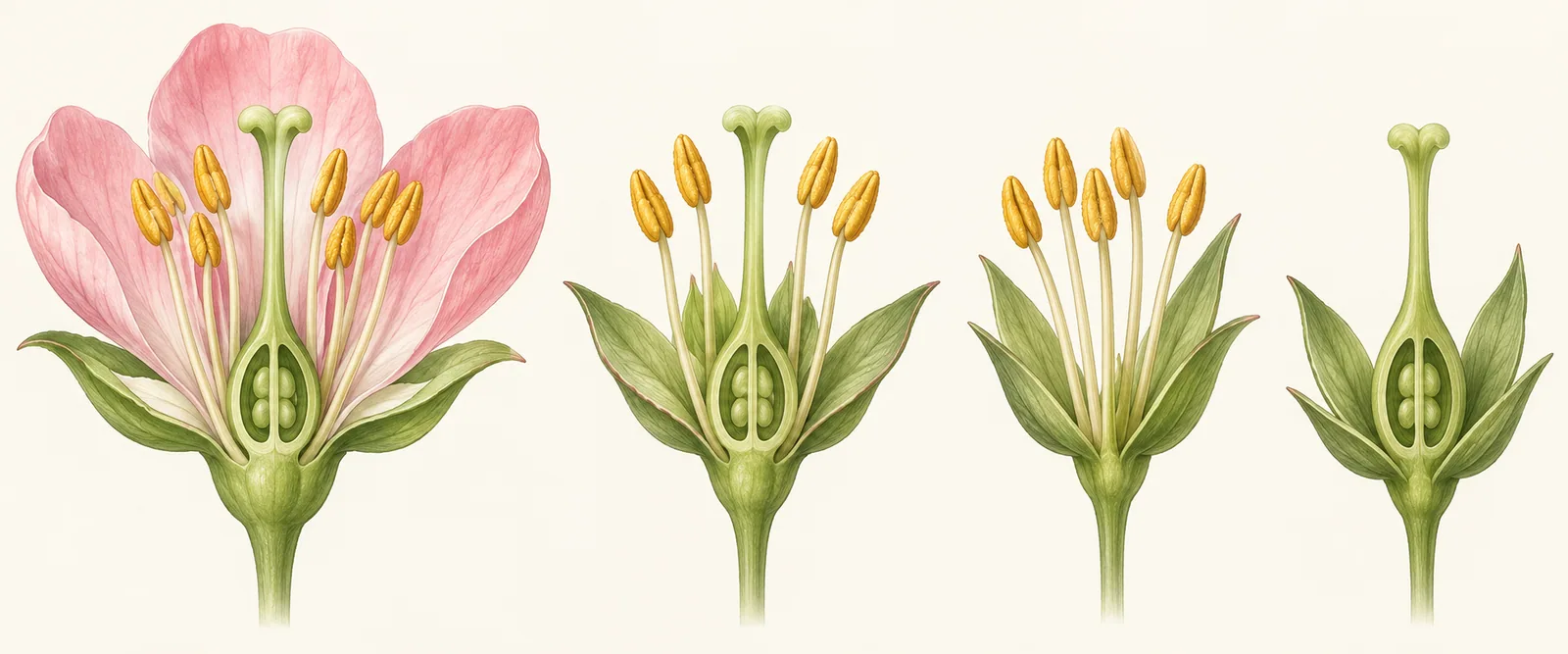
What are the four major floral groups?
For a typical angiosperm flower, an outside-to-inside map is a useful starting point:
- Sepals are the parts of the calyx. They are often outside the other floral parts and may help protect the developing flower bud.
- Petals are the parts of the corolla. They are often more visible after the flower opens and may interact with pollinators through color, shape, scent, or markings.
- Stamens make up the androecium. A stamen usually includes an anther and a filament; the anther is where pollen is produced.
- Carpels make up the gynoecium. A carpel commonly includes a stigma, style, and ovary. Several carpels may remain separate or fuse into one pistil.
So a complete flower is not defined by having large, colorful petals. The important question is whether all four groups are present. Real flowers may have organs that are fused, reduced, concealed, or highly modified, so a quick look from a distance may not show what is actually there.
Complete and bisexual are different classification questions
These terms are often mixed together, but they describe different features:
| Question | What it checks | Common terms |
|---|---|---|
| Are all four floral groups present? | Sepals, petals, stamens, and carpels | Complete or incomplete |
| Are both main reproductive structures present? | Stamens and carpels | Bisexual or unisexual; often also called perfect or imperfect |
Therefore, every unisexual flower is incomplete, because it lacks either stamens or carpels. But not every incomplete flower is unisexual. A flower may lack petals or sepals while still having both stamens and carpels. Such a flower is incomplete but bisexual.
Crossing the two questions produces three possible combinations. “Complete and unisexual” is ruled out by definition, because a unisexual flower already lacks either stamens or carpels.
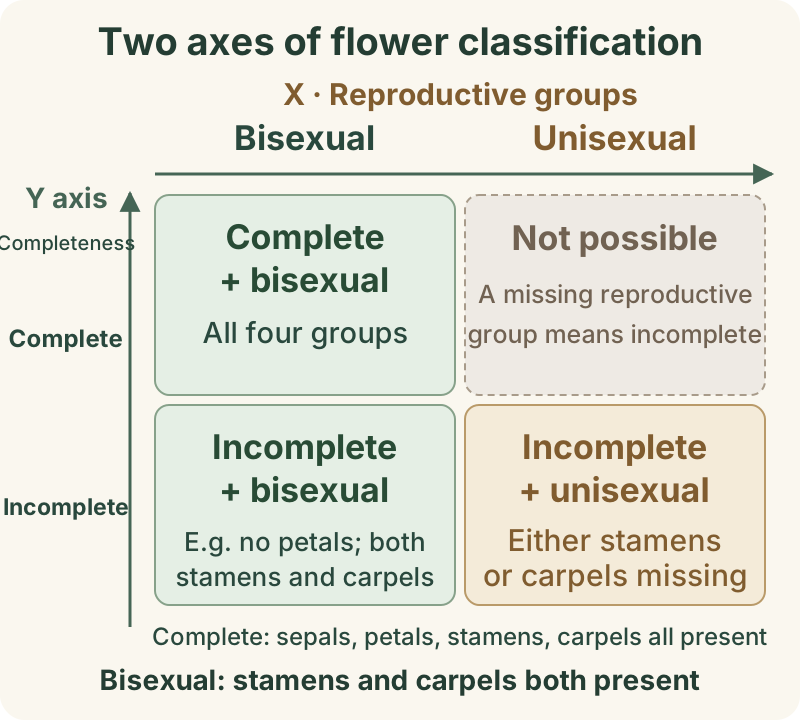
In botanical English, a perfect flower has both stamens and carpels in the same flower. “Perfect” is a technical term here, not a judgment that the flower is beautiful or better. Likewise, an imperfect flower lacks one of the two main reproductive structures; it does not mean that the flower is damaged or of poor quality.
No obvious petals does not mean no stamens or carpels
If a flower truly lacks petals, it is incomplete under the four-group definition. But that only tells you that the petal group is absent. It does not tell you that stamens or carpels are absent. Apetalous means “without petals,” and apetalous is not the same as unisexual.
Petals can be tiny, inconspicuous, fused into a tube or funnel, or hidden inside another floral structure. Sepals are not always green either; they can be colorful or look much like petals. When sepals and petals cannot be separated confidently, the neutral term tepals may be more accurate than guessing from color alone.
A petal-like structure may also be a bract or part of an inflorescence. Sunflowers are a useful reminder: what looks like one large flower is actually a flower head made of many florets. The outer ray florets and central disc florets should not be treated as one single flower when you classify floral structure.
One plant can carry different kinds of flowers
Corn and squash can produce staminate flowers and pistillate flowers in different places on the same plant. A plant with separate male and female flowers on the same individual is called monoecious.
When male and female flowers occur on different individual plants, the condition is called dioecious. These terms describe where the flower types are distributed. They are not alternative definitions of complete and incomplete flowers.
When observing a plant, classify one flower—or one floret inside an inflorescence—at a time. Do not give an entire plant one flower label just because it carries more than one flower type. Do not assume that an obvious outer display structure belongs to every floret inside a flower head.
How to observe a flower without forcing it into a diagram
Choose a flower whose parts are reasonably visible, then work from the outside toward the center:
- Look for sepals, or for petal-like outer parts that may be tepals.
- Look for petals inside them. If you cannot see petals, ask whether they are absent, tiny, fused, hidden, or simply hard to identify.
- Look for stamens and anthers. A hidden or tiny stamen is not automatically an absent stamen.
- Look for a stigma, style, ovary, or other carpel structure in the center.
- If you are looking at a sunflower, chrysanthemum, or another flower head, first decide whether you are examining the entire inflorescence or one floret.
Flower type tells you which floral groups are present. Pollination, fertilization, and later development must be observed separately.
Common mix-ups
- ✕ An incomplete flower is simply a male or female flower.
- ✓ A unisexual flower is always incomplete, but an incomplete flower may only lack petals or sepals and still have both stamens and carpels.
- ✕ A flower without petals has no stamens or pistil.
- ✓ Apetalous only describes the petal group. Stamens and carpels must be checked separately.
- ✕ A complete flower will always produce seeds or fruit.
- ✓ Complete describes the four floral groups. Pollination, fertilization, and later development are separate processes.
- ✕ A perfect flower is the most beautiful kind of flower.
- ✓ Perfect means that stamens and carpels are present in the same flower; it is a botanical term.
- ✕ The yellow outer parts of a sunflower are a ring of large petals.
- ✓ A sunflower head contains many florets, including outer ray florets and central disc florets.
Frequently Asked Questions
Are complete flowers and bisexual flowers the same thing?
No. A complete flower has sepals, petals, stamens, and carpels. A bisexual flower has both stamens and carpels. A flower can lack petals but still have both reproductive structures, making it incomplete but bisexual.
Is a flower without petals always incomplete?
If petals are truly absent, yes, it is incomplete under the four-group definition. But petals may be tiny, fused, reduced, or hidden. Not seeing separate petals from a distance is not enough to prove that the petal group is absent.
Are all unisexual flowers incomplete?
Yes. A unisexual flower has stamens or carpels, but not both, so it lacks one of the two main reproductive structures. Incomplete is the broader category because a flower can also be incomplete simply because it lacks petals or sepals.
Why do corn and squash have male and female flowers on one plant?
Corn and squash are common examples of monoecious plants. Their staminate and pistillate flowers occur in different locations on the same plant. Each individual flower still needs to be classified on its own.
Is a sunflower one complete flower?
First ask whether you mean the entire flower head or one floret. A sunflower head is an inflorescence containing outer ray florets and central disc florets. The two kinds of florets can differ in structure, so the entire head should not be classified as one single flower.
Does a complete flower always make seeds or fruit?
No. Completeness describes the arrangement of floral parts. Seed or fruit development also depends on pollen transfer, stigma receptivity, fertilization, and later development. Flower type alone is not a guarantee.
Are carpels and pistils the same thing?
They are related but not always identical terms. A carpel is a basic female floral unit. A pistil may consist of one carpel or several carpels fused together. For a beginner, both terms point to the central pollen-receiving and ovule-containing structure, but the distinction matters in more detailed botany.
Related Terms
- Complete flower: a flower with sepals, petals, stamens, and carpels.
- Incomplete flower: a flower missing one or more of those four major groups.
- Bisexual flower: a flower with both stamens and carpels; often called a perfect flower.
- Unisexual flower: a flower with stamens or carpels but not both; often called an imperfect flower.
- Staminate flower: a flower with stamens but no pistil or carpels.
- Pistillate or carpellate flower: a flower with a pistil or carpels but no stamens.
- Sepal and calyx: one outer floral part and the collective group of sepals.
- Petal and corolla: one petal and the collective group of petals.
- Stamen and androecium: a pollen-producing unit and the collective group of stamens.
- Carpel and gynoecium: a basic female floral unit and the collective structure made up of carpels.
- Pistil: a female floral structure that may consist of one carpel or several fused carpels.
- Apetalous: lacking petals.
- Naked flower: a flower without sepals and petals; its stamens and carpels still need to be checked separately.
- Tepal: a perianth part that cannot be clearly separated into a sepal or petal.
- Bract: a modified leaf associated with a flower or inflorescence and not automatically a petal.
- Inflorescence and floret: a group or arrangement of flowers and one flower within that arrangement.
- Ray floret or ligulate floret: an outer floret with a strap-like, petal-like corolla in flower heads such as sunflowers; it should not automatically be called a separate petal.
- Disc floret: a usually tubular floret in the central part of a flower head such as a sunflower.
- Monoecious and dioecious: male and female flowers occurring on the same plant or on different plants.
Related Reading
Evidence and attribution
Sources and image rights
These sources were used to check the plant-science concepts and gardening context in this article.
View sources and further reading (7)
- openstax.org — 32 1 reproductive development and structure
- extension.missouri.edu — m00402.pdf
- extension.oregonstate.edu — print
- pubs.ext.vt.edu — ANR 10.html
- gardeningsolutions.ifas.ufl.edu — parts of a flower
- life.illinois.edu — 22.htm
- yardandgarden.extension.iastate.edu — perennial sunflowers home landscape
Image sources and rights
- Plant Note project-made image · project-generated — Created in SVG and served in its original format.