A potted plant is not a clock
Potted plants are better watered by observation than by a fixed calendar schedule. The reason is simple: whether a plant needs water today depends on more than the date. Light, temperature, airflow, pot size, potting mix, root growth, and the plant’s current growth stage all change how quickly a pot dries.
A watering schedule can feel reassuring, but it can hide what is actually happening inside the container. Roots need water, but they also need air. If the potting mix stays too dry for too long, roots may not supply enough water to support the leaves. If the mix stays water-filled for too long, there is less air around the roots, and root function can decline.
So the more useful question is not “How many days between watering?” It is “What is this pot’s root zone probably like right now?”
Why does the same pot dry at different speeds?
A container is a small environment where water is always moving. Roots take up water, and leaves lose water through transpiration. In plain language, transpiration is the movement of water from inside the plant into the surrounding air. Brighter light, warmer temperatures, drier air, and stronger airflow often increase water loss from both the plant and the potting mix.
The container and potting mix matter too. A small pot with a large plant, or a pot filled with roots, may dry faster than a large pot with a small plant. A coarse, airy mix lets water move through more quickly. A fine, water-retentive, decomposed, or compacted mix may look dry on top while the inner layers still hold moisture.
Seasonal change also matters. When a plant is growing actively, receiving stronger light, or producing new leaves, it may use water faster. In lower light, cooler conditions, or slower growth, moisture may stay in the pot longer. This is why a fixed number of days can become unreliable.
Observation means combining a few simple clues
Everyday watering does not need to become a laboratory test. A few practical clues are usually more useful than a calendar alone.
- Pot weight: Notice how heavy the pot feels after a thorough watering, then compare it a few days later.
- Surface condition: A lighter, looser surface means the top layer is drying, but it should not be the only clue.
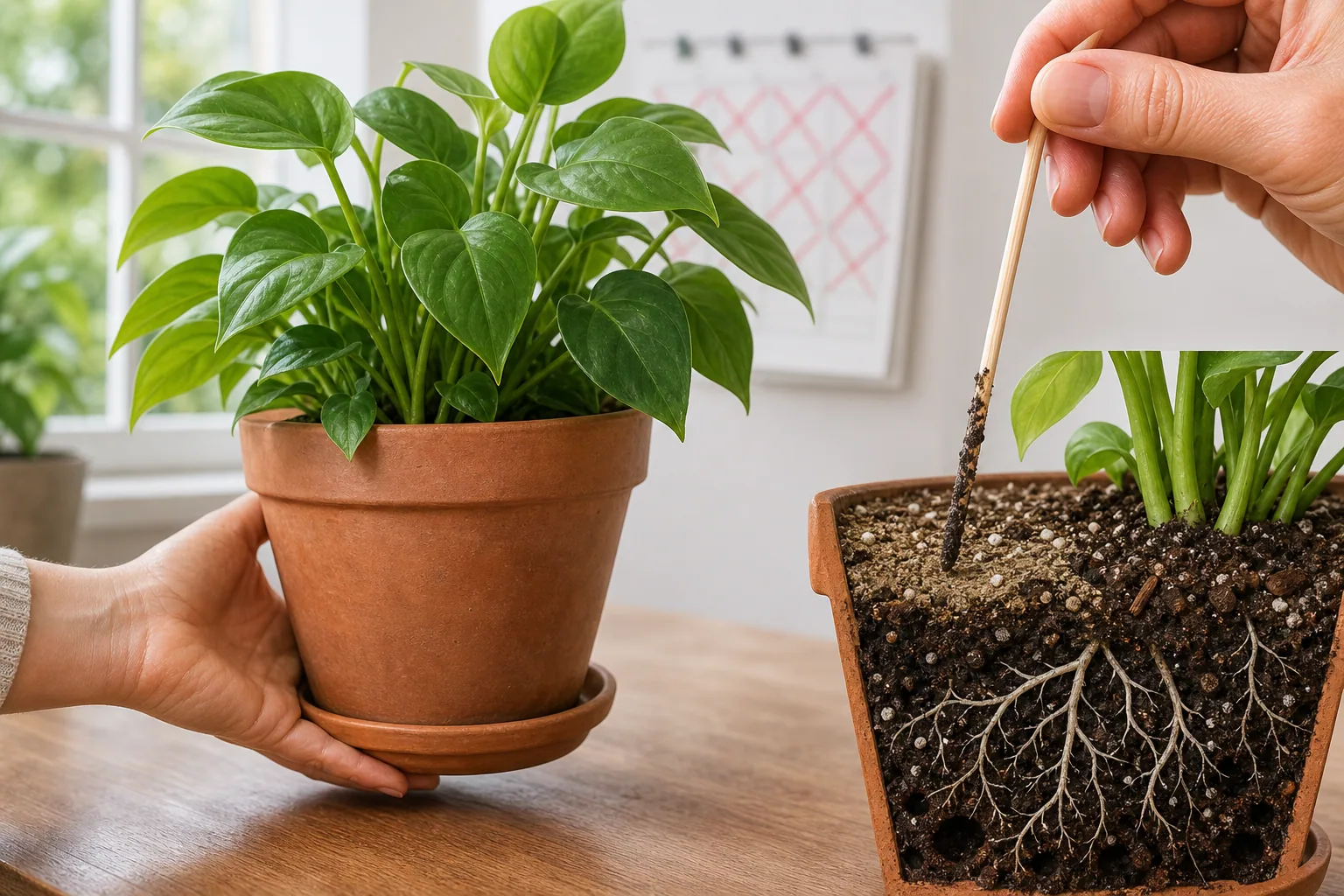
- Deeper potting mix: Near the side of the pot, gently check a little deeper with a clean wooden stick, bamboo skewer, or finger. Avoid forcing it through the root mass.
- Drainage and saucer: If water sits in the saucer for a long time after watering, extra water may not be leaving the pot environment well.
- Plant condition: Leaves, buds, roots, and overall growth can add context, but one visible symptom should not be used as the only answer.
The point is to shift from “Is today watering day?” to “Is this root zone probably getting dry, in a good range, or still quite moist?”
Drooping leaves do not always mean the same thing
When leaves droop, many people immediately add water. Sometimes that is the right clue. But a loss of leaf firmness can also be related to damaged roots, a potting mix that has stayed too wet, very dry air, temperature stress, or a recent move to a different location.
If the pot feels light and the deeper potting mix is dry, lack of water is a stronger possibility. But if the pot is still heavy, the deeper mix is moist, or water remains in the saucer, adding more water may simply reduce air around the roots.
This does not mean every drooping plant has a serious problem. It means the visible plant and the pot environment should be read together. A single leaf symptom, a calendar date, or the dry surface alone can be misleading.
You can still build a rhythm over time
Observation does not mean there will never be a pattern. After caring for the same plant in the same location for a while, you may learn roughly how long it takes for the pot to feel lighter, for the surface to dry, and for the deeper mix to approach the point where watering makes sense.
But that rhythm comes from repeated observation. It is not a formula you apply before you know the pot. Repotting, pruning roots, moving a plant closer to a window, turning on air conditioning, entering winter, or a flush of new leaves can all change the pattern.
Thinking of watering as an observation route is more dependable than memorizing a fixed interval.
Common confusions
- ✕ Watering once a week is always the safest approach.
- ✓ Watering intervals change with light, temperature, airflow, pot material, potting mix, season, and plant growth.
- ✕ If the surface of the potting mix is dry, the whole pot must be dry.
- ✓ The surface is only the outermost clue. The root zone may still hold moisture.
- ✕ Drooping leaves always mean underwatering.
- ✓ Drooping may be related to lack of water, but it can also appear when roots are stressed by overly wet mix or environmental change.
- ✕ A moisture meter means you no longer need to observe the plant.
- ✓ A meter can be a helper, but readings should still be checked against potting mix type, pot weight, drainage, and plant condition.
Frequently Asked Questions
Can I water my potted plant once a week?
Do not treat once a week as a universal rule. It may happen to fit one plant in one season, but not another pot in another location. Pot size, potting mix, light, temperature, airflow, and growth rate all change drying speed.
Should I water as soon as the surface looks dry?
Not always. A dry surface only means the top layer is drying. The middle and lower potting mix, including the root zone, may still hold moisture. Check pot weight, deeper mix moisture, and drainage clues too.
Do drooping leaves mean the plant needs water?
Sometimes, but not always. If the pot is light and the deeper mix is dry, lack of water becomes more likely. If the deeper mix is still moist or the saucer still holds water, adding more water may make the root zone less airy.
How can I tell whether the inside of the pot is still moist?
Use several clues together: pot weight, deeper potting mix, a clean wooden skewer or bamboo stick, and the condition of the drainage holes or saucer. Do not rely only on the surface color, and avoid stabbing into the root mass.
Are moisture meters accurate enough to rely on completely?
Moisture meters can be useful, but they should not replace observation. Potting mix type, salts, fertilizer residues, and the exact probe location can affect readings, so compare the result with pot weight, deeper mix texture, and the plant’s condition.
Why does the same kind of plant need different watering in different places?
Because a windowsill, a darker room, an air-conditioned space, a balcony, and a windy corner all have different light, temperature, humidity, and airflow. Those conditions affect plant transpiration and how quickly the potting mix dries.
Related Terms
- Root zone: The area of the potting mix where roots are actively growing, absorbing water, and exchanging gases.
- Surface layer of potting mix: The uppermost layer in a container, usually the part most exposed to air.
- Aeration: The movement and presence of air in the potting mix around roots.
- Drainage: The ability of extra water to leave the potting mix and container.
- Water retention: The ability of a potting mix to hold some water for later plant use.
- Transpiration: The loss of water vapor from plant surfaces, especially leaves.
Read next
Evidence
References
These sources were used to check the plant-science concepts and gardening context in this article.