
Chlorophyll is not plant food; it is a light-absorbing pigment
Chlorophyll is a pigment found in plants, algae, and some microorganisms. In simple terms, it is a green pigment that helps living cells absorb light energy.
Many leaves look green because their cells contain chloroplasts, and chloroplasts contain chlorophyll. But chlorophyll is not the plant’s food. Plants use photosynthesis to make sugars and other organic materials. Those materials can then support respiration, new leaves, roots, flowers, fruits, and other plant body structures.
Chlorophyll’s role is closer to a key light-receiving part of the system. It helps the light-dependent reactions of photosynthesis begin, but it does not complete the whole process by itself.
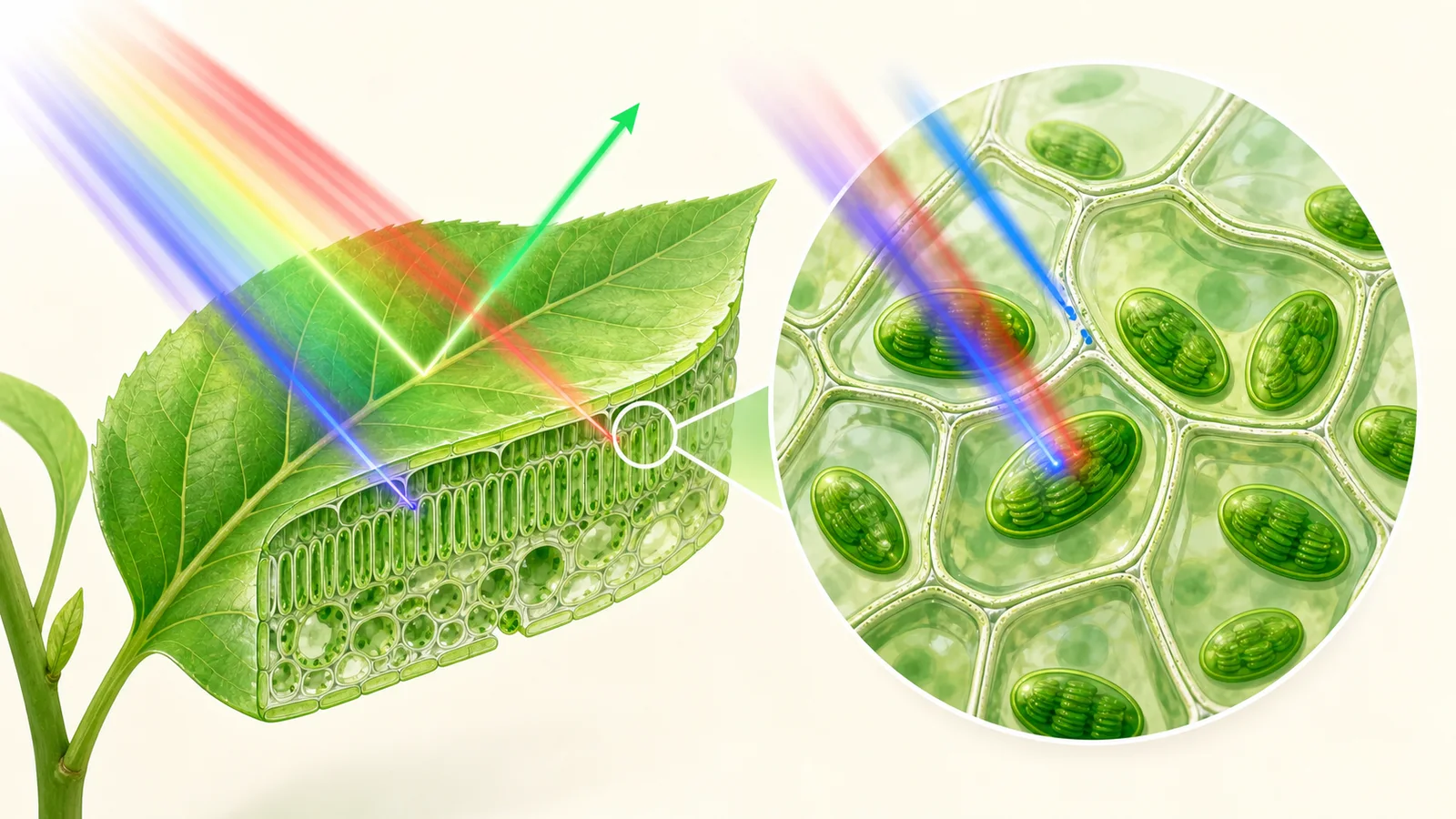
Why do many leaves look green?
White light contains many colors of light. Chlorophyll does not absorb all colors equally. It absorbs red light and blue-violet light strongly, while more green light is reflected from or transmitted through the leaf.
That reflected or transmitted green light reaches our eyes, so many leaves look green.
This does not mean green light is completely useless to plants. It also does not mean plant growth can be explained only by red and blue light. Real leaves contain other pigments, different leaf structures, and many environmental variables. The main point is this: the way chlorophyll absorbs light is one major reason many leaves appear green.
When other pigments become more visually prominent, leaf color can shift toward red or purple; see why plant leaves turn red.
How are chlorophyll and chloroplasts connected?
A chloroplast is a cell structure closely involved in photosynthesis. Chlorophyll is one of the important pigments inside chloroplasts, mainly associated with internal membrane systems where light-dependent reactions occur.
A simple comparison can help: the chloroplast is like a small photosynthesis work area inside the cell, and chlorophyll is one of the parts that receives light energy.
After chlorophyll absorbs light, the plant does not turn that light directly into sugar in one step. First, the photosynthetic system converts light energy into short-lived usable energy forms. Later reactions use that energy to help build sugar precursors from carbon dioxide.
So chlorophyll matters, but it is not working alone. Photosynthesis also depends on water, carbon dioxide, enzymes, chloroplast structure, and a sequence of connected reactions.
Do you need to know chlorophyll a and chlorophyll b?
You do not need to memorize wavelength numbers to understand what chlorophyll is.
A useful point is that plants have more than one kind of chlorophyll. Chlorophyll a and chlorophyll b are two important forms in many plants.
Chlorophyll a can be understood as a core pigment in the photosynthetic reaction system. Chlorophyll b is often described as an accessory pigment. It helps broaden the range of light the plant can use, then passes absorbed energy toward the reaction system.
This is why plants should not be imagined as using only one pigment in isolation. Photosynthesis involves a set of pigments and reaction components working together. If your goal is only to understand why leaves look green and how chlorophyll connects to photosynthesis, this layer is enough for now.
Yellowing and variegation are observation clues, not instant diagnoses
In gardening, leaf color is often used as a clue. Pale or yellow leaves may be related to reduced chlorophyll. The term chlorosis refers to yellowing or loss of normal green color, often connected to insufficient chlorophyll or chlorophyll expression in the leaf.
But yellow leaves do not point to one automatic cause. Leaf yellowing can involve root condition, drainage, media aeration, mineral nutrient supply or uptake, light, natural aging of older leaves, environmental changes, or several factors at once.
A safer habit is to treat leaf color as an observation clue, not a diagnosis or a care prescription.
Variegated leaves can also help explain chlorophyll. Green areas usually contain more chlorophyll. White or pale areas often contain less chlorophyll or lack normal chlorophyll expression. This also helps explain why attractive variegated plants often grow more slowly than comparable all-green individuals: they usually have less green photosynthetic tissue. On the same plant, green tissue is still an important photosynthetic work area.
Common confusions
- ✕ Chlorophyll is plant food.
- ✓ Chlorophyll is a pigment that absorbs light energy. Sugars and other organic materials made through photosynthesis are the plant-made materials that plants can use.
- ✕ Leaves are green because they absorb green light the most.
- ✓ Chlorophyll absorbs red and blue-violet light strongly. More green light is reflected or transmitted, so many leaves look green.
- ✕ More chlorophyll always means a healthier plant.
- ✓ Chlorophyll is related to photosynthesis, but plant condition also depends on roots, water, light, temperature, nutrients, plant type, and growth stage.
- ✕ A yellow leaf means the plant lacks one specific fertilizer.
- ✓ Yellowing may involve reduced chlorophyll, but it has many possible causes. Leaf color alone is not enough for diagnosis.
Frequently Asked Questions
Where is chlorophyll found?
In leaves, chlorophyll is mainly found in cells that contain chloroplasts. Chloroplasts are cell structures closely involved in photosynthesis, and chlorophyll is an important light-absorbing pigment inside them.
Is chlorophyll plant food?
No. Chlorophyll helps absorb light energy so photosynthesis can proceed. Plants use photosynthesis to make sugars and other organic materials, which can then support respiration, growth, and body-building processes.
Why does chlorophyll make leaves look green?
Chlorophyll absorbs red and blue-violet light more strongly than green light. More green light is reflected from or transmitted through the leaf, so many leaves look green to us.
Are red light, blue light, and green light all the same to plants?
No. Different pigments absorb different wavelengths of light. Chlorophyll absorbs red and blue-violet light strongly. However, real plant growth also depends on light amount, duration, other pigments, leaf structure, plant type, and the growing environment.
Does a yellow leaf mean there is no chlorophyll?
Yellowing often means chlorophyll has decreased, broken down, or become less visually dominant. But the cause can vary. Roots, water, aeration, mineral nutrient uptake, light, natural aging, and environmental stress can all affect leaf color.
Can the white parts of variegated leaves photosynthesize?
White or pale areas usually have less chlorophyll, so their photosynthetic capacity may be lower than green areas. Variegation has different causes in different plants, so it should be interpreted carefully. This is one reason many variegated plants grow more slowly than comparable all-green individuals; the green parts of a variegated leaf are still important photosynthetic tissue.
Related Terms
- Chlorophyll: a light-absorbing pigment that often makes leaves look green.
- Chloroplast: a cell structure closely involved in photosynthesis.
- Photosynthesis: the process in which plants use light energy to make sugars and other organic materials from water and carbon dioxide, releasing oxygen.
- Pigment: a substance that absorbs certain wavelengths of light and contributes to color.
- Absorption spectrum: the pattern of light wavelengths absorbed by a pigment.
- Chlorosis: yellowing or loss of normal green color in leaves, often connected to reduced chlorophyll.
- Variegation: a leaf color pattern with green, white, yellow, or other colored areas.
Read Next
Evidence
References
These sources were used to check the plant-science concepts and gardening context in this article.