
Orientation is a rough guide to when sunlight may arrive, not a plant rating
An east-, west-, south-, or north-facing balcony first tells you when sunlight may arrive and from which side.
The easiest starting point is this: east-facing balconies often receive direct morning sun, while west-facing balconies often receive stronger sun later in the day, along with more noticeable heat. South- and north-facing exposures need an extra layer of context: season, latitude, and the buildings or structures around the balcony.
East-facingSun more often in the morning
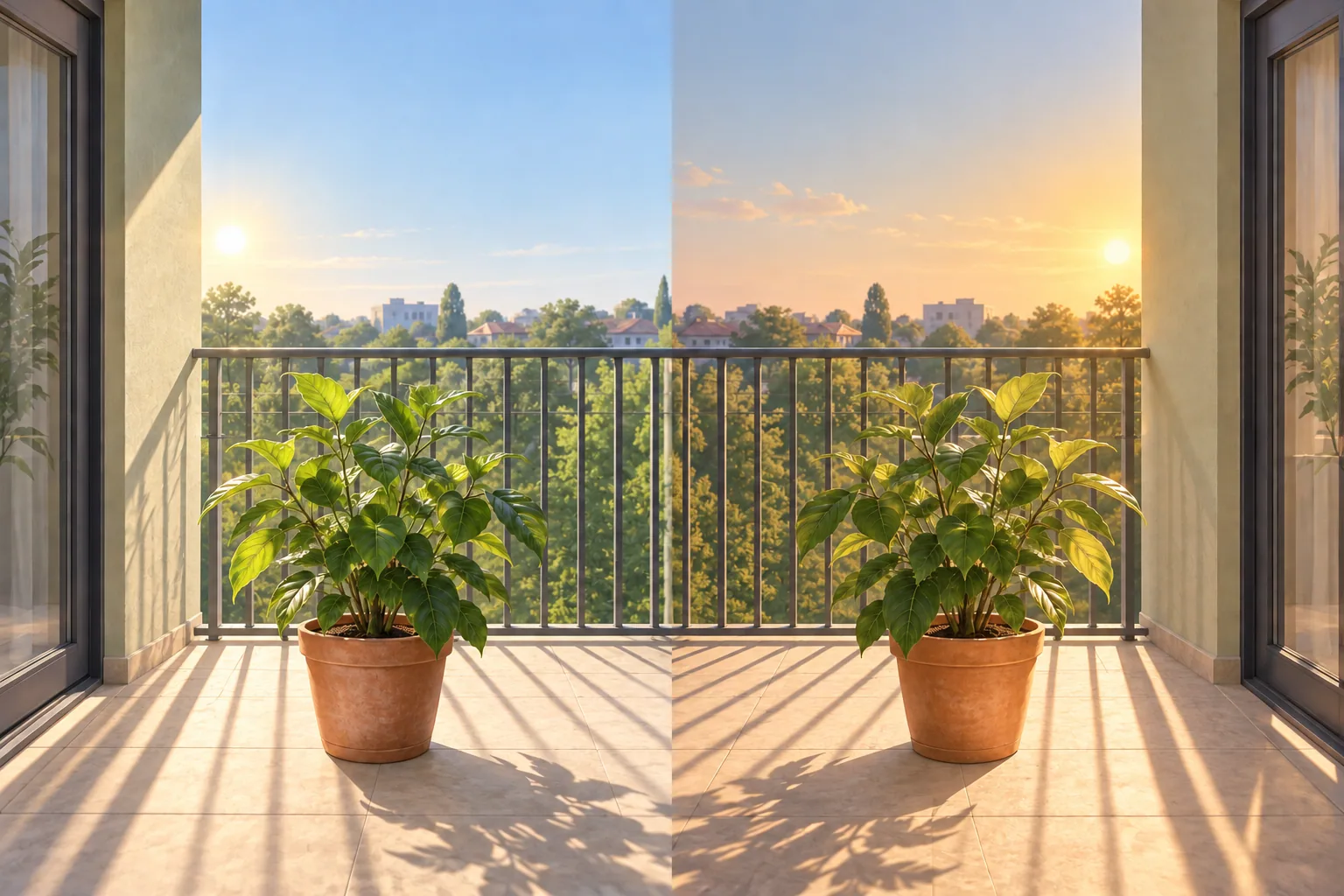
West-facingSun more often in the afternoon
East-facing: often the first balcony to receive sun
In a typical Northern Hemisphere sun path, the sun rises on the eastern side of the sky. An east-facing balcony may therefore receive direct sun in the morning, then shift to bright sky light, reflected light, or shade around midday and later in the day.
Morning does not automatically mean weak light, and an east-facing balcony does not automatically receive sun. Window frames, upper balconies, awnings, tree canopies, and nearby buildings can reduce a period of direct sun to a short interval—or block it completely. A more reliable question is: when does a beam of sunlight actually reach the leaves, and do the leaves cast a clear-edged shadow?
West-facing: afternoon sun usually arrives with heat
Direct sun on a west-facing balcony is more likely from afternoon into evening. It is not only that a plant receives sunlight later in the day. On clear, hot days, strong afternoon sun, warmed walls or flooring, and a heated container can make the space around a potted plant both warmer and drier.
That does not mean a west-facing pot automatically needs more frequent watering. Pot material, growing medium, wind, humidity, cloud cover, and plant size all affect how quickly a pot dries. What is worth noting is when the strongest direct sun begins, whether the potting mix dries faster than in another position, and whether the wall and floor hold heat into the afternoon.
South- and north-facing: start with the Northern Hemisphere rule, then check your place
At mid-to-high Northern Hemisphere latitudes, the sun’s main daily path often crosses the southern part of the sky. A south-facing exposure is therefore often brighter and more likely to receive a longer period of sun, while a north-facing one often receives less direct sun. This is a helpful starting model, not a universal rating.
Latitude and season matter. At lower Northern Hemisphere latitudes, including places near the Tropic of Cancer, the summer sun can be very high in the sky and may pass near overhead. South-facing positions generally have better light conditions, but the actual period of direct sun can still change with the season, location, opening direction, and building shade.
Orientation is best understood as the beginning of a sun path, not as a word on a compass. Sunrise and sunset positions move across the horizon through the year, and the sun’s midday height changes too. Your balcony receives only the part of that path that is not cut off by walls, railings, overhangs, and nearby buildings.
Same south-facing balcony, plant position and overhang
Winter noonLower sun reaches beneath the overhang
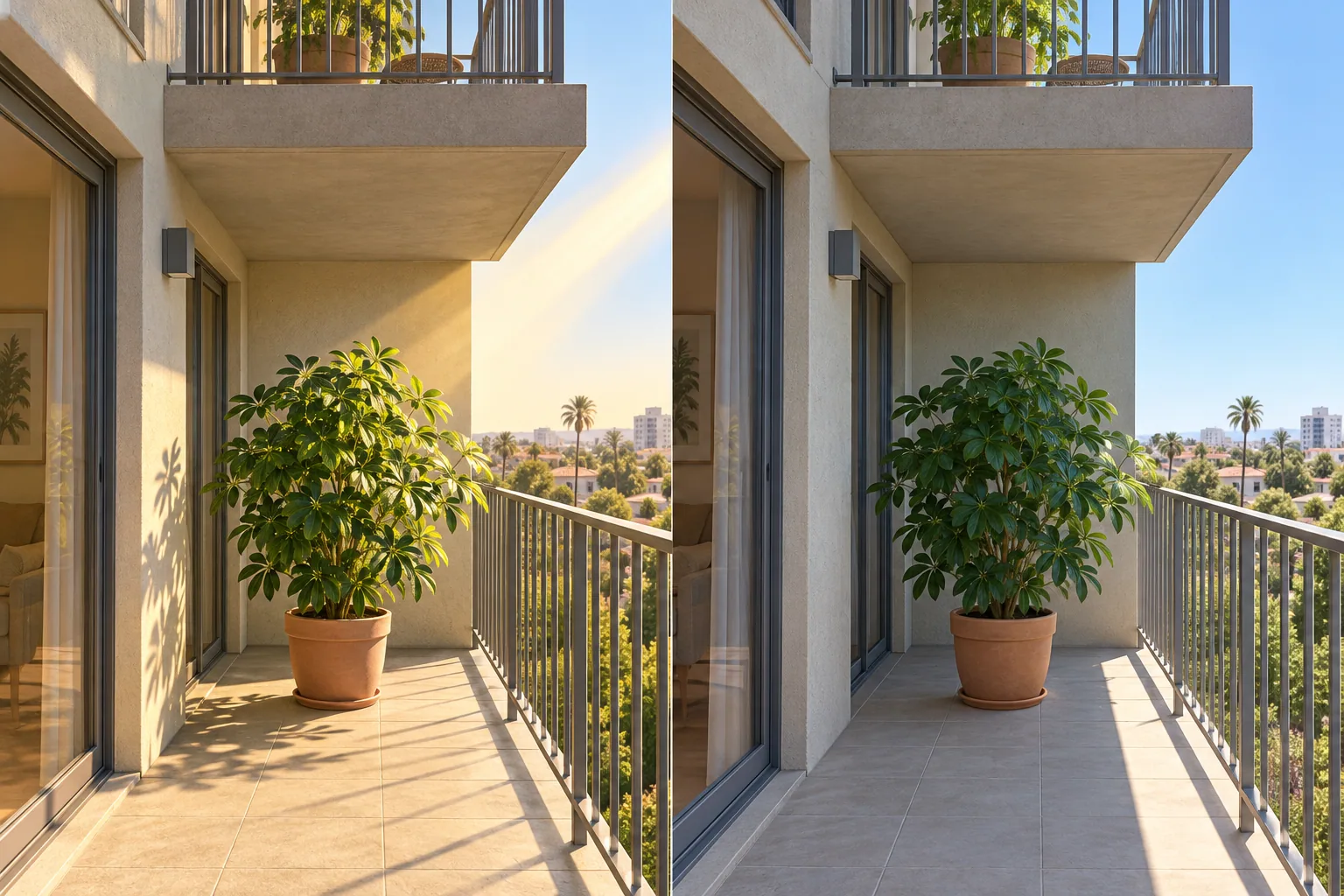
Summer noonThis plant sits in the overhang’s shade
North-facing balconies often receive less direct sun, but they are not always dark. Summer mornings and afternoons may still bring direct sun, and open positions can receive diffuse light from the sky.
In many Taiwanese residential settings: assess afternoon heat, available light, and shade together
For Taiwanese residential settings in the Northern Hemisphere: a west-facing position may be more exposed to afternoon heat in summer; a south-facing position usually has more available light; and a north-facing position usually receives relatively less direct light.
The challenge on a west-facing balcony is not light alone. Afternoon sun, heat held by walls and flooring, and a warming container can occur together, making the space around a pot hotter and drier. When a balcony is not deeply shaded by an awning or nearby building, a south-facing exposure usually receives steadier and more available natural light. A north-facing exposure more often relies on sky light, reflected light, or a shorter period of direct sun. This is why, when making an initial plant choice, it makes sense to treat west-facing as a place that may have more summer afternoon heat exposure, south-facing as a brighter starting point, and north-facing as a relatively gentler light position.
This is a useful default for common Taiwan settings, not a replacement for observation. The summer sun is high in the sky, and awnings, upper balconies, side walls, tree canopies, and neighboring buildings can still darken a south-facing balcony, allow angled sun into a north-facing one, or cut west-facing sun into a very short interval.
Why can two west-facing balconies feel completely different?
Orientation predicts a direction; a balcony’s microclimate decides much of the light that actually reaches a leaf. Compare questions such as these:
- Does an upper balcony or awning block high-angle sun first?
- When do side walls, solid railings, nearby buildings, or tree canopies cast shade?
- Is the balcony open and breezy, or do the walls and floor collect heat?
- Is the pot near the railing, against a wall, or set farther back indoors?
- Has cloud cover, the season, or an opened curtain changed the path of light?
For that reason, orientation is useful for deciding what to observe. It is not a reliable shortcut to a fixed light category or a number of days between watering.
Make a three-time-of-day map of your balcony light
Light also changes over a single day. Keep the plant in the same position and compare morning, near midday and afternoon. Check whether direct sun reaches the leaves, where shadows fall, and which structures block the light.
Choose a clear day and look at the same plant in the morning, near midday, and in the afternoon. Record three simple details:
- Does direct sunlight actually touch the leaves?
- About when does direct sun begin and end?
- Which parts of the balcony have crisp shadows, and which are bright without a visible sunbeam?
Repeat the notes a few months later to see the seasonal change. This small record is closer to the environment the plant receives than a floor plan alone. It also connects orientation to balcony microclimates, transpiration, and checking the pot before watering.
Choose plants by the light they actually receive, then use orientation as a guide
Orientation can narrow the choices, but a plant’s light label still needs to match the period of direct sun you recorded. Use these as starting points:
- East-facing: If direct sun really reaches the balcony in the morning, start with plants labeled for a bright position, morning sun, or some direct sun. First check how long that direct sun actually lasts.
- West-facing: If afternoon sun truly reaches the leaves, focus on sun-tolerant ornamental plants that can accept direct light and warmer conditions. In summer, keep watching heat stored in the pot, wall, and floor; “sun-tolerant” does not mean the spot needs no observation.
- South-facing: Record summer and winter separately. A brighter winter position and a summer position under high-angle sun may not suit the same light requirement. Even when choosing plants that accept bright to direct light, check the awning and the real exposure.
- North-facing or shaded for most of the day: Start with foliage plants labeled for bright indirect light or shade tolerance. Shade tolerant does not mean no natural light at all: a bright window or open bright shade is different from a dark interior corner.
Whatever the direction, a newly acquired plant that has been growing in weaker light is better allowed to adjust gradually before it is moved into stronger direct sun. After the move, continue observing the leaves, potting mix, and balcony conditions; plant type, previous conditions, season, and the balcony microclimate still affect the response.
Common mix-ups
- ✕ An east-facing balcony is always gentle, and a west-facing balcony is always too strong.
- ✓ East and west describe when sunlight is more likely to arrive. Clouds, awnings, building distance, tree shade, and season can change the actual light dramatically.
- ✕ A south-facing balcony is brightest all year, and a north-facing balcony never gets sun.
- ✓ This is a useful starting rule at many mid-to-high Northern Hemisphere latitudes. At lower latitudes, seasonal sun paths and building shade need to be checked too.
- ✕ Pots on a west-facing balcony always need more water.
- ✓ Afternoon sun and heat may dry a growing medium faster, but pot material, medium, wind, humidity, and weather matter as well. Check actual moisture before watering.
- ✕ Knowing a balcony’s direction tells you whether a plant will grow well.
- ✓ Orientation predicts only part of the light environment. Plant species, the real period of direct sun, temperature, airflow, root conditions, and a recent move can all affect the outcome.
Frequently Asked Questions
Which is better for plants: an east-facing or west-facing balcony?
Neither direction is the single winner. East-facing balconies often receive morning sun, while west-facing balconies often receive afternoon sun and heat. Compare the plant’s actual period of direct sun, the shade around it, and the way the environment changes through the day.
Does a north-facing balcony get no sun at all?
Not necessarily. A north-facing balcony often gets less direct sun, but season, latitude, the size and direction of the opening, reflected light, and nearby shade all change the result. It is especially unhelpful to treat north-facing as permanently dark in low-latitude summers.
Is a south-facing balcony sunniest in every season?
South-facing exposures are often brighter under the familiar Northern Hemisphere model. But near the Tropic of Cancer, summer sun is very high, and an awning or neighboring building may substantially reduce direct sun. Observe the actual hours of sun in more than one season.
If an awning or neighboring building shades my balcony, does orientation still matter?
Yes. Orientation still indicates where the sun may come from. But an awning, exterior wall, trees, and neighboring buildings can matter even more in deciding whether sunlight finally reaches the leaves.
Do pots on a west-facing balcony always need more water?
No. Afternoon sun and heat may make a growing medium dry faster, but they do not automatically create a schedule. Check moisture at more than one depth, then consider the weather, wind, and container before deciding whether to water.
Related terms
- Balcony orientation: The main compass direction a balcony faces, such as east or west.
- Sun path: The route the sun follows across the sky during a day and across seasons.
- Direct sun: Sunlight that reaches leaves, a pot, or the ground as a direct beam.
- Obstruction: An awning, wall, neighboring building, or tree that blocks light.
- Microclimate: A small local environment shaped by wind, heat, walls, shade, and humidity.
- Transpiration: The movement of water from plant surfaces, especially leaves, into the air.
Read next
Evidence
References
These sources were used to check the plant-science concepts and gardening context in this article.
View sources and further reading (17)
- spaceplace.nasa.gov — en
- pweb.cwa.gov.tw — as 1.html
- gml.noaa.gov — solareqns.PDF
- yourhome.gov.au — shading
- richmond.ces.ncsu.edu — light considerations for indoor plants
- yardandgarden.extension.iastate.edu — how care houseplants
- extension.umn.edu — when houseplants go outside
- pubs.ext.vt.edu — spes 804.html
- extension.umd.edu — working solar design and system sizing fs 2023 0655
- eng.taiwan.net.tw — m1.aspx
- taiwan.nps.gov.tw — 17989.html
- hko.gov.hk — 2016simp paths sun.pdf
- extension.umn.edu — lighting indoor plants
- ucanr.edu — how assess your microclimates
- gml.noaa.gov — glossary.html
- hko.gov.hk — 00489 a day that lasts one year.html
- cwa.gov.tw — publish 20200310092437.pdf