
Plants do not need harsh wind; they need appropriate air movement
Plants do not feel stuffy or uncomfortable the way people do. But their leaves, potting mix, and roots are always interacting with the air around them. Strong wind can remove moist air from leaf surfaces and dry the surface of the potting mix. In stagnant air, humidity and heat can build up, while air exchange becomes slower around dense foliage or tightly grouped plants.
That is why strong wind and poor air movement can both stress plants, even though they look like opposite problems. The useful question is not whether more wind is always better. It is whether the air around the plant is moving enough to avoid stagnation without creating constant drying or mechanical pressure.
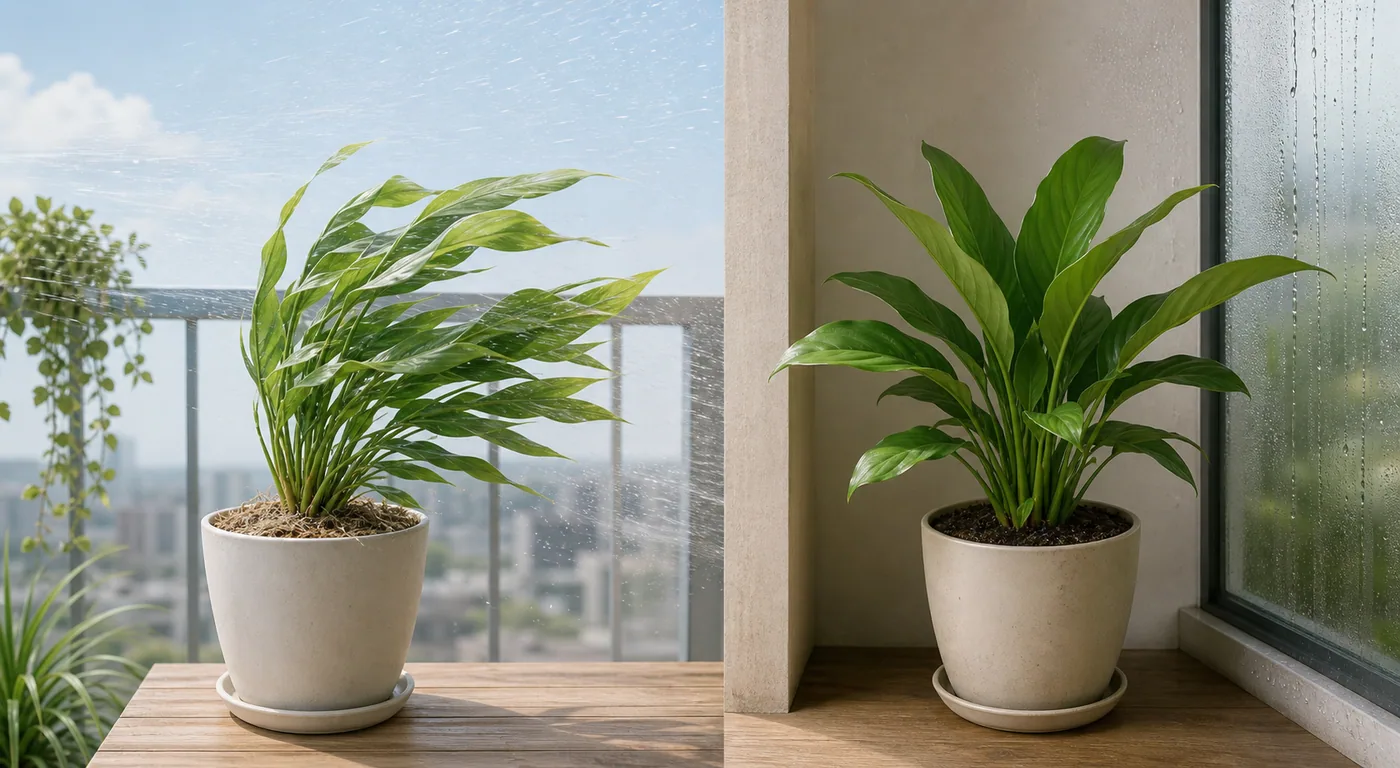
Strong wind can increase water loss from leaves and the potting-mix surface
A thin layer of air sits close to a leaf surface. This near-surface air is the leaf boundary layer. It is often more humid than the surrounding air because leaves lose water vapor through stomata. Stomata are tiny openings in the leaf surface that allow carbon dioxide to enter, while water vapor can leave.
When wind is strong and continuous, that moist air near the leaf is carried away again and again. The water-vapor difference between the leaf and the surrounding air can become larger, so evaporative demand on the leaf may increase and transpiration may rise when other conditions also favor water loss. The potting mix surface can also dry faster, especially in bright light, heat, low humidity, or small containers.
This does not mean every breeze is harmful. Many plants grow with outdoor air movement. The concern is steady strong wind or a local dry draft: a balcony wind corridor, drafts from an air conditioner, heater, or dehumidifier, or a narrow passage where leaves are moved in the same direction for long periods.
Wind can also become mechanical stress
Wind changes more than water loss. It also pushes and pulls on plant parts. Leaves may rub against each other, tender stems may bend repeatedly, flower stalks may sway, and top-heavy pots may rock.
Sturdy outdoor-adapted plants may tolerate this well. New leaves, seedlings, flower stalks, recently moved plants, or plants with unstable root systems may be more sensitive. Even then, dry tips, curled leaves, or wilting should not be read as a single diagnosis. Light, potting mix, roots, temperature, and watering history can all be involved.
Stagnant air traps humidity and heat around leaves
The opposite extreme is air that barely moves. In that situation, humidity and heat near the leaves are less likely to clear. The inner part of a dense plant may feel more humid and still than the room around it. If the potting mix holds water, light is low, or temperature is cool, drying may also slow down.
Poor air movement does not automatically mean disease. When air is stagnant, the leaf zone can become more humid, warm, and still; when that overlaps with dense growth, low light, or potting mix that stays wet for a long time, some humidity-related disease conditions may be amplified.
Airflow, potting-mix aeration, and drainage are different
Gardeners often use words like ventilation, air circulation, aeration, and drainage close together. They are related, but they do not mean the same thing.
In plain terms, airflow is outside the plant, root-zone air is the air in pores around roots, and drainage is water leaving the container through its holes. They influence one another, but they are not one switch.

Common mix-ups
- ✕ Good air circulation around leaves means roots automatically have enough air.
- ✓ Airflow describes air around the plant. Root-zone air depends on potting-mix pores, container structure, drainage, and moisture.
- ✕ Fast-draining potting mix means the air around leaves cannot remain stagnant.
- ✓ Drainage describes how water leaves the container. Air around dense foliage is a separate environmental condition.
- ✕ Dry leaves or wet potting mix prove that wind or poor ventilation is the only cause.
- ✓ These are clues. They need to be read together with light, temperature, container size, potting mix, roots, and placement.
Three low-risk clues to observe
You do not need to start with equipment or a formula. Start with three observations.
First, watch whether leaves move in one direction for long periods. If the same leaves are always being pushed, the plant may be in a wind corridor or a local draft.
Second, compare drying speed. With similar pots and potting mix, exposed bright windy positions usually dry faster, while dim still corners often dry more slowly. This is not a fixed watering schedule. It is a way to understand location differences.
Third, check whether plants are crowded. Leaves touching each other, a dark inner canopy, and potting mix that stays wet for a long time can all point to a more stagnant local environment.
Frequently Asked Questions
Do plants need a fan to have good air circulation?
Not necessarily. The point is that air should not stay stagnant around the leaves for long periods. Gentle natural air movement, a less crowded arrangement, or occasional room air exchange can all change the local environment. This article explains the principle, not a fixed fan angle or schedule.
How are strong wind and dry air connected?
Wind removes moist air from leaf and potting mix surfaces. If the surrounding air is already dry, bright, or warm, water loss pressure can become stronger. Balcony wind corridors and drafts from air conditioners, heaters, or dehumidifiers are worth observing for this reason.
Is stagnant air always bad for plants?
No. Stagnant air is better understood as a condition that can slow air exchange and trap humidity or heat around leaves. If it overlaps with crowding, low light, or potting mix that stays wet, some humidity-related disease conditions may be amplified. Treat stagnant air as one environmental clue, not a diagnosis.
If wind curls the leaves, does that mean the plant needs water?
Not always. Curling leaves can involve wind, low humidity, heat, root water supply, light, plant type, or short-term environmental stress. Wind is one clue, not the whole answer.
What is the difference between air circulation and potting mix aeration?
Airflow is the movement of air around leaves and stems. Potting-mix aeration describes air spaces and air exchange around roots inside the container. The first affects leaf humidity, heat, and gas exchange; the second affects root respiration and the root-zone environment.
Why do some balcony pots dry quickly while others stay moist?
Location matters. A railing edge may be brighter and windier, so it dries faster. An inner corner may be dimmer and more still, so it dries more slowly. Container size, potting mix, root volume, and season also matter.
Related Terms
- Air movement: the way air moves around a plant, from gentle circulation to strong wind or stillness.
- Transpiration: water vapor loss from plant tissues, especially leaves.
- Stomata: tiny adjustable openings on leaf surfaces.
- Boundary layer: the thin layer of air close to a leaf surface, affecting water vapor, heat, and gas exchange.
- Mechanical stress: physical pressure from wind, swaying, rubbing, or bending.
Read Next
Evidence
References
These sources were used to check the plant-science concepts and gardening context in this article.
View sources and further reading (14)
- openstax.org — 30 5 transport of water and solutes in plants
- extension.oregonstate.edu — plant growth development
- extension.oregonstate.edu — environmental factors affecting plant growth
- bio.libretexts.org — 05: Abiotic Stress Effects on Plant Growth and Development
- uaf.edu — controlling greenhouse environment.php
- content.ces.ncsu.edu — 18 plants grown in containers
- passel2.unl.edu — 6
- research.wur.nl — beyond the boundary a new road to improve photosynthesis via wind
- doi.org — eraf325
- extension.umd.edu — growing media potting soil containers
- extension.colostate.edu — understanding tree roots
- njaes.rutgers.edu — fs812
- extension.illinois.edu — container drainage options
- ucanr.edu — drainage containers