Summer does not only make plants “drink more”
Most readers can understand the basic idea: potted plants run short on available water more easily in summer because water leaves the plant-and-pot system faster. The next question is the more useful one: what makes that speed increase?
It is not one single cause. Leaves can transpire more under strong light and heat, the potting mix surface can evaporate more readily, dry air and wind can carry water vapor away, and a warm container can make the root-zone environment less buffered. These factors stack together, which is why a summer pot can move from steady to water-stressed much faster than the same pot in milder conditions.
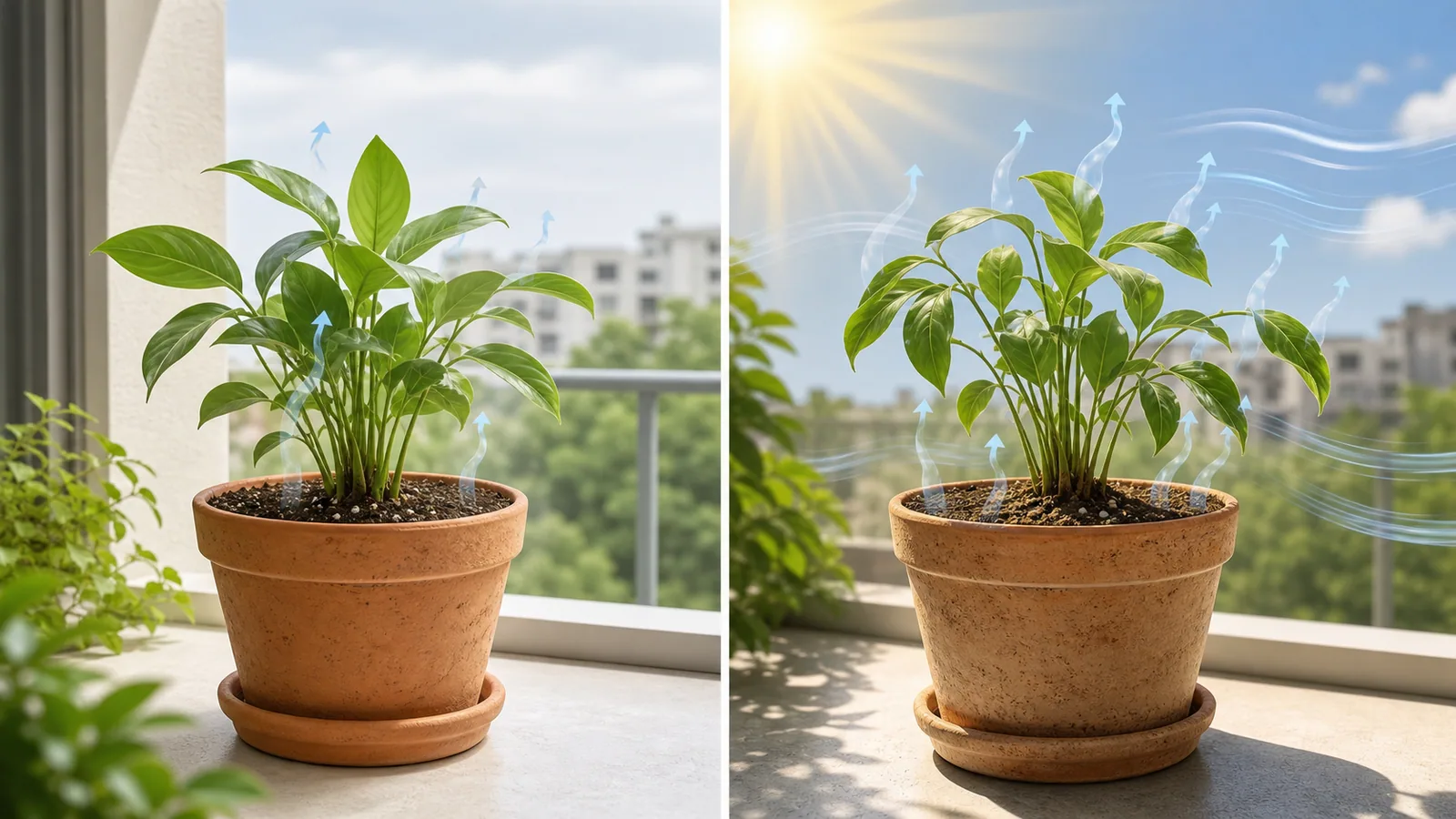
Think of a potted plant as a small water reservoir. Water can leave through the leaves, and it can also evaporate from the surface of the potting mix. Sun, heat, dry air, and wind can speed up both routes. A plant growing in the ground has a larger soil volume around its roots, but a potted plant has a limited root zone and a limited amount of stored water. That is why the same pot may look steady on a cloudy morning but wilt noticeably on a hot, windy afternoon.
This article is not trying to answer “How many days should I wait before watering in summer?” The more useful question is: where is the water leaving, what speeds it up, and why do pot size, potting mix, and location change the result?
Leaves transpire, and potting mix evaporates
There are at least two main routes for water to leave a potted plant.
The first route is through the plant itself. Roots absorb water, water moves upward through the xylem, and some of it eventually leaves the plant as water vapor from the leaves. This process is called transpiration. When stomata, the tiny pores on leaf surfaces, open to let carbon dioxide into the leaf for photosynthesis, water vapor can leave at the same time.
The second route is the potting mix. Water can evaporate from the surface of the mix, from spaces near the container wall, and from open pore spaces in a well-drained medium. When you combine water lost through the plant with water evaporating from the surface, you get a fuller picture of water loss from the pot.
So a summer container is not only affected by “the leaves using water.” The container and potting mix are also drying. If you look only at the leaves, it is easy to miss how quickly the root-zone environment is changing.
Heat, sun, dry air, and wind pull water outward
Summer water stress often comes from several environmental factors stacking together.
Strong light can support more photosynthesis, and stomatal activity becomes part of that exchange. High temperature makes water evaporate more readily and can warm the container and potting mix. Dry air can accept more water vapor, so the difference between moisture inside the leaf and moisture in the surrounding air becomes stronger. Wind removes the more humid layer of air around leaves and the pot surface, bringing in drier air again.
This is why the same temperature does not always produce the same result. A humid, still day; a hot, dry, windy day; a west-facing balcony in late afternoon; a plant behind window glass; and a pot beside a balcony railing can all create different drying speeds. In summer, temperature matters, but light, wind, humidity, and location matter too.
A pot is a small reservoir, not a field
Plants in the ground can often explore a larger soil volume. The soil around them also buffers moisture and temperature changes. A potted plant is different. Its root space is limited by the container, and the potting mix can only hold a limited amount of usable water.
Small pots, shallow pots, root-filled pots, and containers with very coarse potting mix may dry faster. Unglazed terracotta, fabric pots, and other porous containers may also lose more water through the container wall or fabric pores. Dark pots and metal containers can absorb more heat in direct sun, which can change root-zone temperature and drying speed.
This does not mean one container material is always better than another. It means the container is part of the water environment. The same plant can dry at very different speeds depending on pot size, potting mix, container material, color, and where the pot sits.
Afternoon wilting does not have only one meaning
Many potted plants soften or droop on hot summer afternoons, then recover later in the evening or after the temperature drops. One possible reason is that leaf water loss temporarily outruns the water supply from the roots. When leaf cells lose turgor pressure, the leaves look less firm.
But wilting is not a single diagnosis. If the potting mix is truly dry, lack of available water is an important clue. If the deeper mix is still moist and the pot still feels heavy, adding more water may not solve the problem. Roots that are short on air, roots that cannot absorb well, a very hot root zone, or a recent move to a harsher location can also make a plant look water-stressed.
A safer approach is to read the plant and the pot together. Has the pot become much lighter? Is only the surface dry, or is the deeper mix also drying? Does the plant droop only during the hottest afternoon, or does it stay limp all day? Is the setting hot and windy, or hot and still? The answers matter more than one visible symptom.
In summer, observe the pot instead of memorizing a watering interval
Summer watering becomes unreliable when “season” turns into a fixed rule. Some people say to water every day in summer; others say every two days. A potted plant does not follow a calendar that neatly. It responds to the actual environment around its roots and leaves.
Several low-risk clues can help you build a practical rhythm:
- Pot weight: Compare the weight after thorough watering with the weight as the pot dries.
- Deeper potting mix: A dry surface does not always mean the root zone is dry.
- Location: West-facing sun, a windy railing, air-conditioning airflow, and window glass can all change drying speed.
- Container: Small, shallow, porous, and dark containers may need closer checking in hot weather.
- Time pattern: Brief afternoon drooping and all-day wilting do not mean exactly the same thing.
The point is not to turn every plant into a checklist. The useful habit is to ask: what conditions is this specific pot experiencing today?
Common confusions
- ✕ Potted plants dry out faster in summer because plants always drink much more water.
- ✓ More precisely, leaf transpiration, surface evaporation, warm containers, dry air, and wind often make water leave faster.
- ✕ Drooping leaves in the afternoon mean the plant should be watered immediately.
- ✓ Check pot weight and the deeper potting mix first. If the root zone is still moist, more water may reduce air around the roots.
- ✕ If the top of the potting mix is dry, the whole pot is dry.
- ✓ The surface can dry quickly in summer while the middle and lower root zone still hold water.
- ✕ Terracotta, fabric, plastic, and metal pots differ only in appearance.
- ✓ Container material, color, size, and porosity can all change heat absorption and drying speed.
- ✕ A fixed daily watering routine is the safest summer approach.
- ✓ Fixed intervals can miss weather, location, potting mix, container size, root growth, and the plant’s current condition.
Frequently Asked Questions
Do potted plants dry out faster in summer because they use more water?
That can be part of it, especially under strong light and active growth, but it is not the whole story. Summer also speeds up water loss. Leaves can transpire more, potting mix can evaporate more, and dry air or wind can move water vapor away from the plant and pot surface.
Why does the same pot dry quickly on sunny days but last longer on cloudy days?
Sunny days often bring stronger light and higher temperatures. If the air is dry or windy too, both transpiration and evaporation can increase. Cloudy days usually have weaker light and less heating of the container and potting mix, so water may leave more slowly.
Do terracotta pots dry out faster than plastic pots in summer?
They often can. Unglazed terracotta is porous, so water can move through the pot wall and evaporate. Plastic pots are usually less porous. Fabric pots, dark pots, and metal containers can behave differently again. Actual drying speed still depends on pot size, potting mix, location, plant size, and root volume.
If leaves droop in the afternoon and recover at night, is the plant underwatered?
Possibly, but not always. Afternoon drooping can happen when transpiration pressure is high. If the pot feels light and the deeper mix is dry, lack of available water becomes more likely. If the pot is still heavy or the deeper mix is moist, root-zone air, root function, and heat stress also need to be considered.
Should I water as soon as the top of the potting mix looks dry in summer?
Not automatically. The surface layer is exposed to air and can dry first, while the middle and lower potting mix may still contain moisture. Check pot weight, deeper mix condition, and the plant’s time pattern before deciding.
Why do small pots dry out faster than large pots?
Small pots hold less potting mix and less water, so they have less buffer. In strong sun, heat, dry wind, or with a root-filled plant, that limited reservoir can dry quickly.
Related terms
- Transpiration: The movement of water vapor from inside the plant to the surrounding air, mainly through leaves.
- Stomata: Tiny pores on leaf surfaces that help regulate gas exchange, including carbon dioxide entry and water vapor loss.
- Evapotranspiration: The combined water loss from surface evaporation and plant transpiration.
- Root zone: The area of potting mix where roots are growing, absorbing water, and exchanging gases.
- Turgor pressure: The water pressure inside plant cells that helps leaves and tender stems stay firm.
- Potting mix: The container medium that supports roots, stores some water, and provides air spaces.
Read next
Evidence
References
These sources were used to check the plant-science concepts and gardening context in this article.
View sources and further reading (7)
- openstax.org — 30 5 transport of water and solutes in plants
- ucanr.edu — et evapotranspiration and plant water use
- extension.usu.edu — evapotranspiration and precipitation data
- extension.illinois.edu — how to grow fruits vegetables herbs in containers.pdf
- extension.illinois.edu — 2020 06 22 6 tips watering container gardens
- extension.missouri.edu — mg9
- site.extension.uga.edu — container gardening thinking outside the box