
Put phototropism inside the larger idea of tropism
Phototropism is one type of tropism. A tropism is a directional growth response: a plant receives a stimulus from a direction, and its growth direction changes in relation to that stimulus.
The stimulus can be light, gravity, water, or touch. A growth response to light direction is phototropism. A growth response to gravity is gravitropism. A growth response to touch can be seen when some tendrils coil around supports.
So phototropism is not simply “plants like light.” A more accurate idea is this: growing plant parts detect where light is coming from, then change growth direction through unequal growth.
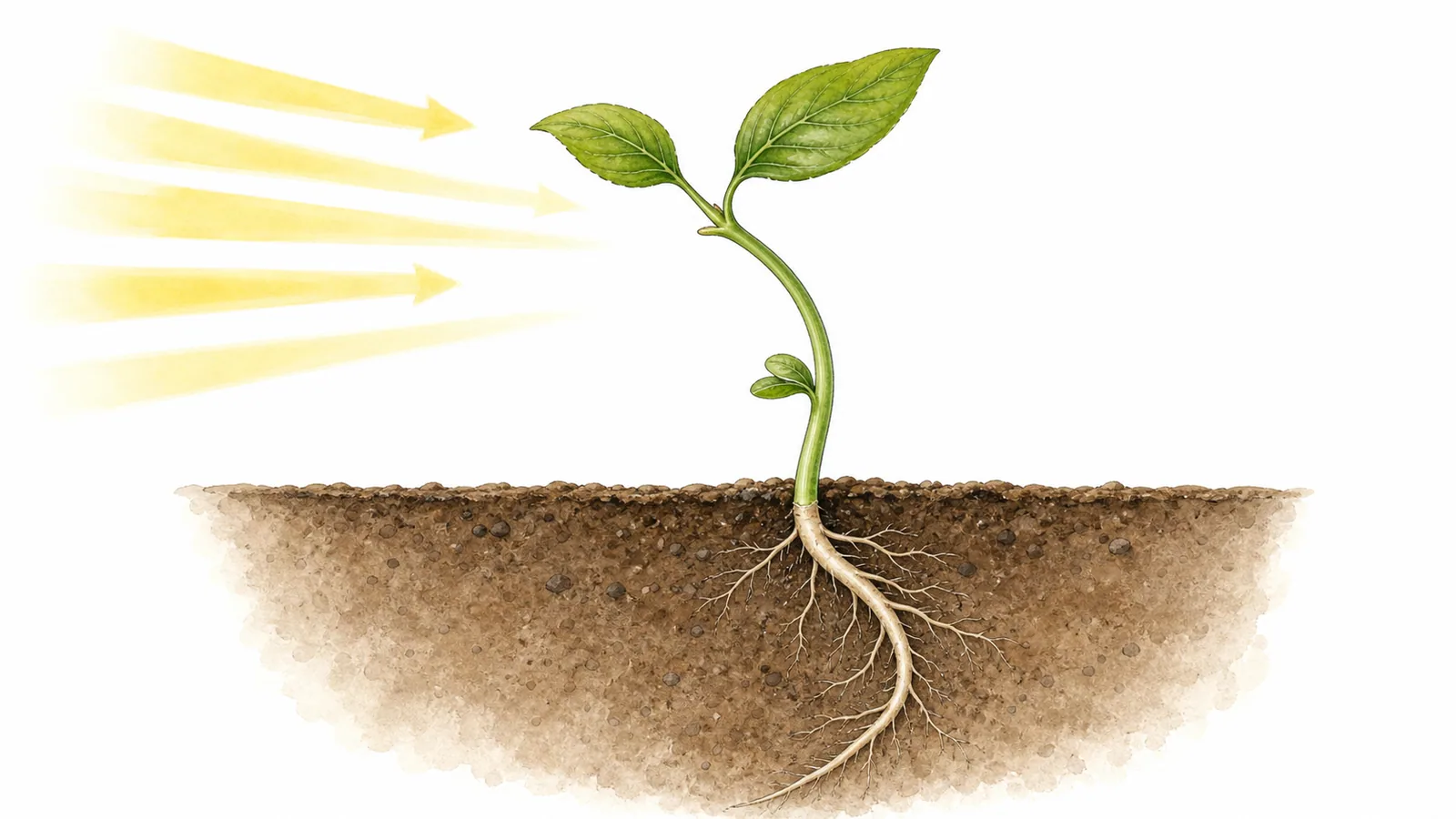
Positive phototropism: growth toward light
Positive phototropism means growth toward a light source. The everyday example is a seedling, young shoot, or soft new stem bending toward a window, grow light, or brighter side of a room.
This response makes sense for above-ground growth. New shoots and leaves benefit from reaching positions where they can receive useful light. The plant is not walking, thinking, or choosing a direction the way an animal would. The growing tissue responds to light signals, one side elongates differently from the other, and the organ curves.
For an entry-level definition, remember this: when people discuss young shoots, buds, or seedlings leaning toward light, they are usually talking about positive phototropism.
Negative phototropism: growth away from light
Negative phototropism means growth away from a light source. It is part of the phototropism vocabulary, even though it is less obvious in everyday houseplant observation than a shoot bending toward a window.
Roots are often discussed in relation to negative phototropism because many roots are better suited to growing into soil than toward exposed light. But root direction should not be reduced to light alone. Roots are also strongly shaped by gravity, moisture, oxygen, soil resistance, and local conditions.
A careful phrasing is: some roots or underground organs can show growth away from light, but root direction needs to be read together with other directional cues.
Why do plants have phototropism?
Phototropism connects growth direction with environmental information. For above-ground shoots, light is not only an energy source; it is also a directional signal. If new growth bends toward a brighter position, future leaves may be better placed to receive useful light.
This is different from photosynthesis. Photosynthesis answers the question, “How does a plant use light energy to make sugars and other organic molecules?” Phototropism answers another question: “Where is the light coming from, and how does new growth change direction?” Phototropism can help leaves and shoots reach better positions, but it is not the chemical process that makes sugars.
For roots, staying away from exposed light and remaining in the soil often fits their roles in anchorage, water uptake, and exploring soil space. Still, that is not a single-cause story. Roots in soil also respond to gravity, moisture, and physical resistance.
The bending mechanism: unequal growth on two sides
A closer explanation involves light receptors, plant hormones, and cell elongation. Light receptors turn light cues into signals the plant can respond to. In many shoot phototropism examples, blue light and receptors called phototropins, often translated in Chinese as 向光素, are especially important.
Auxin is also involved. Auxin is a plant hormone linked with cell elongation. Under one-sided light, the shaded side of a young shoot often elongates more than the lit side. When one side grows longer than the other, the shoot curves toward the light source.
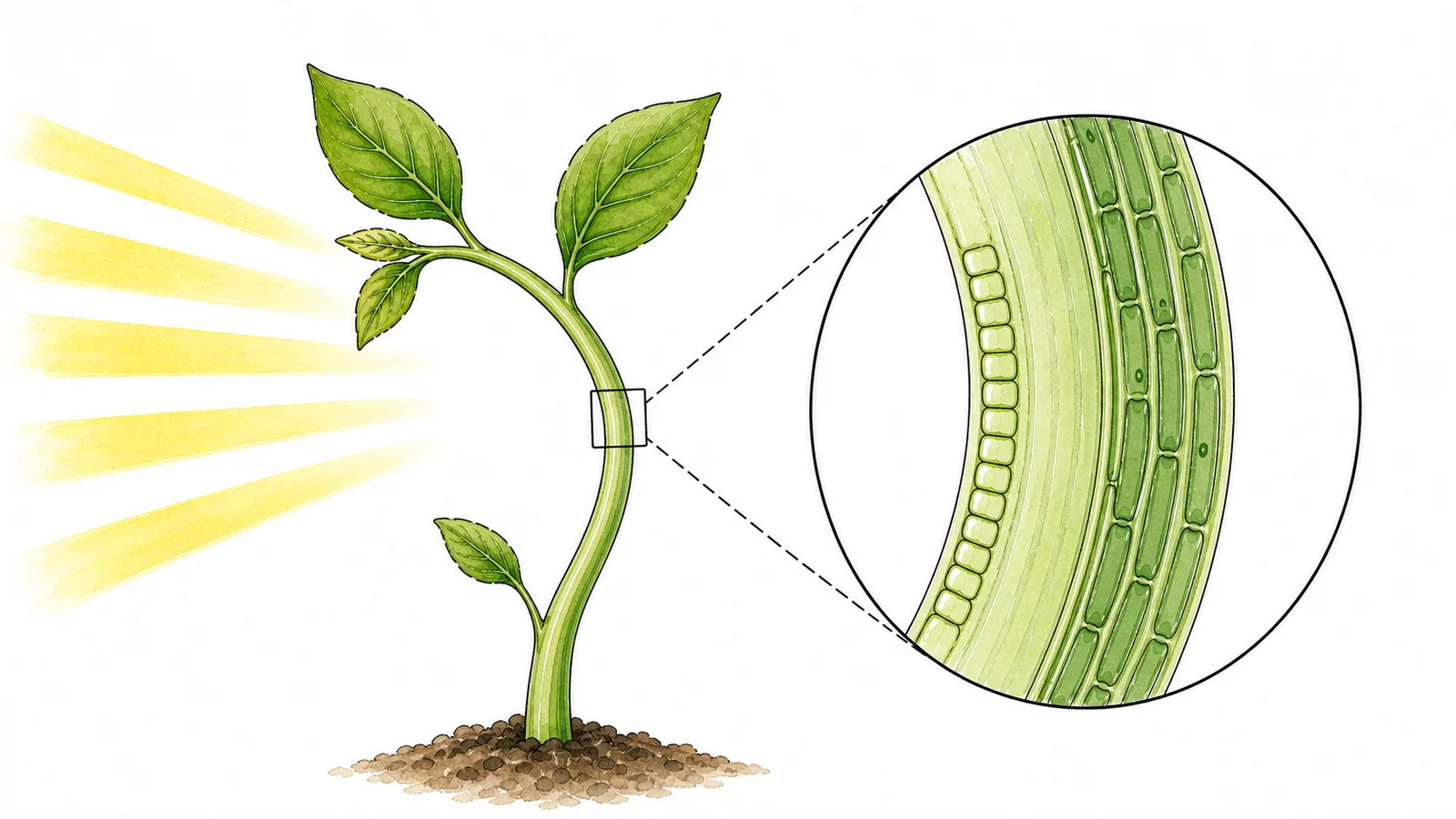
This helps avoid a common misunderstanding. Plants do not bend by using muscles. They change the direction of new growth because one side elongates more than the other.
Do not merge it with photosynthesis or leggy growth
Phototropism and photosynthesis both involve light, but they are not the same process.
- Photosynthesis: using light energy to make organic molecules.
- Phototropism: changing growth direction in response to light direction.
Phototropism is also not the same as leggy growth. Leggy growth usually refers to long, weak, stretched growth with wider spacing between leaves or nodes. Phototropism refers to growth or bending toward a light source.
In real plants, these observations can appear together. A seedling in weak window light may stretch and lean toward the window. In that case, light amount and light direction both deserve attention, but one visible symptom should not become a single diagnosis.
A window-leaning plant gives a clue
Indoor plants often receive light from one side. The window side is brighter, while the room side is dimmer. New buds, soft stems, or petioles may slowly lean toward the window.
Useful questions include:
- Is most of the light coming from one direction?
- Is the leaning most visible in new growth or in older woody parts?
- Are the internodes also getting longer?
- Is the plant simply leaning, or is it also becoming thin and stretched?
Leaning toward a window does not automatically mean the plant is in trouble or that light is the only issue. Plant form, branch weight, support, pruning, gravity responses, watering history, and seasonal growth can also affect appearance. A safer explanation is that phototropism gives you an observation clue: look at light direction and new growth first.
Common confusions
- ✕ Phototropism means plants think and search for the sun.
- ✓ Phototropism is a growth response, not animal-like intention or movement.
- ✕ Phototropism means every plant organ grows toward light.
- ✓ Positive phototropism is growth toward light; negative phototropism is growth away from light. Organs and situations differ.
- ✕ Roots are controlled only by light, so root direction directly proves phototropism.
- ✓ Roots also respond to gravity, moisture, soil resistance, and other cues, so light is only one part of the picture.
- ✕ Phototropism and photosynthesis are the same thing.
- ✓ Photosynthesis uses light to make organic molecules; phototropism changes growth direction in response to light direction.
- ✕ Leggy growth and phototropism are identical.
- ✓ Leggy growth refers to stretched, weak growth; phototropism refers to bending or growing toward light. They can appear together.
Frequently Asked Questions
What is phototropism?
Phototropism is a type of tropism: a plant growth response to light direction. The most familiar example is a young shoot, seedling, or bud bending toward light.
What is the difference between tropism and phototropism?
Tropism is the broader idea: a directional growth response to a stimulus. Phototropism is one type of tropism where the stimulus is light. Gravitropism, hydrotropism, and thigmotropism involve gravity, water, and touch.
What is positive phototropism?
Positive phototropism is growth toward a light source. Young stems and seedlings bending toward a window or grow light are common examples.
What is negative phototropism?
Negative phototropism is growth away from a light source. Roots are sometimes discussed in this context, but root direction is also influenced by gravity, moisture, soil resistance, and other environmental cues.
Why do plants have phototropism?
Phototropism lets plants use light direction as environmental information. Shoots growing toward brighter positions can place future leaves in better light, while underground organs need to be understood together with their soil environment.
How is phototropism different from photosynthesis?
Photosynthesis uses light energy to make sugars and other organic molecules. Phototropism changes the direction of new growth in response to where light is coming from. Both involve light, but they answer different questions.
Why does the shaded side grow more if the shoot bends toward light?
When cells on the shaded side elongate more than cells on the lit side, that longer side pushes the shoot toward the opposite direction, which is the light source. The bend comes from unequal growth.
Related Terms
- Tropism: a directional growth response to a stimulus such as light, gravity, water, or touch.
- Phototropism: a growth response to light direction.
- Positive phototropism: growth toward light.
- Negative phototropism: growth away from light.
- Auxin: a plant hormone involved in cell elongation and growth direction.
- Photoreceptor: a light-sensitive system that helps plants respond to light cues.
- Phototropin: a blue-light photoreceptor involved in phototropism; Chinese term: 向光素.
- Leggy growth: long, weak, stretched growth often associated with unsuitable light conditions.
Related Reading
Evidence
References
These sources were used to check the plant-science concepts and gardening context in this article.
View sources and further reading (5)
- openstax.org — 30 6 plant sensory systems and responses
- bio.libretexts.org — 30.19: Plant Sensory Systems and Responses Blue Light Response
- organismalbio.biosci.gatech.edu — plant hormones and sensory systems
- extension.umn.edu — lighting indoor plants
- extension.illinois.edu — 2018 05 31 houseplants and indoor lighting