
Layering is a propagation method in which a plant stem forms roots while it is still attached to the parent plant. In plain language, the stem is not separated first. A section of stem is encouraged to root, and only after roots form can that rooted section be treated as a new plant.
That is the main difference from a cutting. With most cuttings, the plant piece is separated first and then encouraged to form roots. With layering, the stem remains connected to the parent plant while rooting begins.
Why layering is a form of asexual propagation
Layering does not begin with a seed. It uses a stem or branch from the parent plant to form a new plant. For that reason, it is usually discussed as a form of asexual propagation or vegetative propagation.
In a seed-based route, pollen, ovules, fertilization, and embryos may be involved. In layering, the starting point is existing plant tissue. The new plant usually keeps many traits of the parent plant because it develops from that parent tissue.
Here, “usually” does not mean “guaranteed.” A layered plant may closely resemble the parent, but its later growth can still be affected by environment, plant condition, mutation, and care. Layering also does not work equally well with every plant.
New roots often form near stems or nodes
A useful term here is adventitious root. An adventitious root is a root that starts from a non-root position, such as a stem, node area, or wounded stem region. It is not a bad or abnormal root; the term describes where the root begins.
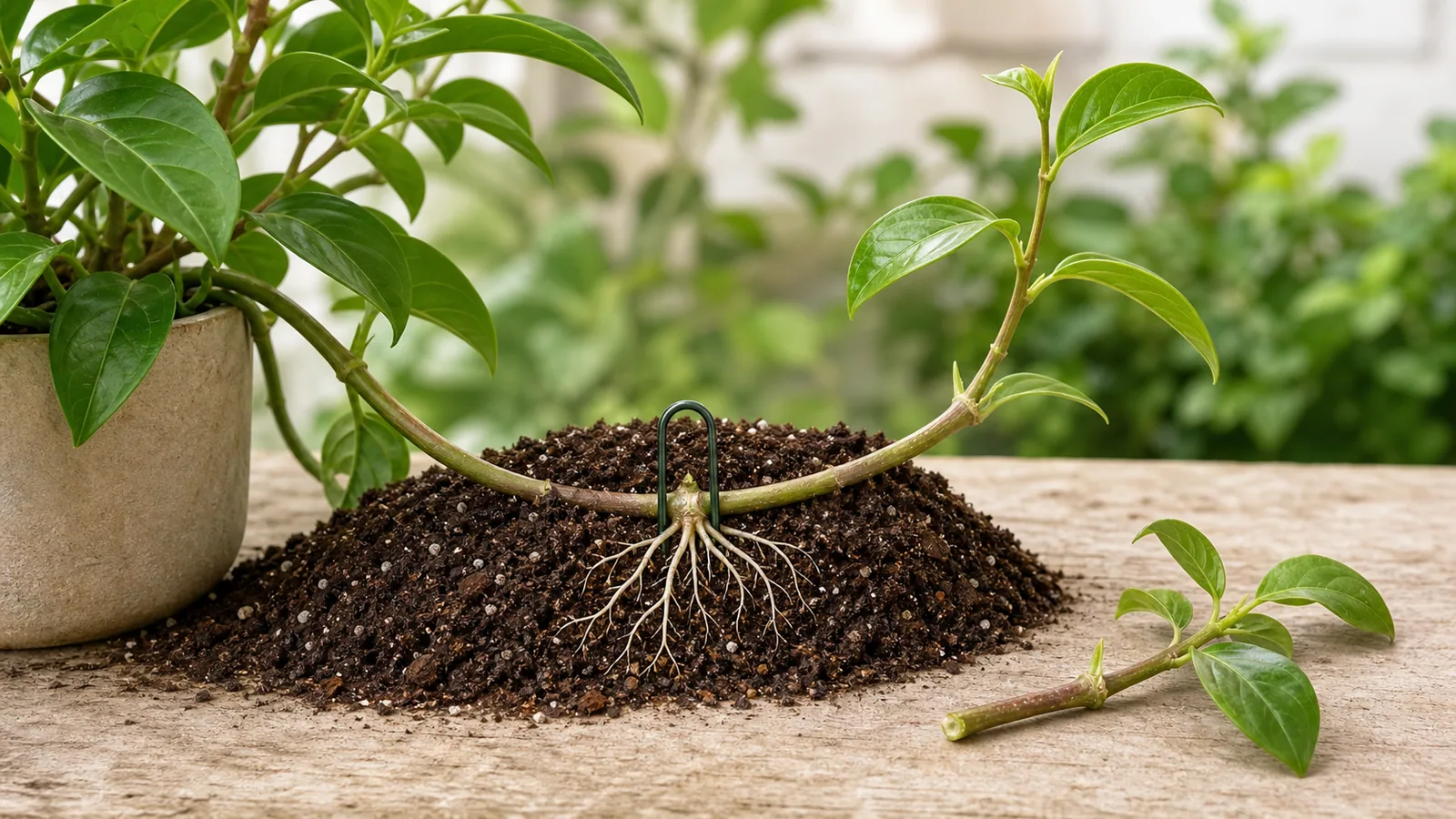
In simple layering, a flexible low branch may be bent down so that one section is covered by potting medium or soil while the shoot tip remains exposed. If roots form at the covered section, those roots are not branches of the original underground root system. They are new roots formed from living stem tissue.
This is why layering connects naturally with plants that root at nodes or along flexible stems. Some trailing or vining plants already show this ability when a node rests against a moist surface. Horticultural layering uses the same biological idea.
Layering, cuttings, and division start differently
Layering, cuttings, and division can all fit under the broad idea of asexual propagation, but they do not start in the same way.
In layering, the stem stays attached to the parent plant while roots begin to form. The attached stem can still receive water and materials from the parent plant during the early rooting stage.
In cutting propagation, a stem, leaf, or root piece is separated first. The cutting then has to form new roots or shoots while managing water loss and stress. That is why cutting articles often focus on nodes, adventitious roots, water balance, and aeration.
In division, a clump or side plant that already has growing points and often some root system is separated. Division is not about bending a connected stem down to make it root; it is about separating a plant body that is already partly self-contained.
What advantages does layering have?
The main advantage of layering comes from the fact that the stem is not separated from the parent plant right away. Before new roots form, the stem can still receive water and materials through the parent plant. For some plants that do not root easily from detached cuttings, or for stems that are more woody, layering can be a useful propagation route to understand.
Layering is also visually easy to read. On one connected stem, a reader can see the parent plant, stem, node area, new roots, and the future plant section that may later be separated. That makes the idea of plant parts forming new roots easier to understand than looking only at a detached cutting.
These advantages are not success guarantees. Layering still depends on plant species, stem condition, environment, and later growth. It is not more advanced than cutting propagation; it is another route for understanding asexual plant propagation.
Air layering is the same larger idea
Air layering is also a form of layering. The rooting position is not at soil level. Instead, roots form around a section of stem or branch that is still attached to the parent plant, often inside a moist wrapping or medium.
You may also see names such as simple layering, serpentine layering, mound layering, stool layering, or tip layering. These names describe how the stem contacts the medium and where roots form. For an entry-level article, the shared concept matters most: a connected stem forms roots before it is separated.
How to read layering in garden and houseplant examples
If you have seen a trailing stem root near a node after touching moist potting medium, you have seen a clue to the layering idea. That does not mean every trailing plant can be layered, and it does not mean pressing a stem down guarantees a new plant. It simply shows that some stems can form roots from places that were not roots before.
When you observe a layering example, ask three questions:
- Is this stem still attached to the parent plant?
- Are roots forming from a stem, node area, or wrapped section?
- How is this different from cutting the piece first and waiting for roots later?
With those questions, layering becomes more than a gardening term. It connects stems, nodes, adventitious roots, asexual propagation, and plant regeneration.
Common confusions
- ✕ Layering is just another name for cutting propagation.
- ✓ Both can produce new plants from plant parts, but layering roots while still attached to the parent plant; cuttings are usually separated first.
- ✕ Layering is always easier or more successful than cuttings.
- ✓ That cannot be promised. Results depend on plant species, stem condition, environment, and later growth.
- ✕ Once roots appear, the new plant is already stable.
- ✓ Rooting is only one stage. The plant also needs shoots, leaves, and enough structure to keep growing.
- ✕ Air layering is a completely separate propagation category.
- ✓ Air layering is still layering. The rooting area is on an attached stem above the soil rather than at ground level.
Frequently Asked Questions
How is layering different from cuttings?
In layering, a stem forms roots while it is still attached to the parent plant. In cutting propagation, the plant piece is usually separated first and then forms roots or shoots. A short way to remember it is: layering roots before separation; cuttings separate before rooting.
Is layering sexual or asexual reproduction?
Layering is usually a form of asexual propagation. It does not begin with pollen, ovules, fertilization, or seeds. It begins with part of the parent plant.
Why can a still-attached stem form roots?
Some stems, node areas, or wounded stem regions can form adventitious roots. Layering uses that ability by keeping a section of stem in a rooting-friendly position while it remains connected to the parent plant.
What is the difference between air layering and simple layering?
Simple layering usually bends a low, flexible stem down so that one section is covered by medium while the tip stays exposed. Air layering encourages roots on a section of stem that remains above the soil, often inside a moist wrapping. Both keep the stem attached at first.
Can every plant be propagated by layering?
No. Plants differ in stem flexibility, node-rooting ability, regenerative capacity, and growth habit. Some plants are good examples for understanding layering; others are not suitable.
Will a layered plant be identical to the parent plant?
It usually preserves many parent traits because it comes from parent tissue rather than from a genetically reshuffled seed. Still, environment, plant condition, mutation, and later growth can affect what the plant looks like and how it performs.
Related Terms
- Layering: a propagation method in which an attached stem forms roots before separation.
- Air layering: layering in which roots form on an attached stem above the soil.
- Asexual propagation: propagation without seed formation through fertilization.
- Vegetative propagation: propagation using stems, leaves, roots, or other vegetative plant organs.
- Adventitious root: a root that forms from a non-root position.
- Node: a stem position where leaves, buds, or branches often occur.
- Parent plant: the original plant that provides the stem or branch used for propagation.
Read Next
Evidence
References
These sources were used to check the plant-science concepts and gardening context in this article.
View sources and further reading (7)
- content.ces.ncsu.edu — 13 propagation
- extension.okstate.edu — layering propagation for the home gardener
- ag.purdue.edu — ho 1 w.html
- yardandgarden.extension.iastate.edu — how propagate houseplants air layering and simple layering
- hgic.clemson.edu — air layering
- openstax.org — 32 3 asexual reproduction
- openstax.org — 30 6 plant sensory systems and responses