
Plant division means separating a unit on the parent plant that already resembles a small plant. That unit is not just a loose leaf or an isolated piece of tissue. It usually already has roots, a stem base or growing point, and leaves, or at least a place that can keep making leaves and shoots.
So the core idea is not “cutting a plant into smaller pieces.” It is separating a small plant unit or clump unit from the parent body so it can continue as another growing individual. That point also helps separate division from cuttings, leaf cuttings, and seed propagation.
In horticulture, division is usually understood as a kind of asexual propagation, also called vegetative propagation. Instead of starting from a seed, the new plant starts from part of the parent plant’s existing body.
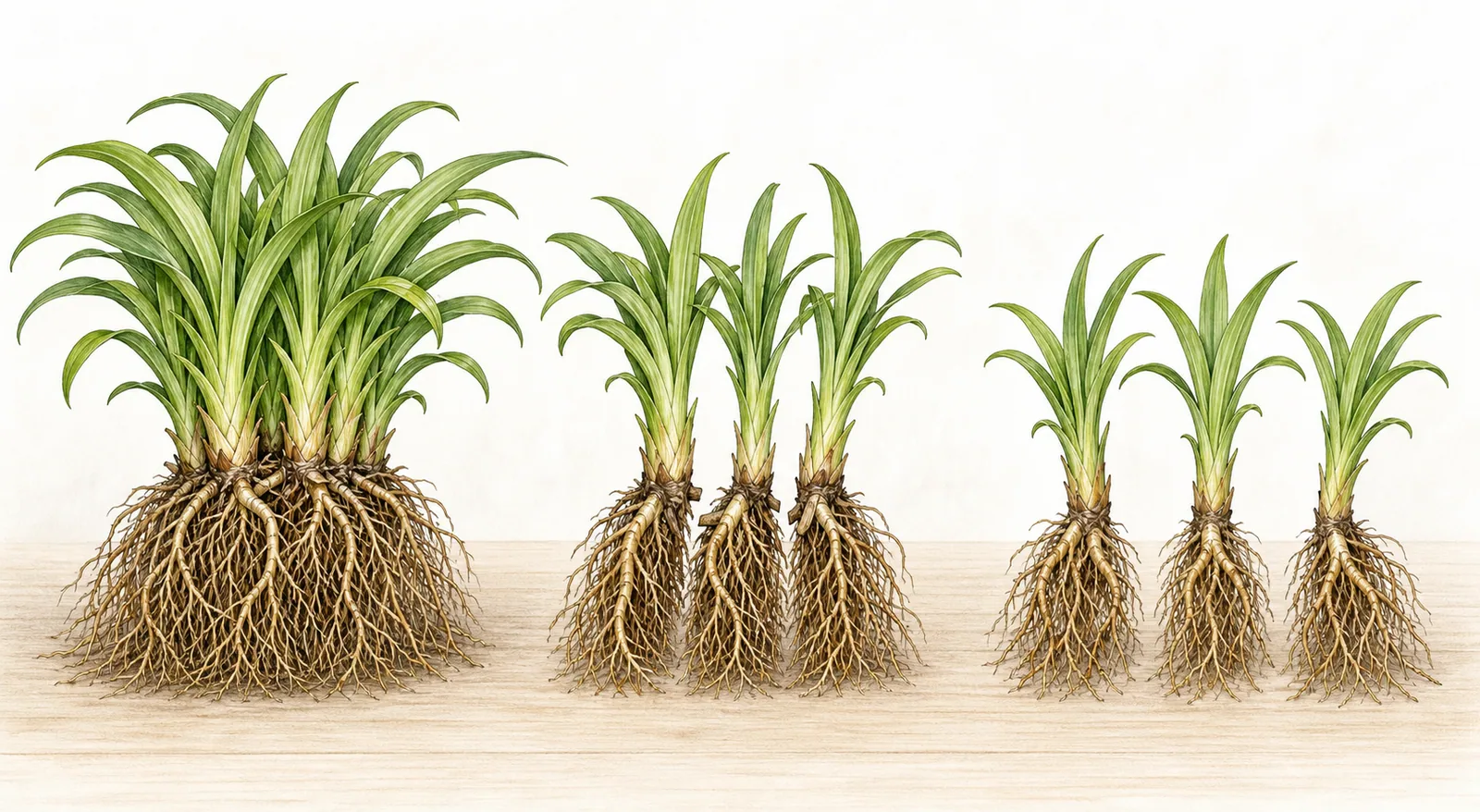
Division starts differently from seed propagation
Seed propagation begins with a seed. In many flowering plants, seeds form after pollination and fertilization, and the young plant that grows from the seed may not look exactly like either parent.
Division starts from a plant unit that has already formed on the parent plant. The separated part might be a small section of a clump, a rooted offshoot, part of a crown, or a rhizome section with a growing point. In other words, it usually already has roots plus a stem base, crown, node, bud, or similar structure that can keep producing leaves and shoots. Because the new plant comes from existing vegetative tissue, it is usually similar to the parent plant.
“Similar,” however, should not be treated as a permanent guarantee. Plant condition, growing environment, mutations, and the stability of variegation or other traits can still affect how a divided plant looks later.
Division is not the same as taking cuttings
Cutting propagation often starts with a piece of stem, leaf, or root. That piece may already contain important structures, such as nodes or buds, but it often has to regenerate a missing organ. A stem cutting, for example, may need to form new roots before it can live independently.
Division is different. It separates smaller plant units that were already part of the parent plant’s clump or crown. These units usually already include some roots plus a stem base, crown, node, bud, or other growing point that can continue producing leaves or shoots.
A simple way to remember the difference is:
- Cutting propagation often starts with a piece of plant material and waits for missing roots or shoots to form.
- Division separates a clump, crown, offshoot, or similar plant unit that usually already has roots, a stem base or growing point, and a way to keep making leaves.
In real gardening language, the edges can overlap. Some plants form offsets, runners, rhizomes, tubers, or small side shoots. A beginner does not need to memorize every category at once. The safer first question is: does this piece still look like a small plant unit, with roots and with a stem, bud, crown, or similar place where new leaves and shoots can continue?
A single leaf is usually not plant division
One common misunderstanding is thinking that plant division means any plant part can become a new plant if it is cut away.
A leaf may stay green for a while after being removed, but that does not mean it has a growing point that can produce a new stem and leaves. Some plants can be propagated from leaf cuttings, but many cannot. Leaf propagation is a separate topic and should not be confused with division.
For division, the key clues are usually these: Does this piece have roots? Does it include a stem base, crown, node, bud, or side shoot? Does it have leaves, or at least a growing point that can keep making leaves and shoots? After it is separated, does it still keep the basic body structure of a small plant?
If all that remains is a leaf with no node, no bud, and no roots, it is usually not a division. For example, Monstera deliciosa leaves or petioles without nodes and axillary buds do not produce new growth; new growth comes from nodes and buds on the stem.
Plants that make division easier to understand
Division is easiest to understand in plants that naturally grow as clumps or produce separable crowns, rhizomes, offsets, or rooted side shoots. Common examples include hosta, daylily, iris, ferns, snake plant, peace lily, ornamental grasses, and some clump-forming foliage plants.
These examples are not a rule that every large potted plant can be divided. Different plants keep their growing points in different places. Their roots, stem bases, crowns, rhizomes, or offshoots may be built very differently.
Placed back into the plant life cycle, division is not a new plant beginning from a seed. It is part of an existing plant becoming a separate individual. That is why division connects naturally with asexual reproduction, vegetative propagation, cuttings, runners, rhizomes, and other ways plants reproduce without starting from seed.
Common Mix-ups
- ✕ Plant division just means cutting a plant into smaller pieces.
- ✓ Division separates units that already resemble small plants, usually with roots, a stem base or growing point, and leaves or a place that can make leaves.
- ✕ If a leaf stays green, it counts as a division.
- ✓ A leaf may be living tissue, but it may not contain the growing point needed to make a complete new plant. Leaf cuttings and division are not the same thing.
- ✕ Division and cuttings are exactly the same.
- ✓ Both can fit under asexual or vegetative propagation, but cuttings often need to regenerate missing roots or shoots. Division usually separates plant units that already include roots and a stem base or growing point.
- ✕ A divided plant is guaranteed to stay exactly like the parent forever.
- ✓ A divided plant is often similar to the parent because it comes from parent tissue, but plant condition, environment, mutations, and trait stability can still affect later growth.
FAQ
Is plant division a form of asexual reproduction?
Usually, yes. Division does not begin with a seed. It uses part of an existing parent plant to form another plant, so it fits under the broader idea of asexual or vegetative propagation.
Does every division need roots?
For beginner-level understanding, roots are an important clue. Many common examples of division separate a plant into pieces that already include part of the root system, plus a stem base, crown, node, bud, or leaf cluster. That makes each piece more like an independent plant unit. Details vary by species, but a rootless, budless leaf with no stem node should not be treated as a division.
What is the difference between division and cuttings?
Cuttings often use a stem, leaf, or root piece and rely on that piece to form missing roots or shoots. Division separates a clump, crown, offshoot, or similar small plant unit that usually already has roots, a stem base or growing point, and a way to keep making leaves. Both are connected to asexual propagation, but their starting points are different.
Does cutting off one leaf count as division?
Usually not. A leaf can remain alive for a while, but it may not contain a growing point that can make a new stem and leaves. Some plants can be propagated from leaf cuttings, but that is different from division and should not be generalized to all plants.
Will a divided plant be the same as the parent plant?
It is usually similar to the parent because it comes from parent plant tissue rather than from a newly mixed seed embryo. But “similar” is not an absolute guarantee. Later appearance can still be affected by environment, plant condition, mutations, and the stability of traits such as variegation.
Can all potted plants be divided when they get large?
No. Division works best for plants that naturally form clumps, crowns, rhizomes, offsets, or separable rooted units. Other plants may be better understood through cuttings, seeds, layering, grafting, or other propagation methods.
Related Terms
- Plant division: Separating a clump, crown, offshoot, or similar small plant unit that usually already has roots, a stem base or growing point, and leaves or a place that can make leaves.
- Asexual reproduction: Reproduction that does not depend on the union of pollen and ovule to form a seed.
- Vegetative propagation: Propagation using vegetative plant parts such as stems, leaves, roots, rhizomes, runners, bulbs, or similar structures.
- Crown: The base area of many herbaceous plants where roots and new shoots are connected.
- Growing point: A plant region that can keep producing new leaves, stems, or buds.
- Node: A place on a stem where leaves, buds, or branches commonly occur.
- Axillary bud: A bud near the angle between a leaf and stem that may develop into a new shoot or branch.
- Offshoot or offset: A smaller side plant or shoot that forms from the parent plant and may sometimes be separated.
Read Next
Evidence
References
These sources were used to check the plant-science concepts and gardening context in this article.