
The simplest difference is this: sexual reproduction usually uses pollen, ovules, fertilization, and seeds to create a new genetic combination. Asexual reproduction often uses part of an existing plant, such as a stem, leaf, root, runner (also called a stolon), rhizome, tuber, bulb, or corm, to form a new plant.
In gardening language, sexual reproduction often points toward seed propagation. Asexual reproduction often points toward cuttings, division, layering, runners, or other forms of vegetative propagation.
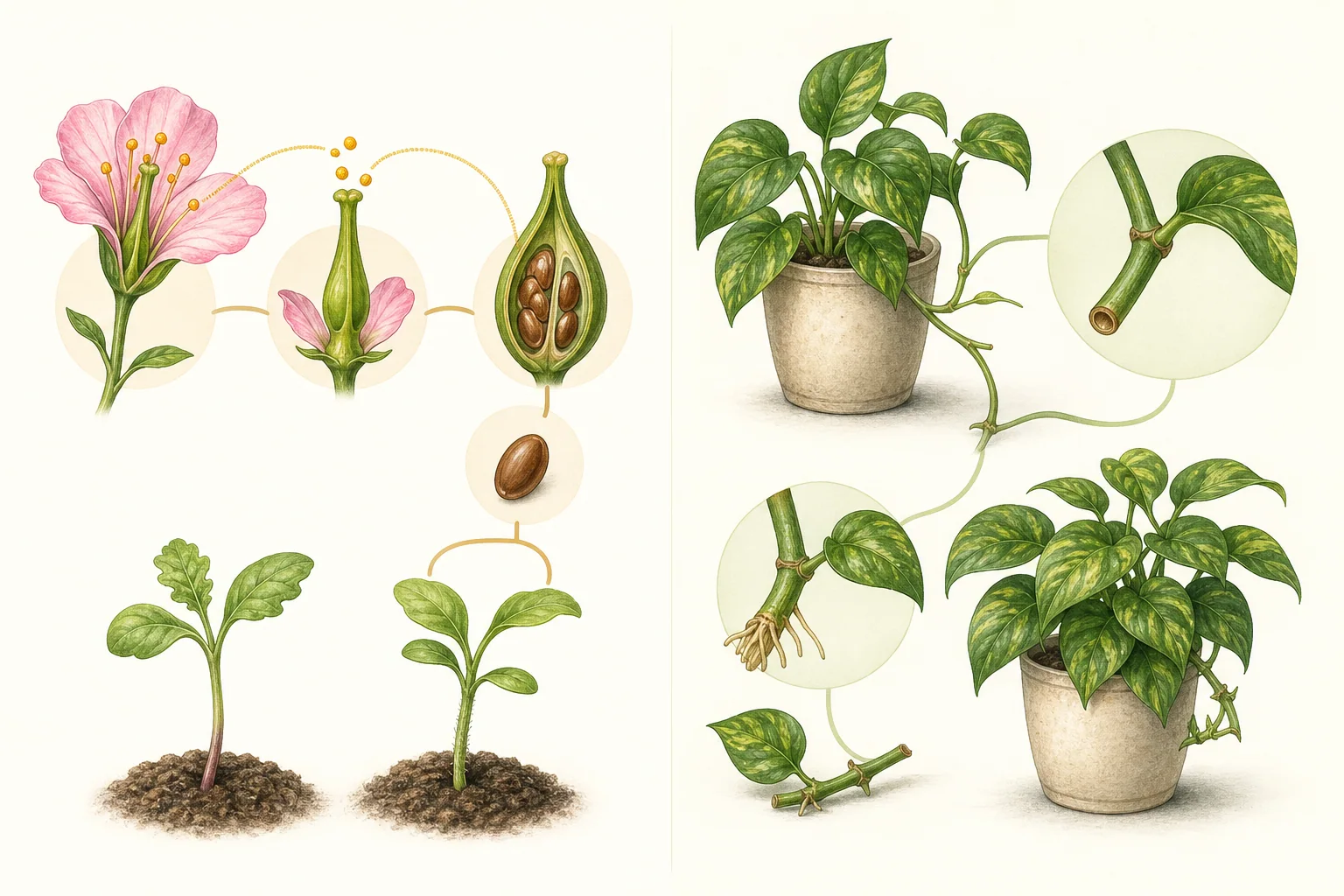
Seeds usually point to sexual reproduction
The core of sexual reproduction is the union of gametes. A gamete is a reproductive cell. In flowering plants, pollen and ovules are part of the route that can lead to fertilization, embryos, and seeds.
A simplified sequence looks like this: pollen reaches a stigma, a pollen tube may grow toward an ovule, fertilization may occur, the ovule can become a seed, and the seed can germinate into a new plant.
One important result is genetic reshuffling. A seed-grown plant is not usually an exact copy of the parent plant. Even seedlings from the same batch of seeds may differ in height, leaf shape, flower color, vigor, or other traits.
Plant parts usually point to asexual reproduction
Asexual reproduction does not begin by forming a seed. It uses an existing plant part to make a new plant. That part may be a stem, leaf, root, runner, rhizome, tuber, bulb, corm, or another vegetative structure.
Many familiar horticultural methods fit under asexual or vegetative propagation: cuttings, division, layering, grafting, and tissue culture (micropropagation). Division separates a plant unit that already has roots or growing points; layering lets a stem form roots while it remains attached to the parent before it may become independent. “Vegetative” here does not mean vegetables for eating. It refers to plant organs involved in growth, water movement, light capture, storage, and support.
Because the new plant comes from parent tissue, it is often genetically very close to the parent. In many cases it can be considered a clone. That is why gardeners may use vegetative propagation to preserve a flower color, leaf pattern, growth habit, or cultivar trait.
But “similar to the parent” is not a permanent guarantee. Environment, plant health, mutation, variegation stability, and the condition of the starting material can all affect how the new plant looks and grows. Also, not every plant part can become a complete plant.
Neither route is automatically better
Sexual and asexual reproduction do different jobs. One is not more advanced than the other.
Sexual reproduction creates variation. In nature, variation can give a population more possibilities when conditions change. In gardening, seed-grown plants may also show new combinations of traits.
Asexual reproduction preserves an existing plant line more closely. A cutting, divided plant, daughter plant formed along a runner, or similar vegetative offspring often resembles the parent. That can be useful when the goal is to keep a known ornamental trait. It also means that if the starting plant material carries a problem, that problem may be carried along too.
The same plant may use both routes. A strawberry plant can flower and form fruit with seeds, and it may also produce runners. A runner is a horizontal stem. At a node—the point on a stem where a new shoot can arise—it may form roots and give rise to a daughter plant when conditions allow. Many plants can use more than one reproductive route, depending on the situation.

How this looks in pots and gardens
When you sow seeds, you are watching a new plant begin from an embryo. The seedlings may look related, but they often are not identical. That is a practical way to understand why sexual reproduction creates variation.
When you observe a houseplant cutting, a strawberry runner, or a divided clump, you are seeing plant tissue rebuild roots, shoots, or a whole plant body. That is a practical way to understand why asexual reproduction often preserves parent traits.
Instead of asking which route is better, ask two clearer questions: Did this new plant begin from a seed, or from a parent plant part? Is its variation coming from genetic reshuffling, or is it mostly carrying forward the parent plant’s existing traits?
Common confusions
- ✕ Asexual reproduction is a lower or less important form of reproduction.
- ✓ It is a common plant strategy, and many plants can reproduce both sexually and asexually.
- ✕ A seed-grown plant will always look exactly like the parent.
- ✓ Seeds commonly come from sexual reproduction, so seedlings often have new genetic combinations.
- ✕ If a cutting grows roots, propagation is complete.
- ✓ Rooting is only one stage. A new plant also needs shoots, leaves, and enough structure to keep growing.
- ✕ Asexually propagated plants are guaranteed to stay exactly identical forever.
- ✓ They are usually genetically close to the parent, but environment, mutation, plant health, and variegation stability can still matter.
Frequently Asked Questions
Is asexual reproduction the same as cloning a plant?
In many beginner-level garden examples, yes: an asexually produced plant comes from part of the parent and is genetically very close to it. It is often called a clone. Still, the visible plant may not stay identical in every condition.
Are plants grown from seeds always the result of sexual reproduction?
Seed propagation is usually discussed under sexual reproduction in garden and classroom contexts because seeds commonly form after pollination, fertilization, and embryo development. A small number of plants can produce seeds without fertilization through a process called apomixis, so “seed” and “sexual reproduction” are not absolute synonyms.
Can one plant reproduce both sexually and asexually?
Yes. A single strawberry plant can flower and form fruit with seeds while also producing runners. Under suitable conditions, a runner may form roots at a node and give rise to a daughter plant. The two routes start from different materials, but they can occur on the same plant.
Are cuttings, division, and runners forms of asexual reproduction?
Usually, yes. They begin with parent plant tissue rather than a seed. Cuttings use a stem, leaf, or root section; division separates clumps or side plants that already have growing points; runners, such as those of strawberries, can form daughter plants along horizontal stems.
Will an asexually propagated plant be exactly the same as the parent?
It is usually much closer to the parent than a seedling would be, because gametes are not being mixed. But “closer” is not a guarantee. Growing conditions, plant health, mutation, and unstable variegation can change how the plant appears.
Why do gardeners use cuttings instead of seeds?
Cuttings and other vegetative methods can preserve parent traits and may be more direct than waiting for seed-grown plants. That does not mean every plant is easy to propagate from cuttings, and it does not guarantee success.
Is pollination the same as sexual reproduction?
Pollination is one step in the sexual reproduction pathway of many flowering plants. It means pollen reaches the stigma. Later steps may include pollen tube growth, fertilization, seed formation, and seed germination.
Related Terms
- Sexual reproduction: reproduction involving gamete union and new genetic combinations.
- Asexual reproduction: reproduction without gamete union, often using part of a parent plant.
- Vegetative propagation: propagation using vegetative organs such as stems, leaves, or roots.
- Seed propagation: growing plants from seeds.
- Cutting: a stem, leaf, or root piece used to grow a new plant.
- Division: separating a clump or side plant that can continue growing.
- Runner / stolon: a horizontal stem that may form roots and give rise to a daughter plant at a node.
- Node: a point on a stem where a leaf, bud, or new shoot can arise.
- Daughter plant: a new plant that develops from a parent plant, often at a runner node.
- Clone: an individual genetically very close to the source plant.
- Genetic variation: inherited differences among offspring or between offspring and parents.
Read Next
Evidence
References
These sources were used to check the plant-science concepts and gardening context in this article.
View sources and further reading (8)
- content.ces.ncsu.edu — 13 propagation
- extension.missouri.edu — mg3
- openstax.org — 32 1 reproductive development and structure
- openstax.org — 32 2 pollination and fertilization
- openstax.org — 32 3 asexual reproduction
- openstax.org — 32 chapter summary
- extension.umn.edu — growing strawberries home garden
- extension.umn.edu — how strawberry plants grow