
Plant grafting means joining a shoot or bud from one plant to another plant’s rootstock, usually its lower stem. If the joined area heals and develops a working connection, the two parts can grow together as one grafted plant. The upper piece is the scion. It usually provides the shoots, leaves, flowers, or fruit above the union. The lower piece is the rootstock, which provides the roots and sometimes the lower stem.
Grafting does not mix the genetic material of two plants into one new cultivar. It also does not begin with a seed. In plant propagation, grafting is usually treated as asexual reproduction because it recombines existing plant parts rather than starting with pollen, ovules, and fertilization.
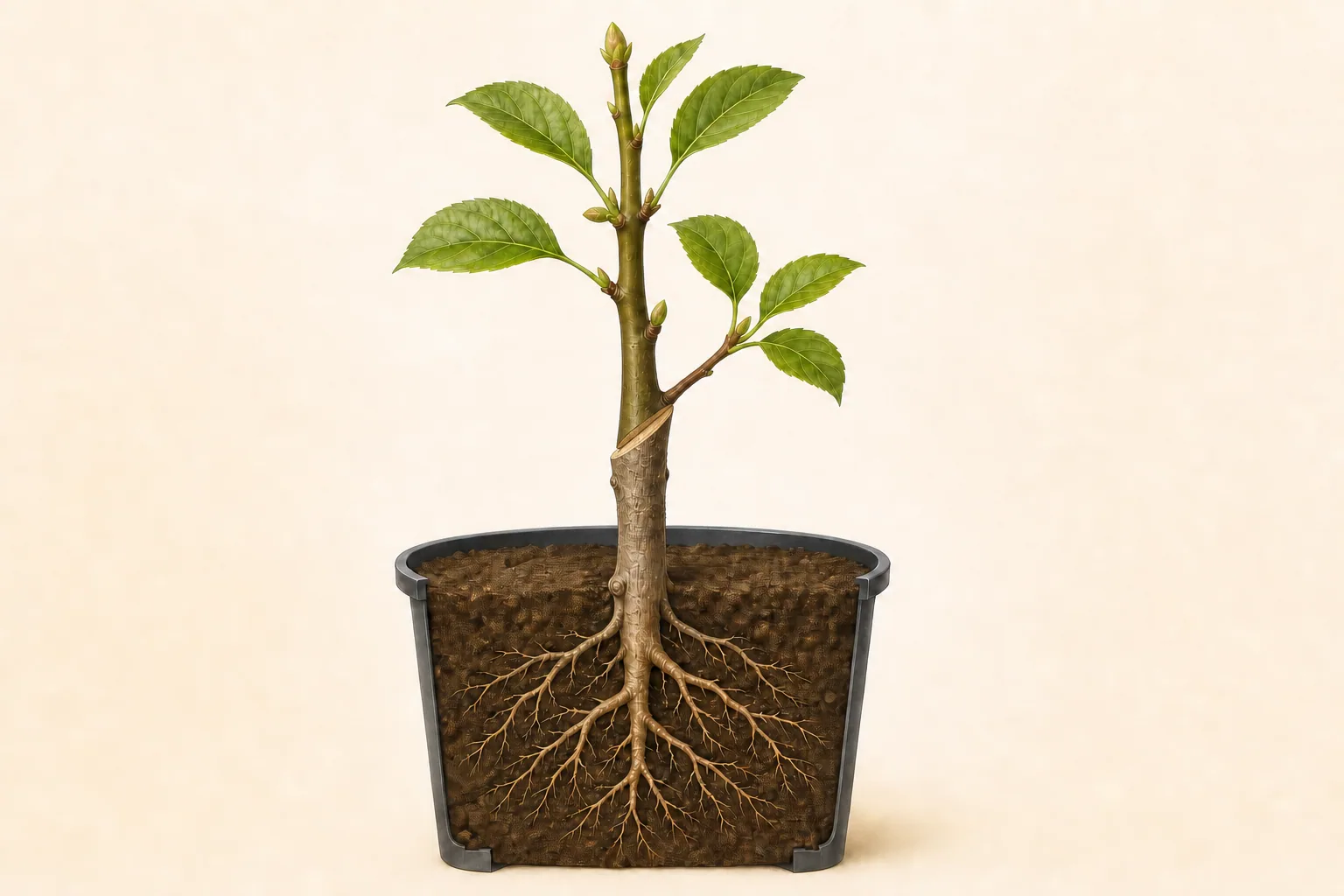
Two roles, one grafted plant
The scion and rootstock usually do not come from the same cultivar. This table gives a first map of their positions and roles:
| Role | Usual position | Main contribution |
|---|---|---|
| Scion | Above the graft union | The shoots, leaves, flowers, fruit, and the cultivar traits people notice |
| Rootstock | Below the graft union | The roots and sometimes the lower stem; it may also influence vigor, size, or support |
For example, the scion of a fruit tree may come from the cultivar whose fruit characteristics a grower wants to preserve. The rootstock may come from another plant material selected for its root system and lower stem. The goal is to place both sets of traits in one plant, not to make the upper and lower parts grow as two separate trees.
This is why the leaves or fruit of a grafted tree do not necessarily tell you what its roots are like. The upper and lower parts may have different origins while sharing one functional graft union.
What happens at a graft union?
In many woody stems, or stems with secondary growth, a thin growth region called the cambium lies between the xylem and phloem. It keeps producing new cells as the stem expands. Xylem is mainly associated with water transport, while phloem transports organic materials made or stored by the plant.
During grafting, the scion and rootstock are cut so that their surfaces can be brought together. The important point is not simply that the bark touches. The cambial regions need close alignment and contact, at least along one side. Surviving cells near the wound, including parenchyma near the cambium, proliferate to produce callus tissue. New tissues from the two partners gradually form a cellular bridge across the junction.
Some cells in and near the bridge then differentiate, developing specialized structures and functions. New xylem and phloem form, while cambial continuity also develops. These changes can overlap, and their order and pace vary with the plant and conditions. Callus growth alone does not mean that a complete vascular connection has formed.
As these connections develop, water from the rootstock may reach the scion and organic materials made in the scion’s leaves may move to other parts of the plant. The two plants do not instantly become one genetic individual; instead, two source tissues develop a working connection at the union.
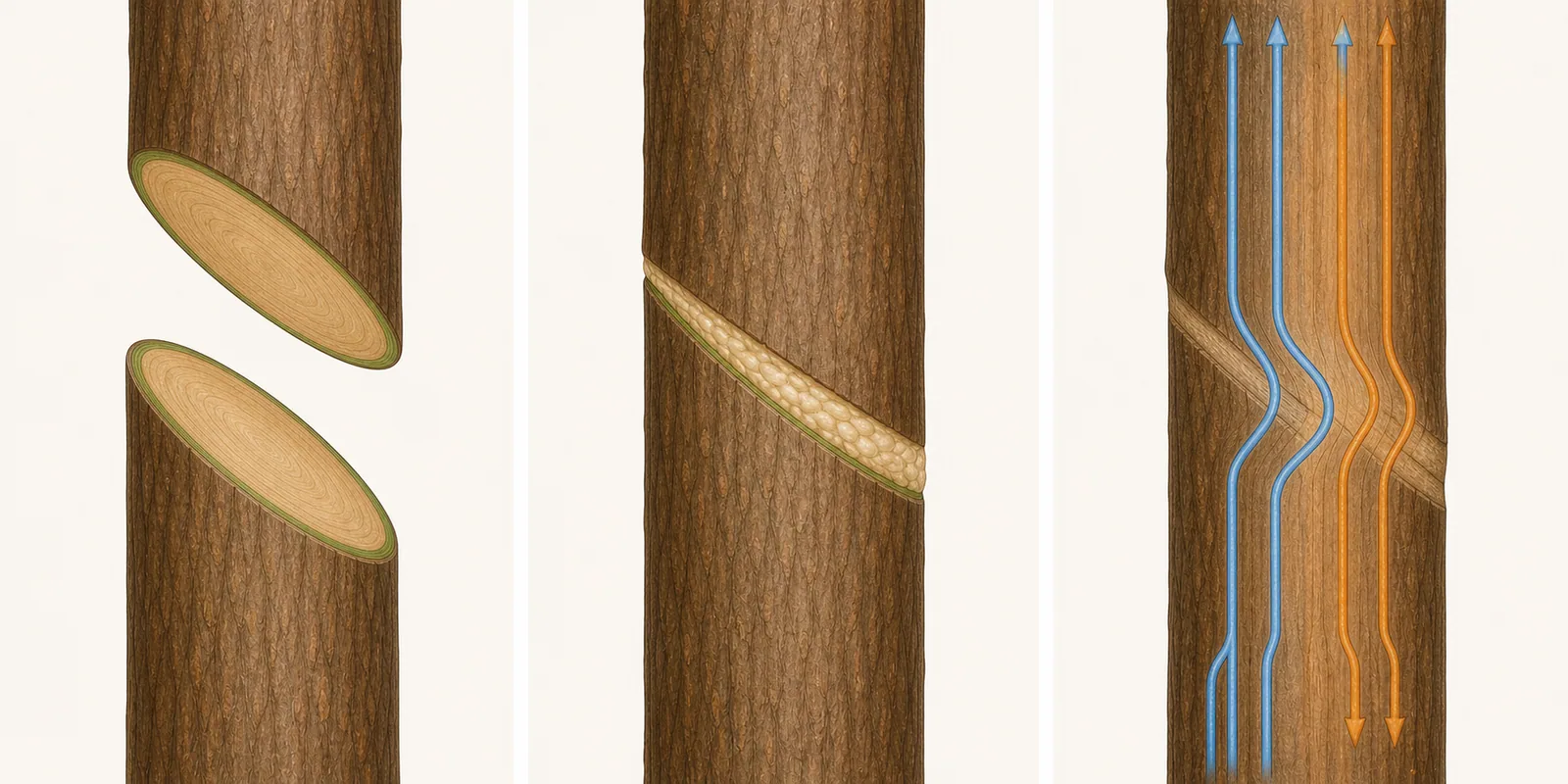
How do two stems grow a living connection?
Explore graft healing, from new cells to renewed transport.
Gold frame: one side of the junction
Scion above · Rootstock below
Find the living growth regions
The cambium is a thin layer between xylem and phloem. Close alignment helps new tissue near the wound connect across the union.
Contact, without a complete new pathwayA conceptual model of a woody scion graft. Stages are not days; tissues and cells are enlarged.
About this model
Wound responses, cell proliferation and differentiation overlap, and the two partners may progress at different rates. Callus can arise from different living tissues near the wound; mature xylem vessels are not shown dividing. Cambial development, vascular reconnection and healing time vary with the plant and conditions.
Here, sugars move from mature leaves toward roots. Phloem transport follows source–sink relationships and is not always downward. The model shows a compatible connection developing; cambial alignment or callus growth alone cannot guarantee long-term compatibility.
Grafting includes more than one technique
The everyday word “grafting” covers more than one method. Scion grafting uses a short stem piece with one or more buds as the scion. Budding, or bud grafting, uses a single bud with a small surrounding piece of tissue. The materials differ in size, but both methods depend on close contact between the scion and rootstock, protection from drying, and healing at the graft union.
The suitable method can vary with the plant, the thickness of the material, and the growth stage. Understanding the scion, rootstock, cambium, and graft union is more useful than memorizing one cutting pattern and applying it to every plant.
Why combine a scion with a rootstock?
Common plant-science and horticultural reasons for grafting include:
- Preserving an existing cultivar: A mature scion can continue its established shoot, leaf, flower, or fruit characteristics. Seed propagation can produce a different genetic combination.
- Combining traits from the root system and the shoot: A rootstock supplies roots and a lower stem, and some rootstocks can influence vigor, plant size, or support.
- Propagating cultivars that do not root easily from cuttings: Grafting can provide a different route when a piece of stem does not readily form its own root system.
- Replacing the upper part of an established plant: In some fruit-tree situations, a new scion can be placed onto a root system or tree that is already established.
These are common reasons grafting is used. Grafting success also depends on how closely related the plants are, the condition of the scion and rootstock materials, the quality of the graft union, and the growing environment.
Why compatibility matters
Grafting requires graft compatibility: the scion and rootstock must be able to heal together and develop a stable, functioning connection. Closely related plants generally have a better chance of forming a lasting union. Different cultivars of the same species are often more compatible than plants that are only distantly related.
A union that looks connected at first is not automatically a long-term success. Some combinations may start new growth and later become unstable or grow out of balance. Grafting is therefore not a matter of attaching any two plants together, and one successful example should not be treated as a rule for every species.
What can you notice on a grafted plant?
A purchased grafted fruit tree or ornamental plant may show a slightly raised, uneven, or different-width line on the stem above the root collar. That line can mark the graft union. The bark, stem thickness, or growth habit above and below it may also look somewhat different.
The point of this observation is not to diagnose a plant from one visual clue. It is to understand that the plant may be built from two sources. The shoot system does not have to look like the root system; if a functional graft union forms, both parts can work together in one plant.
Common mix-ups
- ✕ Grafting turns two plants into one mixed new cultivar.
- ✓ The scion and rootstock usually retain their own genetic backgrounds. They connect and grow together at the union rather than mixing into one new cultivar.
- ✕ The scion is the root system, and the rootstock only holds the plant upright.
- ✓ The scion usually forms the upper part, while the rootstock supplies the roots and sometimes the lower stem.
- ✕ If two cut surfaces touch, the graft will succeed.
- ✓ Compatibility, cambial contact, and conditions that allow the union to heal are all important.
- ✕ Grafting and cutting propagation are the same.
- ✓ A cutting usually has to form its own roots; a grafted scion is attached to a rootstock that already supplies a root system.
- ✕ The rootstock only absorbs water and cannot affect the shoot.
- ✓ The rootstock supplies the root system and may influence vigor, size, or other whole-plant traits. The result depends on the scion, rootstock, and environment together.
Frequently Asked Questions
Is grafting a form of asexual reproduction?
Usually, yes. Grafting uses existing plant parts such as a scion and a rootstock; it does not begin with the fusion of pollen and an ovule. Like cutting propagation and plant division, it uses the plant body to continue or reproduce a plant.
What is the main difference between a scion and a rootstock?
The scion is usually above the graft union and develops the shoots, leaves, flowers, or fruit. The rootstock is below it and supplies the roots and sometimes the lower stem. They can come from different cultivars, and sometimes from different but relatively close plant relatives.
Where is the cambium?
The cambium is a thin growth region inside the stem, between the xylem and phloem. “Bark touching bark” is not enough to show that the cambium is aligned; the cambial regions need close contact along at least one side of the graft.
Why cannot any two plants be grafted together?
The tissues of different plants do not always heal together or develop a stable vascular connection. Closely related combinations often have a better chance, but the plant names alone cannot guarantee a grafting result.
How is grafting different from growing a plant from seed?
Seeds form through pollen, ovules, and fertilization, then recombine genetic information in a new generation. Grafting uses an existing scion, so it can continue the scion’s established cultivar traits while using the rootstock’s root system. The two methods begin with different biological processes.
Will fruit from a grafted plant combine the traits of the scion and rootstock?
Fruit produced by shoots that grow from the scion usually shows the scion’s cultivar traits. The rootstock mainly supplies the roots and lower structure, though it can influence whole-plant growth. If a separate shoot grows from below the union, it comes from the rootstock and should not be confused with a scion shoot.
Related Terms
- Grafting: joining a scion to a rootstock so the two parts can heal and grow together.
- Scion: a bud or shoot attached to a rootstock, usually forming the upper part of the grafted plant.
- Rootstock: the plant material that receives the scion and supplies the roots and sometimes the lower stem.
- Graft union: the region where scion and rootstock heal and develop a working connection.
- Cambium: a growth region between xylem and phloem that produces new cells and contributes to stem thickening.
- Callus tissue: a group of cells produced near a plant wound that can help bridge a graft union.
- Graft compatibility: the ability of a scion and rootstock to heal together and form a stable connection.
- Scion grafting: a grafting method that uses a short stem piece as the scion.
- Budding: a grafting method that uses a single bud and nearby tissue as the scion.
- Xylem: vascular tissue mainly associated with moving water and minerals through the plant.
- Phloem: vascular tissue that transports organic materials made or stored by the plant.
Read Next
Evidence
References
These sources were used to check the plant-science concepts and gardening context in this article.
View sources and further reading (10)
- courses.cit.cornell.edu — BiolGBLeft.html
- pubmed.ncbi.nlm.nih.gov — 25891401
- content.ces.ncsu.edu — 13 propagation
- extension.psu.edu — fruit tree propagation bench grafting
- extension.oregonstate.edu — em 9075 growing hazelnuts pacific northwest plant propagation
- open.lib.umn.edu — 10 1 grafts and wounds
- propg.ifas.ufl.edu — 04 graftingterms graftunion.html
- extension.missouri.edu — g6971
- extension.illinois.edu — selection fruits
- extension.umn.edu — growing apples