
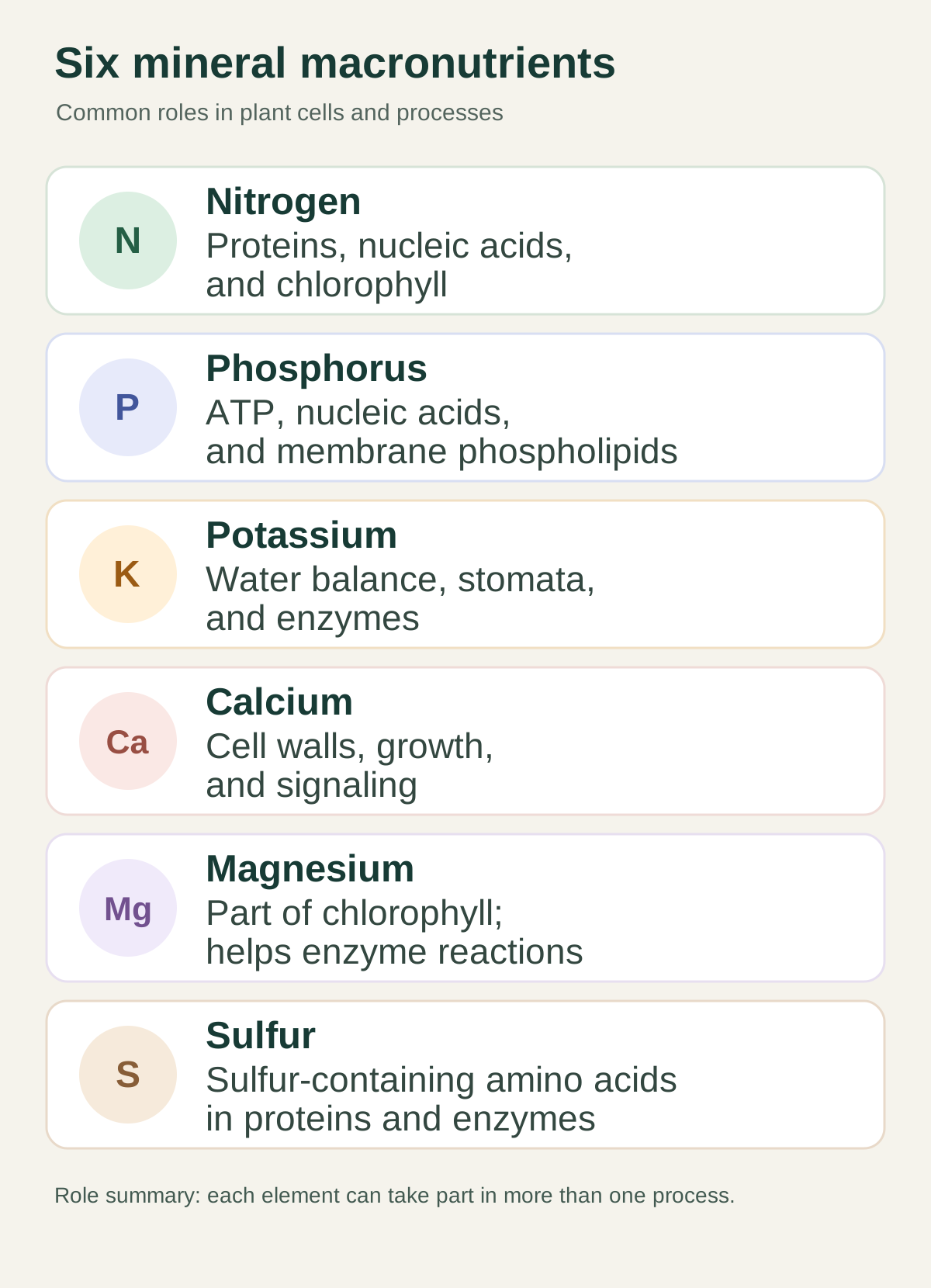
The six mineral macronutrients plants need are nitrogen (N), phosphorus (P), potassium (K), calcium (Ca), magnesium (Mg), and sulfur (S). They help build molecules, transfer energy, regulate water, support cell walls, and carry out many other jobs. Macro refers to the relatively large amounts plants need; it does not mean these elements are more important than micronutrients.
Carbon, hydrogen, and oxygen also count as macronutrients when we consider all essential plant elements. Plants get most of these three from air and water. This article focuses on the six mineral macronutrients commonly discussed in gardening. For the broader picture, see why plants need mineral nutrients; nitrogen, phosphorus, and potassium have their own detailed guide.
Why some are called primary and others secondary
Plant nutrition guides often call N, P, and K primary macronutrients and Ca, Mg, and S secondary macronutrients. The labels describe a general difference in the amounts plants need. Calcium, magnesium, and sulfur are still essential macronutrients. “Secondary” does not mean optional or less important.
These mineral nutrients usually reach roots as dissolved ions in water, then enter the plant and move to where they are needed. A nutrient being present in soil or growing medium does not mean it is available to the plant at that moment. For what happens after uptake, see how plants transport nutrients.
Each element has more than one role. Nitrogen becomes part of amino acids, proteins, nucleic acids, and chlorophyll. Phosphorus is part of nucleic acids, the phospholipids in cell membranes, and molecules such as ATP that transfer energy within cells. Potassium usually works as the ion K⁺, helping regulate water and ion balance, stomatal movement, and enzyme activity. Read more about N, P, and K if you want to follow those roles further.
What calcium, magnesium, and sulfur do
Calcium can link pectin molecules in cell walls, helping support their structure. It also takes part in cell growth and signaling. A cell wall is a supportive layer outside a plant cell, but calcium does more than strengthen plant tissues.
Magnesium is part of chlorophyll, the pigment that helps plants capture light for photosynthesis. It also participates in many enzyme reactions. How chlorophyll works explains the pigment in more detail.
Sulfur is part of sulfur-containing amino acids, including cysteine and methionine. Those amino acids become part of some proteins and enzymes. Both nitrogen and sulfur appear in proteins, but they contribute to different molecular structures; one cannot replace the other.
Knowing a nutrient’s role is not a diagnosis
Leaf color, growth rate, and changes in new shoots do not, by themselves, identify which nutrient a plant may lack, but they can help narrow down possible causes when assessing a plant problem. Water, light, root condition, growing medium, and nutrient availability can all affect what you see. Plant growth is not controlled by six separate switches. Understanding the elements’ physiological functions and roles within the plant can help you assess problems involving plant growth and nutrient supply.
Common mix-ups
- ✕ A macronutrient matters more than a micronutrient.
- ✓ The groups describe relative amounts needed. Essential elements in both groups have roles that other elements cannot simply take over.
- ✕ Potassium forms the structural “skeleton” of stems.
- ✓ Potassium mainly acts as an ion in water and ion balance, stomatal movement, and enzyme activity. It is not the material that builds woody structure.
- ✕ Each nutrient has one job, so a leaf’s appearance reveals which one is lacking.
- ✓ Nutrients take part in several processes, and similar changes in appearance can have different causes.
Frequently Asked Questions
Which six mineral macronutrients do plants need?
They are nitrogen, phosphorus, potassium, calcium, magnesium, and sulfur. Carbon, hydrogen, and oxygen also qualify as macronutrients by amount needed, but plants obtain most of them from air and water. This article focuses on the six mineral elements.
Why are calcium, magnesium, and sulfur called secondary macronutrients?
It is a common way to group nutrients by their relative amounts needed: N, P, and K are called primary, while Ca, Mg, and S are called secondary. The word does not rank their importance or make them optional.
Is potassium part of a plant’s structural framework?
No. Potassium usually acts as K⁺, contributing to water and ion balance, stomatal movement, and enzyme activity. That differs from the materials that make up cell walls.
Can yellow leaves tell me which nutrient is missing?
No single change in appearance is enough to identify a nutrient problem. Light, water, roots, and the growing medium can also affect leaf color. This article explains nutrient functions, not how to diagnose a particular plant.
Related Terms
- Macronutrient: An essential element a plant needs in a relatively large amount. This article focuses on six mineral macronutrients.
- Secondary macronutrient: A common plant-nutrition label for Ca, Mg, and S, which plants generally need in smaller amounts than N, P, and K. It does not mean less important.
- Ion: An atom or molecule with an electric charge. Potassium commonly acts as K⁺ in plant cells.
- Chlorophyll: A light-absorbing pigment in plants that contains magnesium.
- ATP: A molecule cells use to transfer energy; it contains phosphate groups.
Read Next
- Why do plants need mineral nutrients?
- What do nitrogen, phosphorus, and potassium do?
- How do plants transport nutrients?
Evidence and attribution
Sources and image rights
These sources were used to check the plant-science concepts and gardening context in this article.
View sources and further reading (5)
Image sources and rights
- Plant Note project-made image · Created by Plant Note; no third-party image license applies — Created in SVG and served in its original format.