
Model of stomatal opening and closing
SolutesWater
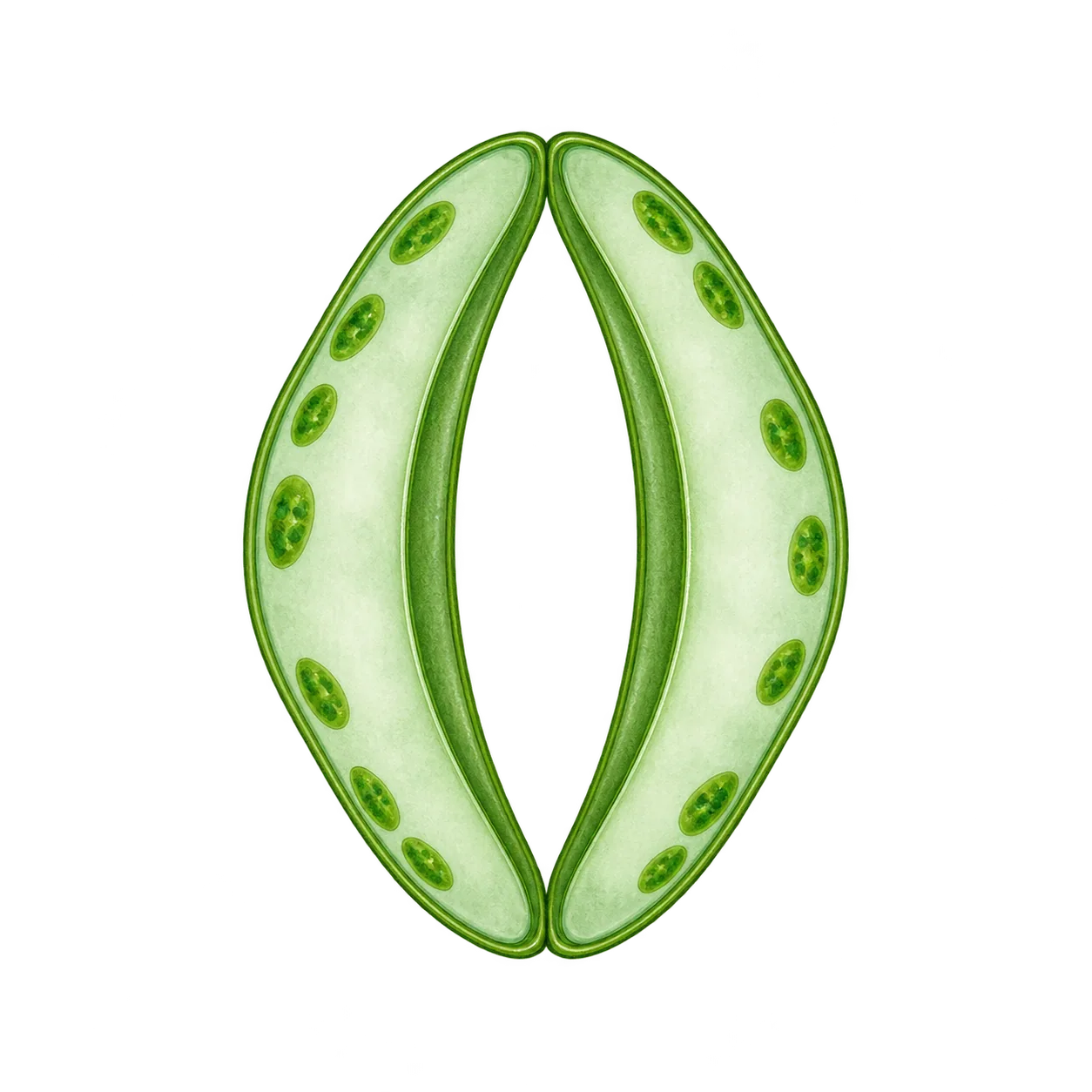
Mechanism: osmosis and guard-cell mechanics. Schematic kidney-shaped cells; dots indicate solute and water movement.
Plants usually close stomata when water loss becomes risky
Plants often narrow their stomata when the risk of losing water rises. Hot, dry, windy conditions, or a plant whose water supply is becoming limited, can all favor a smaller stomatal opening. For many terrestrial C₃ and C₄ plants, stomata are also usually narrower at night than during the day.
This is not a universal timetable shared by every plant. Stomata respond to light, water status, air dryness, temperature, carbon dioxide, and plant type together. The plant is balancing two connected needs: allowing carbon dioxide into the leaf while limiting how much water vapor escapes.
Vapor pressure deficit (VPD) describes how strongly the surrounding air can draw water vapor from a leaf. Dry air generally creates a higher VPD and can increase the risk of water loss. That is why stomata may narrow not only at night or during drought, but also in the middle of a bright, hot day.

What is the plant balancing when a stoma closes?
A stoma is a tiny opening in the leaf epidermis. A pair of guard cells controls its aperture. For a basic introduction to the structure, see What are stomata?.
When the pore is more open, carbon dioxide can enter the leaf more easily and support photosynthesis. At the same time, water vapor can leave the leaf more easily through the same opening, contributing to transpiration. When the pore narrows, water loss usually decreases, but carbon dioxide entry is limited as well.
So “closing the stomata” does not mean the plant shuts down. It means the gas-exchange pathway becomes narrower. Plants continually adjust the balance between acquiring carbon and conserving water. What is transpiration? explains how water vapor leaves the leaf, while What is photosynthesis? explains why carbon dioxide entering the leaf matters.

Conditions that can favor stomatal closure
Limited water supply
When soil water is low, or the leaf is losing water faster than roots can replace it, the plant can activate water-conservation responses. One important signal is the plant hormone abscisic acid (ABA). ABA acts on guard cells and changes their internal ion and water balance. As guard-cell turgor falls, the stomatal pore may become narrower.
This is not a simple rule that the leaf must first wilt visibly before the stomata respond. Cell-level regulation, root and leaf water status, hormone signals, and the surrounding environment can affect stomata together. A general reader should not treat visible appearance as a direct stomatal measurement.
Use the button below to follow an ABA hormone signal into stomatal closure. Turgor is the pressure of fluid inside a cell against its wall. Blue dots in the model represent liquid water; water leaving a guard cell does not mean it evaporates directly into the air.
Heat, dry air, wind, or high VPD
Heat, dry air, or moving air that removes the humid layer near a leaf can make water escape more readily. These conditions can increase the pressure to conserve water, so a plant may narrow its stomata. A high VPD may encourage faster narrowing, but VPD is not a single on/off switch; the response can involve both chemical signals such as ABA and rapid changes in water movement. Species, light, root water supply, and current water status all matter.
Periods without light
For many terrestrial C₃ and C₄ plants, the absence of light at night is associated with a smaller stomatal aperture than during the day, though the stomata may not close completely. The daily rhythm still varies with species and conditions.
The carbon dioxide concentration inside the leaf can also contribute to regulation. When internal carbon dioxide is already relatively high, the plant may have less reason to maintain a wide pore. This is why “more light always means more open stomata” is too simple. Around a hot, dry midday period, high vapor pressure deficit or water stress can still favor partial closure.
Some plants follow a different schedule. Plants using CAM photosynthesis, including cacti and some succulents and other plant groups, often open their stomata at night to take in carbon dioxide and keep them narrower during the hot daytime period. The carbon dioxide taken up at night is converted into organic acids, often malic acid, and stored. During the day, it is released again for carbon fixation. How are C₃, C₄, and CAM plants different? explains this separation in time.
Does closing stomata affect photosynthesis?
It can, but “closed” should not automatically be translated as “photosynthesis stops immediately.” As stomata narrow, the movement of carbon dioxide into the leaf can decrease, which can limit carbon fixation. On the other hand, a narrower pore can reduce water loss and help prevent the plant’s water status from deteriorating further.
This is a protective response with a cost. If a plant kept stomata wide open in hot, dry conditions, it could lose too much water. If it kept them closed whenever water was available, it would restrict carbon dioxide entry. Stomatal regulation is the plant’s changing compromise between those demands.
Can you see stomatal closure on a potted plant?
You usually cannot see an individual stoma or determine its aperture with the naked eye. A leaf that becomes soft or droops on a hot day may be experiencing a change in water status, but that does not directly show that the stomata are closed. A leaf that looks normal does not prove that every stoma is fully open either.
For gardening observation, it is more useful to treat stomata as one physiological clue. Consider the time of day, light, temperature, humidity and air movement, as well as the potting medium and root environment. These clues can explain why a plant might reduce water loss, but they are not a diagnosis or a fixed watering schedule.
Common confusions
- ✕ Every plant closes all its stomata as soon as night begins.
- ✓ Many plants have narrower stomata at night, but species, conditions, and CAM photosynthesis can change the rhythm.
- ✕ Closing stomata means the plant cannot photosynthesize at all.
- ✓ Narrower stomata can limit carbon dioxide entry and reduce photosynthetic carbon fixation, but “limited” does not mean every process stops instantly.
- ✕ A drooping leaf proves that stomata are closed.
- ✓ Stomata are related to water balance, but leaf appearance can also reflect roots, the potting medium, temperature, light, and airflow.
- ✕ More light always means more open stomata.
- ✓ Light often promotes opening, but high internal carbon dioxide, midday vapor pressure deficit, or water stress can still reduce aperture.
- ✕ Stomatal closure is always harmful.
- ✓ Closure can conserve water, but it also restricts carbon dioxide entry. It is a tradeoff rather than a simple good-or-bad state.
Frequently Asked Questions
Do plants close their stomata during the day?
They can. When water supply is limited or the pressure to lose water becomes high, a plant may narrow its stomata during daylight. Daylight does not guarantee that stomata remain at their widest opening.
Why might stomata narrow around midday?
Sunlight may be strong around midday, but temperature and VPD can also be high. If the air is dry or the plant cannot replace water as quickly as it loses it, water conservation may become more important. Stomata may narrow temporarily even in bright light.
Do stomata close on hot days because plants are afraid of heat?
More precisely, heat, dry air, and wind can make water leave the leaf more readily. The plant may give water conservation higher priority and narrow the stomata. This can reduce water loss, but it can also reduce carbon dioxide entry.
Does a plant wilt before it closes its stomata?
There is no single sequence that applies to every plant. Stomatal regulation can begin before obvious wilting, and it responds to root and leaf water status, hormone signals, and environmental conditions. Visible wilting is not a direct measurement of stomatal aperture.
Can you tell whether stomata are closed just by looking at a leaf?
No. Individual stomata are not directly visible to the naked eye, and leaf drooping, softness, or a normal appearance can have several possible causes. Leaf appearance may provide context, but it does not directly measure stomatal aperture.
Why do many succulents open their stomata at night?
Many CAM plants open stomata at night, when conditions are often cooler and less dry, to take in carbon dioxide. They usually keep stomata narrower during the day to reduce water loss. This is a photosynthetic adaptation, not a schedule shared by all succulents or all plants.
How are stomatal closure and transpiration connected?
Stomata are one important route for water vapor to leave a leaf. When they narrow, water loss through that route usually decreases. Actual transpiration also depends on the cuticle, leaf structure, and surrounding air conditions.
Do plants still respire when their stomata are closed?
Yes. Respiration is how living cells release usable energy from organic materials, and it is not the same thing as stomatal movement. Stomata affect gas exchange between the leaf and the air; they do not mean that the whole plant stops respiring. See Do plants breathe? for the distinction.
Related terms
- Stoma: a tiny adjustable opening in the plant epidermis that participates in gas exchange and water-loss regulation.
- Guard cells: a pair of cells surrounding a stoma and controlling its aperture through changes in turgor.
- Transpiration: the movement of water vapor from a plant into the surrounding air.
- Vapor pressure deficit (VPD): a measure of the atmosphere’s drying demand and its potential to draw water vapor from a leaf.
- Abscisic acid (ABA): a plant hormone involved in stress and water regulation that can promote stomatal closure.
- Turgor: pressure produced when water inside a cell pushes against its cell wall, affecting the cell’s firmness and shape.
- CAM photosynthesis: a pathway in which part of carbon dioxide uptake and later photosynthetic use are separated between night and day, common in some drought-adapted plants.
Read Next
Evidence
References
These sources were used to check the plant-science concepts and gardening context in this article.
View sources and further reading (19)
- openstax.org — 30 4 leaves
- openstax.org — 30 5 transport of water and solutes in plants
- openstax.org — 30 6 plant sensory systems and responses
- openstax.org — 8 1 overview of photosynthesis
- labs.biology.ucsd.edu — clickablegc.html
- nature.com — srep32143
- nature.com — srep12449
- pubmed.ncbi.nlm.nih.gov — 15753314
- annualreviews.org — annurev arplant 042809 112226
- pmc.ncbi.nlm.nih.gov — PMC4679528
- academic.oup.com — 6117386
- pmc.ncbi.nlm.nih.gov — PMC1761996
- pmc.ncbi.nlm.nih.gov — PMC5750630
- pmc.ncbi.nlm.nih.gov — PMC8455429
- pmc.ncbi.nlm.nih.gov — PMC5761775
- pubmed.ncbi.nlm.nih.gov — 27807136
- academic.oup.com — 4191306
- askabiologist.asu.edu — cam plants
- extension.umn.edu — watering established trees and shrubs