
When a plant is under stress, it often slows some growth processes first. Making new leaves, extending stems, and producing new roots all require water, organic compounds made through photosynthesis, mineral nutrients, and cells that can function normally. If drought, low light, unsuitable temperatures, salinity, or low root-zone oxygen makes one of these a limiting factor, the plant may reduce cell expansion and new growth while reserving some resources for maintaining cells and responding to changing conditions.
This does not mean that every plant slows down in the same order, or that “slow growth” identifies one cause. It is better understood as an outcome of the plant adjusting the balance among growth, maintenance, and environmental response.

What does “stress” mean in plant biology?
Plant stress does not mean that a plant has emotions. It means that environmental conditions are limiting growth, metabolism, or development. Common environmental limits include insufficient water, too little or excessively intense light, temperatures that are too low or too high, salinity that creates osmotic and ionic stress, and long-lasting waterlogging that reduces oxygen around the roots.
An unsuitable condition does not necessarily become “stress” immediately. Plant species, developmental stage, stress intensity, and duration all affect the outcome. The same temperature may mean something different to a cold-tolerant plant and a tropical plant. A brief change may simply be an adjustment, while a stronger or longer-lasting limit may cause visible damage.
Slow growth alone cannot identify which environmental limit is involved. To compare dormancy, acclimation after a move, and environmental stress, see Why Does a Plant Look Like It Has Stopped Growing?.
Growth requires more than simply staying alive
Plant growth includes several connected processes: growth points produce new cells, cells expand, tissues form, and water, carbon, and mineral nutrients move to where they are needed. Shoot tips and root tips often contain meristems—tissues that can keep producing new cells. For a cell to expand, it also needs enough water to create turgor pressure, allowing the cell wall to stretch in a controlled way.
So a plant that is not obviously getting taller is not necessarily inactive everywhere. Roots may still be adjusting, a bud may be alive but not yet opening, or the plant may be maintaining existing leaves instead of investing heavily in new ones. For an introduction to shoot tips, cell division, and cell expansion, see How Do Plants Grow Taller? From Shoot Tips to Cell Expansion.
When water, energy, or building materials are limited, growth is often one of the first processes affected. New growth requires continued investment; temporarily making one fewer leaf may be easier to adjust than allowing already functioning tissue to fail.
How can stress slow growth?
Insufficient water: cells have more difficulty expanding
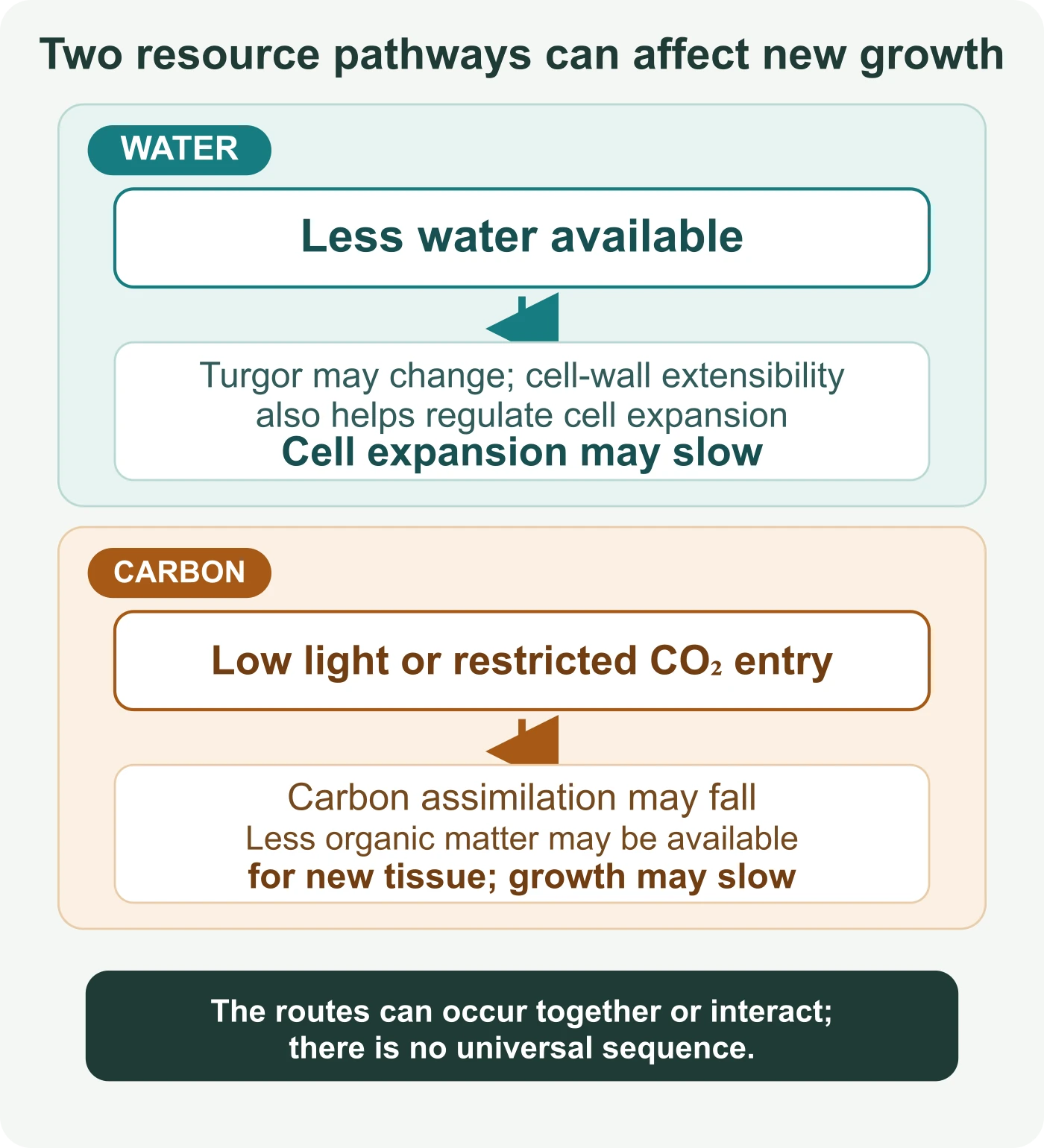
Cell expansion requires water to enter the cell and generate the turgor pressure that helps tissues unfold. When water is unavailable or supply cannot keep up with water loss, cell expansion may slow first. Young leaves, tender shoots, and root tips may therefore grow more slowly. Drought can also reduce stomatal opening, limiting water loss but potentially restricting carbon dioxide entry and slowing photosynthesis. See What Happens to Plants When They Lack Water? for this possible sequence of responses. It is a common physiological pattern, not a fixed timetable for every plant.
Low or excessive light: available carbon and energy change
Photosynthesis converts light energy and carbon dioxide into organic compounds a plant can use. In low light, the plant may accumulate less carbon, leaving fewer materials for new leaves, stems, and roots. Under excessively intense light, especially with high temperature or inadequate water, leaves may also face excess light energy and water-loss stress.
That is why “more light always means faster growth” is not accurate. Photosynthesis, respiration, temperature, and water supply need to be considered together. Read What Is Photosynthesis? to see where organic compounds and energy for growth come from, then Do Plants Respire? to distinguish production from consumption.
Unsuitable temperatures: reaction rates and water balance shift together
Temperature affects photosynthesis, respiration, transpiration, and many cellular reactions. At low temperatures, many reactions may slow. At high temperatures, respiration costs, leaf water loss, and the risk of damage to proteins or cell membranes may increase. The suitable range depends on the species and cannot be reduced to one number for every potted plant.
If daytime photosynthesis produces less organic material, or high temperature increases respiratory consumption, fewer resources may remain for new growth. This can help explain why a plant may produce fewer new leaves during cold seasons, heat waves, or sudden temperature changes. It does not mean that every seasonal slowdown is stress, nor can temperature alone identify the cause.
Long-term wet roots: having water does not mean roots can work normally
Roots need water and oxygen in the pore spaces around them. When a growing medium remains saturated for a long time, air exchange may decline, affecting root respiration and uptake. The shoot may then show clues such as slower growth, limp leaves, or smaller new leaves.
This is easily confused with “there is water in the pot, so the plant cannot be short of water.” In reality, whether roots can obtain water also depends on root health, water potential, pore spaces, and oxygen. Why Do Roots Need Air? explains this pathway. A wet or dry surface alone cannot reveal the full condition of the root zone.
Salinity and nutrient supply: both water access and building materials can be limited
When salinity is high, roots may have more difficulty taking up water even when water is visible in the medium. Prolonged or stronger salinity can also cause ionic imbalance and cellular damage. The plant may show inhibited growth, scorched leaf margins, or smaller new growth, but these appearances often overlap with other forms of water stress.
Nutrient deficiency or imbalance can limit cell division and the production of chlorophyll, proteins, and other plant materials. However, a small new leaf or yellowing leaf cannot identify a particular missing element by itself. Roots, medium pH, water, and light can also affect nutrient acquisition. For background on nutrient roles, see Why Do Plants Need Mineral Nutrients?.
Plants actively adjust growth priorities
Slow growth under stress is not only a matter of “not having enough materials.” Plants also use chemical signals and cellular responses to adjust which tasks come first and which are temporarily slowed. Abscisic acid (ABA) is one well-studied stress signal and may help regulate stomata during water stress. Other plant hormones, sugar signals, reactive oxygen species (ROS), and calcium signals may also participate in the network through which plants sense and respond to conditions.
One useful way to picture this is as reallocation under limited resources. A plant may prioritize cellular water status, ion balance, membrane and protein stability, and protective or repair responses, while reducing investment in some cell expansion, cell division, or new-organ development. This may improve short-term survival prospects, but it can slow new leaves, height growth, or root expansion.
“Reallocation” is not a single resource-flow diagram shared by all plants. Stress type, intensity, species, and tissue location can change the response. Some plants may maintain or increase growth in part of the root system, while others are suppressed throughout. The safer conclusion is that plants adjust priorities between growth and stress response, not that every plant sends the same proportion of resources to the same place.
Slow growth does not necessarily mean damage has already occurred
A mild or brief environmental limit may only reduce growth temporarily, and some physiological activity may gradually recover when conditions improve. That is not a guarantee of recovery, and repeated stress can still leave damage. If stress continues or intensifies, more extensive yellowing, wilting, scorched edges, leaf drop, dead root tips, or other tissue damage may develop.
Three easily confused outcomes should also be separated. Seasonal dormancy is part of the life cycle of some plants. Acclimation is an adjustment by the same plant to new conditions. A stress response is the effect of a limiting condition on current function. They can occur together, but they are not synonyms. Dormancy, Acclimation, and Stress: Why a Plant May Seem to Stop Growing compares them; this article focuses on why stress can slow physiological growth.
In garden observation, first record what is slow
“The plant is not growing” contains very little information. Without repeatedly disturbing the plant, note several changes:
- Is new-leaf expansion slower, are leaves smaller, or are stem internodes becoming longer?
- Is the shoot tip or side bud simply unchanged, or is it shrinking or changing color?
- Is the root zone relatively dry, persistently wet, or cycling sharply between dry and wet?
- Have light, temperature, wind, humidity, or location changed recently?
- Does the slowdown recur seasonally, or did it begin suddenly and keep worsening?
Place observations on a shared timeline with environmental context to see which changes occur together. Different causes can look alike, and several may occur at once. A single yellow leaf, one episode of drooping, or one small bud is not enough to identify the type of stress a plant is experiencing.
Common points of confusion
- ✕ If a plant grows slowly, it must be short of water.
- ✓ Water shortage can limit cell expansion, stomatal regulation, and photosynthesis, but low light, temperature, salinity, low root-zone oxygen, season, or the plant’s own growth rhythm can also slow growth.
- ✕ If a plant is still green, it is not under stress.
- ✓ Some physiological adjustments happen before obvious visual changes. Green leaves do not prove that every growth process is running at its original rate.
- ✕ Once stomata narrow, photosynthesis stops completely.
- ✓ Narrower stomata may restrict carbon dioxide entry and limit photosynthesis, but they do not mean that all life processes stop immediately.
- ✕ If there is water in the pot, roots must be able to take it up.
- ✓ Roots also need suitable water potential and oxygen. Long-term saturation can reduce root-zone oxygen and interfere with uptake and growth.
- ✕ A small new leaf means fertilizer is missing, so adding fertilizer will make it grow faster.
- ✓ Light, water, temperature, the root zone, salinity, and nutrients can all affect new leaves. Fertilizer cannot replace photosynthesis, and one appearance cannot identify the cause.
- ✕ Every stressed plant grows more roots first and then stops growing above ground.
- ✓ Root and shoot responses vary with species, tissue, stress type, and intensity. There is no universal sequence.
- ✕ After conditions improve, the plant will recover immediately.
- ✓ Recovery and its speed depend on species, stress duration, root and growing-point condition, and the rate at which new growth can access resources. A fixed outcome cannot be guaranteed.
Frequently asked questions
Why does a plant still look alive but go a long time without new leaves?
New leaves are not the only sign of activity. A plant may reduce new growth because of low light, temperature, water, root-zone oxygen, or another limit. It may also be seasonally dormant or acclimating after a move. Consider species, season, buds, leaves, and recent environmental changes as one timeline; the absence of new leaves alone cannot show that a growing point has died.
Does slow growth mean the plant needs fertilizer?
Not necessarily. Nutrient shortage can limit growth, but low light reduces the organic compounds that photosynthesis can accumulate, drought affects turgor, waterlogging can reduce oxygen, and unsuitable temperatures change reaction rates. Adding fertilizer immediately can overlook the real limiting factor.
Why is the plant still growing slowly after I watered it?
Watering only shows that water entered the medium at one point in time. It does not show that the root zone continuously has suitable water, oxygen, and root function. The medium may dry again quickly, or remain saturated long enough to reduce oxygen. Salinity and root damage can also affect uptake. Observe the medium, root-zone aeration, light, and temperature together rather than looking only at the act of watering.
Does low light count as plant stress?
In gardening, low light is often called an environmental stress. In physiology, it can be described more precisely by asking whether light has fallen low enough to limit photosynthesis or alter growth. Low light may not cause immediate damage, but prolonged shortage can reduce available carbon, lengthen stem internodes, or reduce new leaves. Species and their original light requirements still matter.
Why can narrower stomata make a plant grow more slowly?
Stomata are an important route for carbon dioxide to enter a leaf. Narrowing them can reduce some water loss, but it can also reduce carbon dioxide entry and limit carbon fixation by photosynthesis. If water stress or another limit continues, fewer resources may be available for growth. Stomatal regulation is a tradeoff between conserving water and obtaining carbon, not simply an on/off switch for photosynthesis.
Can low oxygen around roots slow leaves or new buds?
It can. Roots need oxygen for respiration and normal root function, including water and mineral uptake. Long-term saturation or poor aeration may reduce oxygen around roots, and the shoot may then show inhibited growth or other stress clues. Those appearances can have other causes, however; leaf condition alone cannot establish root-zone hypoxia.
Do stressed plants always grow more roots?
No. Under particular mild water limitations, some plants may change the balance between root and shoot growth. Under severe or prolonged stress, other plants may have inhibited root tips and overall growth. The result depends on species, root tissue, stress type, and intensity. “Stress promotes root growth” is not a universal rule.
Why does a plant not recover immediately after conditions improve?
Recovery depends on how long the stress lasted, whether roots and growing points still function, the species and season, and how quickly new growth can access resources. Improving conditions means that one limit may have eased; it does not mean that a new leaf will appear immediately or that damaged tissue will return to its original state.
How can I tell slow growth from dormancy?
Dormancy is usually related to species, seasonal signals, or a particular developmental stage. A stress response is current environmental limitation suppressing physiological activity. They can occur together: winter’s low light and low temperature may produce seasonal slow growth while also stressing a cold-sensitive plant. See Dormancy, Acclimation, and Stress rather than drawing a conclusion from one appearance.
Key terms
- Plant stress: A condition in which an unfavorable environment limits growth, metabolism, or development.
- Abiotic stress: Stress caused by nonliving environmental factors such as water, light, temperature, or salinity.
- Meristem: Tissue that can keep producing new cells to support shoot, leaf, or root growth.
- Cell expansion: The process in which a cell takes up water and becomes larger as its cell wall is regulated; it is important for much of new growth.
- Turgor pressure: The supporting pressure of water inside a cell against the cell wall, affecting cell shape, tissue firmness, and cell expansion.
- Stomatal conductance: A measure of how open stomata are to gas transfer; a decrease usually means less-open stomata.
- Resource allocation: How a plant invests carbon, energy, water, and nutrients in different tissues or physiological activities.
- Abscisic acid (ABA): A plant hormone involved in stress and water regulation that can affect stomata and some growth responses.
- Root-zone hypoxia: A condition in which oxygen around the roots is insufficient, often associated with long-term saturation or poor aeration.
Continue reading
Evidence and attribution
Sources and image rights
These sources were used to check the plant-science concepts and gardening context in this article.
View sources and further reading (11)
- extension.oregonstate.edu — em 9903 environmental factors affecting plant growth
- extension.usu.edu — starting vegetable seeds indoors seeding culture and transplanting
- academic.oup.com — 6100899
- academic.oup.com — 5714152
- pmc.ncbi.nlm.nih.gov — PMC5961130
- pmc.ncbi.nlm.nih.gov — PMC3252258
- openstax.org — 23 6 plant sensory systems and responses
- openstax.org — 8 1 overview of photosynthesis
- extension.usu.edu — managing saline and sodic soils
- pubmed.ncbi.nlm.nih.gov — 21388861
- doi.org — j.1469 8137.1993.tb03795.x
Image sources and rights
- Plant Note project-made image · Created by Plant Note; no third-party image license applies — The project-made SVG was adapted as WebP for delivery.