
Plants move different things in different ways
When people ask how plants transport nutrients, one word can cause a lot of confusion: nutrients.
In everyday language, nutrients may mean water, minerals from the growing medium, or the sugars a plant makes in its leaves. These are all important for growth, but they do not come from the same place or travel through the plant in the same way.
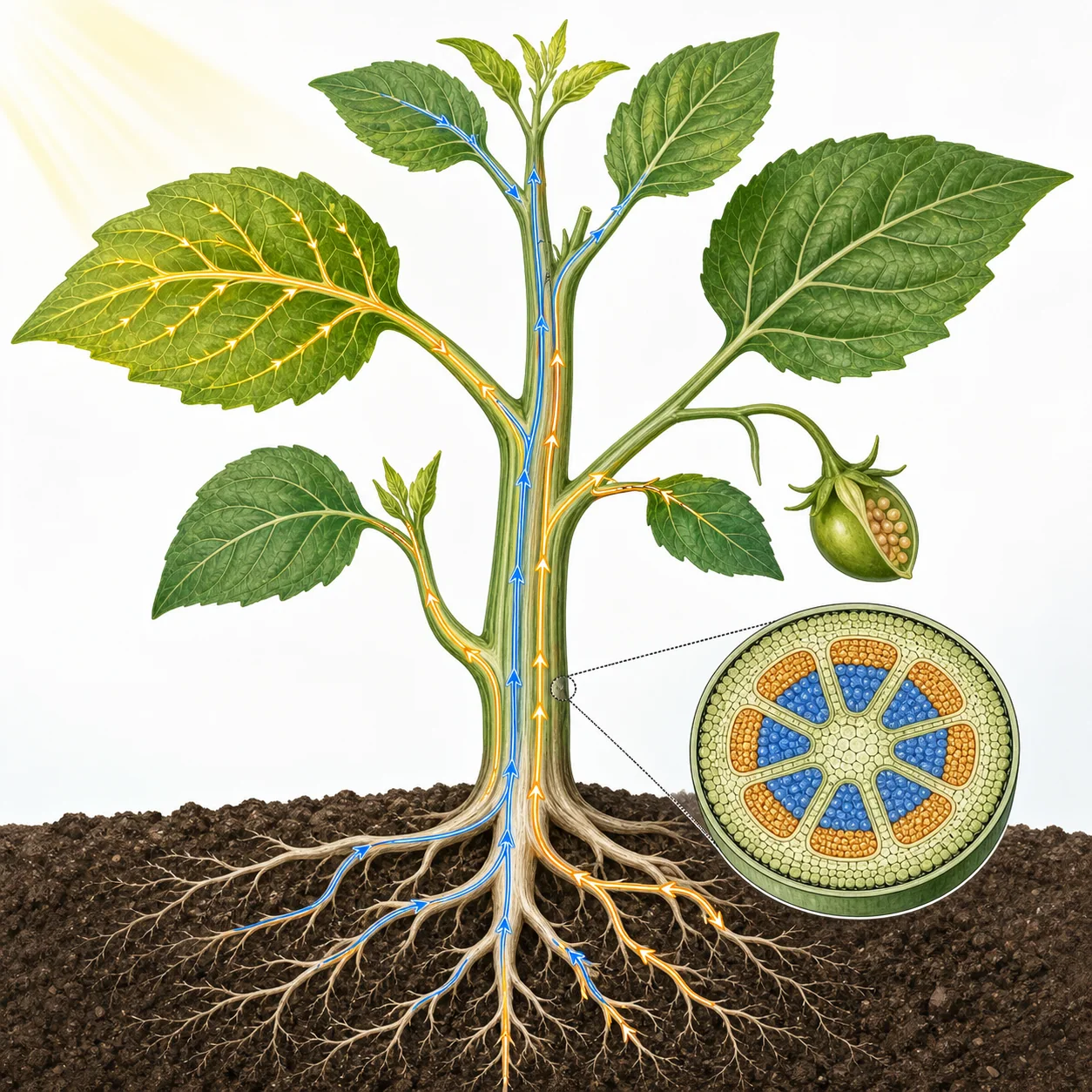
The main idea is simple: water and many mineral nutrients enter through roots and move upward mainly through xylem. Sugars and other photosynthesis products made in leaves move through phloem toward the parts of the plant that are growing, using, or storing them.
Roots, leaves, and stems are connected
Roots are a major entry point for water and mineral nutrients. Minerals are not taken up as solid chunks. They are usually dissolved in water around the roots and absorbed as ions or related forms. Fine roots and root hairs increase contact with the surrounding water, so they are closely tied to absorption.
Leaves are a major source of sugars. Through photosynthesis, leaves use light energy, carbon dioxide, and water to make sugars. Those sugars can provide energy, and they can also become building material for new cells, roots, shoots, flowers, fruits, and seeds.
Stems do more than hold a plant upright. Inside a stem, two vascular tissues—xylem and phloem—connect roots, leaves, and other organs into one transport system. Their roles are different, but they work together as part of the plant’s larger transport network.
Xylem: the upward route for water and many minerals
Xylem is easiest to understand as the main upward route for water and many dissolved mineral nutrients. After water enters the root, it can move into xylem and then travel through roots, stems, petioles, and leaf veins.
This route is closely related to transpiration. When water vapor leaves the leaf surface, the leaf needs replacement water. That pull helps move a column of water upward through xylem. Many minerals dissolved in that water can be carried upward with the flow.
This does not mean every mineral element only ever travels through xylem after it enters the plant. Some elements can be redistributed between tissues later, while others move poorly in phloem. The useful main route is: roots absorb water and many minerals, and xylem moves much of that flow upward. Later redistribution depends on the element, its mobility in phloem, and the plant’s current state.
Phloem: distributing sugars to where they are needed
Phloem mainly transports sugars and other organic products made by photosynthesis. In this context, source and sink describe what a plant part is doing at a particular time: a source is a net exporter of photosynthates, while a sink is a net user, growing tissue, or storage site. These are functional roles, not permanent organ identities, and they are mainly used here to describe the distribution of sugars and other photosynthates.
Mature leaves are often sources because they can photosynthesize and export sugars. Root tips, new shoots, flowers, fruits, seeds, and storage organs are often sinks because they are growing, developing, or storing materials.
This is why phloem should not be described as simply “the downward tube.” A mature leaf near the lower part of a plant may send sugars down to roots. A mature leaf higher up may send sugars to an even higher new shoot. A middle leaf may supply more than one direction. Phloem movement depends on the relationship between sources and sinks.
Sources and sinks can change
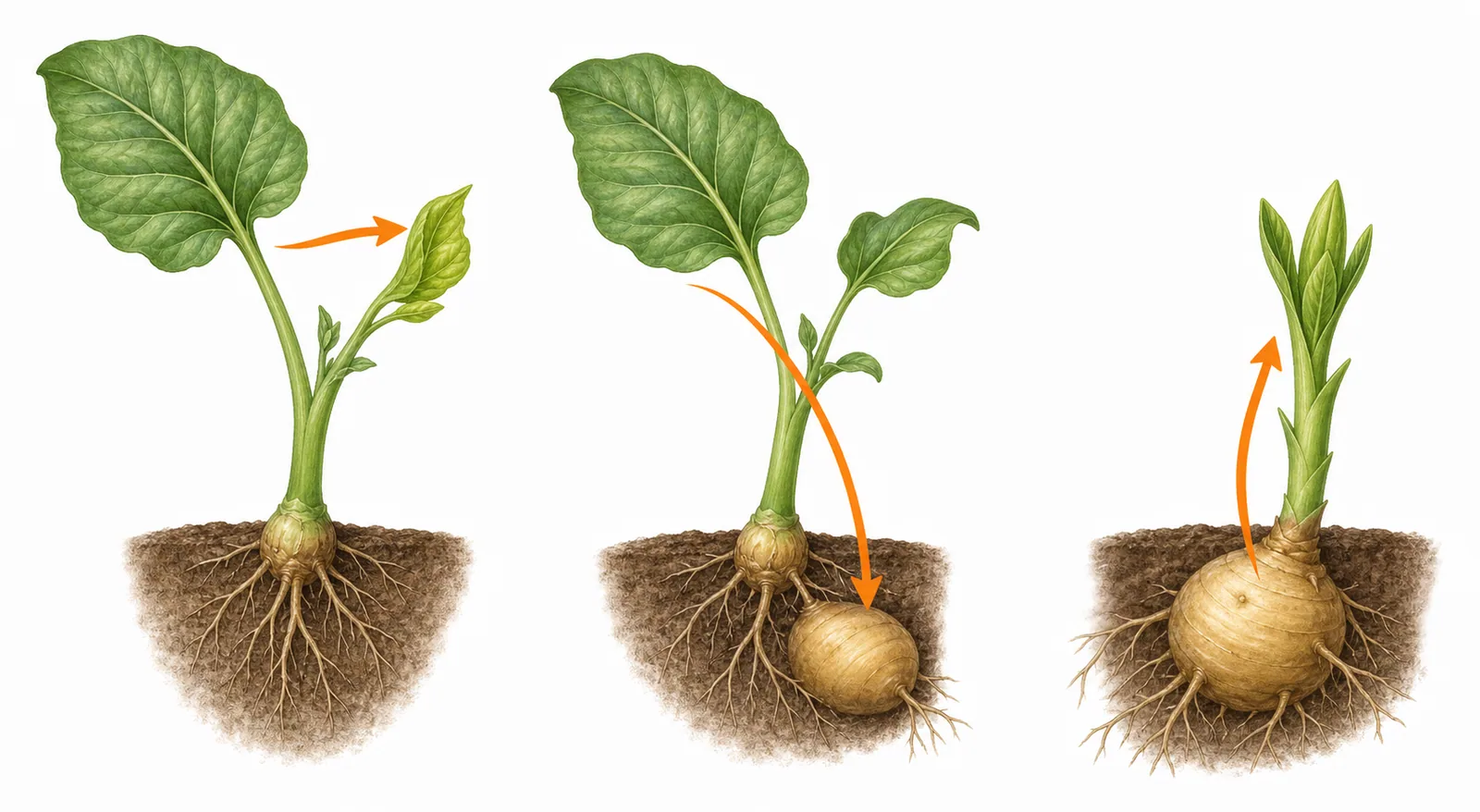
Source and sink roles can change as a plant develops. A mature leaf is often a source, but a young expanding leaf may initially need sugars from older leaves and therefore behave more like a sink. The change is not necessarily an instant switch: as photosynthesis and the leaf’s ability to export sugars increase, the role may shift gradually, and different parts of a developing leaf may not change at exactly the same time.
Storage organ is a general term here, not the name of one particular structure. Depending on the plant, it may refer to a tuber, bulb, storage root, seed, or another tissue that stores reserves. While it is forming, a storage organ often acts as a sink, receiving and storing sugars. During sprouting or renewed growth, stored reserves may be remobilized to support a new shoot or seedling, so that storage tissue may act as a source at that stage. These are common teaching examples, not a fixed timetable shared by all plants.
This helps explain why plants do not divide resources evenly across every part. Fast-growing shoots, developing fruits, new roots, flowers, seeds, and storage tissues may become strong sinks. Plant transport is a dynamic allocation system, not a fixed equal-share system.
Three things often mixed together as nutrients
Moves through xylem toward stems, leaves, and leaf veins. It also supports turgor, transpiration, and photosynthesis.
Many mineral ions enter through roots and are carried upward with xylem flow. Some elements can later be redistributed more easily than others.
Source leaves send photosynthates through phloem toward sinks such as roots, new shoots, developing fruits, or seeds.
Why this matters for plant care observations
If a plant does not receive enough usable light, its leaves may make fewer sugars through photosynthesis. The effect is not limited to those leaves. Roots, new shoots, flowers, fruits, and other sinks may also receive less carbohydrate supply.
If roots are damaged, the growing medium stays too dry for too long, or the root zone lacks enough air, the starting point for water and mineral uptake may be limited. This is one reason leaf, shoot, and flower condition often need to be understood together with roots, watering, potting medium, and airflow.
These routes are an observation framework, not a one-symptom diagnosis chart. Yellowing leaves, slow growth, weak shoots, and poor flowering can have many causes, so light, water, roots, growing medium, season, and overall plant condition still need to be considered together.
Fertilizer is not plant food
“Fertilizer is plant food” is common wording, but it can mislead beginners. Plants do not eat fertilizer the way animals eat food. Plants make sugars and other organic compounds through photosynthesis. Mineral nutrients supplied by fertilizer or the growing medium can provide elements needed for building tissues, maintaining chlorophyll, supporting enzymes, and regulating water balance.
A clearer version is: leaves make sugars, roots absorb water and mineral nutrients, and xylem and phloem move different materials to where they are needed. Fertilizer can be a mineral nutrient source, but it is not the plant’s main food and it is not a button that automatically makes a plant grow better.
Common mix-ups
- ✕ Water, mineral nutrients, and sugars all travel through the same route.
- ✓ Water and many mineral nutrients move mainly upward through xylem. Sugars and other photosynthesis products are distributed mainly through phloem toward sinks.
- ✕ Phloem only moves materials downward.
- ✓ Phloem movement depends on source-sink relationships. It can supply sinks above, below, or in different parts of the plant.
- ✕ Fertilizer is plant food.
- ✓ Fertilizer mainly supplies mineral nutrients. A plant’s sugars are made mainly through photosynthesis.
- ✕ Mature leaves, new shoots, roots, and fruits always keep the same roles.
- ✓ Source and sink roles change with development, season, storage, and growth demand.
- ✕ Knowing transport routes tells you exactly what fertilizer to add.
- ✓ Transport routes explain movement inside the plant. Plant care problems still need to be considered together with light, water, roots, growing medium, season, and overall plant condition.
Frequently Asked Questions
Do plants get nutrients from roots, or do leaves make them?
Both statements can be true, but they refer to different things. Roots mainly absorb water and mineral nutrients dissolved in water. Leaves mainly make sugars and other organic products through photosynthesis. The plant then uses xylem and phloem to move these different materials.
What is the difference between xylem and phloem?
Xylem mainly transports water and many dissolved mineral nutrients, often along the overall route from roots toward stems and leaves. Phloem mainly transports sugars and other photosynthates. Its direction depends on the locations and activities of sources and sinks, so xylem and phloem should not be reduced to two pipes that always move in opposite directions.
Why do sugars need to move from leaves to roots?
Roots need energy and building materials for cell activity, growth, and new root formation. Most roots cannot photosynthesize like leaves. Sugars made in mature leaves therefore need to move through phloem to roots and other sinks.
Can minerals move from old leaves to new leaves?
Some mineral elements are easier for a plant to redistribute than others. Some can move from older tissues toward new growth, while others have low mobility in phloem. This is a general transport principle, not a simple deficiency diagnosis chart; one symptom cannot identify a particular missing element or treatment.
Can phloem move upward, or does it only move downward?
Phloem can move sugars upward, downward, or toward another part of the plant. Its direction depends on which tissues are acting as sources and which are acting as sinks at that time. Water and many mineral nutrients often move upward through xylem, but that does not make phloem a permanently downward route.
When does a young leaf become a source? Does it happen all at once?
There is no single timetable for every plant. An expanding leaf is often a sink at first because it needs sugars from other sources. As photosynthesis and its ability to export sugars develop, it may gradually become a source. Different parts of a developing leaf may not change at exactly the same time.
Why can a storage organ first receive sugars and later supply a new shoot?
The plant’s demand changes between formation and sprouting. While a storage organ is building reserves, it often acts as a sink and receives sugars. During renewed growth, those reserves may be remobilized to support a new shoot or seedling, so the storage tissue may act as a source at that stage. The timing and details differ among plants and storage-organ types.
Why can poor roots affect leaves and new shoots?
Roots are an important entry point for water and mineral nutrients, and roots also need sugars supplied by leaves. If roots are damaged or the root-zone environment is poor, uptake may be affected. If leaves do not photosynthesize well, roots may also receive less sugar. Plant organs work as connected parts of one system.
Can this article tell me whether to fertilize?
No. This article explains how water, mineral nutrients, and sugars move inside plants. It does not provide fertilizer ratios, schedules, brands, or deficiency diagnosis. If a plant looks weaker, light, water, roots, potting medium, season, and other conditions should be considered together.
Related Terms
- Xylem: vascular tissue that mainly transports water and many dissolved mineral nutrients.
- Phloem: vascular tissue that mainly transports sugars and other photosynthesis products.
- Photosynthates: organic products made by photosynthesis, often transported as sugars such as sucrose.
- Source: a plant part that is a net exporter of sugars or other photosynthesis products at a particular time, often a mature leaf or a storage tissue releasing reserves.
- Sink: a plant part that is a net user, growing tissue, or storage site for sugars and other photosynthesis products at a particular time, such as root tips, new shoots, fruits, seeds, or storage organs.
- Translocation: movement of sugars and related substances through phloem from sources toward sinks.
- Mineral nutrients: inorganic elements plants need, often absorbed by roots in dissolved ionic forms.
- Storage organ: a tissue or organ that stores sugars, starch, or other reserves; examples can include tubers, bulbs, storage roots, or seeds.
Read Next
Evidence
References
These sources were used to check the plant-science concepts and gardening context in this article.
View sources and further reading (12)
- openstax.org — 30 5 transport of water and solutes in plants
- bio.libretexts.org — 25.4B: Vascular Tissue Xylem and Phloem
- bio.libretexts.org — 30.16: Transport of Water and Solutes in Plants Transportation of Photosynthates in the Phloem
- organismalbio.biosci.gatech.edu — plant transport processes ii
- extension.oregonstate.edu — environmental factors affecting plant growth
- ucnfa.ucanr.edu — 292518.pdf
- ext.vt.edu — ANR 10.html
- open.edu — view.php
- chess.cornell.edu — what happens when leaves go sink source
- ask.ifas.ufl.edu — HS1373
- pmc.ncbi.nlm.nih.gov — PMC8421792
- pmc.ncbi.nlm.nih.gov — PMC7534467