Parent plants, hybrids, and traits often appear together on seed packets, plant labels, and articles about breeding. The simple version is this: parent plants provide genetic contributions to the next generation, hybridization combines compatible parent plants or parent lines to produce offspring, and traits are features that can be observed, described, measured, or compared in those offspring.
Once these ideas are connected, many common labels become easier to read. For example, “F1 hybrid” identifies a generation produced from a particular parent cross. It does not automatically mean the plant is better. It also does not guarantee that every plant will look the same, and it is not a synonym for GMO.
Parent plants provide the genetic source
In everyday plant language, a parent plant is a plant that contributes to the next generation. In flowering plants, the two reproductive roles can be described more precisely.
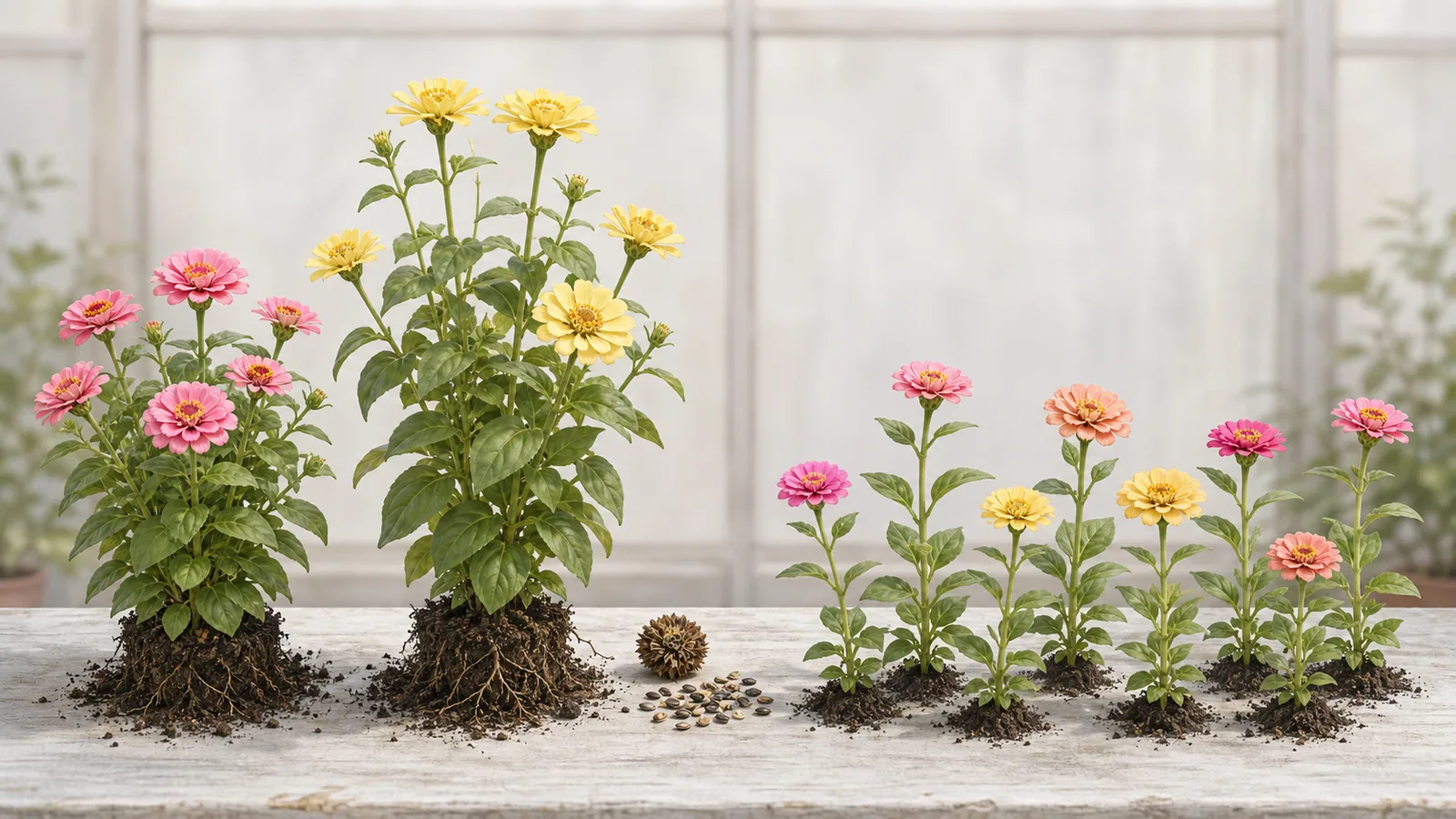
The seed parent is the parent that bears the seed, provides the ovule, and receives pollen. The pollen parent provides the pollen. The ovary is the maternal plant tissue in which the seed develops, but that does not mean the seed parent supplies most of the embryo’s inherited traits. Both parents contribute genetic material to the embryo.
These terms describe reproductive roles rather than human family roles. In many horticultural breeding records, a cross is written as A × B, with the seed or female parent listed first and the pollen or male parent listed second. That is a common recording convention, not an absolute rule for every species, breeder, database, or label. When a source provides a legend or separate fields, follow that source’s definitions.
The useful starting point is therefore: parent plants are important sources of offspring variation, but offspring are not simply an average of the two parents’ visible appearances.
Hybridization combines parent plants to produce offspring
Hybridization can be understood as the recombination of genetic sources from different compatible parent plants or parent lines through sexual reproduction. “Different” does not mean that any two plant species can cross successfully. Compatibility and the recording context still matter.
In flowering plants, hybridization connects to pollination, fertilization, and seed formation. Pollen landing on the stigma is only one step. A pollen tube must grow, fertilization must occur, and the embryo and seed must develop before there is an offspring plant to observe. For a closer look at what develops inside a seed, see embryo and seed development.
In horticulture and plant breeding, hand pollination is sometimes used to control the pollen source. The purpose is not to guarantee a result, but to make the parent relationship clearer. If you know which plant provided pollen and which plant provided the ovule, later observations of offspring traits have a more meaningful context.
Hybridization is not the finished form of a new cultivar. It is the beginning of an offspring population. Observation, selection, testing, and an appropriate way to maintain selected traits may still be needed. One possible next strategy is backcrossing: selected hybrid offspring are crossed to a designated parent. Continue with What Is Backcrossing? Why Do Breeders Cross Offspring Back to a Parent?.
Traits are observable plant features
A trait can be flower color, flower shape, leaf shape, plant height, flowering time, flower number, variegation, growth habit, or another feature that can be observed, described, measured, or compared.
But visible appearance is not the whole story. The way a plant actually looks or performs is its phenotype. The genetic makeup behind it is its genotype. What you see may be shaped by both heredity and environment.
For example, a plant may look short because of its genetic background, but it may also be short because of light level, water balance, root space, season, or growing conditions. Breeding and selection cannot rely on one quick visual impression alone. One especially attractive or disappointing moment may reflect the plant’s temporary environment as much as its inherited traits.
To explore how chromosome-set numbers relate to traits, continue with what polyploidy means in plants.
Offspring are not always an average of two parents
It is tempting to assume that if one parent has purple flowers and the other has yellow flowers, the offspring will be an in-between color. Or if one parent is tall and the other is short, the offspring will be medium height. Real inheritance does not always work that way.
Introductory genetics often uses pea plants to show that some traits may appear consistently in the first generation, then separate into different combinations in the next generation. That does not mean the cross failed. It means hereditary material can be redistributed across generations.
In ornamental plants, flower color, plant form, leaf shape, and variegation may also be influenced by multiple genes and by the growing environment. Offspring may resemble one parent, show a mix of both, or appear as a group with noticeable variation. This is why breeding work often looks at many offspring, not just one plant.
F1 means first generation, not a guarantee that all offspring look the same
F1 means the first filial generation: the first generation of offspring produced from a defined cross between parent plants. It is a generation label, not a promise of higher quality, better performance, or uniform appearance.
For how F1 seed labels relate to the F1–F2 sequence, see What Do F1 and F2 Mean in Plant Generations?.
Some commercial F1 hybrids may be relatively uniform for particular traits. This can happen when selected parent lines are themselves relatively genetically uniform and are crossed in a defined, repeatable combination. The apparent uniformity comes from the parent materials and breeding background, not from the label “F1” itself. Not every F1 is equally uniform, and uniform does not automatically mean better.
F1 hybrid is also not the same thing as GMO. F1 hybrid describes the generation produced by crossing parent plants. GMO refers to genetic engineering. The two terms should not be treated as synonyms.
If seeds are saved from an F1 plant and grown again, the next generation may show different combinations of flower color, height, leaf form, flower number, or other traits. The next generation may be less uniform than the original F1 group. In a defined breeding scheme, offspring produced by selfing or intercrossing F1 individuals may be called F2; simply saving any seed from an F1 plant does not, by itself, explain the full crossing history.
This is one reason some horticultural plants are produced from a particular parent combination each time, while others are maintained by cuttings, division, or other vegetative propagation methods. The choice depends on the plant and the trait-maintenance context; it is not a guarantee that every F1 must be propagated in one particular way.

How to read these words on plant labels
When you see “parent plant,” think of genetic source. When you see “hybrid,” think of offspring produced from a parent combination. When you see “trait,” think of a feature that can be observed or compared.
If a label or article writes A × B, read it first as a cross between two parent plants. In many breeding records, A is the seed parent and B is the pollen parent, but that order is a convention rather than a universal law. Check the label’s notes or the breeding record’s field definitions when they are available.
If a label says seed parent or pollen parent, it is identifying reproductive roles: which parent bears the seed and receives pollen, and which parent supplies pollen. These terms describe source and relationship; they do not say that the seed parent contributes more visible traits.
If an article mentions a line, strain, or cultivar, read the context carefully. A line or strain often refers to a source line in breeding or propagation. A cultivar usually refers to a selected, named, and maintained group of cultivated plants. These ideas may be related to hybrids, but they are not the same word.
Common points of confusion
- ✕ Hybrid offspring must be the exact average of two parent plants.
- ✓ Offspring may resemble one parent, show some traits from both, or appear as a varied group. Many traits are influenced by heredity and environment together.
- ✕ The seed parent supplies most of the offspring’s traits.
- ✓ Seed parent and pollen parent describe reproductive roles. Both parents contribute genetic material to the embryo; the labels do not assign a larger share of visible traits to one parent.
- ✕ F1 means every plant will be uniform or better.
- ✓ F1 identifies the first filial generation. Some F1 groups may be relatively uniform for particular traits when their parent materials and cross are suitable, but F1 alone is not a quality or uniformity guarantee.
- ✕ F1 hybrid means GMO.
- ✓ F1 means the first generation from a parent cross. GMO involves genetic engineering. They are not the same thing.
- ✕ Once a cross succeeds, a new cultivar has already been created.
- ✓ A cross only produces offspring. Observation, selection, testing, and a way to maintain the selected traits may still be needed.
- ✕ Traits can be fully judged from appearance alone.
- ✓ Visible appearance is phenotype. It is affected by genotype and environment. Stable traits usually require repeated observation.
- ✕ Seeds saved from an F1 plant will always grow into plants just like the original F1.
- ✓ A later generation may show trait segregation and may not keep the original F1 group’s uniform appearance. The precise label F2 requires a defined F1-derived crossing context.
FAQ
Are parent plant, seed parent, and pollen parent the same thing?
Parent plant is the broader term. It means a plant that contributes to the next generation. In flowering plant reproduction or cross records, the seed parent usually means the parent that bears the seed, provides the ovule, and receives pollen. The pollen parent provides pollen. Both parents contribute genetic material to the embryo.
Which plant comes first in A × B?
In many horticultural breeding records, the seed or female parent is written first, so A commonly represents the seed parent and B the pollen parent. This is a convention, not an absolute rule for every plant, breeder, database, or label. When the source gives its own notation or field definitions, use those definitions.
Does the seed parent provide more traits than the pollen parent?
Not as a general rule. “Seed parent” and “pollen parent” name reproductive roles: one bears the seed and receives pollen, while the other supplies pollen. Maternal tissues support seed development, but that does not mean the seed parent automatically contributes more visible traits.
Will hybrid offspring always look like one of the parents?
Not always. Offspring may look more like one parent, show a different combination of both parents’ traits, or vary widely as a group. The more a trait is influenced by multiple genes and growing conditions, the less useful a simple one-parent-or-the-other expectation becomes.
Is an F1 hybrid plant a GMO?
No. F1 hybrid means the first generation produced from crossing two parent plants. GMO refers to genetic engineering. Seeing “F1 hybrid” on a seed packet should not be interpreted as meaning GMO.
Does F1 mean that every plant will be uniform or better?
No. F1 means the first filial generation, not a quality label. Some commercial F1 hybrids may be relatively uniform for particular traits because they use selected, relatively uniform parent lines and a defined cross. Other F1 groups may show more variation, and uniformity does not automatically mean better performance.
Why can seeds from an F1 plant grow into plants that look different?
The next generation may receive different combinations of hereditary material. Traits that looked relatively uniform in the F1 group can separate into different combinations in a later generation, and the growing environment can also change the phenotype. In a defined breeding scheme, that F1-derived generation may be called F2; saved seed is not automatically an F2 label without the crossing context.
Are plant traits controlled by genes or by the environment?
Both can matter. Genes provide the inherited basis for traits, while environment can change how traits are expressed. Plant height, leaf color, flowering condition, and growth form can all be affected by light, water, root space, season, and other growing conditions.
What is the difference between a hybrid, a cultivar, and a line or strain?
A hybrid emphasizes that a plant came from a parent combination. A cultivar emphasizes a cultivated plant group that has been selected, named, and maintained. A line or strain often refers to a source line in breeding or propagation. The exact meaning depends on context, so it is better not to judge from one label word alone.
Related terms
- Parent plant: A plant that contributes to offspring or provides a genetic source.
- Seed parent: In a cross record, the parent that bears the seed, provides the ovule, and receives pollen.
- Pollen parent: In a cross record, the parent that provides pollen.
- Hybridization: The process of combining genetic sources from compatible parent plants or parent lines to produce offspring.
- Offspring: A new generation of plants produced from parent plants.
- Trait: A plant feature that can be observed, described, measured, or compared.
- Phenotype: The actual observable appearance or performance of a plant.
- Genotype: The genetic makeup behind a plant’s traits.
- F1: The first filial generation of offspring from a defined parent cross.
- F2: A later generation produced from F1 individuals in a defined selfing or intercrossing scheme.
- Trait segregation: The appearance of different trait combinations among offspring.
Read next
Evidence
References
These sources were used to check the plant-science concepts and gardening context in this article.
View sources and further reading (9)
- open.lib.umn.edu — 14 4 plant breeding
- openstax.org — 8 2 laws of inheritance
- openstax.org — 12 2 characteristics and traits
- open.lib.umn.edu — 9 1 seed morphology
- propg.ifas.ufl.edu — 10 seedsdevelopment pollination.html
- goldbook.iupac.org — 10703
- extension.oregonstate.edu — how read seed packets you buy
- extension.psu.edu — seed saving simple and free
- extension.oregonstate.edu — print