Start Here: Selecting a Plant Is Not the Whole of Breeding
Selection and plant breeding are often mentioned together, but they are not exactly the same thing.
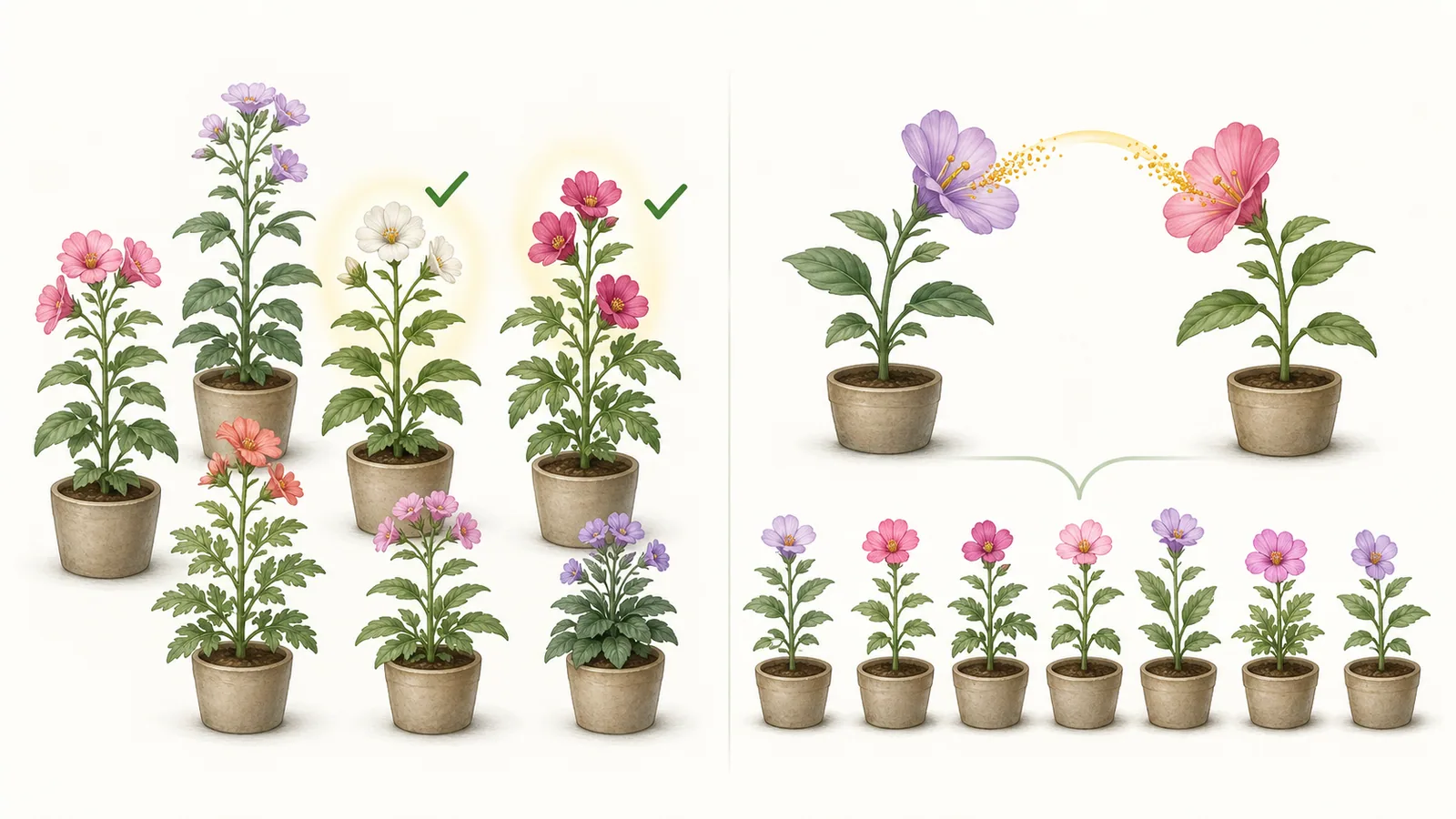
Selection is closer to choosing from differences that already exist. Imagine a tray of seedlings from the same batch. Some plants may have deeper flower color, shorter growth, wider leaves, or earlier flowering. A person can choose the individuals that best match a goal and keep them for later observation or propagation.
Plant breeding is broader. It is not just picking one attractive plant. Breeding starts with a goal, uses natural or planned variation, may involve chosen parent plants, and then follows the offspring through repeated observation, selection, testing, and propagation. The question is not only “Does this plant look good today?” but also “Can this trait be understood, selected, and carried forward in a useful way?”
In short: selection is often an important step inside plant breeding. Plant breeding is the larger, multi-step process.
Breeding Needs Variation Before There Is Anything to Select
If every plant in a group were exactly the same, selection would have little to work with. Breeding depends on variation: real differences among plants.
Those differences may include flower color, flower shape, leaf form, plant height, growth habit, fragrance, flowering time, or overall ornamental appearance. In plain language, these are traits: features that can be observed, compared, or measured.
But a visible difference is not automatically a stable inherited trait. A plant may look taller, shorter, greener, or more floriferous because of genetics, environment, age, nutrition, light, water, or the season. Breeders therefore care about more than the first visible impression. They need to know whether a trait can appear again in offspring or be maintained through an appropriate propagation method.
That is why breeding often requires many plants and repeated observation. Looking at one plant one time can mistake a temporary environmental effect for a stable trait.
New traits can also appear on a localized branch of an existing plant. See What Is a Bud Sport? for how researchers compare branches and observe traits after propagation.
Parents, Offspring, and Traits: How the Pieces Connect
In plant breeding, a parent plant is a plant that contributes genetic material to the next generation. If a breeder wants to combine traits from two plants, they may make a controlled cross, meaning pollen from one selected parent is directed to a receptive stigma of another selected parent.
A controlled cross is only an entry point. Fertilization, seed formation, germination, seedling growth, and later trait observation still have to follow. Even when seeds are produced, the offspring may vary widely. They may not show the exact combination a person hoped for.
This is why breeding discussions often use the words parent, offspring or progeny, trait, and selection together. Parent plants provide the starting material. Offspring show new combinations. Selection is the step where people choose the individuals that come closest to the goal.
Selection Is Not Just Choosing the Prettiest Plant
In ornamental horticulture, it is easy to begin with appearance. A plant may have an unusual flower color, neat form, distinctive leaves, or a compact habit. Those features matter, but serious selection does not end with one glance.
A plant that looks excellent in one season may behave differently in another environment. A seedling that flowers in an unusual way the first time may not pass the same appearance to seed-grown offspring. A cutting from a selected plant may look closer to the original, but even clonal material can still be affected by growing conditions and plant age.
This is where phenotype and genotype help. Phenotype is what can be seen or measured, while genotype is the plant’s genetic makeup. A phenotype can reflect the genotype, the growing environment, and the interaction between them. The key point is simple: appearance is useful evidence, but it does not by itself show whether a difference is inherited or environmentally produced. Repeated comparisons can reduce that uncertainty, but they do not by themselves prove inheritance.
After selecting a candidate, breeders move from visual impressions to defined measurements. They may record plant height, flower number, or flowering time, then repeat those measurements across multiple plants, batches, and comparable conditions. A pattern that remains within a similar range provides stronger evidence for consistency than a single striking plant does.
For a closer look at comparing candidate lines under shared conditions, read what cultivar trials compare.

For selection to matter in breeding, the selected plant or material usually needs more observation, comparison, and a way to be maintained.
Seeds and Cuttings Preserve Traits in Different Ways
Some breeding work can be carried forward through seeds. Seeds come from sexual reproduction, which means genetic material from parent plants can recombine. This is useful when the goal is to create or observe new variation. It also means seed-grown offspring may not be identical to the parent plant.
Many ornamental plants are therefore maintained by vegetative propagation, such as cuttings, division, grafting, or tissue culture. Vegetative propagation is often used when a particular individual has a valuable combination of traits, such as flower color, leaf shape, plant form, or variegation.
This does not mean vegetative propagation makes plants completely unchanging in every situation. Plant type, propagation method, environment, and plant condition can all affect final appearance. The practical idea is narrower: vegetative propagation can keep a selected individual’s trait combination more closely than seed reproduction often can.
What Does F1 Mean, and Why Saved Seed May Not Look the Same
Seed packets and gardening articles often use the term F1. A simple way to understand F1 is “the first generation from a specific parent cross.”
Some F1 hybrids look relatively uniform because the parent combination is controlled. But if seed is saved from an F1 plant and grown again, the next generation may not keep the same appearance. Traits can separate and recombine, producing a wider range of plants.
This helps show the difference between seeing a trait and maintaining a trait. Breeding is not finished when one desired feature appears. The larger question is how that feature arose, whether it can be selected again, and what propagation method can keep it close to the target.
How This Looks in Ornamental Horticulture
In ornamental plants, breeding goals may involve flower color, flower shape, fragrance, plant form, leaf shape, variegation, flowering time, or overall ornamental value. These goals sound familiar and visual, but they connect back to basic plant biology: flowers, pollen, ovules, seeds, seedlings, traits, and propagation.
A breeder might choose two parent plants, make a controlled cross, grow many seedlings, and then select only a few plants that approach the goal. If one individual looks promising, the work is still not over. It may need further observation, comparison with other plants, and a way to propagate it without losing the important trait combination.
Perennial ornamentals and woody plants can take even longer because it may take years to see mature form, flowering, or repeated performance. This is one reason plant breeding is usually a long process, not a single action.
Common Mix-Ups
- ✕ Selection is the whole of plant breeding.
- ✓ Selection means choosing from variation. It is often part of breeding, but breeding also includes goals, parent or material choices, offspring observation, testing, and propagation.
- ✕ Crossing two flowers means a new cultivar has already been bred.
- ✓ A cross may produce offspring, but the later steps of observation, selection, testing, and stable maintenance still matter.
- ✕ If a plant looks attractive, its trait must be inherited.
- ✓ Appearance is phenotype. It may be influenced by both genetics and environment, so stability needs further observation.
- ✕ Seeds saved from an F1 plant will always look like the original F1.
- ✓ Later generations from F1 plants may show separated and recombined traits, so they may not be true to type.
- ✕ Vegetative propagation means plants can never change.
- ✓ Vegetative propagation often helps maintain a selected individual, but environment, plant condition, and the plant itself can still affect appearance.
FAQ
What is the difference between plant selection and plant breeding?
Selection means choosing individuals or material from existing variation. Plant breeding is the broader process that may include setting a goal, choosing parent plants or source material, producing offspring, observing traits, selecting promising plants, testing them, and maintaining them through suitable propagation.
Is crossing two plants the same as breeding a new plant?
No. A cross can be one step in breeding, but it does not mean the work is complete. Offspring may or may not appear, and their traits may or may not match the goal. Breeding still requires observation, selection, and a way to maintain the selected material.
Why do breeders grow many seedlings and select only a few?
Seedlings from a cross can differ from one another because genetic material recombines. A large group gives more opportunity to observe variation. Only some individuals may come close to the breeding goal, and those still need further evaluation.
Does plant breeding always happen in a laboratory?
No. Traditional plant breeding can happen in fields, greenhouses, nurseries, botanic gardens, research settings, or home gardens. A home gardener can observe variation, make selections, or try controlled crosses. Judging whether a trait can be maintained consistently still requires traceable parent or source material, enough offspring, and repeated comparisons under useful conditions.
Why are some cultivars propagated by cuttings instead of seed?
Seed-grown offspring often recombine traits and may not look like the selected parent plant. If a particular individual has a valued flower color, leaf pattern, plant form, or other trait combination, cuttings or other vegetative methods may preserve that individual more closely.
Can you judge a trait just by looking at the plant?
Looking is a useful start, but it is not always enough. A visible trait may reflect genetics, environment, plant age, or recent growing conditions. Breeding and selection usually require repeated observation rather than one-time judgment.
Does breeding guarantee a better plant?
No. Breeding uses goals and selection, but outcomes still depend on genetic combinations, environment, observation time, and propagation method. A more careful way to say it is that breeding tries to increase the chance of finding and maintaining plants that match a target.
Related Terms
- Plant breeding: A goal-directed process that uses variation, parent combinations, selection, testing, and propagation to develop plant material or cultivars.
- Selection: Choosing individuals or plant material that match a goal from existing or newly produced variation.
- Trait: An observable or comparable plant feature, such as flower color, leaf shape, plant height, or flowering time.
- Phenotype: The plant’s visible or measurable expression.
- Genotype: The plant’s genetic makeup.
- Parent plant: A plant that contributes genetic material in a cross or breeding process.
- Offspring / progeny: Plants produced from parent plants.
- Hybridization / crossing: Combining parent plants to produce offspring for observation and selection.
- F1 hybrid: The first generation from a specific parent cross.
- Cultivar: A cultivated plant selection maintained because of valued traits.
- Vegetative propagation: Propagation by cuttings, division, grafting, tissue culture, or similar methods rather than by seed recombination.
Read Next
Evidence
References
These sources were used to check the plant-science concepts and gardening context in this article.
View sources and further reading (8)
- ers.usda.gov — background the science of seed.pdf
- iastate.pressbooks.pub — the process of cultivar development pure line variety
- smallfarms.cornell.edu — on farm variety improvement part ii selection and plant breeding
- rhs.org.uk — f1 hybrids
- arboretum.harvard.edu — plant breeding at the arnold arboretum
- openstax.org — 12 2 characteristics and traits
- passel2.unl.edu — 4
- passel2.unl.edu — 5