Hand Pollination Means Helping Pollen Reach a Stigma
Hand pollination is easiest to understand as one specific intervention: a person helps pollen reach a stigma.
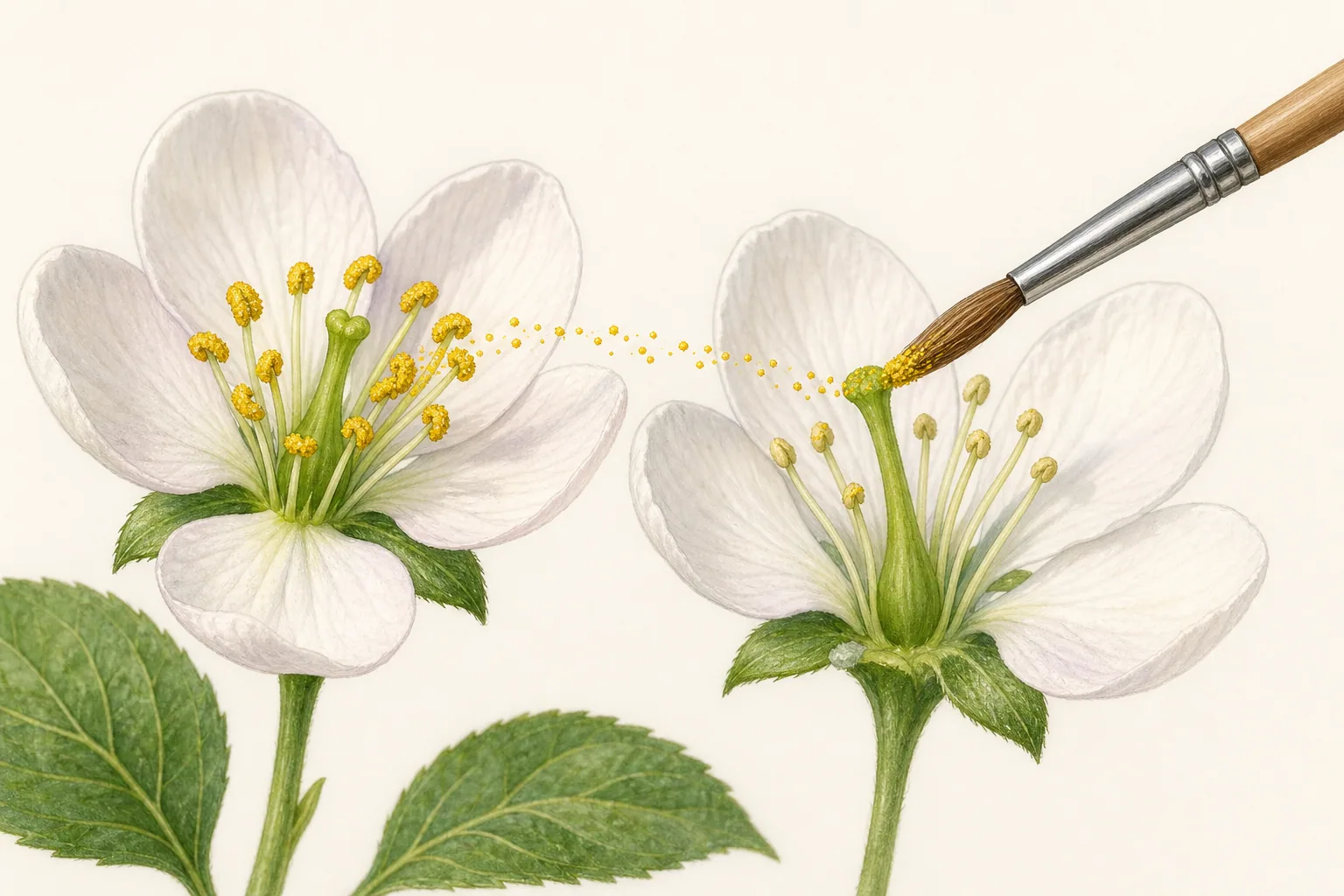
In many flowers, pollen is produced by the anthers, which are part of the stamens. The stigma is the receptive surface at the top of the pistil or carpel. Natural pollination may happen through insects, wind, birds, bats, or movement within the same flower. Hand pollination means a person deliberately helps or controls that pollen transfer.
It does not let the plant skip reproduction. It also does not mean a flower will definitely become a fruit. Hand pollination only enters the process at the point where pollen reaches the stigma.
Why Natural Pollination Does Not Always Happen at the Right Moment
An open flower creates an opportunity for pollination, but it does not guarantee that pollination has happened. Pollen still has to arrive on a suitable stigma. After that, pollen germination, pollen-tube growth, and fertilization still have to occur before seed or fruit development may begin. Hand pollination intervenes only in the earlier transfer step; it cannot guarantee the later stages.
Natural pollination can work very well, but it depends on many conditions. Pollinator activity, wind, flower structure, the way pollen is released, the timing of flowering, and the surrounding environment can all affect whether pollen reaches the stigma.
Some flowers release pollen more easily when they are moved or vibrated. Some plants have separate male and female flowers. Some need pollen from another plant of the same species. In other situations, plants may be grown indoors, under cover, or in isolated spaces where natural pollen movement is limited.
This is why hand pollination appears in horticulture, research, plant breeding, seed preservation, and teaching. It is not a replacement for every natural process. It is a way to assist or control one important step.
One Use: Filling the Pollen Transfer Gap
In some growing situations, the natural carriers of pollen may not be present or active enough. In a greenhouse, indoor collection, covered growing space, or isolated planting, pollen may not easily move from anther to stigma.
That gap can happen for several reasons. In some flowers, the anthers and stigma are far enough apart that pollen is unlikely to land on the receptive surface by itself. Some plants have separate male and female flowers, or an uneven number of open flowers at the same time, so available pollen and receptive stigmas may not line up neatly. Some pollen moves more easily with wind, vibration, or contact from visiting animals. When those conditions do not come together, human assistance can act like a missing carrier for the pollen.
Hand pollination may be used to help fill that gap. The important word is “help.” It may help pollen reach the stigma, but it does not control every step that follows.
A more accurate way to say it is this: hand pollination can assist pollen transfer, but it cannot guarantee pollen germination, fertilization, seed formation, fruit development, or a desired result.
Another Use: Controlling Which Plant Provides the Pollen
Hand pollination is also used when the pollen source matters.
In plant breeding, hybridization, seed preservation, and teaching experiments, people may need to know which plant provided the pollen and which plant received it. If pollen can arrive from any nearby flower, it becomes harder to understand where the next generation’s traits came from.
Controlled pollination helps create a known parent combination. This is why hand pollination is often discussed with parent plants, hybrids, and traits, plant breeding and selection, and controlled crosses. The goal is not simply to “make a flower set fruit.” The goal may be to track which plant contributed pollen and which plant received it.

This distinction matters. In a casual garden setting, people may focus on whether a flower becomes a fruit. In a breeding or research setting, the key question may be: do we know the parentage well enough to interpret the offspring?
It Can Also Make Flower Structure Easier to Understand
Hand pollination can also be useful as a teaching concept because it makes flower parts more concrete.
Once you can identify the anther and the stigma, pollination becomes easier to understand. It is not just “pollen touching a flower.” It is pollen reaching the flower part that can receive it.
This helps prevent common misunderstandings. Pollen on a petal is not the same as pollination. An insect visiting a flower does not always mean pollen reached the stigma. Pollen on the stigma does not automatically mean a seed or fruit will mature.
Seen this way, hand pollination works like a lens. It lets us look closely at one stage in plant reproduction without turning that stage into a promise of the final result.
How It Connects to Breeding and Selection
Breeding and selection both involve plant traits across generations.
Selection usually means choosing from variation that already exists or has appeared. Breeding often involves planning parent combinations and then observing how traits appear in the next generation.
In that context, hand pollination is valuable because it can control the cross. If someone wants to compare how traits from two parent plants appear in their offspring, uncertain pollen sources make the observation less useful. A controlled cross gives the later comparison a clearer starting point.
Hand pollination does not determine a new variety, a desired trait, or a successful result on its own. Offspring traits depend on genetics, environment, selection, and repeated observation over time. Hand pollination is only one controllable step in a much larger process.
Hand pollination changes how pollen reaches a stigma. It is separate from flower and fruit thinning, which changes how many flowers or young fruits remain later.
Common Mix-Ups
- ✕ Hand pollination means a plant will definitely produce fruit.
- ✓ Hand pollination only helps or controls pollen reaching the stigma. Pollen compatibility, germination, and later plant and environmental conditions can still affect the result.
- ✕ Pollen touching a petal counts as pollination.
- ✓ Pollen needs to reach the stigma to enter the pollination process.
- ✕ Hand pollination is only used when natural pollination has failed.
- ✓ It may also be used in breeding, controlled crosses, seed preservation, and teaching, where the pollen source needs to be known.
- ✕ Pollination and fertilization are the same thing.
- ✓ Pollination is pollen reaching the stigma. Fertilization is a later event involving the union of reproductive cells.
- ✕ All flowering plants can be hand-pollinated in the same way.
- ✓ Flower structures vary widely, so one hand-pollination approach should not be assumed to fit every plant.
FAQ
What is the difference between natural pollination and hand pollination?
Natural pollination depends on wind, insects, other animals, flower movement, or the plant’s own structure to move pollen. Hand pollination means a person helps or controls pollen transfer to a stigma. Both still depend on the same core event: pollen must reach a receptive stigma.
Does hand pollination always lead to fruit?
No. After pollination, pollen still has to germinate, grow a pollen tube, and complete fertilization. Early seed or fruit development may also depend on plant condition and environment. Hand pollination can help with pollen placement, but it cannot guarantee these later stages.
Why do plant breeders use hand pollination?
Plant breeders often need to know the parent plants. Hand pollination can help control which plant provides pollen and which plant receives it. That makes it easier to trace how traits appear in the next generation.
If a plant flowers but does not produce fruit, does it need hand pollination?
Not necessarily. A flower may fail to produce fruit for many reasons, including pollination, fertilization, early development, plant species, flower age, or environmental conditions. No single observation, including the absence of fruit, can show that hand pollination is needed.
Can self-pollinating plants still be hand-pollinated?
Sometimes, but the purpose may not be to replace natural pollination. It may be used for teaching, seed preservation, controlled parentage, or preventing unwanted pollen from mixing in. Whether that matters depends on the plant and the goal.
Related Terms
- Hand pollination: Human-assisted or human-controlled movement of pollen to a stigma.
- Controlled pollination: Pollination in which the pollen source and receiving stigma are deliberately controlled, often for research, breeding, or seed preservation.
- Anther: The part of a stamen that produces pollen.
- Stigma: The receptive surface of a pistil or carpel where pollen can land.
- Fertilization: A later reproductive-cell union that can follow pollen reaching the stigma.
- Pollen tube: A tube that may grow from a pollen grain after it germinates on a stigma, extending toward the ovule.
- Parent plant: A plant that contributes genetic material in breeding or crossing.
- Hybridization: Combining different parent plants to produce offspring for observation or selection.
- Trait: An observable or measurable plant feature, such as flower color, plant form, or maturity timing.
Read Next
Evidence
References
These sources were used to check the plant-science concepts and gardening context in this article.
View sources and further reading (7)
- openstax.org — 32 2 pollination and fertilization
- openstax.org — 12 1 mendels experiments and the laws of probability
- extension.oregonstate.edu — reproductive plant parts
- propg.ifas.ufl.edu — 10 seedsdevelopment pollination
- ars.usda.gov — pollinators at pi
- extension.umd.edu — Tomato pollination and.pdf
- gardens.si.edu — why what when where who how pollination