
Start with the plant label as an ID card
A plant label is a little like an ID card. Some parts tell you where the plant fits in nature. Some parts tell you how people selected, named, or maintained it in gardens and nurseries.
The confusing part is that the same everyday word can mean different things in different settings. In English, variety can be a formal botanical rank, but gardeners and catalogs also use it loosely for “kind,” “type,” or “selection.” Strain can also sound scientific, but in plants it is often a practical word from breeding, seed, or propagation work rather than a standard taxonomic level.
A simple way to start is this: species is a major rank used to describe and name plant diversity; species plant is nursery language for a plant presented under a species identity rather than as a garden hybrid; cultivar is a named cultivated-plant group with distinguishable characteristics that can be maintained by suitable propagation. A breeding line tracks material through selection or propagation, while strain is a looser, context-dependent term rather than a universal rank.
First, Separate Nature Names from Garden Names
Scientific plant names help people talk about plants clearly across languages, gardens, herbaria, seed lists, and databases. A species name is normally written as a two-part binomial: a genus name plus a specific epithet. That two-part name is the core botanical address.
Garden names work differently. A plant can belong to a species and also have a cultivated name because people selected it for a flower color, leaf pattern, growth habit, fruit trait, or other stable feature.
So the question is not “Which word is the real name?” The better question is: which layer of identity are we talking about?
Species: The Main Scientific Identity
A species is one of the main units used in botanical naming. In a plant name, the genus name is followed by a specific epithet; together they form the species name.
For example, in a label written like this:
Genus speciesthe full binomial helps point to an accepted scientific identity. Plant databases such as Kew’s POWO and WCVP emphasize accepted names because stable names make plant information easier to connect across references.
Species names do not tell you every visible trait. Plants within one species can still vary in leaf size, flower shade, growth vigor, local adaptation, and other details. The species name is the broad identity card, not a full description of every individual plant.
Wild Species and Species Plants
In gardening and nursery writing, species plant usually means a plant presented under a species identity rather than as a named cultivar or complex garden hybrid. Wild species describes a naturally occurring taxon; it does not establish that a particular specimen was collected from the wild.
That wording does not automatically mean the plant was collected from the wild. Many species plants are nursery-propagated. It also does not mean the plant is better, easier, or more authentic for every garden. It simply points to a different identity layer than a cultivar or trade name.
The clearest question is: is the label talking about a naturally occurring species, or about a selected cultivated form? That question is often more useful than treating every label as one strict ladder.
Botanical Variety: The Formal var.
A botanical variety is one formal infraspecific rank governed by botanical nomenclature. It is usually written with var. in a scientific name.
This is different from the loose everyday sentence “this nursery has many varieties.” In formal botany, a variety is not just any plant type. It is a named rank used when a naturally occurring group within a species is recognized as distinct in a botanical naming context.
That is why a plant labeled as a botanical variety is not the same thing as any “variety” in a nursery catalog. If the plant is a garden selection with a cultivar name, cultivar is the more precise word.
Cultivar: A Selected Plant Maintained by People
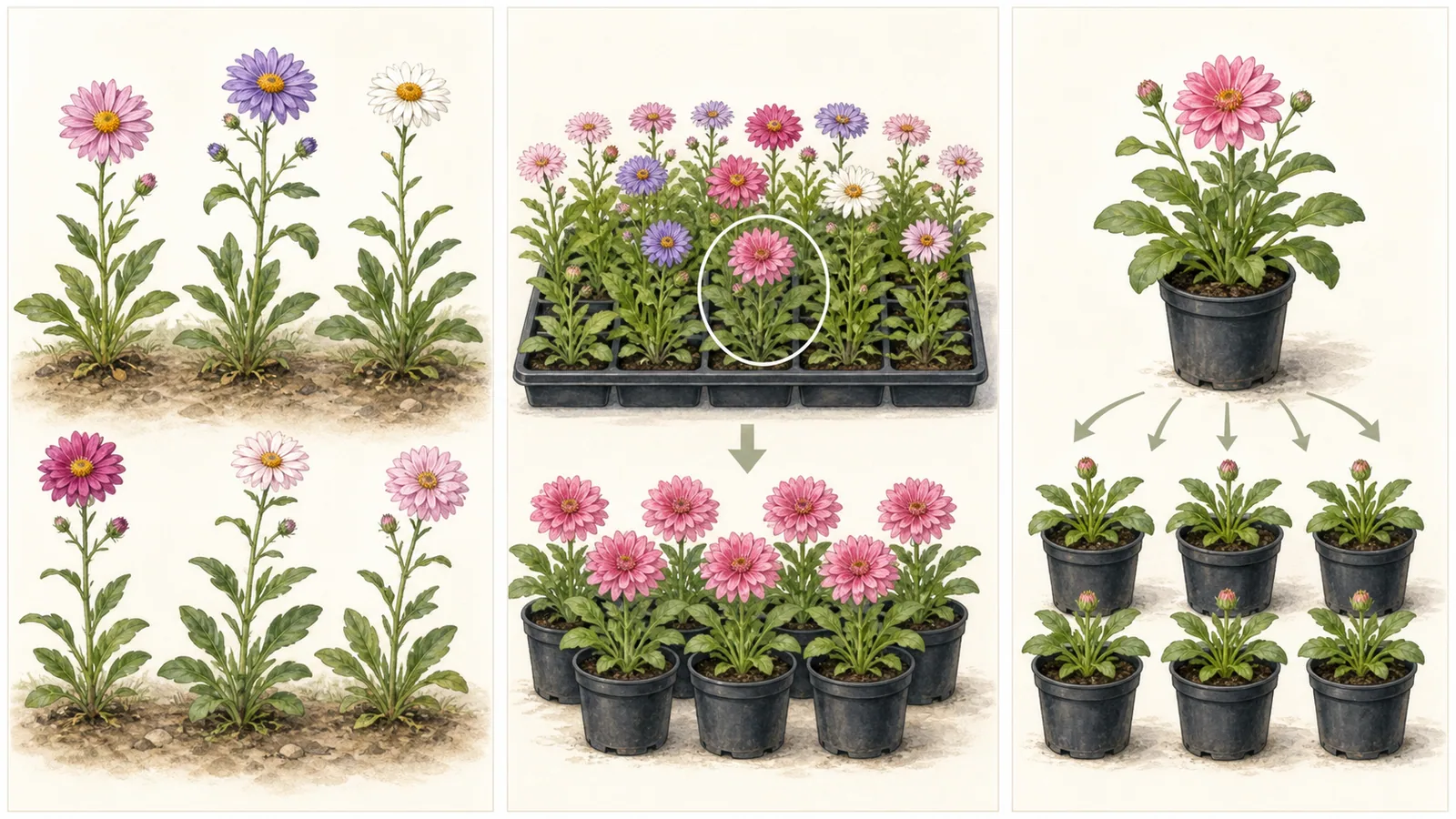
A cultivar is a named cultivated-plant group with distinguishing characteristics that can be maintained by an appropriate means of propagation. It may come from breeding, selection, or a distinctive plant discovered in cultivation or the wild; it is not a taxonomic rank.
In writing, cultivar names are usually placed in single quotation marks:
Genus species 'Cultivar Name'A cultivar may be maintained by cuttings, division, grafting, tissue culture, seed under controlled conditions, or other methods depending on the plant and trait. Some cultivars do not come true from ordinary seed, so vegetative propagation is often used when the goal is to preserve the same selected features.
The key idea is simple: a cultivar name identifies a cultivated plant group selected or recognized for distinguishing characteristics.
Why Catalog Variety Can Be Misleading
This is one of the easiest places to get confused in English.
In everyday gardening speech, variety may mean a cultivar, a hybrid group, a market type, a seed line, a named ornamental selection, or simply “which kind.” But in formal botanical naming, variety has a narrower meaning as a rank below species.
So a careful reader should ask:
- Is this a formal botanical rank? Use variety or botanical variety only if that is what is meant.
- Is this a named cultivated plant? Use cultivar.
- Is this a general “kind” in casual speech? Use type, kind, form, or selection if those fit better.
- Is this a breeding or seed-production context? Line or strain may be appropriate, but it needs context.
Line or Strain: Useful Words, But Not Always Formal Ranks
A line or strain often refers to a group maintained within breeding, seed production, or propagation work. It can mean a selected line, an inbred line, a seed strain, or a practical group being kept for certain traits.
But line and strain are not general formal taxonomic ranks like species. They are context words. In some cultivated-plant naming systems, a line or multiline may be recognized in relation to a cultivar, but that does not make strain a universal level in plant classification.
A safe summary is: a line or strain usually tells you about breeding or propagation history, not a standard place in the natural classification ladder.
A Plant Label May Contain Several Layers at Once
A label can combine natural identity and cultivated identity:
Genus species 'Cultivar Name'The first part points to the botanical species. The cultivar part points to a selected cultivated form.
Sometimes labels include trade designations or selling names. These can be useful in commerce but should not be confused with the formal cultivar name. A trade name may help sell or group a plant in the market, while the cultivar name is the more stable naming unit for the selected cultivated plant.
Trade designations help with selling and recognition, but they answer a different question from botanical names and formal cultivar names.
What This Means When You Buy or Read About Plants
When you see a plant label, do not try to force every word into one ladder. Instead, read it as stacked information:
- Scientific identity: what plant group is this?
- Natural variation: is there a formal variety or naturally occurring form?
- Cultivated selection: has it been selected and named by people?
- Propagation or breeding context: is it a line, strain, hybrid group, seed series, or trade designation?
Different layers answer different questions. A species name helps you connect to botanical references. A cultivar name helps you understand a selected garden form. A line or strain may tell you something about breeding or seed history, but it usually needs more context before you can know what traits are stable.

Genus species and a name containing var. belong to botanical nomenclature; single quotation marks identify a cultivar; line or strain needs breeding or seed context and is not a universal taxonomic rank.
Common Mix-Ups
- ✕ Every “variety” in a catalog is a botanical variety.
- ✓ In casual gardening English, variety may simply mean type, selection, cultivar, line, or market group.
- ✕ A species plant is always wild-collected.
- ✓ Many species plants are nursery-propagated; the term describes identity, not collection source.
- ✕ A cultivar is just another botanical variety.
- ✓ A botanical variety is a formal rank in botanical naming. A cultivar is a named cultivated-plant group with distinguishing characteristics that can be maintained by suitable propagation; it may originate through breeding, selection, or discovery.
- ✕ Strain is a standard taxonomic level.
- ✓ Strain or line is usually a practical breeding or propagation term, not a universal formal rank like species.
- ✕ A species name tells me exactly what every plant will look like.
- ✓ A species name gives a scientific identity, but individuals and populations can still vary.
FAQ
Is a cultivar the same thing as a variety?
Not usually. In everyday speech, people may mix the words, but they are not the same in precise writing. A botanical variety is a formal rank below species. A cultivar is a named cultivated-plant group with distinguishing characteristics that can be maintained by suitable propagation, whether it originated through breeding, selection, or discovery.
Why do cultivar names use single quotation marks?
Single quotation marks help show that the name is a cultivar name, not a Latin scientific species name. For example, the quoted part in Genus species 'Cultivar Name' identifies a selected cultivated form.
Can a cultivar be grown from seed?
Some can, but many cultivars do not reliably keep the same traits from ordinary seed. For many selected ornamental plants, cuttings, division, grafting, or other controlled propagation methods may be used to maintain the same traits.
Does species plant mean the specimen was wild-collected?
No. Species plant is horticultural or nursery language about identity, not proof of provenance. A species plant may be nursery-propagated, and a wild species describes a naturally occurring taxon without proving that a particular specimen was collected from the wild.
Why do catalogs use variety so loosely?
Because variety is also an ordinary English word. A catalog may use it to mean a type, selection, seed form, hybrid group, or cultivar. In precise botanical writing, botanical variety is narrower and usually appears with var. in the scientific name.
Is strain a scientific plant classification level?
Usually no. Strain is commonly a practical word used in breeding, seed, or propagation contexts. It does not function like species, genus, or botanical variety in standard plant taxonomy.
What is an orchid grex?
Grex is a special naming idea in cultivated orchids. It refers to the hybrid group from the same parent combination. It is not the same as a cultivar; individual plants within a grex may still have cultivar names. This is useful background, but this article stays focused on general plant-name layers.
Related Terms
- Species: a main scientific identity used in botanical naming, usually written as a two-part binomial.
- Species plant: a plant presented as a naturally occurring species rather than a named cultivar or complex cultivated hybrid.
- Wild species: a naturally occurring species, often used to contrast with cultivated selections or hybrids.
- Botanical variety: a formal rank below species, written with var.
- Cultivar: a named cultivated-plant group with distinguishing characteristics maintained by suitable propagation; it may originate through breeding, selection, or discovery.
- Trade designation: a marketing or selling name that should not be confused with the formal cultivar name.
- Line: a breeding or propagation group maintained for certain traits.
- Strain: a practical term for a maintained group in some seed, breeding, or propagation contexts.
Read Next
Evidence
References
These sources were used to check the plant-science concepts and gardening context in this article.