
Polyploidy can be understood simply as a condition in which a cell has three or more complete sets of chromosomes. A typical diploid plant is often described as 2n for its somatic chromosome number, while its formal ploidy may be written as 2x. If the basic chromosome set is present three or four times, the plant may be described as 3x or 4x.
The important point is that polyploidy adds a whole set, not one random extra chromosome. This is why polyploidy sometimes appears in discussions of large flowers, thick leaves, or unusual plant form. Still, ploidy alone does not guarantee that a plant will be larger, stronger, or better. The final trait depends on the species, genetic background, tissue, environment, and stage of development.
Compare one, two, three, and four chromosome sets
Imagine a chromosome set as a complete toolkit of genetic information. Before reading the number, identify the notation: x commonly describes one basic chromosome set, n commonly describes the chromosome number in a gamete, and 2n is often used for the somatic chromosome number.
The word set matters. It does not mean that we are counting only one chromosome. We are describing how many copies of a full, corresponding group of chromosomes are present.
Use x when counting sets. The symbols n and 2n commonly record gamete and somatic chromosome numbers, respectively; in polyploids, n need not equal x. A tetraploid’s somatic number may be written as 2n = 4x, while a normally reduced gamete is n = 2x: it still has two sets.
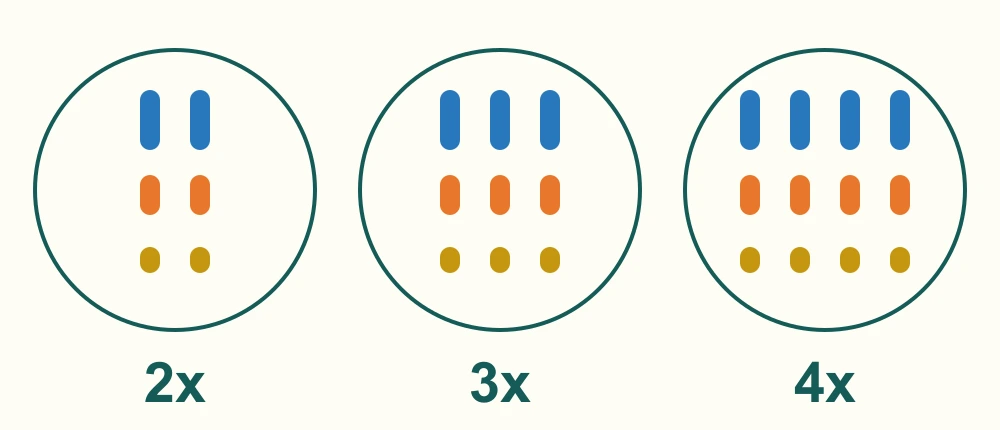
This is also why “more chromosomes” should not be read as “more unrelated functions.” Polyploidy usually adds copies of an entire genetic complement. How those copies are regulated, whether they keep the same activity, and how cells rebalance their processes all affect the final phenotype.
How can polyploidy form?
Polyploidy can arise during natural evolution, and it can also be used as a source of material in breeding research. The general idea is not one fixed procedure. It is that a complete chromosome set is retained, duplicated, or brought together during cell division, reproductive-cell formation, or hybridization.
For example, after DNA has been copied, chromosomes may fail to separate in the usual way during cell division. Some daughter cells can then receive an extra complete set.
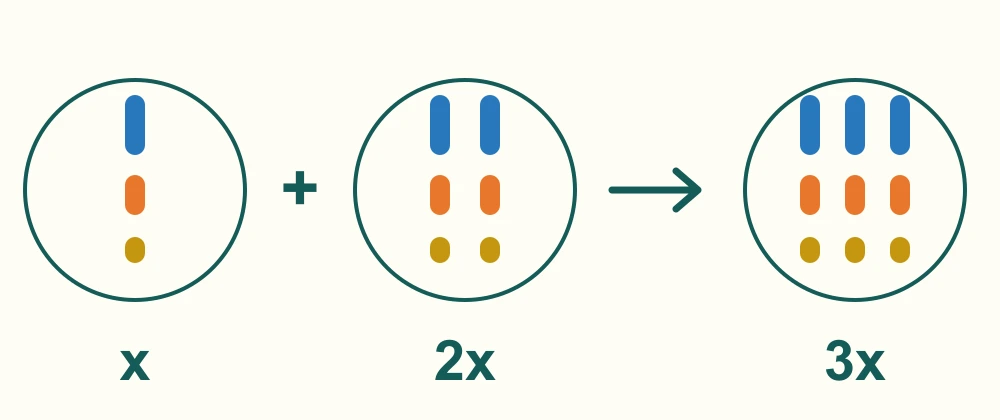
The diagram below shows a different situation: chromosome number is not halved normally during gamete formation. Take diploid plants of the same species. They start with two sets, while a normal gamete receives one. Changes in chromosome distribution or cell separation during meiosis can instead produce an unreduced gamete that retains two sets. The 2x in this diagram is therefore a formed gamete carrying two sets, not a nucleus caught in the act of dividing.
If a normal one-set gamete and an unreduced two-set gamete successfully fertilize, they can form a triploid zygote, x + 2x → 3x. Two unreduced gametes can potentially form a tetraploid zygote, 2x + 2x → 4x. The sets brought together at fertilization add up; one original nucleus is not growing from x through 2x to 3x.
Hybridization can also be part of the story. If two parent plants contribute different chromosome sets, an offspring may carry both sources. If the chromosome complement later doubles, some chromosomes may have a more suitable partner during meiosis. A polyploid formed by duplicated sets from the same species or closely related background is often called an autopolyploid. A polyploid that combines chromosome sets from different sources is often called an allopolyploid.
These terms describe genetic history. They do not label a plant as good or bad. Naturally formed, hybrid-derived, and human-selected polyploids can all have different genetic backgrounds and growth patterns.
Why can cells and organs change?
Across many plant studies, higher chromosome-set numbers are often associated with larger cell volume. More DNA in the nucleus can influence the cell cycle, cell expansion, gene activity, and tissue development. Changes at the cell level can then be reflected in leaves, flowers, fruits, stomata, or other organs.
This is why research or horticultural records sometimes report larger cells, thicker leaves, different flower dimensions, or a changed plant habit in polyploids. These are possible patterns, not a universal direction of change. Different tissues may respond differently. A larger cell does not guarantee a larger whole plant, and a larger plant does not guarantee faster growth, earlier flowering, or better reproductive performance.
Extra gene copies can also change gene dosage and regulation. Metabolism, stress responses, and developmental signals may be rebalanced, but the outcome depends on the species, the origin of the chromosome sets, the time since polyploid formation, and the growing environment. A label such as “tetraploid” is not enough to predict every trait.
Why can fertility be affected?
Before plants produce sperm and egg cells, they go through meiosis. This first produces spores with a halved chromosome number. Further development produces the structures that make sperm or egg cells. During meiosis, corresponding chromosomes pair and separate. In a diploid plant, pairing in twos is usually more straightforward; in a polyploid, more chromosomes must be distributed.
When the ploidy level is odd, such as triploid, chromosomes may be harder to divide evenly. Some spores can receive unbalanced chromosome combinations, affecting later reproductive development. Some triploid plants therefore have more difficulty producing functional pollen or egg cells, or form fewer seeds.
But “triploid” does not mean “completely sterile.” Chromosome pairing, genetic background, tissue condition, and species differences all matter. Reduced fertility may be a common tendency, but it should not be treated as an absolute rule.
Polyploidy can also connect hybridization with fertility. Some hybrid offspring have chromosome sets that do not pair easily during meiosis. Doubling the full chromosome complement may make those pairing relationships clearer, so fertility may have a chance to recover. This depends on genetic background and chromosome pairing during meiosis.
What can horticultural observation tell us?
Polyploidy is sometimes used to explain large flowers, large leaves, thick leaves, changes in plant form, or differences in seed formation. But appearance alone usually cannot confirm ploidy. Light, water, temperature, root-zone space, plant age, flowering stage, and other growing conditions can also change size and form.
A safer observation path is to separate what is visible from what is being proposed as the cause:
- If a leaf looks thicker than leaves from the same batch, record leaf age, light, plant size, and growing conditions rather than calling it polyploid.
- If a flower is larger or pollen seems scarce, treat that as a clue worth checking, not as proof of a particular chromosome number.
- If ploidy must be confirmed, look for a well-documented cultivar or research record, or use specialist analyses such as chromosome counting or flow cytometry. These methods require suitable samples and interpretation; they cannot be replaced by visual inspection.
This is closely related to the breeding distinction between phenotype and genotype. Phenotype is what can be seen or measured. Its cause may involve more than one factor. Connecting a trait to ploidy requires traceable material, appropriate comparisons, and clear analytical evidence.
Common points of confusion
- ✕ Polyploidy means that a plant has one extra chromosome.
- ✓ Polyploidy means that a complete chromosome set has been added. Gaining or losing one chromosome is a different kind of chromosome-number change.
- ✕
nalways means one set, and2nalways means two sets. - ✓
xmore directly describes the basic chromosome set.ncommonly describes the chromosome number in a gamete, while2noften describes the somatic chromosome number. Always check the source’s notation. - ✕ A polyploid plant must be larger, stronger, or better.
- ✓ Polyploidy can change cells and organs, but the direction and size of the effect depend on the species, tissue, genetic background, and environment.
- ✕ Every triploid plant is completely sterile.
- ✓ Triploids may have reduced fertility because chromosome pairing and separation can be less regular, but the actual result depends on the material and species.
- ✕ Large flowers or leaves prove that a plant is polyploid.
- ✓ Visible traits are clues at most. Ploidy needs reliable records or specialist analysis for confirmation.
- ✕ Polyploidy is the same thing as a GMO.
- ✓ Polyploidy describes chromosome-set number. GMO describes the use of particular genetic-engineering methods. They are not synonyms.
- ✕ More chromosome sets automatically mean more gene functions.
- ✓ Polyploids often carry more copies of genes, but gene activity, regulation, and phenotype cannot be predicted from set number alone.
Frequently Asked Questions
How is a polyploid different from a diploid?
A diploid usually has two complete chromosome sets and may be written as 2x; its somatic chromosome number is often written as 2n. A polyploid has three or more complete sets, such as 3x or 4x. The key is the number of complete sets, not the count of one particular chromosome. The meaning of n still depends on the species and the notation being used.
Does polyploidy occur naturally, or is it made by people?
Both occur. Polyploidy is common in plant evolution and can arise through natural changes in cell division, reproductive-cell formation, or hybridization. Breeding research can also use polyploid materials, but different species and materials produce different results.
Do polyploid plants always have larger flowers or fruits?
No. Higher ploidy is often associated with larger cells or changes in some organ dimensions, but whole-plant size, flower size, fruit size, and growth are also affected by genetic background, tissue, environment, and development. Ploidy is not a size guarantee.
Is every triploid plant seedless?
No. Triploids often have reduced fertility because chromosome sets can be difficult to distribute evenly during meiosis. However, pairing behavior and reproductive outcomes vary among plants. A specific cultivar still needs its own reliable documentation.
Can I tell whether a plant is polyploid by looking at it?
Usually not. Large flowers, thick leaves, plant form, and growth differences can have many causes. Confirmation requires a reliable cultivar or research record, or an analysis such as chromosome counting or flow cytometry.
How are polyploidy and hybridization related?
Hybridization can bring different parent chromosome sets into one offspring. If those sets do not pair easily during meiosis, a later doubling of the full chromosome complement may change the pairing relationship. This is one possible genetic pathway, not a guarantee for every hybrid or doubling event.
Can polyploidy be treated as a better horticultural plant?
No. Polyploidy describes a chromosome-set condition, not a quality score. Horticultural evaluation still depends on the goal, material, environment, propagation context, and repeatable observations.
Related Terms
- Ploidy: The state of having a particular number of complete chromosome sets; the basic-set notation commonly uses
x. - Polyploid: A cell or organism with three or more complete chromosome sets.
- Diploid: A cell or organism with two complete chromosome sets, a ploidy of
2x; its somatic chromosome number can be written as2n = 2x. - Autopolyploid: A polyploid formed through duplication of chromosome sets from the same species or closely related genetic background.
- Allopolyploid: A polyploid that combines chromosome sets from different genetic sources.
- Meiosis: Cell division that halves chromosome number. In plants it produces spores, which develop further into structures that produce gametes.
- Phenotype: The observable or measurable expression of a plant.
- Genotype: The genetic makeup behind a plant’s traits.
- Genome doubling: An increase in the number of complete chromosome-set copies, rather than an addition of one chromosome.
- Basic chromosome set: The chromosome-set baseline represented by
x;ncommonly describes the chromosome number in a gamete.
Read next
Evidence and attribution
Sources and image rights
These sources were used to check the plant-science concepts and gardening context in this article.
View sources and further reading (12)
- iastate.pressbooks.pub — ploidy polyploidy aneuploidy haploidy 2
- biodiversity.research.ufl.edu — polyploidy and plant diversity
- actahort.org — 935 9.htm
- pmc.ncbi.nlm.nih.gov — PMC3859924
- pmc.ncbi.nlm.nih.gov — PMC5737848
- academic.oup.com — 2893294
- journals.uchicago.edu — 700636
- pubmed.ncbi.nlm.nih.gov — 26715561
- doi.org — ajb2.1258
- annualreviews.org — annurev genet 112618 043602
- openstax.org — 11 1 the process of meiosis
- openstax.org — 32 1 reproductive development and structure
Image sources and rights
- Plant Note project-made image · Created by Plant Note; no third-party image license applies — The project-made SVG was adapted as WebP for delivery.
- Plant Note project-made image · Created by Plant Note; no third-party image license applies — The project-made SVG was adapted as WebP for delivery.