
Most branches on a plant usually produce similar leaves, flowers, or fruit. Occasionally, one branch keeps showing a different leaf shape, flower color, fruit color, or growth habit. In horticulture, a localized new trait like this is often called a bud sport (also known as a bud mutation). Bud sports are often associated with a change in cells at a growing point. But a difference in branch appearance alone is not enough to confirm a bud sport.
How can a change in a terminal bud affect a whole branch?
Terminal buds and lateral buds contain groups of cells called meristems. These cells keep dividing and form new shoots, leaves, flowers, and fruit. If some cells acquire a genetic or gene-regulation difference and pass it to their descendant cells, the tissues formed from that cell lineage may develop differently from the rest of the plant. For a basic introduction to how buds produce new shoots, see What Is a Plant Bud? Where Do New Shoots Come From?.
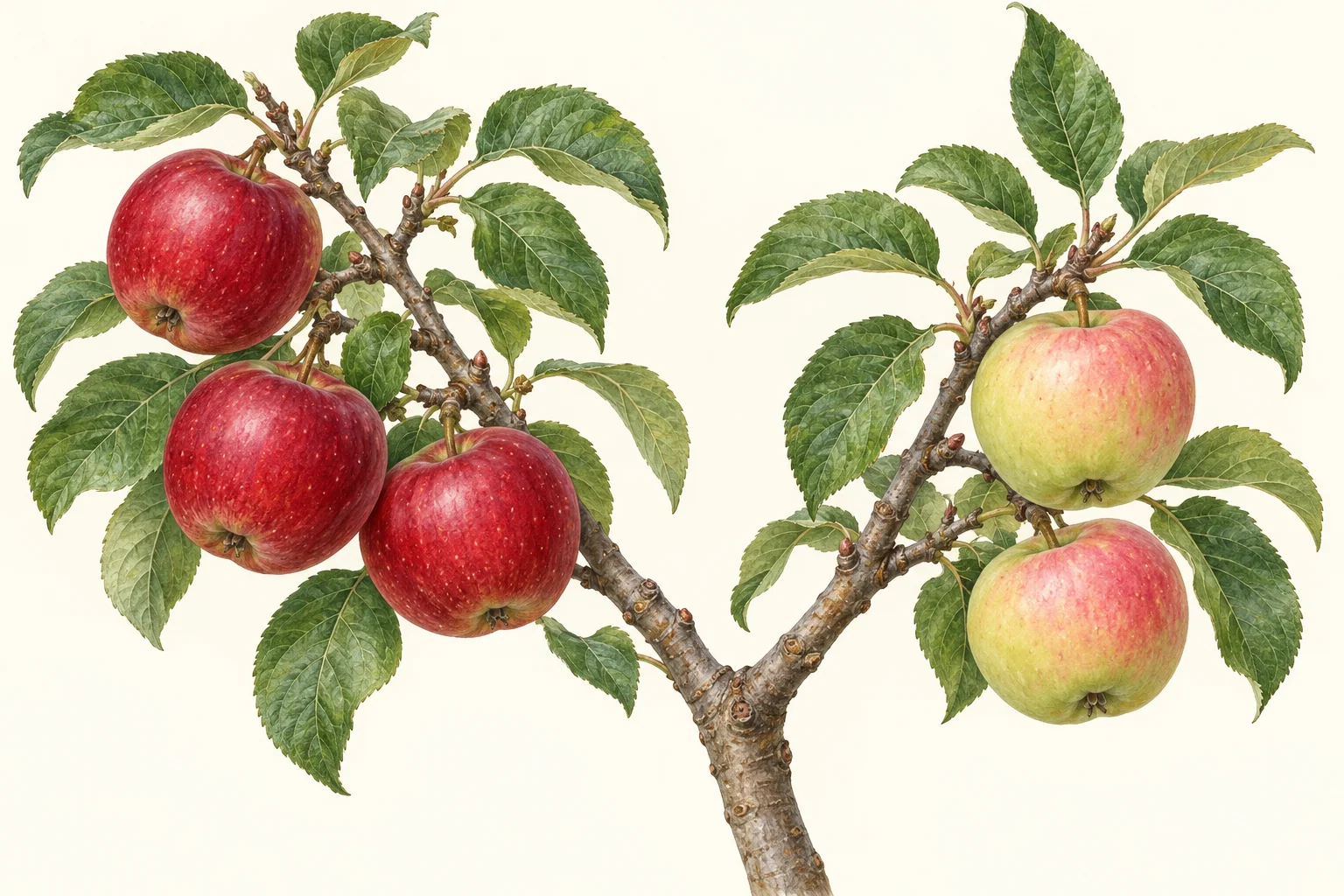
Some bud sports involve a change in the DNA sequence. Other studied cases also involve epigenetic changes: differences in how cells use genes without changing the DNA sequence. A bud may contain cell groups with different genetic or regulatory states; this arrangement is called a chimera. Where those cell groups occur can affect whether a new trait appears along a whole branch, in only part of an organ, or fades during later growth. Meristems differ among plants, so this is a useful model for understanding some bud sports, not a claim that every plant has the same structure.
This is one reason a bud sport may not remain stable. A group of variant cells may continue to form new tissues, or it may become less common as the plant grows. Some sports can retain their traits through vegetative propagation, while others separate into different cell groups or revert toward the earlier appearance. A newly observed difference does not automatically become a stable cultivar.
An apple branch with paler fruit
Researchers observed one branch on an ‘Oregon Spur II’ apple tree whose fruit skin stayed paler than fruit on the other branches over multiple years. Buds taken from that branch were grafted, and the resulting plants also produced paler fruit. When researchers compared branch and fruit-skin tissues, they found DNA variation and differences in gene regulation in this case. The study shows why researchers consider observations from different branches and years together with what happens after propagation. One differently colored apple, on its own, would not establish that a bud sport had occurred.
That study explains one apple case. Other bud sports may involve different genes, cell layers, or regulatory changes, so its mechanism should not be treated as a general rule for all bud sports.
How is a bud sport different from a hybrid or a polyploid?
A bud sport is a localized difference that appears on an existing plant. Hybridization refers to sexual reproduction that produces offspring from parent plants or lines with different genetic contributions. The two are not mutually exclusive: a plant that began as a hybrid can later develop a bud sport on one branch. For more on parent plants, hybrids, and traits, see How Are Parent Plants, Hybrids, and Traits Connected?.
Polyploidy describes cells with multiple complete sets of chromosomes. It answers a different question from “Is there a localized trait difference on this plant?” A few bud sports may involve a change in chromosome-set number, but leaf, flower, or fruit appearance alone cannot show that a plant is polyploid. See What Is Polyploidy in Plants?.
If a bud sport remains stable through propagation, horticulturists may evaluate whether it has value for breeding or cultivar selection. Observing a variation and establishing a new cultivar are separate steps. Continue with What Is Plant Breeding? How Is Selection Different from Breeding? and What Do Plant Cultivar Trials Compare?. For a basic explanation of carrying a plant forward through vegetative propagation, see What Is a Cutting?.
What can you observe when one branch looks different?
Record where the difference appears and whether it involves leaves, flowers, fruit, or growth habit. Note whether the same trait appears again as the plant grows, and whether other branches show it too. These observations help separate what you can see from what you are inferring. They cannot confirm a mutation on their own; researchers need evidence suited to the particular plant and question.
Common mix-ups
- ✕ One different leaf or fruit on the same plant proves it is a bud sport.
- ✓ An unusual appearance is a clue. A bud sport needs more evidence than one observation or photograph.
- ✕ A bud sport and a hybrid are the same thing.
- ✓ Hybridization describes parent plants and offspring produced through sexual reproduction. A bud sport describes a localized new trait on an existing plant. A hybrid plant can later develop a bud sport.
- ✕ Every bud sport can be kept forever through vegetative propagation.
- ✓ Some sports can be carried forward vegetatively; others may separate or revert. Stability depends on the plant and the type of variation.
- ✕ A bud sport is just another name for a polyploid.
- ✓ These terms describe different things: a localized trait difference and the number of complete chromosome sets. A specific sport may involve a ploidy change, but appearance alone does not establish one.
Frequently asked questions
Is a bud sport the same as a mutation?
A bud sport is a horticultural term for a localized difference in traits on a plant, often associated with a change in cells at a growing point. A mutation is one possible cause. Research has also found differences in gene regulation, so an unusual-looking branch should not automatically be called a confirmed mutation.
Can a bud sport be preserved from seed?
Not reliably. Seeds form through sexual reproduction, which reshuffles genetic material; they usually cannot be expected to reproduce all the traits of the plant that carried the sport. Vegetative propagation may carry the original branch’s cell traits forward. However, if a change is present in cells that contribute to reproduction, it may also affect seed offspring. It is therefore too broad to say that a bud sport can never pass through seed.
Why can a bud sport’s traits disappear?
A bud can contain cell groups with different genetic states. As new shoots form, the proportion or position of those groups may change. A trait may then remain in only part of an organ, become less noticeable, or revert toward the earlier appearance. Stability varies with the plant and the kind of variation.
Does every bud sport become a new cultivar?
No. A difference observed in horticulture still needs to be identified and evaluated. If the trait is not stable through propagation or does not become a recognizable feature, it may not be selected as a cultivar.
Can a photograph tell me whether a plant has a bud sport?
No. Lighting, developmental stage, and other conditions can affect how a plant looks. Research cases commonly compare branches on the same plant, observations over time, and results after propagation. A photograph can document a clue, but it cannot confirm the cause by itself.
Key terms
- Bud sport: A horticultural term for a localized new trait on a bud, branch, flower, or fruit of a plant. It is also called a bud mutation or sport mutation.
- Somatic variation: A change in cells of the plant body that may be present in only part of a plant.
- Meristem: A group of plant cells that continues dividing and forms new organs, such as the growing regions at shoot tips and in side buds.
- Chimera: Plant tissue containing cell groups with different genetic states; their arrangement can affect how a trait appears and whether it remains stable.
- Epigenetic change: A cellular change that affects gene activity without changing the DNA sequence.
- Polyploid: A cell or organism with three or more complete chromosome sets.
Read next
Evidence
References
These sources were used to check the plant-science concepts and gardening context in this article.
View sources and further reading (8)
- nature.com — s41438 018 0062 x
- academic.oup.com — 6674672
- ask.ifas.ufl.edu — EP356
- propg.ifas.ufl.edu — 04 genetic chimera.html
- propg.ifas.ufl.edu — 15 genetic mutation.html
- open.lib.umn.edu — 14 2 inheritance of big differences
- yardandgarden.extension.iastate.edu — what difference between cultivar and variety
- kmweb.moa.gov.tw — theme data.php