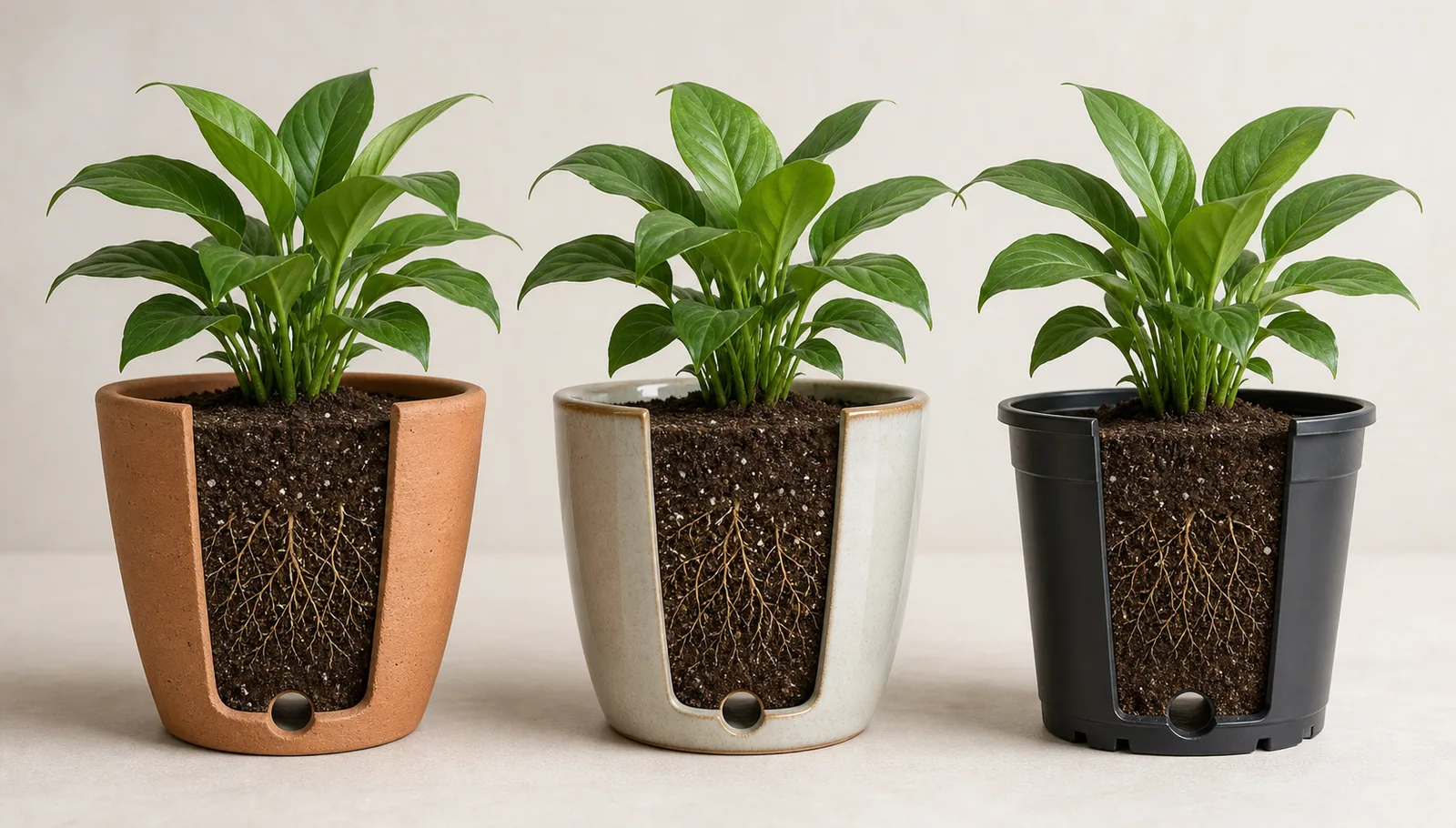
Pot material can affect how quickly potting mix dries. Think of the pot as part of the root environment. An unglazed terracotta pot can let some water move through and evaporate from its walls. A glazed ceramic or plastic pot has less-permeable walls. Water still evaporates from the potting-mix surface and is taken up by the plant before leaving through leaves; excess water after watering needs a route out through the drainage hole at the bottom.
That means a change of pot material can change a plant’s drying rhythm. The useful thing to check is still the potting mix itself, not the calendar.
Why unglazed terracotta often dries faster
Unglazed clay, including familiar terracotta pots, has tiny pores in its walls. When the potting mix is moist, the wall can absorb some water and water can gradually move outward near the pot surface. This gives water an additional route out of the container.
That does not mean every terracotta pot will dry quickly. A pot in a cool, shaded place can behave very differently from one in bright sun with moving air. Pot size, root volume, and the amount of potting mix also matter. But when pot diameter, mix, plant, and location are similar, an unglazed terracotta pot will usually need its moisture checked sooner than a plastic one.
Where does water leave glazed ceramic and plastic pots?
A glazed ceramic surface reduces the chance for water to leave through the pot wall. Plastic pot walls also do not readily absorb water. In these containers, changes in moisture usually depend more on evaporation from the potting-mix surface, water taken up by the plant, air movement, and whether excess water can leave through the drainage hole.
Because glazed ceramic is still ceramic, it is easy to assume that it behaves just like unglazed terracotta. The more useful distinction is whether the pot wall is exposed and absorbent, rather than whether the pot is simply made of clay.
Factors that can matter even more than material
Two pots made of the same material can dry at very different rates. These factors often work together:
- Light and temperature: Brighter light and warmer conditions often increase water loss from leaves and the potting-mix surface.
- Air movement and humidity: Moving air and the humidity of the surrounding space change how readily water leaves leaf and mix surfaces.
- Pot size and root volume: A smaller pot, a fuller root system, or a smaller volume of potting mix can make moisture conditions change more quickly.
- Potting-mix particles and drainage: How much water the mix holds, how much pore space it has, and whether excess water can leave all affect conditions around roots.
Pot material is one factor, but it is rarely the only explanation. “Plastic pots dry more slowly” should not become “every plastic pot must be watered after a long interval.”
After changing pots, learn the new drying rhythm
When the same plant moves from unglazed terracotta to glazed ceramic or plastic, an old watering interval may no longer fit. Rather than immediately watering less or more, observe the new setup for several cycles. Is the surface as dry as the mix deeper in the pot? How quickly does the pot become lighter? Does the mix remain wet for a long time after excess water drains away? Has the plant stayed in the same light and airflow conditions?
These clues help put pot material back into the full root environment where it belongs.
Common Mix-Ups
- ✕ A terracotta pot is automatically better than a plastic pot for every plant.
- ✓ Unglazed terracotta usually loses water faster. Whether it suits a plant still depends on the plant, potting mix, light, and environment.
- ✕ Plastic pots never dry out.
- ✓ Plastic does not add water loss through an absorbent wall, but the mix can still dry through light, airflow, roots, and temperature.
- ✕ Changing to a certain pot material makes a fixed watering interval reliable.
- ✓ Material can change the drying rhythm, but the actual decision still depends on the potting mix and root environment.
Frequently Asked Questions
Which dries more easily: terracotta or plastic?
When pot size, potting mix, location, and plant are similar, unglazed terracotta usually dries faster than plastic because the pot wall can also allow water to leave. This is a tendency, not a fixed speed. Sunlight, wind, and root volume can change the result.
Is a glazed ceramic pot as fast-drying as unglazed terracotta?
Not necessarily. A glaze reduces water loss through the pot wall, so glazed ceramic often behaves more like plastic than like unglazed terracotta in this respect.
Should I immediately water less after moving a plant into a plastic pot?
There is no need to apply a fixed adjustment first. A plastic pot may change the drying rhythm, but light, potting mix, pot size, and root volume also affect the outcome. Check the moisture deeper in the pot and the pot’s weight before deciding whether anything needs to change.
Can pot material alone tell you what is happening with roots?
No. Pot material can affect how quickly water is lost, but potting-mix moisture, drainage, air around roots, and environmental conditions all need to be considered. Pot material alone cannot diagnose root condition.
Why do some plastic pots still dry very quickly?
A plastic pot does not absorb water through its wall, but its potting mix can still lose water from the surface and supply water to the plant. Small pots, fuller root systems, stronger air movement, brighter or warmer conditions, and coarser potting mix can all make a plastic pot dry quickly.
Related Terms
- Unglazed terracotta pot: A clay pot without a glaze, usually with a porous wall.
- Glazed ceramic pot: A ceramic pot with a glazed surface that is less likely to absorb water through its wall.
- Potting mix: The material that supports roots and provides them with water and air in a container.
- Pores: Small spaces within a material or potting mix that can hold water or air.
- Drainage hole: An opening in the bottom of a container through which excess water can leave.
Read Next
Evidence
References
These sources were used to check the plant-science concepts and gardening context in this article.