A seed embryo is the starting point of a new plant
A seed embryo is the tiny early form of a new plant inside a seed. It is not a fully grown plant in miniature, but it already has a basic direction: one end can develop toward the root, and another end can develop toward the shoot, stem, and leaves.
A simple way to picture a seed is to think of three parts working together: a protective outer covering, an embryo, and stored resources that support early growth. The embryo is the part that can continue developing into the next plant.
What parts or directions does an embryo have?
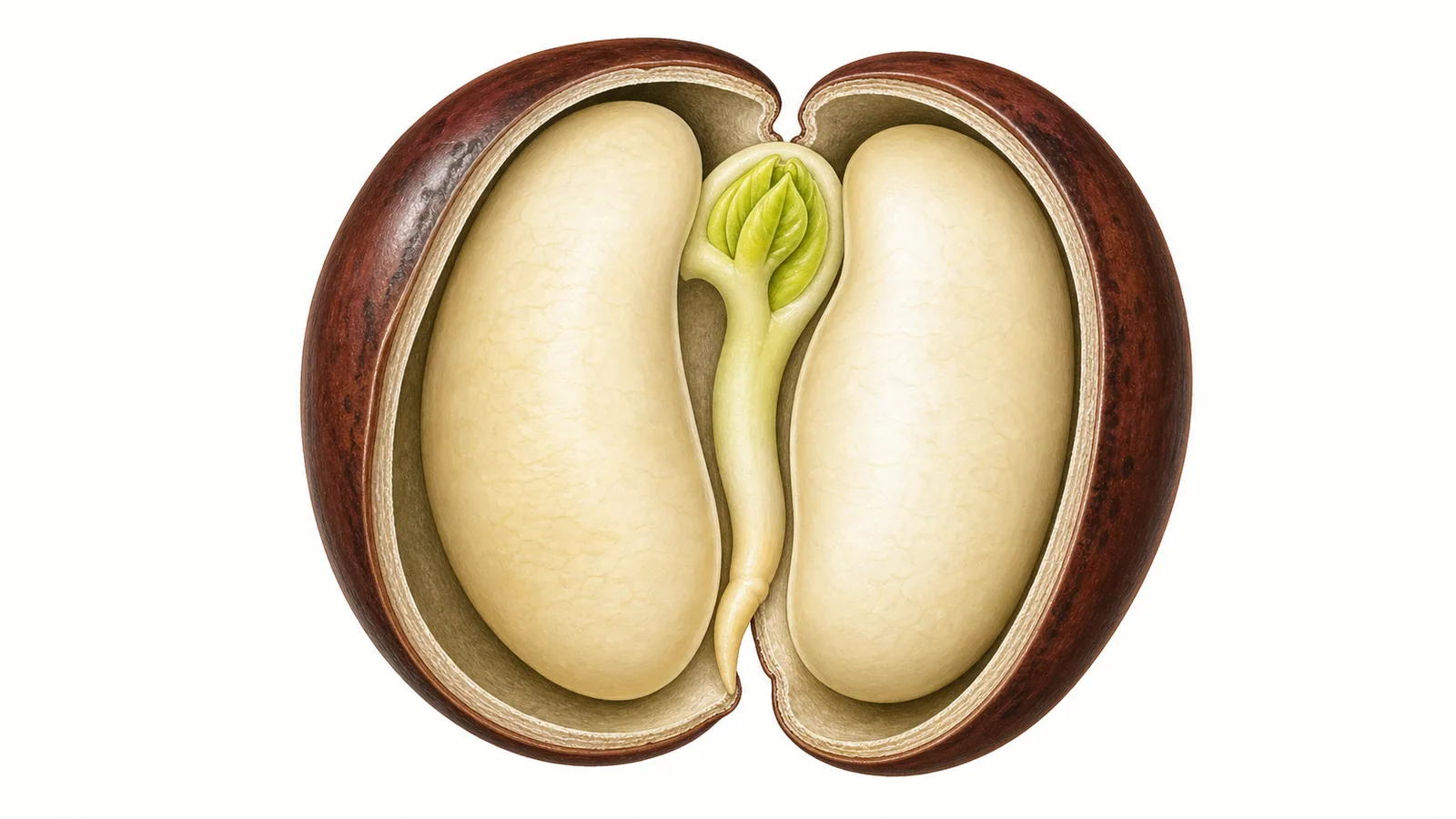
You do not need to memorize every term at once. The most useful idea is that the embryo has a root direction and a shoot direction.
The radicle is the beginning of the future root. In many seeds, the radicle is the first clearly visible structure to break through the seed coat during germination, so people often notice a small white root first.
The plumule, or young shoot region, is related to the future stem, leaves, and above-ground growth. The plumule is still inside the seed embryo, not a visible sprout that has already emerged from the seed coat. More detailed botany may also mention the hypocotyl, epicotyl, and embryo axis. For general readers, it is enough to understand the embryo axis as the early body line connecting the future root end and the future shoot end.
The cotyledons are also part of the embryo. They are sometimes called seed leaves, but they are not always like ordinary mature leaves. Depending on the plant, cotyledons may store resources, absorb or transfer resources, or turn green after emerging into light and briefly use that light.
The embryo and endosperm are not the same thing
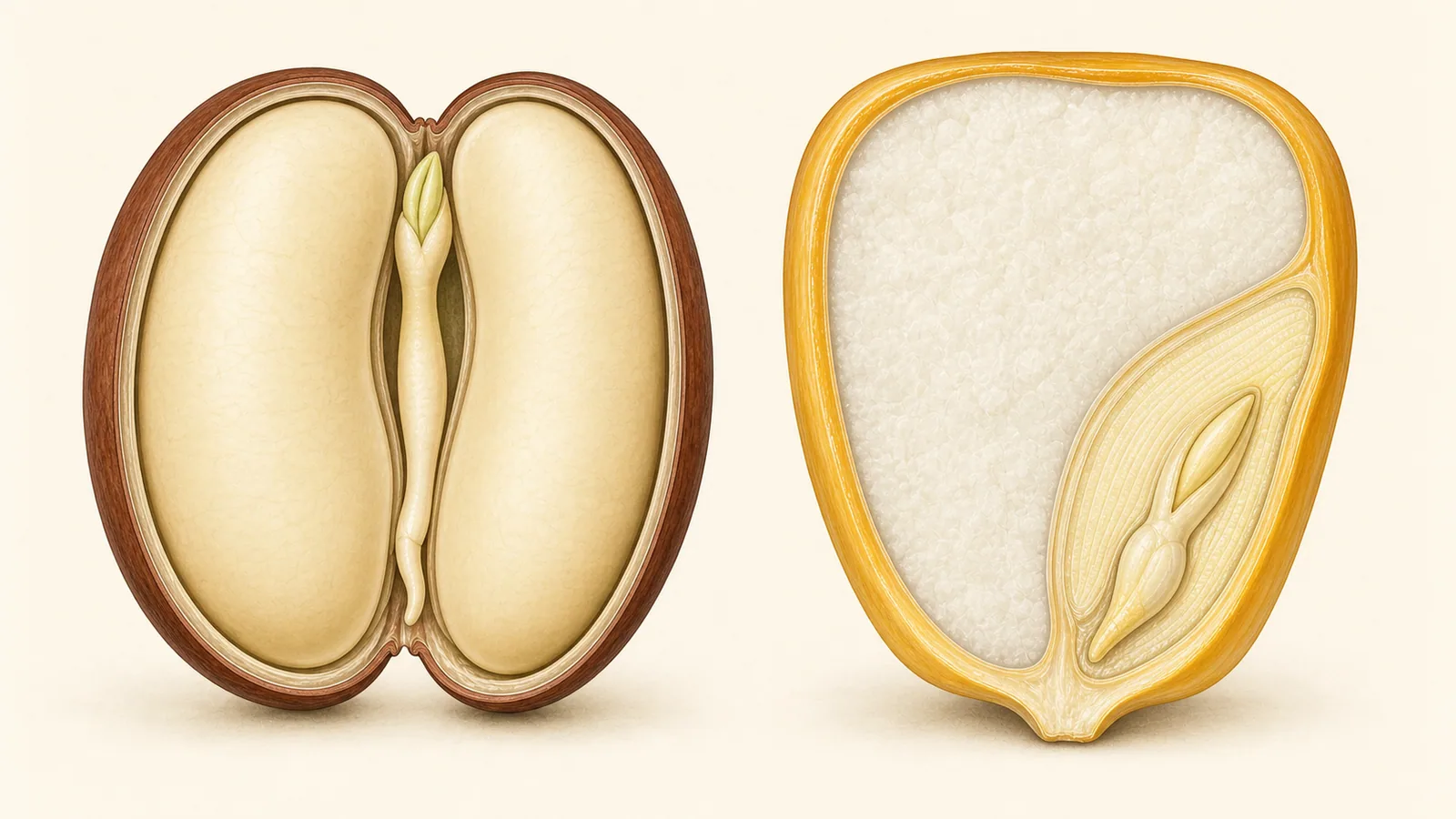
The embryo can develop into the new plant. The endosperm is usually a storage tissue outside the embryo. Both matter for early growth, but they are not the same structure.
In bean-like seeds, the two thick cotyledons often take up much of the seed, while the embryo axis is small. In grasses such as corn and wheat, the endosperm often makes up a large portion of the seed, the embryo sits to one side, and the single cotyledon is more involved in absorbing and transferring stored resources.
So when you hear that a seed contains “food” or stored resources, do not automatically call all of it the embryo. The stored material may be in cotyledons, in endosperm, or arranged differently depending on the plant.
During germination, the embryo starts growing again
When a seed is dry or waiting for suitable conditions, the embryo’s growth is paused. When water enters the seed and conditions such as oxygen and temperature are suitable, the embryo’s metabolism starts up again.
Germination does not mean the whole seed turns into a plant all at once. It means the embryo resumes growth, lengthens, and begins to form the young seedling. In many plants, the radicle breaking through the seed coat is a clear sign of germination. The cotyledons, young stem, and first true leaves become easier to see later.
This is why understanding the embryo helps you understand germination. The embryo is not just a vocabulary word; it is the living link between a seed and a seedling.
How can you observe a seed embryo?
If you carefully open a softened bean seed after soaking, you may see two thick cotyledons. The embryo is often between them or along one side, looking like a small curved axis with a root direction and a shoot direction. This can be useful for learning seed structure, but it is not necessary to pull apart every kind of seed.
In a seed tray or pot, when a small white root emerges from a crack in the seed coat, you can often understand it as the radicle beginning to grow. Later, the seedling emerges, cotyledons open, and true leaves gradually appear. These visible steps connect the hidden embryo inside the seed with the seedling you can see.
Different plants vary a lot. Some seeds are tiny, and some embryos are difficult to see without magnification. Some seeds are dormant and may not germinate just because they are wet. This article explains structure and basic principles; it does not promise a germination result.
Common mix-ups
- ✕ The embryo is a complete tiny plant.
- ✓ The embryo is an early form of a new plant. It has root and shoot directions, but it still needs germination and further growth.
- ✕ The whole seed is the embryo.
- ✓ The embryo is only one part of the seed. A seed may also include a seed coat, cotyledons, endosperm, and other structures.
- ✕ Endosperm is part of the embryo.
- ✓ Endosperm is usually storage tissue outside the embryo. It does not directly become the new plant.
- ✕ Cotyledons are always the same as the ordinary leaves a seedling grows later.
- ✓ Cotyledons are part of the embryo. They may store, absorb, or transfer resources; some turn green after emerging into light, but they are still different from later true leaves.
- ✕ All seed embryos are as easy to see as those in beans.
- ✓ Bean seeds are helpful teaching models, but seed size, embryo position, and storage tissues differ widely among plants.
FAQ
Is the embryo just a tiny plant?
You can think of it as the early form of a new plant, but not as a complete mature plant shrunk down. It has directions for future root and shoot growth, but it still needs germination, elongation, and seedling development.
What is the difference between the embryo and endosperm?
The embryo can develop into the new plant. The endosperm is usually storage tissue outside the embryo that helps support early growth. Both are important, but they are different parts of the seed.
What does the radicle become?
The radicle is the beginning of the future root system. In many plants, it is the first part of the embryo to break through the seed coat during germination.
What does the plumule become?
The plumule, or young shoot region, is related to future above-ground growth, including the stem, leaves, and growing point. It is useful to think of it as the embryo’s direction toward shoot and leaf growth.
Are cotyledons part of the embryo?
Yes. Cotyledons are part of the embryo. They may store resources, absorb or transfer resources from the endosperm, and in some plants turn green after emerging into light.
During germination, does the root or leaf appear first?
In many plants, the radicle breaks through the seed coat first, so the future root is often the first visible part. The seedling, cotyledons, and true leaves become more obvious later. Details vary among plant species.
Do all seed embryos look the same?
No. Bean seeds make the embryo and cotyledons relatively easy to observe. Grass seeds such as corn often have a large endosperm and an embryo along one side. Many other seeds are much smaller or harder to interpret with the naked eye, so diagrams should be treated as teaching models.
Related terms
- Embryo: the early form of a new plant inside a seed.
- Embryo axis: the axis-like part of the embryo connecting the future root end and shoot end.
- Radicle: the part of the embryo that develops toward the root.
- Plumule: the part of the embryo related to future shoot and leaf growth.
- Cotyledon: part of the embryo that may store, absorb, or transfer resources for early growth.
- Endosperm: storage tissue, usually outside the embryo, that supports early embryo or seedling growth.
- Seed coat: the protective outer layer of a seed.
- Germination: the restart of growth under suitable conditions, often seen when the radicle breaks through the seed coat.
Related Reading
Evidence
References
These sources were used to check the plant-science concepts and gardening context in this article.