Start with three seed parts
A seed may look small and quiet, but it is not empty. For a beginner, the clearest way to understand seed structure is to look for three things: a protective outer layer, a young plant embryo inside, and stored resources that support early growth.
The protective layer is the seed coat. The embryo is the early form of the next plant. The stored resources may be held mainly in cotyledons, in endosperm, or in a mix of tissues depending on the plant.
 Seed coat Fruit wall
+ seed coat Embryo Embryo Cotyledon Endosperm
Seed coat Fruit wall
+ seed coat Embryo Embryo Cotyledon Endosperm Select a part name above to explore its role.
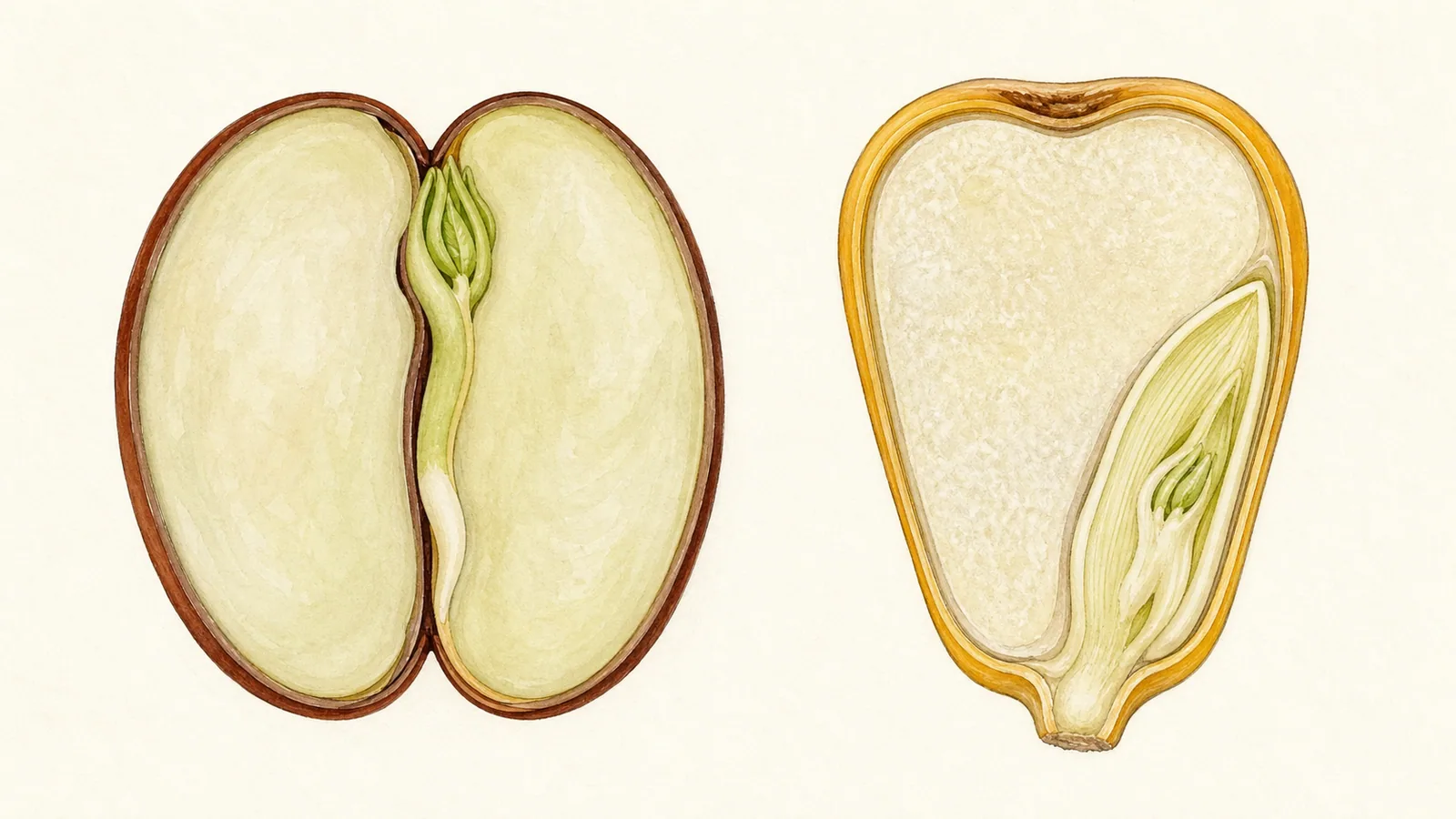
A bean has a seed coat; a corn kernel also has a fruit wall
The seed coat protects the embryo and stored resources. The corn kernel on the right is a caryopsis, a fruit with a closely fused fruit wall and seed coat, so its outer covering is not simply a typical seed coat.
Trace the outside edges of both models, separate from the thick storage tissue inside.
The embryo includes the axis and cotyledons
The embryo is the young plant. In the bean-like model, the narrow central region is the embryonic axis with root and shoot regions, and both large cotyledons also belong to the embryo. The corn embryo lies to one side and includes one specialized cotyledon.
On the left, include the whole embryo inside the coat. On the right, locate the side embryo, separate from the large endosperm.
The two large bean cotyledons often store early-growth resources
Cotyledons belong to the embryo and differ from later true leaves. The bean model has two thick cotyledons. Corn has one specialized cotyledon that helps transfer endosperm resources to the embryo.
Look at the two large pale-yellow structures filling most of the left model.
Corn has a large endosperm outside the embryo
Endosperm supplies resources to the embryo or young seedling and is distinct from a cotyledon. Corn retains a large endosperm; the amount retained at maturity differs among plants.
Compare the large pale-yellow region on the right with the smaller side embryo.
The seed coat protects the embryo and stored resources
The seed coat, also called the testa, is the outer covering of a seed. It develops from tissues around the ovule and helps protect the embryo and stored resources while the seed is dry, moved, or waiting for suitable conditions.
Seed coats vary a lot. Some are thin and soften quickly when they take up water. Others are harder and slow water entry. That difference can affect how germination begins, but this article focuses on structure rather than seed treatment methods.
The main point is simple: the seed coat is not just a useless shell. It is part of how the seed protects what is inside.
The embryo is the young plant inside the seed
The embryo is the beginning of the next plant, but it is not a complete miniature adult plant. It is an early plant body with a direction: one end is connected to future root growth, and the other is connected to future shoot and leaf growth.
The radicle is the embryonic root. In many seeds, the radicle is the first part to break through the seed coat during germination, because the young plant needs to begin anchoring and contacting water.
The plumule is the young shoot region, connected with future leaves and above-ground growth. In more detailed botany, the embryo can also be described with terms such as epicotyl, hypocotyl, and embryonic axis. For a first understanding, it is enough to remember that the embryo already has a root direction and a shoot direction.
Cotyledon and endosperm both support early growth, but they are not the same part
Cotyledons are part of the embryo. They are often called seed leaves, although they are not the same as the true leaves that appear later on a seedling. In many dicot seeds, such as bean-like teaching examples, the two cotyledons are large and store resources used during early growth.
Endosperm is usually a storage tissue outside the embryo. In flowering plants, endosperm forms through the reproductive process and can supply resources to the embryo or young seedling. In grass seeds such as corn-like examples, the endosperm often makes up a large part of the seed, while the single cotyledon helps absorb and transfer stored resources to the embryo.
So cotyledon and endosperm should not be treated as the same structure. Both may be connected to early resources, but the cotyledon belongs to the embryo, while endosperm is a separate storage tissue.
Monocot and dicot seeds are more than a cotyledon count
The words monocot and dicot come from cotyledon number. As a beginner rule, many monocots have one cotyledon, and many dicots or eudicots have two cotyledons.
But real seeds are more varied than a simple diagram. Some dicot seeds still have endosperm at maturity. Some have transferred much of the stored resource into the cotyledons. Some monocot seeds are not as easy to read as a corn-like diagram.
Corn also has a special complication: botanically, a corn kernel is a caryopsis, a grain-type fruit in which the fruit wall and seed coat are closely fused. That makes it useful as a monocot teaching model, but not a universal model for every monocot seed.
Use diagrams as entry points. Do not turn one bean seed or one corn kernel into a rule for all seeds.
How seed structure connects to germination
When a seed receives suitable conditions, water enters, metabolism restarts, and the embryo begins to grow. In many plants, the radicle breaks through the seed coat first. Later, the seedling begins to establish roots, stems, cotyledons, and true leaves.
Stored resources in cotyledons or endosperm support the earliest growth. After the seedling has green tissues that can receive light, photosynthesis gradually becomes a more important source of sugars and other organic materials.
This is why seed structure helps explain germination. The seed coat, embryo, radicle, cotyledons, and endosperm are not isolated vocabulary words. They are parts of the bridge from seed to seedling.
In a pot, seed tray, classroom activity, or garden observation, focus on what you can actually see: seed coat, cotyledons, true leaves, or the young root. Avoid judging seed quality or growing success from one sign alone. Different plants have very different seeds, and germination speed varies widely.
Common mix-ups
- ✕ A seed contains a complete tiny adult plant.
- ✓ A seed contains an embryo, but the embryo is an early plant body that still needs germination and growth.
- ✕ Cotyledon and endosperm are the same structure.
- ✓ A cotyledon is part of the embryo; endosperm is usually a storage tissue outside the embryo.
- ✕ Every seed has two obvious cotyledons.
- ✓ Cotyledon number and seed appearance vary. Monocot and dicot examples are useful, but not universal.
- ✕ The seed coat is only an inactive shell.
- ✓ The seed coat protects the embryo and stored resources and can affect how water enters the seed.
- ✕ A corn seed diagram can represent all seeds.
- ✓ A corn-like diagram is a useful monocot model, but corn kernels have special structure and should not stand for every seed.
Frequently Asked Questions
What are the main parts of a seed?
A beginner can start with three parts: the seed coat, the embryo, and stored resources. The seed coat protects the inside. The embryo is the young plant. Stored resources may be held in cotyledons, endosperm, or both depending on the plant.
What are the seed coat, embryo, and endosperm?
The seed coat is the protective outer covering. The embryo is the young plant inside the seed. Endosperm is a storage tissue that can help feed the embryo or young seedling during early growth.
Is a cotyledon a leaf?
A cotyledon is part of the embryo and is often called a seed leaf. It is different from the true leaves that the seedling produces later. Cotyledons may store resources, absorb resources, transfer resources, or briefly receive light depending on the plant.
Is the radicle the future root?
Yes. The radicle is the embryonic root. In many plants, it is the first part to emerge from the seed coat during germination and later develops into the young root system.
Does every seed have endosperm?
Not in the same visible amount at maturity. Many flowering plant seeds form endosperm during development, but some mature seeds retain a large endosperm while others transfer much of the stored resource into cotyledons.
What is the difference between monocot and dicot seeds?
The simplest difference is cotyledon number: many monocots have one cotyledon, and many dicots or eudicots have two. In corn-like monocot examples, the endosperm is often large. In bean-like dicot examples, the cotyledons are often thick and storage-rich. These are teaching models, not fixed rules for every plant.
Related Terms
- Seed coat: The protective outer covering of a seed; also called the testa.
- Testa: Another term for the seed coat.
- Embryo: The young plant inside a seed.
- Embryonic axis: The embryo’s root-to-shoot axis.
- Radicle: The embryonic root that becomes the beginning of the root system.
- Plumule: The young shoot region of the embryo, connected with future leaves and above-ground growth.
- Cotyledon: A seed leaf that is part of the embryo; it may store, absorb, or transfer early growth resources.
- Endosperm: A storage tissue, usually outside the embryo, that supports embryo or seedling growth.
- Monocot: A major group of flowering plants whose embryos usually have one cotyledon.
- Dicot or eudicot: A flowering plant group often introduced by embryos with two cotyledons.
Related Reading
Evidence
References
These sources were used to check the plant-science concepts and gardening context in this article.