
A terminal bud sits at the tip of a shoot. A lateral bud sits on the side of a stem, and many common lateral buds are found in the leaf axil, the small angle where a leaf or leaf stalk meets the stem. In simple terms, the terminal bud is the growth point at the shoot tip, while a lateral bud is a bud outside that tip, positioned along the side of the stem.
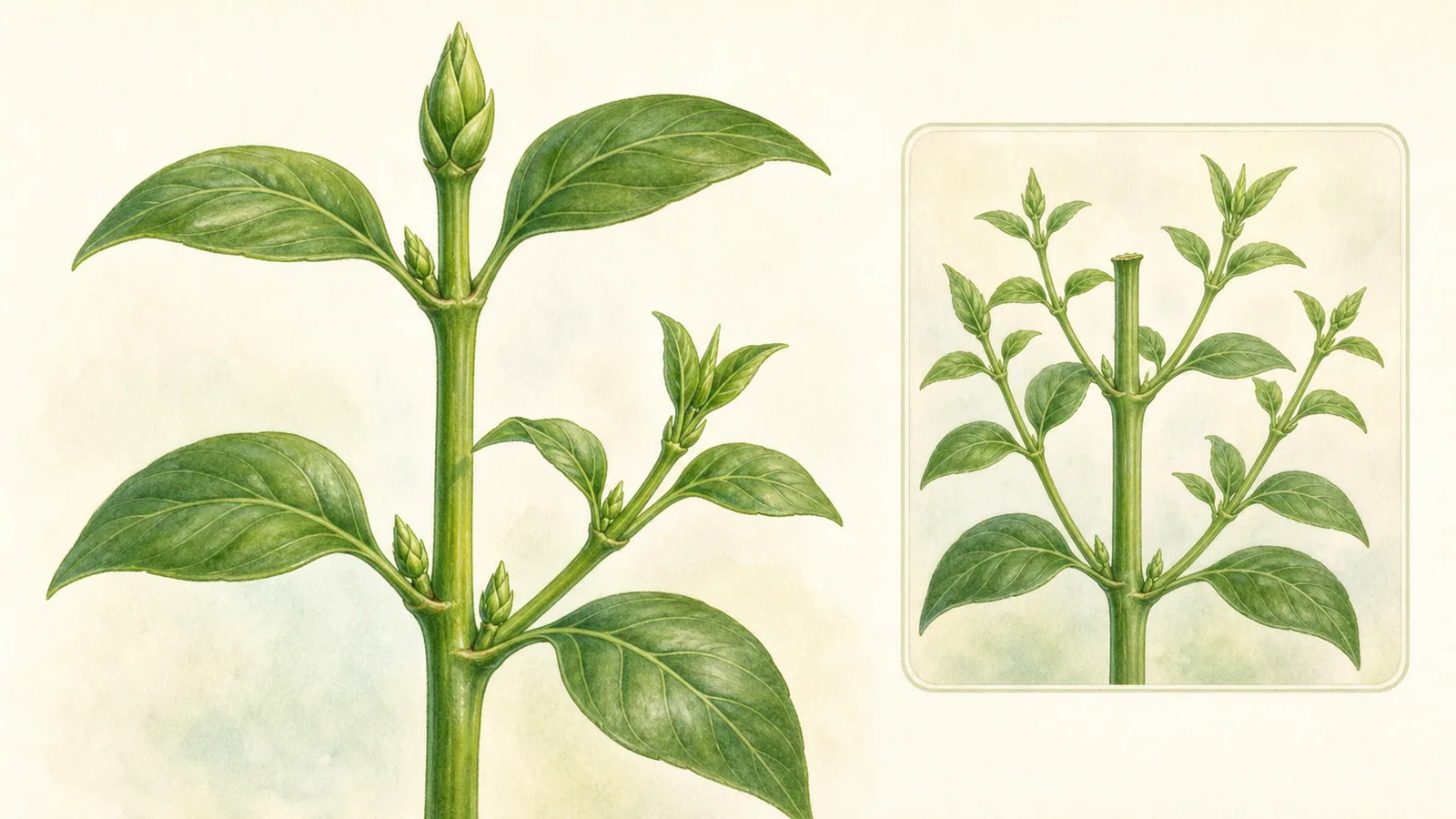
Start with position: tip bud or side bud?
The easiest way to separate these buds is by location. A terminal bud, also called an apical bud, is found at the end of a stem or shoot. It sits near the shoot tip, where new stem growth is organized. In plant biology, this region is associated with the shoot apical meristem, a small zone of actively dividing cells that helps the shoot extend.
For everyday observation, you do not need to start with the full technical definition. You can first think of the terminal bud as the growth center at the front end of a shoot.
A lateral bud is found along the side of a stem, outside the terminal growth point. In many familiar plants, lateral buds are located in the leaf axil, the small corner formed where a leaf, or its petiole, meets the stem. That is why lateral buds and axillary buds are often understood together in everyday observation. When looking at a stem, a small bump beside the base of a leaf is often your first clue.
A quick summary:
- Terminal bud: at the shoot tip; often involved in continued shoot extension.
- Lateral bud: on the side of a stem, outside the terminal growth point.
- Axillary bud: a lateral bud near a leaf axil; the type most often encountered in everyday observation.
- Adventitious bud: a bud from a less typical position, not necessarily at the tip or in a leaf axil.
Are lateral buds and axillary buds the same?
For everyday reading, it is usually fine to understand them as one closely related idea.
“Lateral bud” describes the bud’s position on the side of a stem. “Axillary bud” describes a bud’s position in a leaf axil. Because many common lateral buds on ordinary shoots are axillary buds, beginner gardeners can usually start with this rule of thumb: side buds are often near leaf axils.
The more precise distinction matters only when a bud does not arise from a leaf axil. In that case, it is usually discussed as an adventitious bud.
Terminal buds extend shoots; lateral buds keep branching options open
Terminal buds and lateral buds are not a ranking of importance. They are different positions with different roles.
When a terminal bud is active, the main shoot often continues to lengthen. Lateral buds are side growth points outside the shoot tip. Some remain tiny for a long time. Some grow into side branches. Some may develop into flower buds or flowering shoots, depending on the plant and its stage of growth. This is one reason a plant does not grow only as a single straight line; it can build branches, leaf positions, and flowering points.
This also connects the topic back to nodes and leaf axils. A node is the part of a stem where leaves, buds, branches, or flowers are commonly attached. The space between two nodes is an internode. Once you identify a node, look near the leaf axil for a small bud.
Why can the terminal bud affect lateral buds?
Many plants show apical dominance. This means that when the shoot tip is actively growing, some lateral buds may be less likely to grow out strongly at the same time.
Auxin and other plant signals are involved in this regulation. Auxin is one kind of chemical signal that helps coordinate plant growth. In this topic, it is enough to know that it participates in the relationship between an active shoot tip and lateral bud outgrowth. Whether a lateral bud grows out also connects with plant species, growth stage, season, light, water status, nutrient status, and other internal signals.
When side buds become more noticeable after a shoot tip is removed or lost, you can read that pattern through apical dominance, node position, and the plant’s overall growth state.
What to observe in a garden or houseplant
When observing a plant, look at three things: where the bud is, whether it is elongating, and how the whole plant is growing.
The bud at the very end of a shoot is the terminal bud. A small bump beside a leaf base is often a lateral or axillary bud.
A lateral bud is not truly becoming a visible side shoot until it starts to elongate and produce new leaves or other structures. Some buds stay as small bumps for a long time.
If a plant is growing with long internodes, weak side growth, or a constantly extending shoot tip, the lateral buds may be hard to see. Light, internode length, leaf size, stem thickness, and the difference between older and newer growth can all help you read the pattern.
Common mix-ups
- ✕ Lateral buds and axillary buds should never be discussed together.
- ✓ In everyday observation, many lateral buds are the axillary buds in leaf axils; only buds from non-axil positions need a separate label.
- ✕ A terminal bud is just the highest leaf.
- ✓ A terminal bud is the not-yet-fully-expanded growth point at the shoot tip, not a mature leaf.
- ✕ Every lateral bud will become a new branch.
- ✓ A lateral bud may grow, remain small, or stay dormant for a period of time.
- ✕ Terminal buds and lateral buds only matter for gardening techniques.
- ✓ They are basic stem-growth concepts that also help explain branching, flowering, and plant form.
Frequently Asked Questions
Is a terminal bud the same as a growing point?
Not exactly, but they are closely related in everyday explanation. A terminal bud is the visible or recognizable bud at the end of a shoot. A growing point is a broader idea, often referring to a region that can produce new tissues. For beginners, it is reasonable to think of the terminal bud as the shoot’s front-end growth center.
Is a lateral bud different from an axillary bud?
A lateral bud is a bud positioned on the side of a stem. An axillary bud is a bud located in a leaf axil. Since many common lateral buds are axillary buds, beginners can usually learn them together first; the distinction matters more when a bud comes from a non-axil position.
Does every leaf axil have a lateral bud?
Many plants form axillary buds at nodes, but they may be tiny, hidden, inactive, or difficult to see. Visibility depends on the plant species, shoot age, growth stage, and current condition of the shoot.
Will every lateral bud become a branch?
No. Some lateral buds grow into branches, some may become flower-related structures, and some remain small or dormant. A bud is a growth point whose later development can differ by position, timing, and plant type.
Will side buds always grow after the terminal bud is removed?
A common pattern is that some lateral buds become more likely to elongate after apical dominance changes. The actual response still connects with the plant, timing, light, water status, and overall condition.
Are terminal buds related to flower buds?
They can be, depending on the plant. A bud can be described by position, such as terminal or lateral, and also by what it later develops into, such as a leaf bud or flower bud. A terminal bud may stay vegetative and continue shoot growth, or in some plants and seasons it may develop toward flowering.
Related terms
- Terminal bud: a bud at the end of a shoot or stem.
- Lateral bud: a bud on the side of a stem.
- Axillary bud: a bud near a leaf axil; a common type of lateral bud.
- Leaf axil: the small angle between a leaf or leaf stalk and the stem.
- Node: a point on the stem where leaves, buds, branches, or flowers commonly attach.
- Internode: the stem section between two nodes.
- Apical dominance: the tendency for active shoot-tip growth to suppress some lateral bud outgrowth.
- Auxin: one kind of chemical signal involved in plant growth regulation.
Read next
Evidence
References
These sources were used to check the plant-science concepts and gardening context in this article.