A bud is an undeveloped growth point
A new shoot usually does not appear from a random spot on a stem. In many plants, it begins from a bud that was already present, even if that bud was small and easy to miss.
A bud is an undeveloped growth point. From the outside, it may look like a tiny swelling at the shoot tip or beside a leaf. Inside, it may contain young leaves, a short undeveloped stem, or structures that can later form a flower. When the plant is in a suitable growth state, some buds elongate and become new shoots, leaves, or flowers.
That is why it helps to look at more than the leaf blade itself. The place where a leaf meets a stem often holds clues about where the next visible growth may begin.
Start with nodes and leaf axils
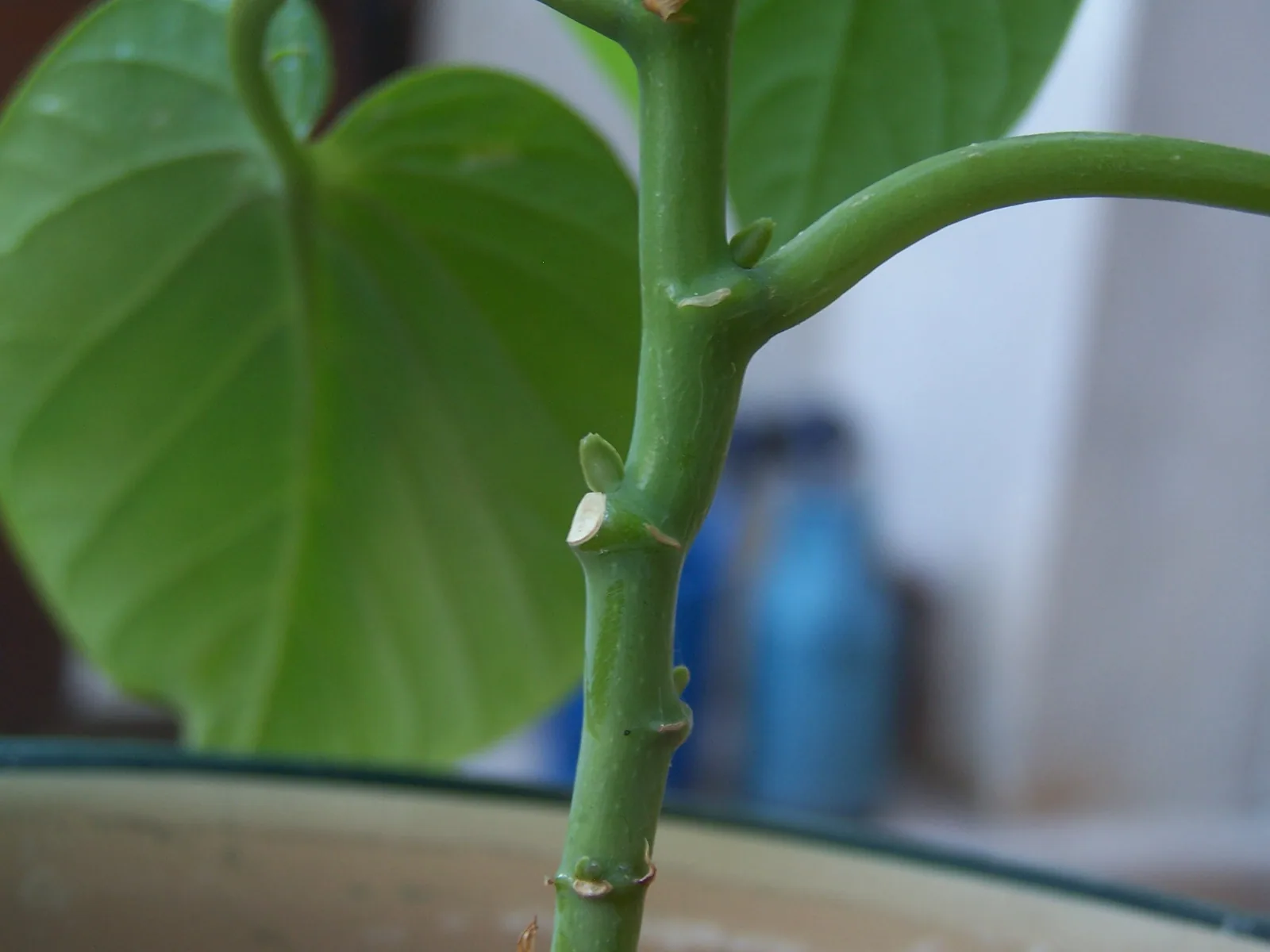
To understand where buds sit, it helps to know two stem terms: node and leaf axil.
A node is a point on the stem where leaves, buds, branches, or flowers commonly attach. The stem section between two nodes is called an internode. The small angle between a leaf and the stem is the leaf axil. In many plants, an axillary bud sits in or near that leaf axil.
So when you are trying to find a bud, first look for a leaf or a leaf scar, then check the nearby angle against the stem. Sometimes the bud is obvious. Sometimes it is tiny. Sometimes it stays small for a long time. Not every bud becomes a branch, but buds give the plant the possibility of producing growth from the side.
Terminal buds and axillary buds
A terminal bud is at the end of a shoot or stem. It is often connected with the shoot continuing to lengthen. In botanical terms, the shoot tip contains a shoot apical meristem, a region where cells can keep dividing and form new tissues; it is the growth center at the front end of a shoot.
An axillary bud is usually found in the leaf axil, near the place where a leaf meets the stem. It may remain small, or it may later develop into a side shoot, leaves, or a flower.
“Lateral” describes a bud on the side of a stem, while “axillary” describes a bud in or near a leaf axil. Many lateral buds are axillary, but the terms are not identical.
The main exception is an adventitious bud, which forms from a less typical position. That kind of bud is not necessarily axillary, because it may not be in a leaf axil.
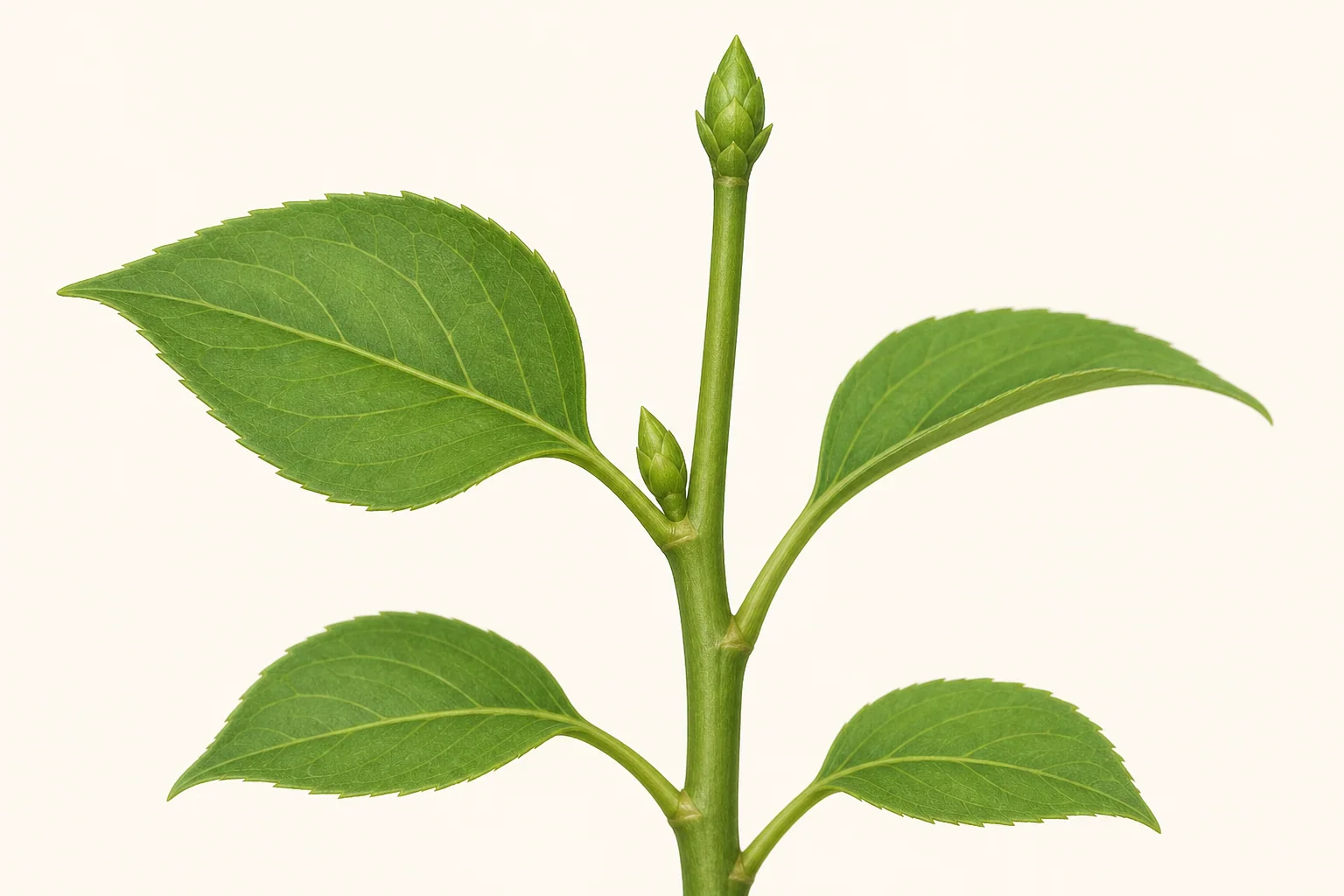
A useful first comparison is location. The terminal bud sits at the shoot tip, while the axillary bud sits beside a leaf, near the node. The wordless diagram below uses a general plant form to make that spatial relationship easier to see. Read it as a guide to position and possible growth direction; real buds vary with the plant and its growth stage.
A practical way to sort them is:
- Terminal bud: at the shoot tip; often involved in continued shoot extension.
- Axillary bud: near the leaf axil; often a starting point for side shoots, leaves, or flowers.
Leaf buds and flower buds have different outcomes
Buds are not all the same. A leaf bud, also called a vegetative bud, usually develops into leaves or a leafy shoot. A flower bud, also called a floral bud, develops into a flower or an inflorescence.
In some plants, flower buds may look rounder or fuller, while leaf buds may look narrower or more pointed. That can be a useful observation clue, but it is not a rule for all plants. Bud shape varies widely by species and growth stage. The safer way to read a bud is to combine its position, appearance, plant type, and later development.
This difference also connects buds to the larger plant life cycle. A plant does not only keep producing leaves forever. At certain stages, some buds may shift toward flowering, which can later connect to pollination, fruit formation, and seed development.
Why some buds stay small
Seeing a bud does not mean it will immediately become a new shoot. A bud may be active, or it may stay dormant or very small for a while. Its activity can be influenced by season, light, the plant’s internal condition, and other growing points on the same shoot.
For example, when the shoot tip is growing strongly, some side buds may remain less active. This is often discussed under apical dominance. A plain way to read it is this: when the terminal bud at the shoot tip is active, the plant’s growth is often directed toward extending that main shoot, while nearby axillary buds may stay small for a time.
Plant signals such as auxin are involved. The useful observation is that a strong shoot tip can hold back some side buds for a time. This relationship does not make pruning a guaranteed way to produce branches. Knowing the term helps you observe plant structure; it does not mean you can force every plant to branch in a predictable way.
A safer and more useful habit is to use buds as clues. Where is the bud located? Is it at the shoot tip, in a leaf axil, or in a less typical position? Are there nearby nodes, leaf scars, or new leaves? Is the bud elongating, or is it still a small bump?
Buds can look very different across plants
A general herbaceous stem is often the easiest way to learn buds because the leaves, nodes, leaf axils, and side shoots may be easy to see. But real plants do not all show buds in the same way.
Woody plants may have winter buds protected by bud scales. Herbaceous plants may have softer, less obvious young buds. Some underground stems, bulbs, corms, or tubers also have bud-like growing points. The “eyes” on a potato are related to buds, but that example also involves specialized stems and underground structures.
The main idea is that buds are important starting points for new plant growth, and their positions often connect closely with shoot tips, nodes, and leaf axils.
Common mix-ups
- ✕ A bud is just a leaf that has already grown out.
- ✓ A bud is an undeveloped growth point. It may contain young leaves, a short stem, or flower structures.
- ✕ New shoots appear from any random place on the stem.
- ✓ Many side shoots develop from axillary buds that were already present near leaf axils.
- ✕ If you can see a bud, it must grow right away.
- ✓ A bud may become active, stay dormant, or remain very small depending on the plant, season, and conditions.
- ✕ Flower buds and leaf buds are always easy to tell apart by shape.
- ✓ Some plants show visible differences, but bud shape varies too much to use one rule for every plant.
- ✕ Understanding terminal and axillary buds means you can guarantee branching.
- ✓ These ideas help explain plant structure and observation. They are not a guarantee or a pruning prescription.
Frequently asked questions
Is a bud a leaf or a branch?
A bud is not an expanded leaf or a mature branch. It is an undeveloped growth point. Depending on the type of bud and the plant’s stage, it may later become leaves, a leafy shoot, or a flower.
Do new shoots always come from leaf axils?
Many side shoots come from axillary buds near leaf axils, but not all new growth comes only from leaf axils. Plants may also form adventitious buds, buds on specialized stems, or other growth points in less typical positions.
What is the difference between a terminal bud and an axillary bud?
A terminal bud is at the end of a shoot and is often involved in continued shoot extension. An axillary bud is near the place where a leaf meets the stem and may become a side shoot, leaves, or a flower. “Lateral” is a broader position term for a bud on the side of a stem; many lateral buds are axillary, but the terms are not identical. An adventitious bud may form elsewhere.
How can I tell a leaf bud from a flower bud?
A leaf bud, or vegetative bud, usually develops into leaves or a leafy shoot. A flower bud develops into a flower or an inflorescence. Some plants show visible differences in bud shape, but those differences are not universal.
Why do some buds never seem to grow?
A bud may be dormant, or it may be held in a small inactive state by season, light, water status, the plant’s growth stage, or the influence of other growing points. This is part of plant growth regulation and does not point to one single cause in every case.
What do nodes have to do with buds?
Nodes are points on the stem where leaves, buds, branches, or flowers commonly attach. Because axillary buds are often near nodes and leaf axils, finding the node can help you find where a bud is likely to be.
Related terms
- Bud: an undeveloped plant growth point that may form a shoot, leaf, or flower.
- Terminal bud: a bud at the end of a shoot or stem.
- Axillary bud: a bud near the leaf axil, often connected with side shoots or flowers. In many common stem examples, this is what people mean by a lateral bud.
- Lateral bud: a positional term for a bud on the side of a stem; many lateral buds are axillary, but the terms are not identical.
- Adventitious bud: a bud that forms from a less typical position and is not necessarily in a leaf axil.
- Leaf bud: a bud that usually develops into leaves or a leafy shoot.
- Flower bud: a bud that develops into a flower or inflorescence.
- Node: a point on the stem where leaves, buds, branches, or flowers commonly attach.
- Leaf axil: the small angle between a leaf or leaf stalk and the stem.
- Meristem: a region of plant tissue where cells can keep dividing and form new tissues.
Read next
Evidence and attribution
Sources and image rights
These sources were used to check the plant-science concepts and gardening context in this article.
View sources and further reading (6)
Image sources and rights
- Eiku / Wikimedia Commons · CC BY-SA 4.0 — The source JPEG was prepared as WebP for delivery.
