Flower bud differentiation is a change of job at the growing point
In gardening, “flower bud differentiation” is often used broadly for the continuous development from preparing a bud to form flowers through the development of flowers and floral parts inside it. It describes a plant that has already changed the structures that will develop next inside a bud.
In stricter developmental language, the shift from vegetative growth to reproductive growth at the shoot apex is the floral transition; flower-bud initiation and later differentiation then build the flower. Species and sources do not draw these boundaries in exactly the same place. The shared idea is that some growing points no longer only extend leaves and shoots, but begin to build a flower or inflorescence.
How is it different from a visible flower bud?
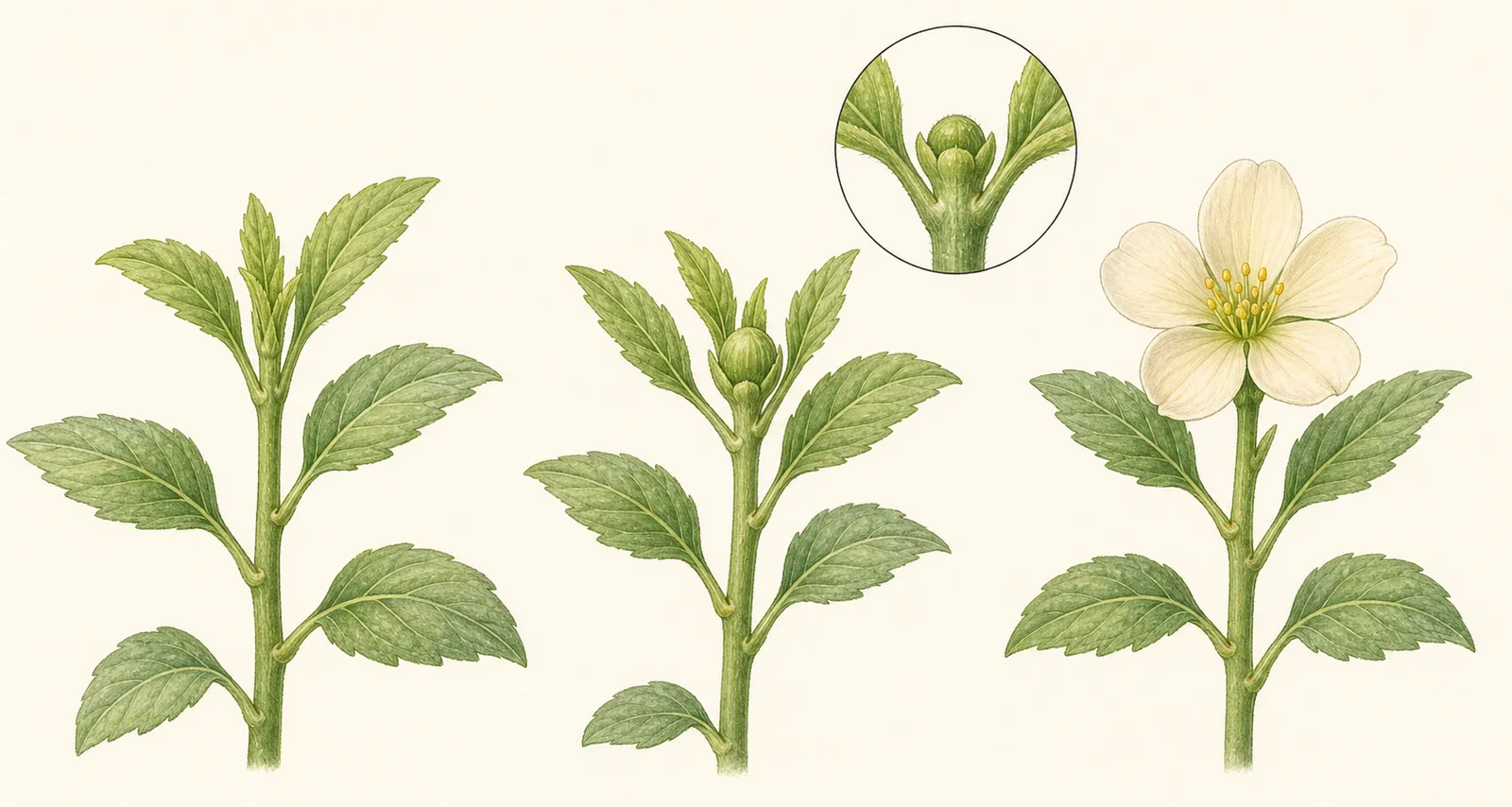
In everyday language, a visible flower bud is an unopened bud or inflorescence structure that can already be recognized from the outside. It often appears after reproductive development is under way, but flower-bud initiation, development inside the bud, and a visible external form can overlap differently among species. A fixed sequence cannot be assumed, and the absence of a visible bud does not identify the stage inside a growing point.
This helps explain why some woody plants and bulbous plants may complete part of their flower-bud development in one season but flower much later. From the outside, a twig or bud may not look very different. Inside the growing point, however, the structure for a later season may already be taking shape.
Different books and gardening resources sometimes use flower bud differentiation and flower bud formation almost interchangeably, while others distinguish bud initiation from the later development of flower parts inside the bud. The useful shared idea is that the plant is moving away from making vegetative organs and toward building reproductive structures. Whether an obvious bud is already visible is a separate point in time.
Why does a growing point change its developmental direction?
Plants do not use one single switch to decide on flower bud differentiation. They integrate seasonal information from outside the plant with their own developmental readiness. Leaves can sense information such as the relative length of day and night, while photoreceptors and internal timing systems help process it. In some species, a prolonged cool period also contributes to the response. These cues can affect flowering-related signals that travel from leaves toward the shoot tip and help redirect development there.
The plant also has to be capable of flowering. Its age, size, established leaves and roots, and life cycle all influence whether it is ready. Some annual plants can mature and flower within one growing season. Biennials, perennials, and woody plants may need a longer vegetative phase, or may need to pass through a cool season before reaching a state that supports flowering.
Looking at those factors together is closer to how plants work than assuming that more light or more fertilizer always produces flowers. Light quantity can support photosynthesis and overall growth, but day length, uninterrupted darkness, temperature, maturity, and species-specific responses can each play a different part.
How do messages from leaves reach the shoot tip?
At a deeper level, leaves do more than make sugars. They also receive environmental information, including photoperiod cues, and take part in producing or regulating flowering-related signals. Plant scientists often use the term florigen for a class of systemic flowering signals. In model plants, signals associated with the FT protein can move from leaves through vascular tissue toward the shoot tip.
At the shoot tip, the growing point is given a new developmental task. The shoot apical meristem, which had been geared toward leaves and branches, can become a meristem capable of forming an inflorescence or flowers. The molecular details are not identical in every plant; not all plants follow the same fixed route. The important connection is simpler: leaves receive seasonal clues, and the growing point changes its developmental program.
If a potted plant keeps making leaves, has flower bud differentiation not happened?
Possibly, but leaves alone cannot answer the question. With no visible buds, reproductive development may not yet have begun in a recognizable way, or it may already be under way without an externally recognizable form; the plant may also simply not have reached the age or season when its species normally flowers. Bud positions, flowering seasons, and environmental cues vary greatly among species.
A more useful order of observation starts with plant identity and its usual life cycle. Where does this plant normally make flowers? At what time of year? Is indoor lighting routinely breaking up the dark period at night? Then place total light, root condition, potting medium, and water stability in the larger picture.
Common mix-ups
- ✕ Flower bud differentiation means a visible flower bud has already formed.
- ✓ Flower bud differentiation can describe continuous development from flower-bud initiation through development inside the bud. A visible bud is a separate external stage, and their timing can differ by species and by how the terms are used.
- ✕ Giving more light will make every plant start flower bud differentiation.
- ✓ Light quantity matters, but many plants also integrate day-night length, temperature, maturity, and species-specific seasonal cues.
- ✕ Every bud will eventually become a flower bud.
- ✓ A bud may continue as leaves, a shoot, a branch, or a flower, depending on its position, developmental state, and the plant species.
- ✕ No visible flower bud means the plant is not preparing to flower.
- ✓ Reproductive development can begin before a bud is visible; alternatively, the plant may still be in vegetative growth. Species and season need to be considered together.
Frequently Asked Questions
How long after flower bud differentiation does a plant flower?
There is no fixed interval. In some herbaceous plants, the time from early flower-bud formation to an open flower is relatively short. In trees, bulbous plants, or strongly seasonal plants, buds may form in one season and open in a later suitable season. Species and conditions both affect the timing.
Can flower buds and leaf buds be distinguished by appearance?
In some plants, yes. Flower buds may be rounder or plumper, while leaf buds look narrower. That is not a universal rule, though. Bud position, season, and developmental stage can differ even on the same plant, so it is best to check the structural features of the particular species.
Does flower bud differentiation mean the plant has enough fertilizer?
No. Mineral nutrients support overall growth, but flower bud differentiation is also related to maturity, photoperiod, temperature, and species characteristics. Fertilizer alone cannot explain every flowering pattern.
Can a developing flower bud stop developing?
Yes. After a bud has begun developing, it still needs to continue changing. The plant’s resource allocation, seasonal conditions, and environmental state can all affect what happens next. A visible bud does not promise that a flower will open on a particular date.
Do all plants undergo flower bud differentiation?
This term mainly applies to flowering plants, or angiosperms. Ferns, mosses, and other plant groups have different reproductive structures and life cycles, so flower bud differentiation is not the right term for describing their reproduction.
Related terms
- Growing point / meristem: a location where plants keep producing new cells and organs; the shoot tip is a common example.
- Vegetative growth: the stage mainly devoted to building roots, stems, and leaves.
- Flower bud: a bud that can develop into a flower or inflorescence.
- Inflorescence: the arrangement and structure of flowers on a stem or flowering stalk.
- Photoperiod: the regular pattern of light and dark hours in a day; many plants can use it as a seasonal cue.
- Vernalization: the process by which some plants become more able or ready to flower after a period of low temperature.
Read Next
Evidence
References
These sources were used to check the plant-science concepts and gardening context in this article.