Plant Hormones Are Chemical Signals
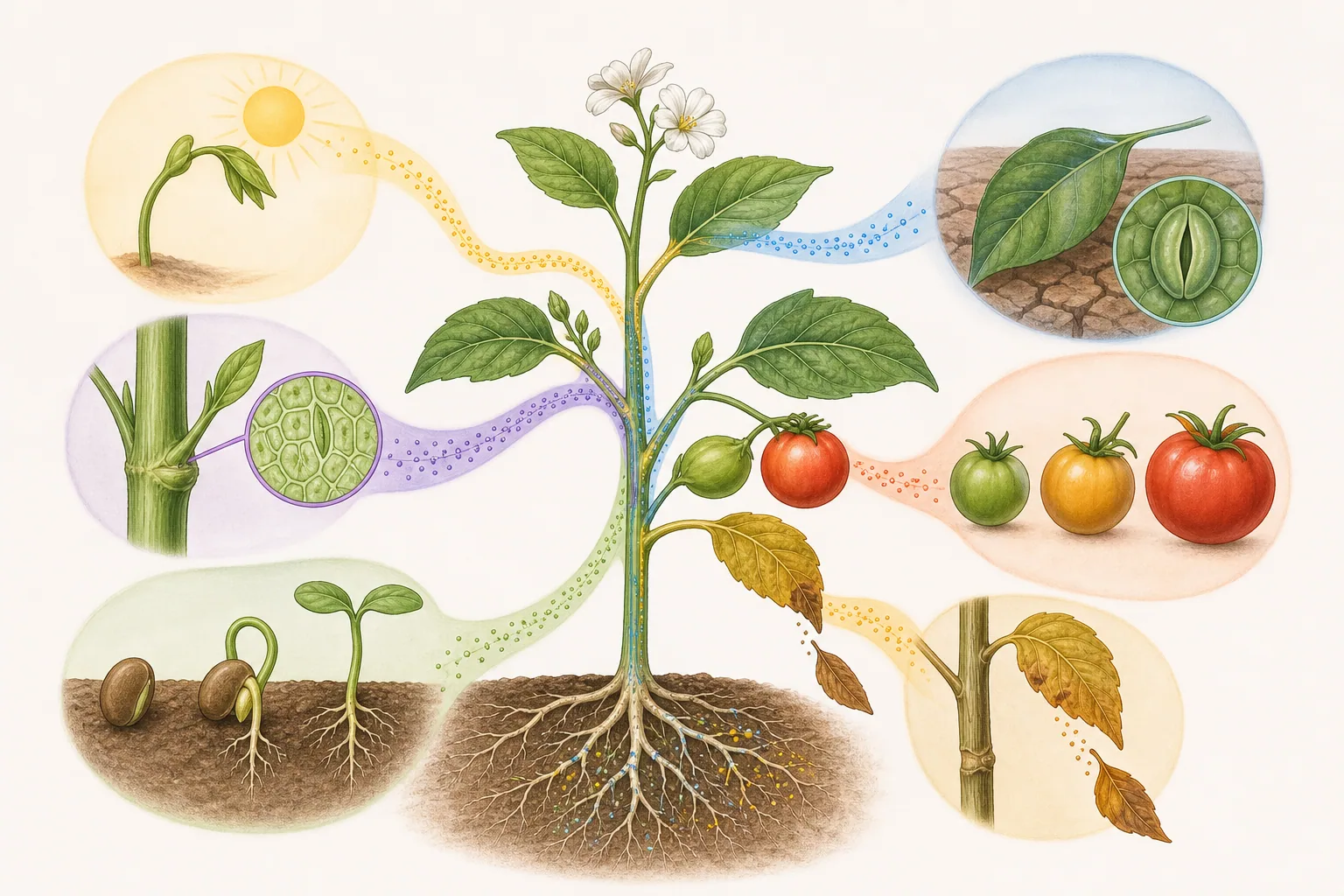
Plant hormones are chemical signals made by plants in very small amounts. They help coordinate growth, development, and responses to the environment.
A plant hormone may act near the place where it is produced, or it may move between cells and tissues to affect another part of the plant. Because roots, stems, leaves, buds, flowers, fruits, and seeds must work together, plants need internal signals that help coordinate what happens in each part.
A seed beginning to germinate, a young stem bending toward a window, a shoot tip influencing side buds, a fruit ripening, or a leaf changing before it falls may all involve plant hormones. However, these events are rarely controlled by one hormone acting alone. The result usually depends on several signals, the plant tissue involved, hormone concentration, timing, developmental stage, and environmental conditions.
How Do Plants Use Chemical Signals?
Plants cannot move away when light, temperature, water availability, or gravity changes. They also do not have a brain that gives the whole plant one central command. Instead, different tissues detect conditions and communicate through chemical signals, transport systems, and changes in cell sensitivity.
A simplified sequence looks like this:
- A cell or tissue detects an environmental or developmental cue.
- The plant changes the production, transport, breakdown, or storage of one or more signals.
- Other cells perceive those signals through receptors or related sensing systems.
- The cells adjust processes such as division, elongation, dormancy, maturation, or organ separation.
The same hormone can therefore produce different outcomes in different tissues. A root and a shoot may respond differently to the same concentration of auxin. A young seedling may respond differently from a mature plant. A short signal pulse may also have a different effect from a signal that remains active for a longer period.
This is why plant hormones are best understood as part of a signalling network, not as simple instructions with one fixed meaning.
The Five Traditional Groups of Plant Hormones
Introductory plant biology often begins with five classic groups: auxin, cytokinin, gibberellin, abscisic acid, and ethylene. This is a useful starting map, not a complete list of every important plant signal. Modern plant science also studies jasmonates, salicylic acid, brassinosteroids, strigolactones, and other signalling molecules.
1. Auxin: Connecting Growth with Direction and Position
Auxin is commonly discussed in relation to cell elongation, phototropism, gravitropism, apical dominance, vascular development, and the development of roots and shoots.
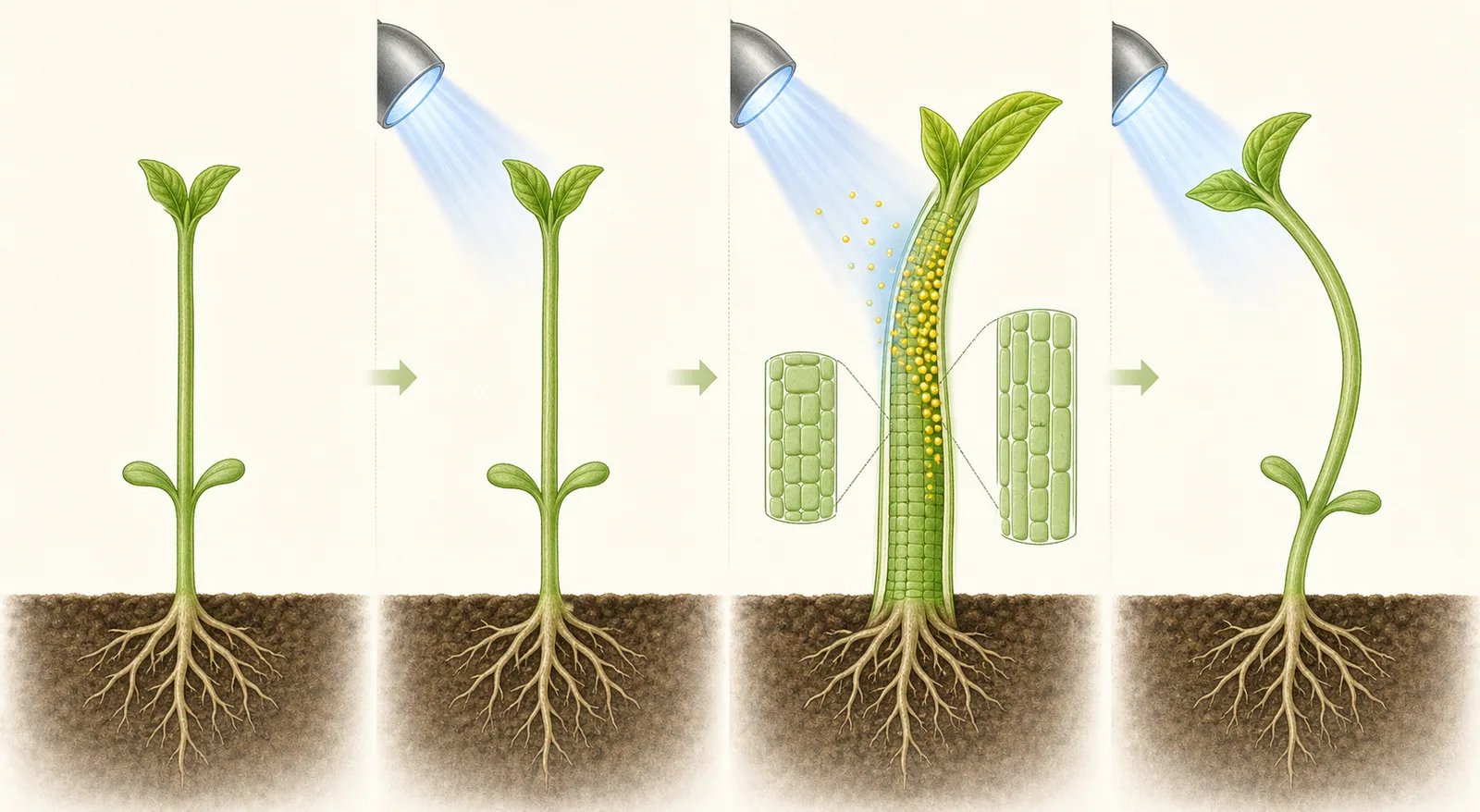
When a young shoot receives light mainly from one side, photoreceptors first detect the direction of the light. The photoreceptors do not act as auxin themselves. Instead, the light-sensing process helps change how auxin is distributed. Cells on the two sides of the shoot then elongate at different rates, causing the shoot to bend toward the light.
Auxin is therefore not simply a chemical that “makes a plant grow taller.” Its effects also depend on where it is present, how much is present, how long it remains active, and how the receiving tissue responds.
Auxin concentration is especially important. A concentration that promotes elongation in part of a shoot may inhibit elongation in a root. Roots and shoots can have different sensitivities and response ranges. Auxin is not “the more, the better.”
2. Cytokinin: Cell Division and Bud Activity
Cytokinins are associated with cell division, the activity of growing tissues, bud development, and the rate at which leaves enter senescence.
Cytokinin and auxin often work together when plants balance root and shoot growth. Their relative levels and distribution can influence whether growth is directed more toward roots, shoots, or particular buds.
It would be too simple to describe cytokinin as a substance that merely makes plants bushier. Its effects depend on the tissue, concentration, developmental stage, timing, and other signals present at the same time.
3. Gibberellin: Germination and Stem Elongation
Gibberellins, often abbreviated as GA, participate in the germination of some seeds, stem elongation, and parts of flower and fruit development.
Seed germination is a useful example of hormone balance. Gibberellin-related signals can support processes associated with germination, while abscisic acid, or ABA, is often associated with maintaining dormancy. This does not mean that the two hormones always simply cancel each other out. Germination also depends on seed maturity, temperature, water, light conditions in some species, and other internal and external factors.
Gibberellin is therefore one part of a process rather than a universal germination switch.
4. Abscisic Acid, or ABA: Dormancy and Water-Related Responses
Abscisic acid, commonly called ABA, is associated with seed dormancy, bud dormancy, regulation of stomata during water stress, and other environmental responses.
When a plant needs to reduce water loss or temporarily slow a process, ABA-related signalling may help adjust stomatal behaviour or developmental activity. Dormancy can also protect a seed or bud until conditions are more suitable.
ABA should not be treated as a “bad hormone” or as a chemical that always stops growth. Temporarily slowing growth, maintaining dormancy, or reducing water loss can be useful ways for a plant to manage difficult conditions.
ABA is also not the explanation for every case of leaf drop. Leaf senescence, environmental stress, seasonal cues, and organ abscission involve several possible signals and processes.
5. Ethylene: A Gaseous Plant Hormone
Ethylene is a volatile, gaseous plant hormone. It participates in many cases of fruit ripening, flower and leaf senescence, organ abscission, and responses to conditions such as wounding, infection, or flooding.
Because ethylene is a gas, it can diffuse through spaces in plant tissues and between nearby tissues. It does not need to travel only through a liquid transport stream in the way a dissolved substance might.
Ethylene is often associated with fruit ripening and the later stages of flowers and leaves. However, it is not the sole cause of every ripening, senescence, or abscission event. The plant species, tissue, developmental stage, environment, and other signals all matter.
It is also useful to distinguish two related terms:
- Senescence is the developmental ageing of a cell, tissue, or organ.
- Abscission is the controlled separation and shedding of an organ, such as a leaf, flower, or fruit.
Senescence may occur before abscission, but the two terms do not mean exactly the same thing.
Why Does One Hormone Have More Than One Effect?
Plant hormone responses depend on context. Important factors include:
- the hormone concentration;
- the tissue or organ receiving the signal;
- the presence and sensitivity of receptors;
- how long the signal lasts;
- the plant’s developmental stage;
- environmental conditions;
- the distribution and transport of the hormone;
- interactions with other hormones.
For example, auxin can promote elongation in certain shoot cells but inhibit elongation in roots at a different concentration range. Auxin and cytokinin can also influence how growth is balanced between roots and shoots or between a main shoot and side buds.
Seed germination is similarly dependent on more than one signal. Gibberellin and ABA may be important, but seed maturity, temperature, water availability, and other conditions also affect whether germination can proceed.
This interaction between signals is called hormone crosstalk. It means that a visible plant response usually reflects a network of changing signals rather than one molecule working by itself.
Everyday Examples of Plant Hormone Signalling
A young plant bends toward a window
In phototropism, photoreceptors first detect the direction of light. The plant then changes the distribution of auxin, and the two sides of the shoot elongate at different rates. The unequal growth causes the shoot to bend.
You can continue with Why Do Plants Bend Toward Light?.
A seed begins to germinate
Gibberellin, ABA, seed maturity, water, temperature, and other conditions can work together during germination. A single hormone does not guarantee that every seed will germinate in every environment.
See How Do Seeds Germinate? for the broader process.
A plant slows its growth during an unsuitable season
ABA-related signals may participate in dormancy and water-related responses. Dormancy also depends on temperature, day length, species, and the developmental history of the plant.
Read more in Why Do Plants Go Dormant?.
A fruit ripens or a flower and leaf age
Ethylene may participate in fruit ripening, flower senescence, leaf senescence, and abscission. Other hormones and developmental signals can also contribute, so the visible change should not automatically be attributed to ethylene alone.
Flower and fruit development can be connected with Why Do Plants Flower? and What Is Flower Bud Differentiation?.
A plant responds after injury
Ethylene can participate in some wound responses, but wound sealing, damaged-tissue isolation, and rebuilding depend on several signals and on the organ and situation involved. See How Do Plants Repair Wounds?.
A main shoot influences side buds
Auxin produced or transported from growing shoot regions can participate in apical dominance. Cytokinin and other signals may also affect side-bud activity. This is an example of a balance between signals, not a single hormone permanently controlling every branch.
Plant Hormones Are Not Fertilizer
Plant hormones and fertilizer are not the same thing.
Fertilizer supplies mineral nutrients, such as nitrogen, phosphorus, and potassium, that plants use as materials for building tissues and carrying out metabolism. Plant hormones are chemical signals that help coordinate when, where, and how cells change their activity.
A simple comparison is:
- Mineral nutrients are materials the plant needs to build and operate its body.
- Plant hormones are signals that help coordinate growth and development.
A plant may have access to mineral nutrients and still not germinate, flower, or produce more side shoots at a particular moment. Light, temperature, water, maturity, and signalling networks also influence development. Conversely, hormone signals cannot replace the mineral materials needed to construct new tissues.
For more background, see Why Do Plants Need Mineral Nutrients?.
Plant hormones are also not the same as vitamins. Vitamins are nutritional compounds in particular biological contexts, while plant hormones are signalling molecules that regulate plant processes.
What Are Exogenous Plant Growth Regulators?
Horticultural writing sometimes uses the term plant growth regulator for substances that influence plant growth and development. The term may include naturally occurring plant hormones, synthetic compounds that imitate hormone activity, or other substances that alter a plant response.
An externally applied growth regulator is not automatically identical to the natural hormone system inside a plant. The outcome can depend on the plant species, tissue, developmental stage, concentration, timing, and environmental conditions.
Because responses can differ by species, tissue, concentration, timing, and environment, a product name or single example cannot serve as a universal rule for all plants.
Common Misunderstandings
-
✕ Plant hormones are plant fertilizer or nutrient solution. ✓ Plant hormones are regulatory signals; fertilizer supplies mineral nutrients used to build and operate plant tissues.
-
✕ Each hormone has only one job, such as auxin only making stems longer. ✓ One hormone can participate in several responses, and one visible response can involve several hormones.
-
✕ Auxin is always better in larger amounts. ✓ Auxin responses depend on concentration, tissue, timing, and interactions with other signals. Roots and shoots may respond differently.
-
✕ Photoreceptors are the same thing as auxin. ✓ Photoreceptors detect light direction first. Light signalling can then help change auxin distribution and produce unequal growth.
-
✕ ABA is a harmful hormone that only stops growth. ✓ ABA can support dormancy, stomatal regulation, and responses that help plants manage unsuitable conditions.
-
✕ Ethylene is the only cause of every fruit-ripening, ageing, or leaf-drop event. ✓ Ethylene may participate, but development, species, environment, senescence, abscission, and other signals also matter.
-
✕ Yellow leaves or falling leaves prove that one hormone is missing. ✓ Visible symptoms have many possible causes and should not be used alone to identify a hormone state.
-
✕ Plant hormones work exactly like animal hormones made by fixed endocrine glands. ✓ Plant hormones are chemical signals produced and perceived across different cells and tissues; plants do not have the same gland arrangement as animals.
Frequently Asked Questions
Are plant hormones made by the plant itself?
Usually, yes. Plant hormones, or phytohormones, are naturally produced signalling molecules. Plants can also encounter externally supplied growth-regulating substances that imitate or alter hormone-related responses. Similar names or effects do not mean that natural and external substances behave identically in every plant.
Do plant hormones move through a plant?
Some plant hormones move between cells or over longer distances, while others act mainly near where they are produced. Ethylene can also diffuse as a gas through plant tissues and nearby spaces. The route depends on the molecule, tissue, developmental stage, and physiological condition.
Is more auxin always better?
No. Auxin is not a “more is better” substance. The response depends on concentration, tissue, timing, and other signals. A level that supports elongation in part of a shoot may inhibit elongation in a root. Roots and shoots can have different response ranges.
Do roots and shoots respond differently to the same hormone?
Yes. Different organs may have different sensitivities, receptors, transport patterns, and developmental states. This is one reason a hormone cannot be described as having one identical effect throughout the whole plant.
What is the difference between gibberellin and ABA?
Gibberellin and ABA are often discussed together in seed biology. Gibberellin-related signals can support processes associated with germination, while ABA is commonly associated with maintaining dormancy and regulating responses to water stress. Germination is still controlled by the balance of signals and by conditions such as seed maturity, temperature, and water availability.
Why is ethylene called a gaseous plant hormone?
Ethylene is a small, volatile molecule that can move through air spaces in tissues and between nearby tissues. Its gaseous nature helps explain why it can act as a signal without relying only on transport through a liquid stream.
Are plant hormones the same as fertilizer?
No. Fertilizer provides mineral nutrients that plants use as materials for growth and metabolism. Plant hormones are signals that coordinate growth and development. Neither category simply replaces the other.
Can plant hormones be seen with the naked eye?
Usually not. Hormone molecules cannot normally be seen directly. People observe outcomes such as phototropism, germination, elongation, ripening, senescence, or dormancy, while laboratory methods are used to study hormone amounts, distribution, and signalling responses. One leaf or bud is usually not enough to identify the state of a particular hormone.
Do all plants have exactly these five hormone groups?
The five groups are a traditional introductory framework, not a complete or perfectly identical list for every plant. Plants also use other signalling molecules, and species can differ in hormone amounts, receptors, transport, sensitivity, and response networks.
Are plant hormones involved in flowering?
Yes, some hormones participate in flower-bud development, flower formation, and flowering-time responses. Flowering also depends on plant maturity, day length, temperature, nutrition, water status, and the overall developmental state. Flowering cannot be reduced to adding one hormone.
Related Terms
- Plant hormone / phytohormone: A chemical signal produced in small amounts that helps regulate plant growth, development, or environmental responses.
- Auxin: A group of signals associated with cell elongation, phototropism, gravitropism, apical dominance, and root or shoot development.
- Cytokinin: A group of signals associated with cell division, bud activity, meristem growth, and the timing of leaf senescence.
- Gibberellin: A group of signals involved in some forms of seed germination, stem elongation, and parts of flower and fruit development.
- Abscisic acid, or ABA: A signal associated with seed and bud dormancy, stomatal regulation, and responses to environmental stress.
- Ethylene: A volatile, gaseous plant hormone associated with many cases of fruit ripening, senescence, and abscission.
- Senescence: Developmental ageing of a cell, tissue, or organ.
- Abscission: The controlled separation and shedding of an organ, such as a leaf, flower, or fruit.
- Hormone crosstalk: Interactions among signalling pathways that make a plant response depend on several hormones rather than one molecule.
Continue Reading
Evidence
References
These sources were used to check the plant-science concepts and gardening context in this article.
View sources and further reading (8)
- openstax.org — 30 6 plant sensory systems and responses
- annualreviews.org — annurev arplant 070722 015329
- ncbi.nlm.nih.gov — NBK26895
- open.lib.umn.edu — 4 2 plant hormones
- frontiersin.org — full
- pubmed.ncbi.nlm.nih.gov — 34102450
- annualreviews.org — annurev cellbio 101011 155741
- openstax.org — 31 1 nutritional requirements of plants