Flowering is one way a plant enters its reproductive stage
Plants flower for a direct reason: in many plants, flowers are part of reproduction. Flowers connect pollen, ovules, pollination, fertilization, and the later formation of seeds or fruits.
But a plant usually does not flower the moment it sprouts. First, it builds a body. Roots take up water and minerals. Stems support and transport materials. Leaves capture light and make sugars through photosynthesis. This early body-building stage is called vegetative growth.
Later, when the plant is mature enough and the right seasonal or environmental signals fit that kind of plant, some growing points may change direction. Instead of continuing to make more leaves or shoots, they begin forming flower buds.
So a flower is not just a decoration that suddenly appears. It is a developmental shift. The plant moves from mainly building leaves, stems, and roots toward structures that can lead to pollination, fertilization, fruit, or seed formation.
How are flowers connected to seeds and fruits?
Many flowers contain reproductive structures. Stamens produce pollen. Pistils or carpels may include the stigma, style, ovary, and ovules. Flower forms vary widely: some are bright and showy, some are small, some rely on animals for pollination, and others use wind.
If pollen reaches a suitable part of the flower, pollination and fertilization may follow. After fertilization, ovules can develop into seeds. The ovary, and sometimes other flower-related tissues, may help form fruit.
That is why flowers are often discussed as part of the plant life cycle. They are not only attractive structures. In many flowering plants, they help connect one generation to the next.
Still, an open flower does not always become a fruit. Not every flower forms mature seeds. Plant species, pollination success, environmental conditions, and the condition of the plant itself can all affect what happens after flowering.
How does a plant switch from making leaves to making flowers?
When a plant is mainly producing roots, stems, and leaves, it is in vegetative growth. In this context, “vegetative” does not mean fertilizer or nutrition advice. It means the plant is building its body.
Leaves support photosynthesis. Roots take up water and mineral nutrients. Stems support the plant and move water and sugars. This body-building stage gives the plant the resources and structure it needs before reproduction becomes possible.
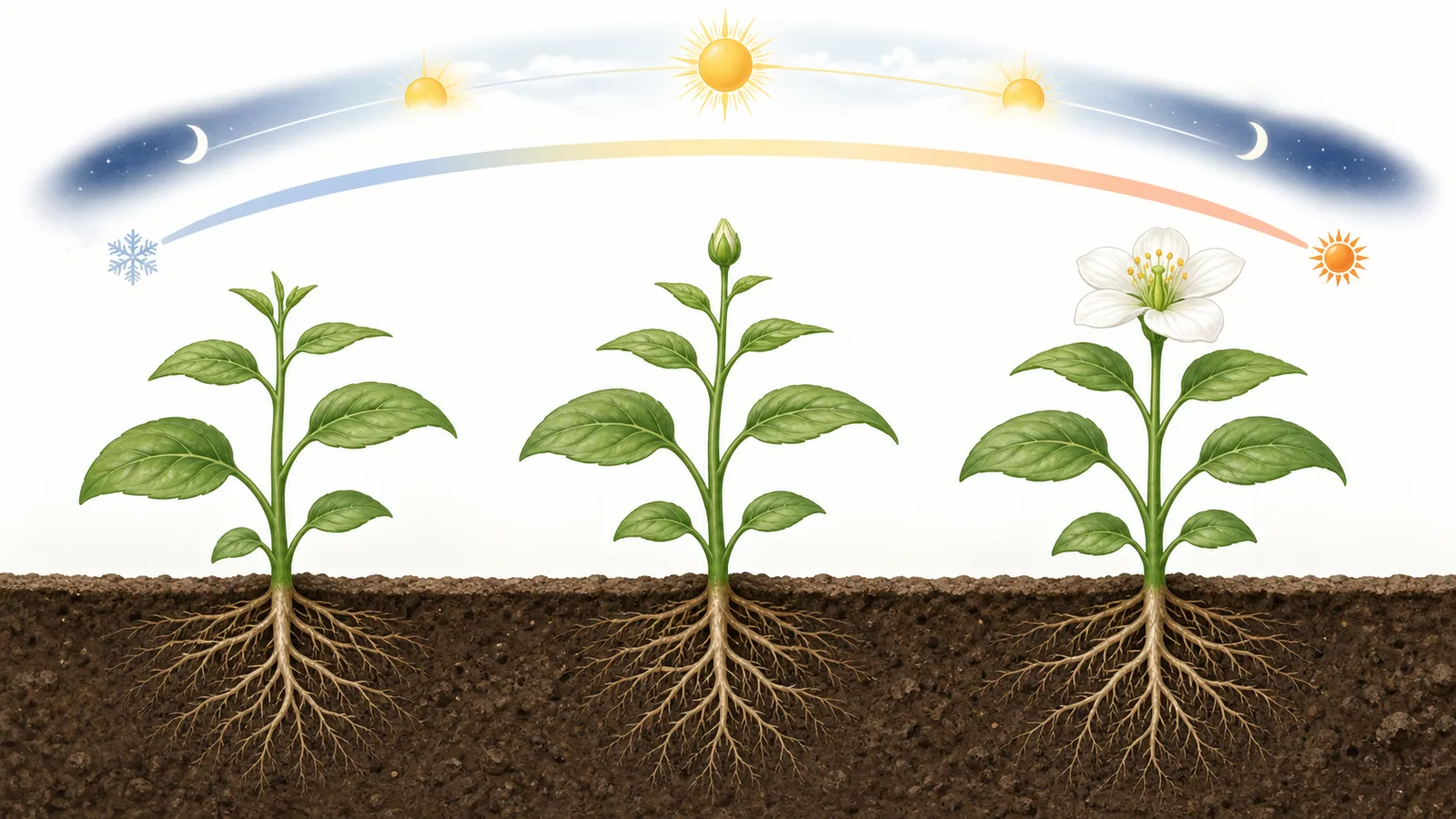
When a plant enters reproductive growth, some growing points change their role. A shoot tip that might have kept making leaves or branches may begin forming flower buds instead. This shift toward floral development is often discussed with the term flower bud differentiation. Those flower buds then develop over time before they become visible buds and open flowers.
This shift usually does not depend on just one condition. A plant may need to reach a certain size or age. It may need enough leaves and roots to support the process. In many plants, day length, night length, temperature, cool-season experience, total light, and plant type also matter.
Day and night length can work like a seasonal clue
Plants cannot move around or read calendars, but they can sense patterns in their environment. One important pattern is the changing length of day and night through the year.
A plant response to the length of light and dark periods is called a photoperiod response. This is where terms like short-day plant, long-day plant, and day-neutral plant come from.
Those names can be misleading at first.
Short-day plants are not plants that “do not need sunlight.” They are plants whose flowering response is often associated with shorter days or longer nights. Long-day plants often flower more readily or more quickly when days are longer and nights are shorter. Day-neutral plants are less directly controlled by day length, though their flowering can still depend on age, temperature, total light, and overall growth.
For many classic photoperiod responses, the length of uninterrupted darkness is especially important. That means photoperiod is not the same as “more light always makes more flowers.” Day and night length are timing signals. They are not a flowering guarantee.
Some plants also respond to cool periods or maturity
Some plants need a period of cool conditions before they are able, or more ready, to flower later. This process is called vernalization.
A simple way to understand vernalization is this: some plants use cold exposure as evidence that a cool season has passed. After that, if day length, temperature, maturity, and growth conditions also fit, the plant may be more able to continue toward flowering.
Vernalization does not mean that chilling a plant briefly will make flowers appear right away. It is not a universal flowering recipe. Some plants require a cool period, some respond to it only partly, and many do not use it as a major flowering cue.
Maturity also matters. Some annual plants can flower within one growing season. Some perennial or woody plants need to build larger roots, stems, branches, or storage resources before flowering becomes regular. From the plant’s point of view, flowering takes resources. If the body is not ready, continuing to grow leaves and roots may be the more reasonable path.
Flowering signals move inside the plant
At a deeper level, flowering is not just a visible change on the outside. Leaves, light receptors, internal clocks, plant hormones, and growing points all take part in signal networks.
One flowering signal often discussed in plant science is called florigen. In plain language, florigen is a term for a mobile or systemic flowering-related signal that can connect environmental cues received by leaves with a developmental shift at the shoot tip. In some model plants, FT-related signals are important in this research picture, but molecular details and signal composition are not identical in every plant.
Leaves can sense day-night information and other environmental cues. Signals related to flowering may then move toward the shoot tip. At the growing point, the plant may shift from making leaves or shoots to forming flower buds. That is why flowering is better understood as a developmental change rather than a flower simply appearing.

Why might a potted plant keep growing leaves but not flowers?
If a potted plant keeps making leaves but does not flower, it is usually too simple to say only “it needs fertilizer” or only “it needs more light.”
Several explanations are possible. The plant may not be mature enough. It may not have received the day-night pattern, temperature pattern, or seasonal cue that its species responds to. It may not have enough total light to support strong growth. Its roots, water balance, potting medium, or mineral nutrition may not be stable enough to support flowering.
Different plants respond very differently to photoperiod, cool periods, maturity, and growing conditions. A single sign cannot identify the cause, and no one condition can guarantee a flowering outcome.
A safer way to think about a non-flowering plant is to start with the plant’s identity. Is it a plant that normally flowers in cultivation? At what life stage or season does it usually flower? Then look back at broad clues: light level, whether nights are regularly interrupted by artificial light, root health, water stability, and potting conditions.
Common mix-ups
- ✕ Plants flower only to look beautiful.
- ✓ In many plants, flowers are reproductive structures connected to pollination, fertilization, seed formation, or fruit formation.
- ✕ More light always means a plant will flower more easily.
- ✓ Light affects growth, but many flowering responses also depend on day-night length, uninterrupted darkness, maturity, and plant type.
- ✕ A short-day plant does not need sunlight.
- ✓ A short-day plant has a flowering response associated with short days or long nights. It still needs enough light to support photosynthesis and growth.
- ✕ Vernalization means a cold treatment will make flowers appear immediately.
- ✓ Vernalization means that some plants become able, or more ready, to flower after cool exposure. Later flowering still depends on other conditions.
- ✕ Fertilizer alone can make a plant flower.
- ✓ Mineral nutrition is one part of growth, but it cannot replace maturity, light, roots, water stability, day-night timing, or species differences.
FAQ
Does flowering mean a plant is about to die?
Not necessarily. Many plants flower as a normal part of reproduction and continue growing afterward. Some annual plants approach the end of their life cycle after flowering and seed formation, but many perennials, woody plants, and ornamental plants can flower repeatedly or seasonally.
Do all plants make flowers?
No. Flowering plants, or angiosperms, produce flowers. Ferns, mosses, and many gymnosperms do not use flowers as their reproductive structures. The everyday word “plant” covers many different groups, so flowering is not a feature of every plant.
Why do some plants wait for a certain season before flowering?
Season changes affect day length, night length, temperature, and water conditions. Many plants use these cues to place flowering near a time that is more suitable for pollination, seed development, or later seedling growth.
Does every flower become a fruit?
No. An open flower only means the plant has reached a stage where reproduction may happen. Fruit or mature seed formation still depends on pollination, fertilization, plant type, and later growing conditions.
Why does a plant keep growing leaves but not flowers?
There are many possible reasons. The plant may be too young, may not have enough total light, may not have the right day-night pattern, may lack a cool-season cue if that species needs one, or may have unstable roots, water, potting conditions, or mineral nutrition. It is better not to conclude from one sign alone.
Do plants know when to flower?
Plants do not know in the human sense. But they can sense light, darkness, temperature, and their own developmental state. Those signals can be converted into growth and developmental responses, which makes it look as if the plant “knows” when the timing is right.
Related terms
- Flower bud: A bud that can develop into a flower or inflorescence, rather than only a leaf or shoot.
- Flower bud differentiation: A term for developmental changes associated with the shift toward flower-bud formation; its boundary with initiation or later formation varies among sources and species.
- Vegetative growth: The stage when a plant mainly builds roots, stems, and leaves.
- Reproductive growth: The stage when a plant develops structures related to flowers, fruits, seeds, or reproduction.
- Photoperiod: The length of light and dark periods within a day.
- Vernalization: A process in which some plants become able, or more ready, to flower after exposure to cool conditions.
- Flowering signal: A network of signals that helps shift a plant from leaf-making growth toward flower formation. Florigen is one well-known example.
Read Next
Evidence
References
These sources were used to check the plant-science concepts and gardening context in this article.
View sources and further reading (8)
- openstax.org — 30 6 plant sensory systems and responses
- openstax.org — 32 1 reproductive development and structure
- openstax.org — 26 3 angiosperms
- openstax.org — 32 2 pollination and fertilization
- extension.oregonstate.edu — day length plays key role plant flowering
- extension.illinois.edu — 2021 10 29 what makes plants bloom different times year
- canr.msu.edu — vernalization part 1
- ohceac.osu.edu — CEBPI Flowering Basics