Water does more than keep a plant from drying out
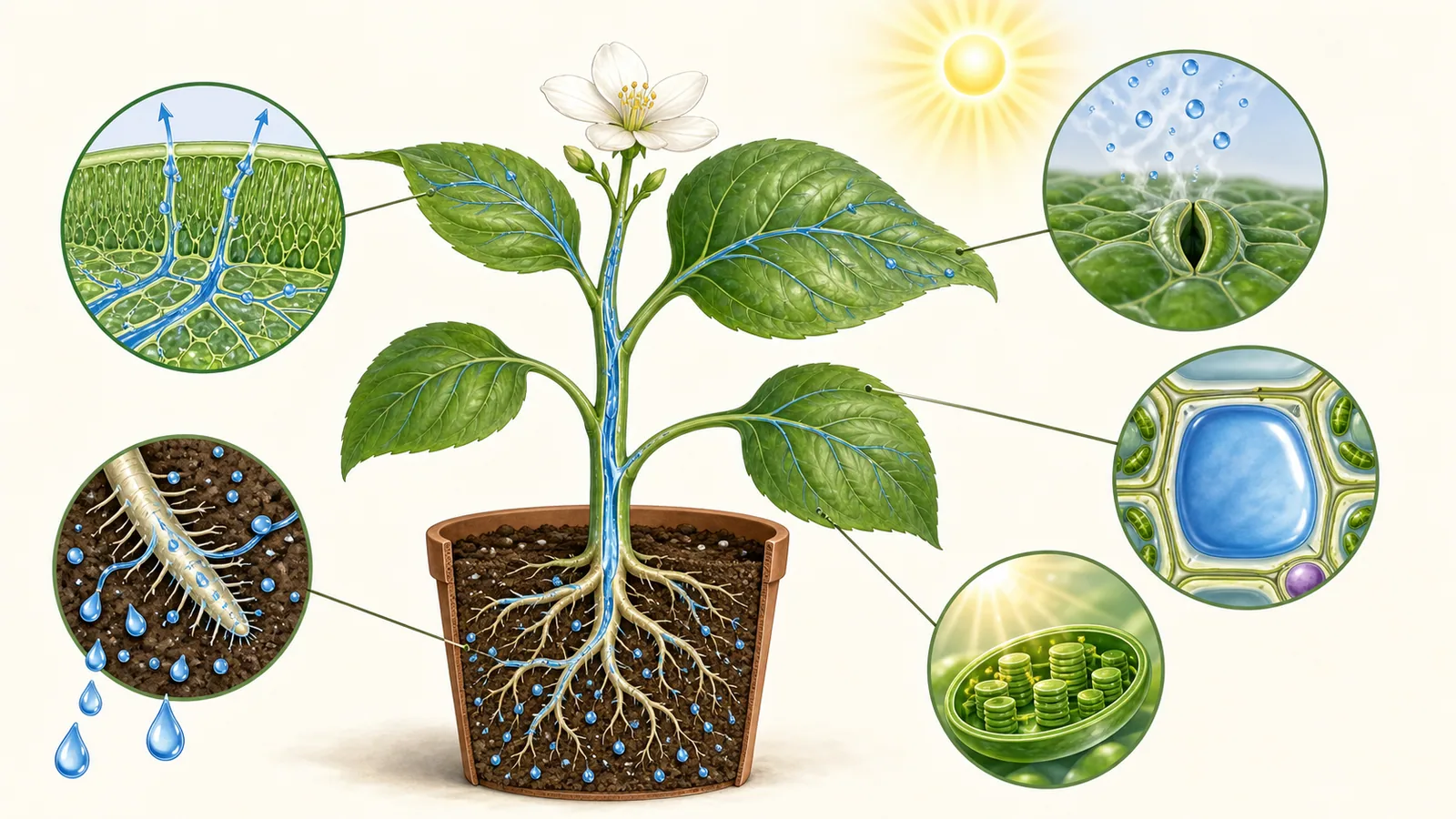
Water has several jobs inside a plant at the same time. It helps soft tissues stay firm, gives dissolved substances a way to move, supplies one raw material for photosynthesis, and leaves the plant during transpiration, which can help pull more water upward and cool leaves.
So plants need water for more than simply “not being dry.” A better way to think about it is this: water is part support system, part transport medium, part reaction material, and part cooling pathway. These roles often happen together, even though we notice them in different situations.
Water pressure helps leaves and soft stems stay firm
Many leaves, seedlings, and soft green stems are not held up only by hard woody tissue. Much of their firmness comes from water inside their cells.
A simple image is a flexible water-filled bag inside a firm outer wall. In a plant cell, water and other cell contents press outward, while the cell wall keeps the cell from expanding without limit. This inner pressure is called turgor pressure. In plain language, the water pressure inside many plant cells helps the tissue stand up.
When a plant does not have enough usable water, turgor pressure can drop. Leaves or young stems may soften and wilt. A wilted plant may be short on water, but wilting can also be related to damaged roots, low oxygen around roots, short-term heat stress, or other environmental changes.
How does water hold a leaf up?
Zoom in on one cell inside a leaf to see how turgor and the leaf’s posture change as the cell loses water and then gains it back.
The large central vacuole is full of water and pushes outward, while the tough cell wall pushes back and stops the cell from growing larger. The pressure that builds as the wall resists this push is called turgor. With many cells pressing together, the leaf stands firm.
In short: plenty of water → the vacuole presses the wall tight (high turgor) → firm leaves; less water → turgor falls → the leaves wilt.
About this model
This is a qualitative model of a generic soft-leaved herb, not a particular species, and nothing on screen is a measured value. In measurements, leaves near zero turgor usually still hold about 77–89% of their water, and their cell layers thin by only about 10–20%; the cell here shrinks within that range, with a dashed line marking its original size. Showing one cell is a simplification, since different cells in a leaf shrink by different amounts. Thick, leathery leaves are held up mainly by cell walls and fibers and may barely droop as they lose water.
When a leaf loses water to the air, each cell’s membrane stays against its wall and the whole cell shrinks slightly. The textbook picture of a membrane pulling away from the wall, called plasmolysis, mostly comes from soaking cells in a strong solution. Only if water loss continues well past zero turgor do cell walls start to buckle inward, which is beyond what this demonstration shows.
Water is a transport medium, not just stored liquid
Plants take up many mineral nutrients only after those nutrients are dissolved in water. Water also creates the internal liquid environment that lets substances move between roots, stems, and leaves.
The main tissue that carries water over long distances is xylem. After water enters the roots, it can move upward through xylem in the stem, petioles, and leaf veins. This connects directly with the question of how water moves from roots to leaves. For this article, the larger idea is enough: water does not simply sit in one part of the plant. It links organs together.
This is why “plants need minerals” and “plants need water” are not completely separate ideas. Water helps dissolved minerals enter roots and move through the plant. It is the moving medium that makes uptake, transport, and use of many substances possible.
Photosynthesis uses water, but water is not plant food by itself
A common misunderstanding is that plants drink water, so water must be their food. That is too simple.
Photosynthesis uses water, carbon dioxide, and light energy. In that process, plants use light energy to turn carbon dioxide and water into energy-rich sugars and other organic materials, while oxygen is released. Water is one important raw material in photosynthesis, but a plant is not simply eating water as food.
The more accurate idea is: plants use water as part of the process that makes sugars. That process also depends on light, carbon dioxide, chloroplasts, enzymes, and later movement of materials through the plant. For a beginner, the key point is enough: water is one raw material, not the whole food supply.
Transpiration lets water leave, and that still helps the plant work
Not all water taken up by a plant stays inside the plant. A large amount can leave the leaves as water vapor. This process is called transpiration.
At first, transpiration may sound like wasted water. But it is also part of how plant water movement works. When water evaporates from leaf surfaces, especially through stomata, it helps pull more water upward through the xylem from roots toward leaves. As water evaporates, it can also remove some heat from the leaf surface.
On hot, dry, bright, or windy days, the difference between water inside the leaf and the surrounding air can become larger. That can increase the demand for transpiration. This helps explain why potted plants may change quickly in summer conditions, but it should not be turned into a simple watering rule. The same visible symptom can have more than one cause.
Wet potting mix does not always mean roots can use water well
In gardening, one of the easiest ideas to confuse is “water is present” with “roots can use the water.”
Roots need water, but they also need air. In a potting medium, pore spaces may hold water or air. If the medium stays too wet and poorly aerated for too long, water can fill many of those pores and reduce oxygen around the roots. Root respiration and water uptake may then be affected. In that situation, a plant may look stressed or even wilted even though the potting mix is wet.
This does not mean every wilted plant is overwatered. It also is not a rescue recipe. It only shows why plant water should be understood together with root oxygen, drainage, potting medium aeration, leaf transpiration, and the surrounding environment. Water matters, but more water is not always better.
Common confusions
- ✕ Water is plant food.
- ✓ Water is one raw material for photosynthesis. Plants use light energy, carbon dioxide, and water to make sugars and other organic materials.
- ✕ Most water a plant absorbs stays in the plant body.
- ✓ Much of the water taken up by roots can leave through transpiration, while still helping water movement, mineral transport, and leaf cooling.
- ✕ Wilted leaves always mean the potting mix is too dry.
- ✓ Wilting often involves reduced turgor pressure, but the cause may be water shortage, root damage, low root oxygen, heat, or other stresses.
- ✕ More water is always safer for potted plants.
- ✓ Roots need both water and air. Long-lasting wet, poorly aerated conditions can reduce oxygen around roots and interfere with uptake.
- ✕ Transpiration is only a waste of water.
- ✓ Transpiration does release water vapor, but it also helps pull water upward, supports mineral movement, connects with stomatal regulation, and can cool leaves.
FAQ
What does water do inside a plant?
Water helps plant cells stay firm, dissolves and carries minerals and other substances, provides one raw material for photosynthesis, and leaves through transpiration in a way that helps water keep moving through the plant.
Is water plant food?
Water is not plant food by itself. It is one raw material used in photosynthesis. Plants make sugars and other organic materials using light energy, carbon dioxide, and water.
Why do plants wilt when they do not have enough water?
Many soft plant tissues depend partly on turgor pressure, the pressure of water inside cells. When cells lose usable water, that pressure drops, so leaves and young stems may soften or droop. Wilting can have several causes, so it should be read as a clue, not a complete diagnosis.
Does all the water a plant absorbs stay inside the plant?
No. Some water becomes part of growing tissues or is used in plant processes, but a large amount can leave through transpiration as water vapor from leaves.
Why can a plant look wilted when the soil or potting mix is wet?
If the root zone stays waterlogged or poorly aerated, roots may not get enough oxygen for normal respiration and uptake. In that case, water may be present around the roots, but the roots may not be functioning well enough to supply the leaves.
How does water help move minerals in plants?
Many mineral nutrients must dissolve in water before roots can take them up. Water then helps carry dissolved minerals through plant tissues, especially as water moves upward through the xylem.
Why do plants lose water through their leaves?
Water vapor leaves leaves through transpiration, much of it through stomata. This loss helps maintain an upward pull of water from roots to leaves and can remove some heat from the leaf surface.
Is this article a watering guide?
No. This article explains what water does inside plants. It can help you understand observations such as wilting, fast drying, or wet potting mix, but it does not give a fixed watering schedule or a diagnosis for a specific plant.
Related Terms
- Turgor pressure: The pressure created when water inside a plant cell pushes outward against the cell wall, helping soft tissues stay firm.
- Xylem: The vascular tissue that carries water and dissolved minerals from roots toward stems and leaves.
- Transpiration: The loss of water vapor from plant surfaces, especially leaves.
- Stomata: Tiny openings on leaf surfaces that help regulate gas exchange and water vapor loss.
- Photosynthesis: The process in which plants use light energy, carbon dioxide, and water to make sugars and other organic materials.
- Potting medium aeration: The ability of a potting medium to keep air spaces around roots, so roots can get oxygen as well as water.
Read Next
Evidence
References
These sources were used to check the plant-science concepts and gardening context in this article.
View sources and further reading (11)
- extension.oregonstate.edu — environmental factors affecting plant growth
- extension.oregonstate.edu — plant growth development
- openstax.org — 30 5 transport of water and solutes in plants
- bio.libretexts.org — 4.5.01: Water Transport
- openstax.org — 5 1 overview of photosynthesis
- extension.umd.edu — overwatered indoor plants
- extension.colostate.edu — role of water in plant growth
- pmc.ncbi.nlm.nih.gov — PMC3982740
- pmc.ncbi.nlm.nih.gov — PMC4844282
- doi.org — ajb.1300158
- pmc.ncbi.nlm.nih.gov — PMC396569