Brown leaf tips are a clue, not a complete diagnosis
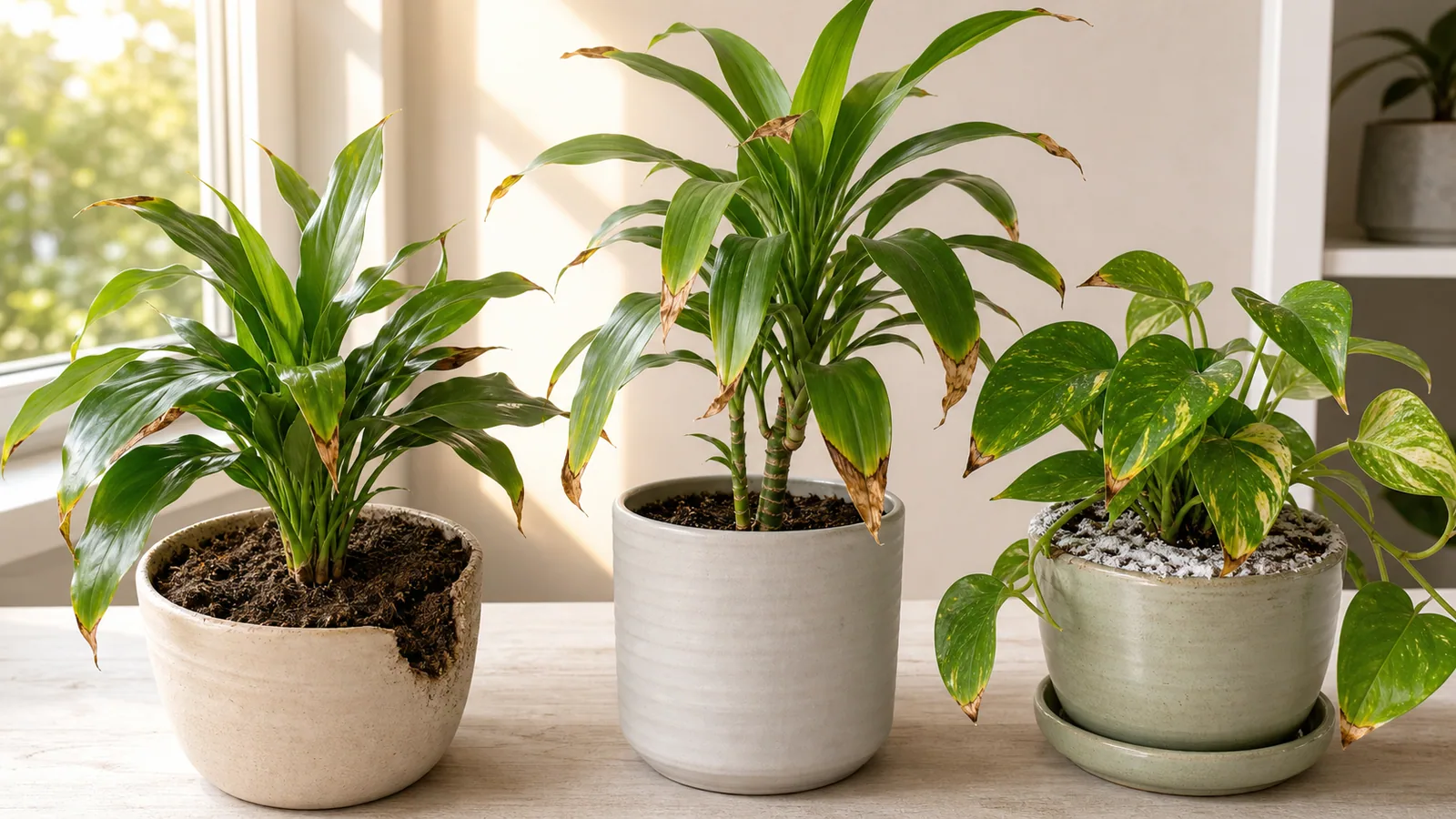
When the tips of houseplant leaves turn brown, dry, or crispy, it does not automatically mean the plant is simply thirsty. It also does not automatically mean the plant has a disease. Brown leaf tips and brown leaf edges are better understood as visible clues: somewhere in the plant’s water balance, root function, light and heat exposure, air dryness, or salt buildup, conditions may be out of balance.
A useful first step is to describe what you actually see. Is only the very tip brown? Are the leaf edges also crispy? Are new leaves affected, or only older leaves? Then look at the potting mix, the light and heat around the plant, the humidity, recent fertilizer use, and any recent move or repotting. This approach will not identify one cause immediately, but it helps you avoid reacting too quickly by adding water, fertilizer, or sprays.
Why the tips and edges often show stress first
Water inside a leaf does not appear by itself. Roots take up water, water moves through the stem and leaf veins, and the leaf surface loses water vapor through transpiration. In plain language, the plant has a water route from roots to leaves, and then from leaves to the surrounding air.
When leaves lose water faster than roots and conducting tissues can replace it, the leaf margins and tips may show stress early. These areas are near the outer end of the leaf’s water supply path, so they can be among the first places to dry, yellow, brown, or become crisp under dry heat, low humidity, strong light, dry wind, or poor root function.
That is why “leaf tip burn” is not one single disease name. It is an appearance. It can happen when the pot is too dry, but it can also happen when roots cannot take up water well. It can be connected with light and heat, or with soluble salts and fertilizer residue in the potting mix.
Dry mix, heat, and dry air can speed up water loss
The most intuitive possibility is that the plant is not getting enough usable water. If the potting mix stays dry too long, watering does not reach the root zone, or a small pot dries very quickly, leaf tips or edges may brown because the leaves are not being supplied fast enough.
But the potting mix is not the only factor. A hot sunny window, reflected balcony heat, dry wind, or air from heating and cooling vents can make leaves lose water faster. Low humidity also increases the difference between the moisture inside the leaf and the surrounding air, so water can leave the leaf more quickly. Some indoor plants show more crispy tips during seasons when indoor air is especially dry.
The important caution is this: brown tips do not mean “water heavily right now.” If the potting mix is already wet, the problem may not be a lack of water in the pot. It may be that the roots are not able to take up water properly.
Wet potting mix can still lead to crispy tips
Overly wet conditions are easy to miss. When potting mix stays wet and airless for too long, water fills many of the spaces that roots also need for air. Fine roots can be damaged under those conditions. Once roots are damaged, the plant may struggle to move water to the leaves even though the pot itself contains plenty of water.
That is why some potted plants look thirsty while the potting mix feels heavy and wet. Leaves may wilt, curl, yellow, or develop brown tips and edges. This does not mean every brown tip is root rot. It means the root environment belongs on the observation list.
Check clues such as whether the potting mix takes a long time to dry, whether water often sits in a saucer, whether the mix has become compacted, whether the plant does not perk up after watering, or whether it was recently repotted, root-pruned, or moved to a darker place.
Salts, fertilizer residue, and water quality can also show at the tips
Brown leaf tips can also be connected with soluble salts. Fertilizer, hard water, certain water-quality issues, or salts that have built up in the potting mix may add stress around roots and leaf margins. As water moves through the plant and leaves transpire, leaf tips and edges can become places where stress is easier to see.
This does not mean you can look at a brown tip and identify a specific nutrient deficiency. It also does not mean fertilizer is always the cause. Different plants, potting media, water sources, and fertilizer habits can produce different results. A safer way to think about it is to ask observation questions: Was fertilizer used recently? Was it stronger than usual? Is there a white crust on the surface of the mix or pot? Has this plant been watered with the same water source for a long time?
If brown tips appear together with yellow-brown leaf edges, surface crusting, or a clear worsening after fertilizing, salt or fertilizer stress is worth considering. This article does not provide fertilizer rates, flushing formulas, or treatment prescriptions.
Brown tissue usually will not turn green again
Once the tip of a leaf has dried and turned brown, that part of the tissue is usually damaged or dead. It normally will not become green and whole again. The more useful question is what happens next: do new leaves keep developing brown tips, does the brown area keep spreading, or is the whole plant also wilting, yellowing, or dropping leaves?
Trimming brown tips can make a plant look neater, but it does not remove the cause. If the same environmental pressure remains, new leaves may show the same pattern again. If you trim, treat it as cosmetic cleanup, not as the main way to solve the underlying issue.
A simple order for checking brown tips
When you notice brown or crispy tips, sort the clues in this order:
- Look at the pattern: Is it only a few older leaf tips, or are new leaves affected too? Is the browning at the tip, along the edge, or scattered across the blade?
- Look at water: Has the potting mix stayed dry too long, swung sharply between wet and dry, or stayed heavy and wet?
- Look at light, heat, and air movement: Is the plant near a hot bright window, a balcony heat source, dry wind, or a heating or cooling vent?
- Look at roots and potting mix: Was the plant recently repotted? Is the pot too large? Is the mix compacted, slow to drain, or often sitting in water?
- Look at fertilizer and water quality: Was fertilizer used recently? Is there a white salt-like crust? Do sensitive plants develop tips only after long-term use of the same water source?
The goal is not to force one cause. The goal is to decide whether the next thing to investigate is water supply, light and heat, root conditions, or salt and fertilizer stress.
Common mix-ups
- ✕ Brown leaf tips always mean underwatering.
- ✓ Dryness is one common direction, but wet roots, blocked water uptake, heat, dry air, low humidity, and salt buildup can also produce brown tips or edges.
- ✕ If the potting mix is wet, the plant cannot show drought-like symptoms.
- ✓ Water in the pot does not guarantee that roots can absorb it. Airless or damaged roots may fail to replace water lost from leaves.
- ✕ Trimming crispy tips fixes the problem.
- ✓ Trimming is only cosmetic. If the environment does not change, new leaves may develop the same pattern.
- ✕ Brown tips tell you exactly which nutrient is missing.
- ✓ Leaf tips alone usually cannot identify a specific nutrient problem. Fertilizer, salts, water quality, root uptake, and growing conditions need to be considered together.
Frequently Asked Questions
Are brown leaf tips always caused by underwatering?
No. Dry potting mix, dry air, and strong light or heat can make leaves lose water faster, but wet potting mix, poor root function, salt buildup, or fertilizer stress can also lead to brown tips. Check the potting mix, root zone, light and heat exposure, and recent changes before simply adding more water.
Will brown leaf tips turn green again?
Usually not. A dry or brown tip is typically damaged tissue. The better sign to watch is whether new leaves grow more normally and whether the brown area stops spreading.
Can I cut off crispy leaf tips?
You can trim them for appearance, but trimming is not a cure. Avoid removing too much healthy leaf tissue. More importantly, look for the water, heat, root, or salt-related clues that may still be present.
Why are the tips brown when the soil is still wet?
If potting mix stays wet and airless for too long, fine roots can be damaged. Damaged roots may not replace water lost from the leaves, so the plant can look thirsty even while the pot is wet.
Can too much fertilizer cause brown tips?
It can. Fertilizer residue or other soluble salts may contribute to yellow-brown or crispy leaf tips and edges. But brown tips alone cannot prove that fertilizer is the only cause, and they cannot identify a specific missing nutrient. Look at timing, concentration, surface crust, water source, and root condition together.
How are brown leaf tips different from yellow leaves?
Brown tips usually start at the end or edge of the leaf and often point you back toward water balance, heat, low humidity, salts, and root uptake. Yellow leaves can reflect a wider range of clues, including older leaf turnover, low light, root stress, or nutrient movement. The two can happen together, but the observation route is not exactly the same.
Are indoor and balcony plants affected by different causes?
Often, yes. Indoor plants may be affected by dry air, heating or cooling vents, uneven watering, and salt buildup. Balcony plants may face stronger sun, higher heat, dry wind, hot walls, and faster-drying pots. In both settings, roots, potting mix, and the plant’s usual growing conditions still matter.
Related Terms
- Leaf tip burn: A visible pattern where the end of a leaf turns yellow, brown, dry, or crispy.
- Brown leaf edges: Browning or drying along the leaf margin.
- Transpiration: The process by which water vapor leaves the plant, mostly through leaves.
- Soluble salts: Dissolved minerals or fertilizer components that can build up and stress roots or leaves.
- Blocked water uptake: A situation where roots cannot supply leaves well because of dryness, wet damage, root injury, or potting media problems.
- Low humidity: Air with less moisture, which can increase water loss from leaves.
Read next
Evidence
References
These sources were used to check the plant-science concepts and gardening context in this article.
View sources and further reading (5)
- yardandgarden.extension.iastate.edu — diagnosing houseplant problems improper environmental conditions
- extension.missouri.edu — g6881
- ipm.ucanr.edu — nutrient and mineral excesses salinity and salt toxicity
- openstax.org — 23 5 transport of water and solutes in plants
- extension.umd.edu — fertilizer or pesticide burn vegetable leaves