The upper and lower sides of a leaf can look quite different
Hold a typical broad leaf in your hand and you may notice that its two sides differ in shine, color, hairs, or texture. This is not only an appearance difference. In many horizontally oriented leaves, the upper surface is closer to the light, the lower surface often has more stomata, and the cells inside the leaf are arranged in an up-and-down pattern.
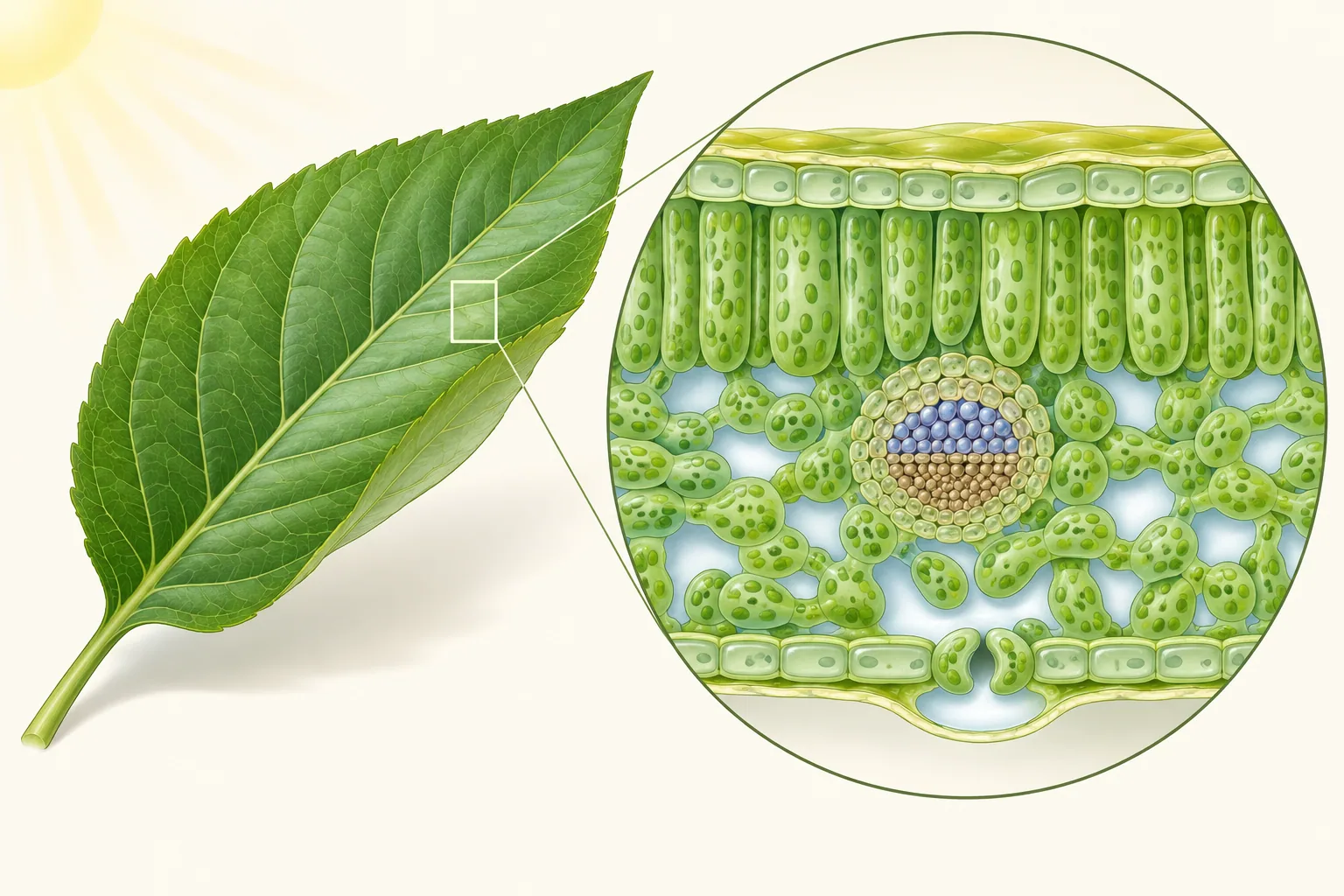
A common model helps us begin. From top to bottom, a typical broad leaf may have a cuticle and upper epidermis, followed by the more tightly arranged palisade mesophyll. Farther down is the spongy mesophyll, which has more intercellular air space, and then the lower epidermis. The lower epidermis often has more stomata controlled by guard cells.
This is an introductory model for many ordinary broad leaves, not a fixed template for every plant. In land plants, a cuticle usually covers the outer sides of both epidermal layers, although its thickness can differ. The illustration makes the upper cuticle more visually prominent simply to make the feature easier to show; it does not mean that only the upper surface has a cuticle. In addition, the two surfaces are not separate organs. They are two working interfaces of the same leaf, facing light and air in different ways.
The upper surface: closer to light, while also limiting surface water loss
The side of a leaf oriented toward the stem axis, and often toward the light in a horizontally held leaf, is commonly called the upper surface or adaxial surface. Its outer layers usually include a cuticle and upper epidermis. The cuticle is a waxy protective layer over the epidermis that can reduce water loss from the leaf surface. The epidermis forms a protective boundary that helps maintain the tissues inside the leaf. The outer side of the lower epidermis usually has a cuticle as well, although its thickness and appearance may differ.
The palisade mesophyll often lies below the upper epidermis. Its cells are commonly more elongated and more tightly arranged, and they often contain many chloroplasts. In many horizontally oriented leaves, this position makes it easier for the tissue to receive light entering from above and support photosynthesis.
Saying that the upper surface receives more light does not mean that it has no stomata. In many land leaves, stomata are concentrated mainly on the lower surface, but the upper surface may still have some. Other plants have very different stomatal distributions. Understand this as a pattern found in many cases, not as an absolute rule.
The lower surface: often the side with more stomata
The side of a leaf oriented away from the stem axis, and often positioned underneath in a horizontal leaf, is commonly called the lower surface or abaxial surface. The lower epidermis also protects the tissues inside and usually has an outer cuticle, but in many familiar broad leaves this side often has more stomata than the upper surface.
A stoma is a tiny opening in the epidermis, usually bordered by a pair of guard cells. Guard cells can change shape and regulate whether the stoma is open or closed. This allows carbon dioxide, oxygen, and water vapor to move between the leaf and the surrounding air. Beneath a stoma there is often a connection to the leaf’s internal air spaces, so gases do not remain only at the surface; they can move farther into contact with mesophyll cells.
Many horizontally oriented leaves place more stomata on the lower surface. This may help reduce the pressure of water loss caused by direct exposure to strong light, heat, and moving air while preserving gas exchange. This is a common relationship between structure and environment, not a universal arrangement. Leaf orientation, habitat, and species all affect stomatal distribution.
In cross-section, the upper and lower differences form one connected pathway
If a typical broad leaf is viewed in cross-section from top to bottom, the following table gives a useful introduction to each region and its most visible functional clue:
| Position | Common structures | Main functional clue |
|---|---|---|
| Outer upper surface | Cuticle and upper epidermis | Protect the inner tissues, reduce surface water loss, and allow light to enter the leaf |
| Beneath the upper epidermis | Palisade mesophyll | More tightly arranged cells, often with many chloroplasts, supporting light capture and photosynthesis |
| Middle and lower part of the leaf | Spongy mesophyll and intercellular air spaces | Allow carbon dioxide, oxygen, and water vapor to move through the leaf; the cells themselves can also carry out photosynthesis |
| Outer lower surface | Cuticle, lower epidermis, stomata, and guard cells | Protect the inner tissues and regulate gas exchange and water-vapor loss |
This table is a convenient cross-sectional model, not a way of dividing every plant into four fixed zones. Leaf veins, or vascular bundles, also pass through these tissues. They bring water and minerals into the leaf and carry sugars or other photosynthetic products made in the leaf to other parts of the plant. The upper and lower surfaces, mesophyll, stomata, and veins therefore work as a system.
Do the upper and lower directions of a leaf have different functions?
Three connected needs provide a useful starting point:
- Receiving light: Cells near the light-facing surface and arranged relatively densely can help intercept light and support photosynthesis.
- Exchanging gases: Stomata and internal intercellular air spaces allow carbon dioxide to enter and oxygen and water vapor to leave.
- Regulating water loss: The cuticle and the opening and closing of stomata together affect water exchange between the leaf and the air.
These are not three unrelated jobs. A leaf needs carbon dioxide, but obtaining it can also allow water to escape. A leaf needs light, but its inner tissues also face heat and drying pressure. Differences between the two surfaces are one way a plant arranges these competing needs within the same leaf.
Not all leaves are the same
“Palisade mesophyll on top, spongy mesophyll below, and more stomata on the lower surface” is a useful way to learn about common broad leaves. It should not be used as a checklist for every leaf.
To compare the left and middle panels below, start with light intensity during leaf development. In some plants, new leaves formed under higher light have a larger share of their stomata on the upper surface than leaves formed under lower light. Under lower light or shade, stomata may be more concentrated below.
Plants differ in how strongly they respond to light. Some experiments found increased stomatal density (the number per unit leaf area) on both surfaces without a statistically significant change in the upper-side share. When a study does not detect a clear difference, that does not prove that light has no effect.
Water supply and air dryness may also influence the response. When a mature leaf changes position, its existing stomata mainly adjust their opening; changes in distribution concern developing leaves.
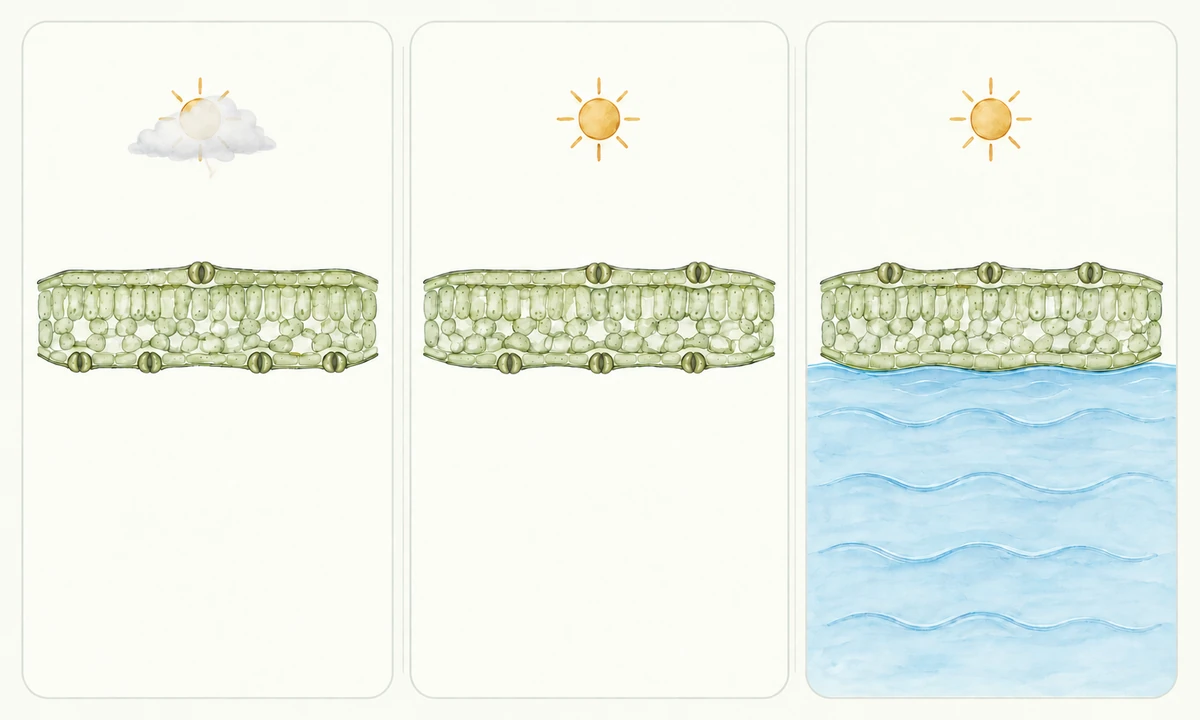
When light limits photosynthesis, adding upper-surface CO₂ entrances may offer less benefit. In some plants, new leaves formed under lower light have a smaller share of stomata above, with more concentrated below.
With ample light and other suitable conditions, more CO₂ supply may support photosynthesis. In some plants, new leaves formed under higher light develop a larger share of upper-surface stomata, adding entrances above; water loss remains a cost.
A floating leaf's upper surface meets the air directly, so functional stomata are often found there for gas exchange. This is a common pattern; some floating leaves also have stomata below.
Beyond light, distinguish root-zone water shortage from dry air: the former affects water supply from the roots, while the latter affects the pressure for water loss to the air.
These conditions influence stomatal opening and may also affect stomatal density and the share on each surface in developing leaves. Studies show different directions of response, so dry conditions do not mean stomata will be limited to the lower surface, and humid conditions do not mean they will be on both surfaces.
- Some leaves have stomata on both surfaces, or have similar numbers on both sides.
- If a leaf is upright, floating, or growing in an unusual light or water environment, the functional pressures on its two surfaces may differ.
- Some monocot leaves are not clearly divided into the typical palisade-mesophyll and spongy-mesophyll pattern.
- Sun leaves, shade leaves, young leaves, and mature leaves may also differ in thickness, cell arrangement, and stomatal distribution.
For that reason, seeing fewer stomata on the back of a leaf does not mean that the leaf is “abnormal.” Likewise, a very thick or very thin leaf cannot be used by appearance alone to identify its internal tissues. Confirming cell arrangement and stomatal position usually requires magnified or microscopic observation, together with records of the plant species and growing environment.
When observing a leaf, compare the two surfaces first
With the naked eye, you can record the shine, color, hairs, roughness, whether the midrib is raised, and which side receives more direct light. These observations help you understand the leaf’s orientation, but they cannot show individual stomata or tell you how many layers of palisade cells are present.
When you turn a leaf over, treat it as a comparison between two surfaces of the same organ, not as if the front were the “real” leaf and the back were an accessory surface. Whether the leaf can maintain light capture, gas exchange, and water balance depends on how both surfaces work together with the tissues in between.
Common confusions
-
✕ The upper surface is only for photosynthesis, while the lower surface is only for respiration.
-
✓ Both surfaces belong to the same leaf. Many mesophyll cells can participate in photosynthesis, while stomata regulate gas and water-vapor exchange.
-
✕ All plants have stomata on the underside of their leaves.
-
✓ Many familiar broad leaves have more stomata on the lower surface, but some plants have stomata on both sides. Distribution changes with species, leaf orientation, and environment.
-
✕ The stomata visible on the lower surface are the same thing as the air spaces inside the leaf.
-
✓ A stoma is an opening in the epidermis. It usually connects to intercellular air spaces in the mesophyll; the two structures are connected but different.
-
✕ Palisade mesophyll has chloroplasts, but spongy mesophyll does not.
-
✓ Both types of mesophyll usually contain chloroplasts. Their main differences are cell arrangement and the distribution of spaces, which give them different advantages for light capture and gas movement.
-
✕ If the back of a leaf looks darker, it must have more stomata.
-
✓ Color and shine are only surface clues. They cannot replace magnified observation or determine stomatal distribution in every plant.
Frequently Asked Questions
Which side of a leaf is more important: the upper or lower surface?
Both are important, although the common functional clues differ. The upper surface is more often closer to the light, while the lower surface often has more stomata. The cuticle, epidermis, mesophyll, and veins still work together, so neither side should be treated as the leaf’s only “functional surface.”
Why do many leaves have more stomata on the lower surface?
The lower surface is often less directly exposed to strong light and moving air. Placing more stomata there may help maintain gas exchange while reducing some pressure from water loss. Different plants and leaf environments make different arrangements, so “stomata are on the underside” is not an absolute rule.
Can the mesophyll beneath the lower surface photosynthesize if that side is not the main light-facing surface?
Yes. The question concerns the mesophyll beneath the lower surface, not the lower surface itself as a photosynthetic tissue. If those mesophyll cells contain chloroplasts and receive suitable light, they can participate in photosynthesis. Actual efficiency also depends on leaf thickness, the direction of light, the plant species, and tissue arrangement.
Can I see stomata with the naked eye?
Usually, you cannot clearly see individual stomata. You can compare the shine, hairs, and midrib on the two surfaces with the naked eye, but confirming stomatal position and number usually requires magnified or microscopic observation.
Are the upper and lower epidermis the same type of tissue?
Both belong to the leaf epidermal system, and both mainly help protect the inner tissues and take part in surface exchange. However, their orientation, stomatal distribution, and neighboring mesophyll arrangement may differ, so they should not be treated as perfectly identical mirror images.
Can the difference between a leaf’s two surfaces tell me whether a plant is thirsty or diseased?
No conclusion should be based on surface differences alone. Leaf shine, wilting, color, hairs, and stomatal condition can all be affected by leaf age, species, light, water, temperature, and other environmental factors. This article provides an entry point for observing structure and function; it is not a diagnosis based on a single sign.
On which side do floating leaves have stomata?
Floating leaves often use the upper surface that contacts the air as their main gas-exchange interface, so functional stomata are commonly found on the upper surface. The lower surface is close to the water, so the usual terrestrial impression that “stomata are underneath” does not transfer directly. Individual plants can still vary.
Related terms
- Upper surface / adaxial surface: The side oriented toward the stem axis and, in many horizontal leaves, also toward the light.
- Lower surface / abaxial surface: The side oriented away from the stem axis; many broad leaves have more stomata on this side.
- Cuticle: A waxy layer over the outer leaf epidermis that can reduce surface water loss.
- Epidermis: The cell layer covering the outside of the leaf, including the upper and lower epidermis.
- Stoma; plural stomata: A tiny opening in the epidermis, usually regulated by guard cells.
- Guard cells: Epidermal cells on either side of a stoma that regulate its opening and closing.
- Palisade mesophyll: In many typical broad leaves, the more tightly arranged mesophyll region near the upper epidermis.
- Spongy mesophyll: A mesophyll region with more loosely arranged cells and more intercellular space.
- Intercellular air space: A space between leaf cells that allows gases to move through the leaf.
Read Next
Evidence
References
These sources were used to check the plant-science concepts and gardening context in this article.
View sources and further reading (16)
- openstax.org — 30 4 leaves
- lima.osu.edu — plant anatomy
- propg.ifas.ufl.edu — 10 celltypes stomate.html
- nickrentlab.siu.edu — Lecture20 Leaf Histology.html
- nickrentlab.siu.edu — Lecture21 Leaf Variation.html
- nickrentlab.siu.edu — Lecture7 Epidermis.html
- digitalcommons.unl.edu — 461
- ask.ifas.ufl.edu — FR296
- personal.ems.psu.edu — Manual of Leaf Architecture small.pdf
- nph.onlinelibrary.wiley.com — nph.15652
- buckleylab.ucdavis.edu — triplett et al 2024 amphistomy.pdf
- pubmed.ncbi.nlm.nih.gov — 26002974
- academic.oup.com — 7688001
- nph.onlinelibrary.wiley.com — nph.14956
- onlinelibrary.wiley.com — tpj.16944
- mdpi.com — 290