Cotyledons are early support structures inside the seed embryo
A cotyledon is part of the seed embryo. It is not just an ordinary leaf that appears later. It is already present as the seed forms, and it often helps support the young seedling during its earliest growth.
A simple way to picture this is: a seed contains an embryo, and the embryo needs a bridge between stored resources and a living seedling. Cotyledons may store resources, absorb and transfer resources from endosperm, or in some plants emerge above the soil and turn green for a short time.
So the key question is not whether a cotyledon looks exactly like a leaf. The more useful question is what it does during the transition from seed to seedling. Once true leaves develop, the seedling gradually relies more on newly formed leaves for light capture and photosynthesis.
Cotyledons and true leaves are not the same thing
When people first look at seedlings, it is easy to call every small green part a leaf. For learning, it helps to separate two ideas: cotyledons are early embryo structures, while true leaves are leaves that unfold and develop during later seedling growth.
In many dicot-style seedlings, cotyledons are simpler, rounder, or thicker than the later leaves. The true leaves above them often look more like the mature plant’s leaves and may show clearer veins. That is why seed trays often show a lower pair of plain seed leaves and a newer set of leaves that looks more plant-specific.
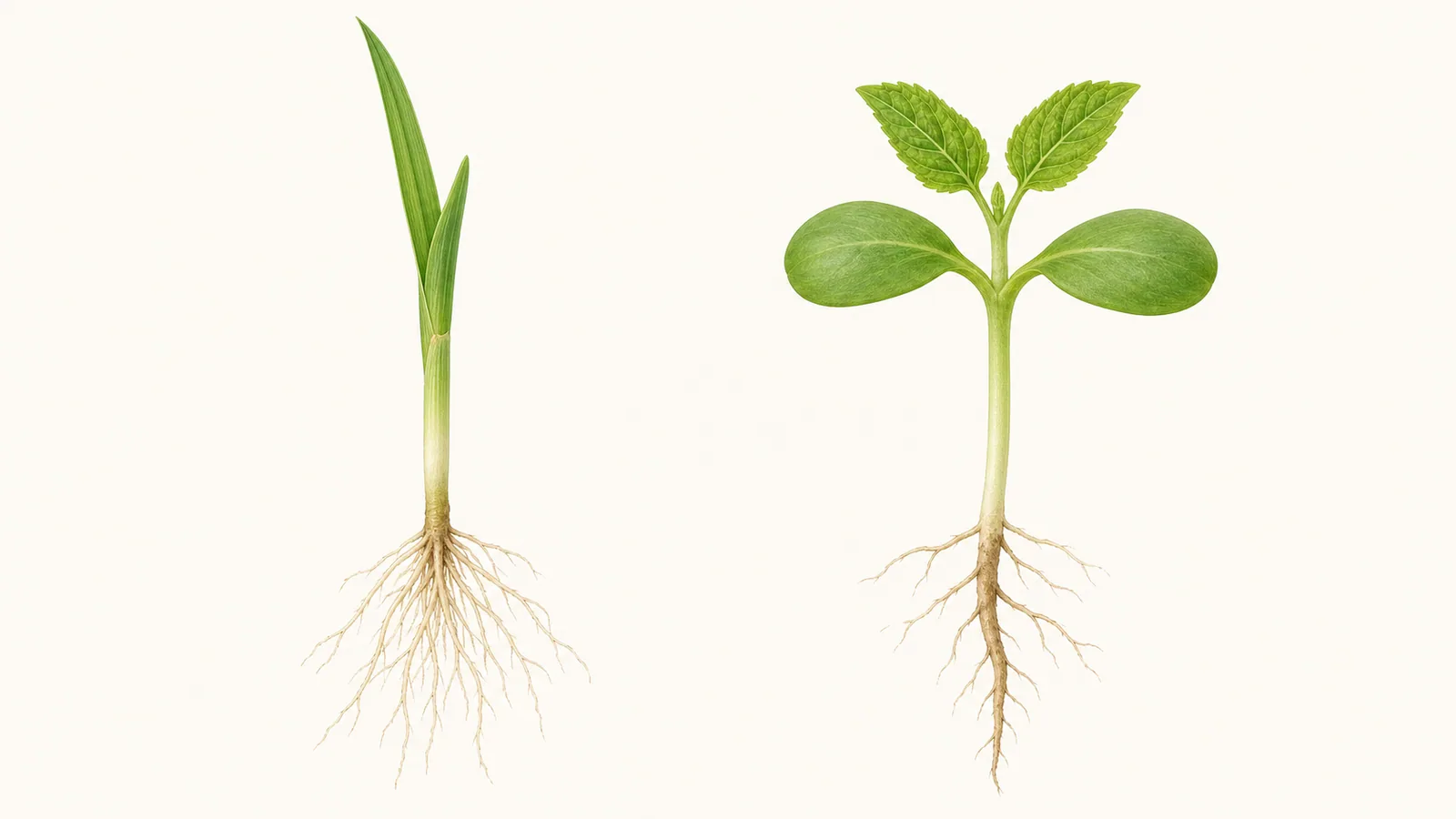
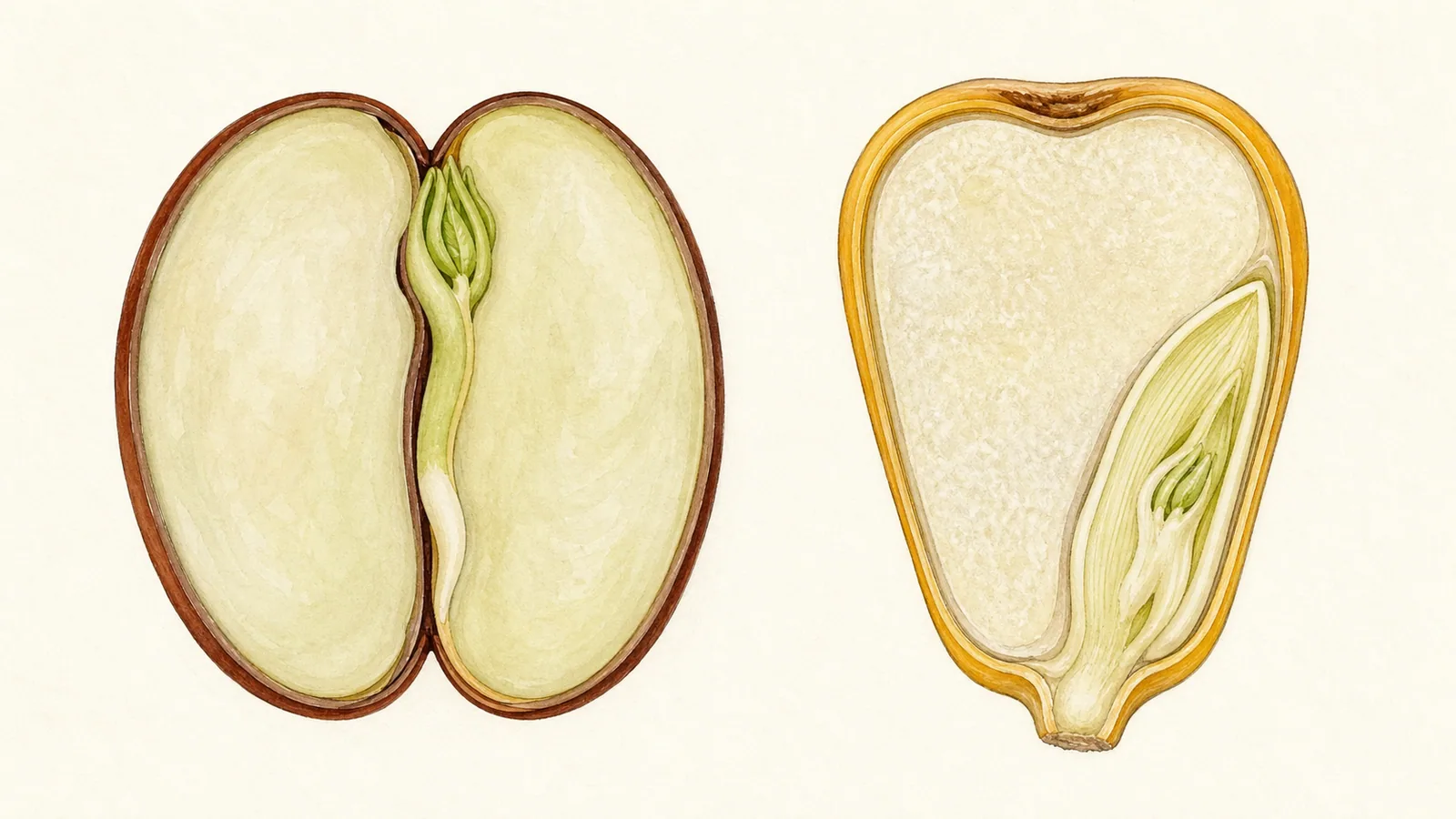
This pattern is not universal. Monocots do have a cotyledon, but it often does not appear as a broad, obvious seed leaf the way bean cotyledons do. In corn and other grasses, the scutellum is the single modified cotyledon of the embryo. It lies next to the endosperm and helps absorb and transfer stored resources to the developing embryo. The radicle emerges first; the coleoptile is a protective sheath around the plumule and young first foliage leaf. The leaf later emerges through the sheath. This “sheath before leaf” sequence is a corn and grass model, not a rule for every monocot. Orchid seeds are even more specialized, so they should not be imagined from a bean seedling alone.

Monocot and dicot names begin with cotyledon number
Monocot embryos usually have one cotyledon. Dicot embryos usually have two cotyledons. That is the most direct way to understand the words monocot and dicot.
Common monocots include rice, corn, wheat, lilies, orchids, palms, and grasses. Common eudicots include beans, tomatoes, sunflowers, roses, and mints. These are two major flowering-plant groups that provide a useful starting point for comparison.
One distinction is worth making: dicot is a traditional and everyday term that focuses on embryos usually having two cotyledons. Eudicot is a more precise group in modern classification. Most classroom and garden examples commonly called dicots are actually eudicots. But not every flowering plant traditionally placed under dicots is the same thing as a eudicot.
But cotyledon number is only the first clue, not the whole classification system. Botanists also use pollen, vascular tissue, root systems, leaf veins, flower-part arrangement, and other traits. It is more accurate to start with cotyledons and then learn that several features are considered together.
Common differences are useful clues, not absolute rules
Monocots and dicots often differ in several visible ways.
Many monocots have parallel leaf veins, like the long straight lines in rice, corn, lily, or grass leaves. Many eudicots have net-like leaf veins, like the branching networks in bean, tomato, sunflower, or mint leaves.
Root systems also often differ. Many monocots produce a fibrous-looking root system with many roots emerging from the base. Many eudicots begin with a more obvious primary root and lateral roots. Flower parts are another common clue: monocot flowers often appear in threes or multiples of three, while many eudicot flowers appear in fours, fives, or their multiples.
These are patterns, not absolute identification rules. Some plants are exceptions, and some seedlings are too young, hidden, or damaged for easy observation. Use the patterns to build an observation route, not to force every plant into a simplified checklist.
Why this matters in garden and classroom observation
Cotyledons help you read the stage of a seedling in a seed tray, classroom activity, balcony pot, or garden bed.
If a seedling has two simple lower leaves and a newer set of more mature-looking leaves above them, the lower pair can often be understood as cotyledons and the upper leaves as true leaves. That connects germination to the early seedling stage.
If you are observing rice, corn, onions, lilies, or other monocots, do not force the bean-seedling picture onto them. Their early growth may appear as a narrow blade or sheath, and their roots may look more like a bundle of fine roots. In corn, the coleoptile emerges before the first foliage leaf emerges through its sheath.
Cotyledons turning yellow or dropping does not automatically mean the whole plant is in trouble. In some plants, cotyledons age after their early role is finished. Compare cotyledon color with new leaves, roots, light, and water conditions instead of drawing a conclusion from color alone.
Easy Mix-Ups
- ✕ Cotyledons are just the normal leaves the plant will keep using as it grows.
- ✓ Cotyledons are part of the embryo and often support early growth; true leaves are produced later by the seedling.
- ✕ Every dicot seedling clearly shows two round cotyledons.
- ✓ Two cotyledons are a common feature, but seed and seedling appearance varies widely.
- ✕ Monocots do not have cotyledons.
- ✓ Monocots usually have one cotyledon, though it may not look like the large seed leaves of a bean.
- ✕ The first narrow green structure you see in a germinating monocot must be the cotyledon.
- ✓ In many monocots, the first visible green structure may be a foliage leaf, sheath, or shoot-related structure, while the cotyledon is not obvious from the outside.
- ✕ Leaf veins alone can identify every monocot or dicot with certainty.
- ✓ Venation is a useful clue, but plant classification uses several traits and includes exceptions.
- ✕ Yellowing cotyledons always mean a seedling is failing.
- ✓ Cotyledons may age after early growth support; compare true leaves, roots, light, and water conditions too.
Frequently Asked Questions
Are cotyledons leaves?
Cotyledons are often called seed leaves, but they are not the same as the true leaves produced later by the seedling. They are embryo structures that may store, absorb, transfer, or briefly photosynthesize during early growth.
What is the difference between cotyledons and true leaves?
Cotyledons are already present in the seed embryo and often appear early in seedling growth. True leaves unfold and develop during later seedling growth and usually resemble the mature plant’s leaves more closely.
Are monocots and dicots different only because of cotyledon number?
No. Cotyledon number is the naming clue and a useful first observation. Other common differences include leaf venation, root systems, flower-part numbers, and vascular-tissue patterns.
Can you see the cotyledon when a monocot germinates?
Not always as an obvious seed leaf. Monocots usually have one cotyledon, but it may not be broad and exposed like a bean cotyledon. In corn, rice, grasses, and similar plants, the green structure you first see may be the first foliage leaf, a sheath, or another shoot-related structure, while the cotyledon is more involved in absorbing and transferring stored resources inside the seed.
Are dicots and eudicots the same?
Not exactly. Dicot is a traditional and common term for flowering plants whose embryos usually have two cotyledons. Eudicot is a more precise modern classification group. Beans, tomatoes, sunflowers, roses, and many familiar garden examples are eudicots. Dicot remains a common search term, while eudicot is the more precise term when classification matters.
Is corn a monocot and a bean a dicot?
Corn is a common monocot teaching example, and beans are common eudicot teaching examples. Corn-like seeds often have a large endosperm with a side embryo, while bean-like seeds often show two large cotyledons. They are teaching models, not universal seed shapes.
Are orchids monocots?
Yes. Orchids are monocots. However, orchid seeds are extremely small and have specialized early development, so they should not be pictured simply as bean or corn seedlings.
If I see two small leaves on a seedling, is it definitely a dicot?
Many dicot seedlings show two cotyledons, but observation still depends on the plant and the stage. Tiny, hidden, damaged, or unusual seedlings may be harder to interpret.
What is a scutellum?
A scutellum is the specialized single cotyledon of a grass seed. In corn, it stays inside the seed next to the endosperm and helps absorb and transfer stored resources to the embryo. It is not the first narrow leaf that emerges above the seed.
What comes out of a corn seed first: the root, coleoptile, or leaf?
In a typical corn germination sequence, the radicle, or embryonic root, emerges first. The coleoptile then rises as a protective sheath around the plumule and young first foliage leaf. The first foliage leaf later emerges through the coleoptile. This is a corn and grass teaching model, not a universal rule for every monocot.
Should yellow cotyledons be cut off?
Cotyledons may age after supporting early growth. Any action should be considered in the context of the plant species and the whole seedling, not only cotyledon color.
Related Terms
- Cotyledon: part of the embryo that may store, absorb, transfer, or briefly photosynthesize during early seedling growth.
- True leaf: a leaf produced later by the seedling, usually closer to the mature plant’s leaf form.
- Monocot: a major flowering-plant group whose embryo usually has one cotyledon.
- Dicot: a traditional and common term for flowering plants whose embryos usually have two cotyledons.
- Eudicot: a more precise modern classification group that includes many familiar examples such as beans, tomatoes, sunflowers, and roses.
- Endosperm: storage tissue outside the embryo that often supports early growth.
- Embryo axis: the early body axis connecting the future root and shoot regions.
- Radicle: the embryonic root, often the first embryonic structure to emerge in a typical corn germination sequence.
- Plumule: the embryonic shoot that develops into the young shoot and leaves.
- Scutellum: the specialized single cotyledon of a grass seed, often involved in absorbing and transferring endosperm resources.
- Coleoptile: the protective sheath that encloses the plumule and young leaf in grasses.
- Parallel venation: a leaf-vein pattern common in many monocots.
- Reticulate venation: a net-like leaf-vein pattern common in many eudicots.
Related Reading
Evidence
References
These sources were used to check the plant-science concepts and gardening context in this article.
View sources and further reading (10)
- openstax.org — 32 2 pollination and fertilization
- openstax.org — 26 3 angiosperms
- openstax.org — 30 4 leaves
- open.lib.umn.edu — 9 1 seed morphology
- extension.umn.edu — lawn weeds
- extension.umn.edu — soybean growth stages
- propg.ifas.ufl.edu — 04 seedsdevelopment embryogenesis.html
- agronomy.k-state.edu — corn growth development.html
- ag.purdue.edu — corn germination.html
- forages.oregonstate.edu — germination and seedling