Humidity changes how fast leaves lose water
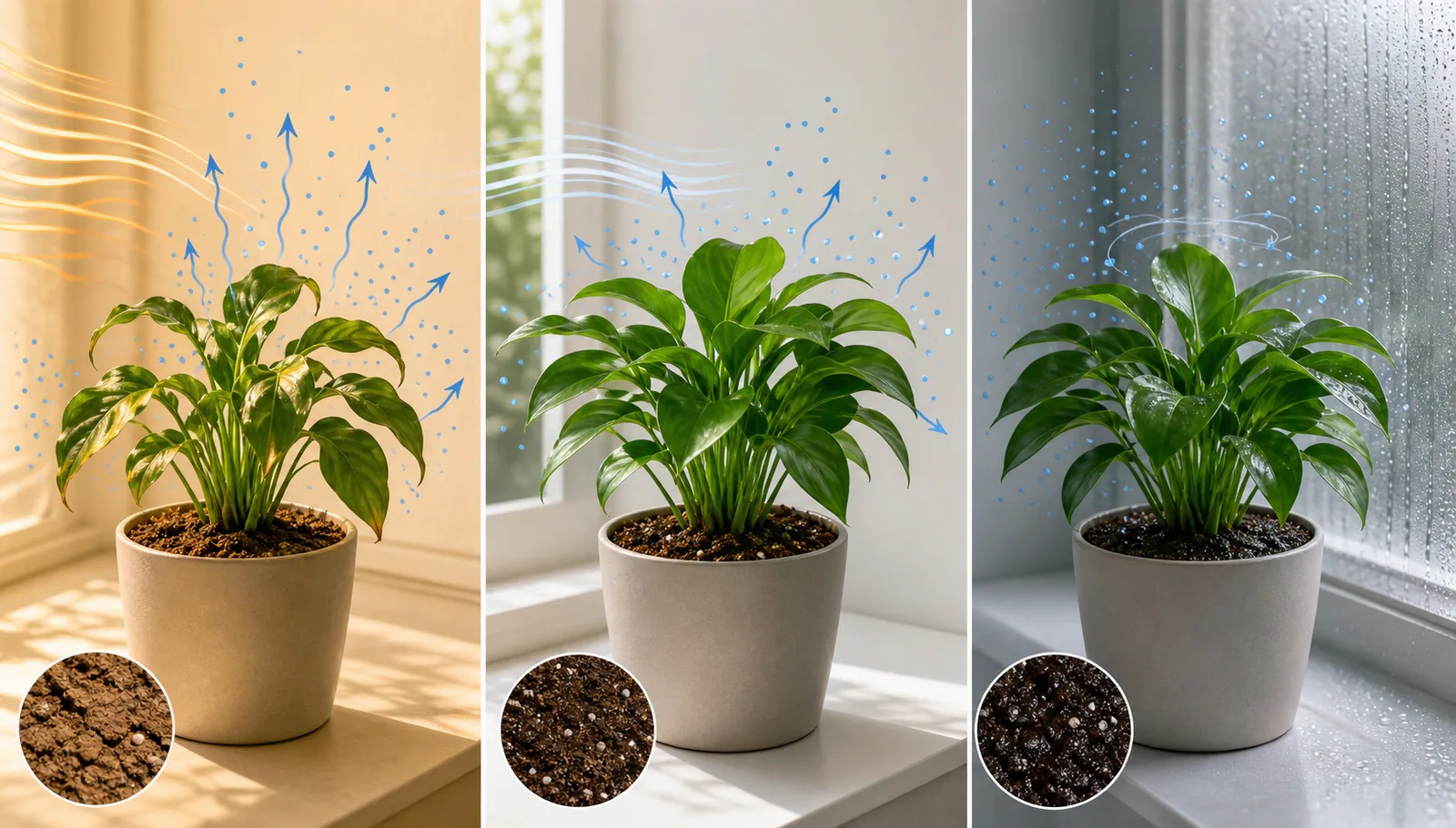
Humidity is not only about whether a room feels dry to people. It also changes how quickly water vapor moves between a plant leaf and the surrounding air. The air spaces inside a leaf are usually very moist. When the air outside the leaf is much drier, water vapor can leave the leaf more easily. If that dry air also comes with bright light, warm temperatures, or constant airflow, the leaf may lose water faster.
The simplest way to understand humidity and plants is this: drier air usually increases water loss from leaves; more humid air usually slows that water loss, but only when airflow, light, temperature, and leaf wetness are also considered.
What humidity means for a plant
In everyday plant care, people often talk about relative humidity. Relative humidity describes how much water vapor the air currently holds compared with how much it could hold at that temperature. Warm air can hold more water vapor than cooler air, so temperature changes can also change how “dry” the air feels to a plant.
For a leaf, the important point is the difference between moist air inside the leaf and the air outside it. If the outside air is dry, the difference is larger, so water vapor tends to move out more strongly. Plant scientists may describe this as a humidity gradient or vapor pressure deficit. For a general reader, it is enough to think of it as the drying pull between wet leaf air and drier room air.
Why low humidity can make potted plants dry faster
Leaves lose water through transpiration. In transpiration, water enters the plant through the roots, moves upward through the plant, and leaves the leaf as water vapor. This process is closely linked to stomata, the tiny pores on leaf surfaces. When stomata open, carbon dioxide can enter the leaf for photosynthesis, but water vapor can also escape.
Low humidity increases the difference between the moist inside of the leaf and the drier outside air. If roots and potting mix cannot supply water as quickly as the leaves are losing it, leaves may temporarily soften, droop, or lose firmness. The potting mix surface may also dry faster, especially in small pots or in airy mixes.
That does not mean dry leaf tips or drooping leaves always prove that humidity is too low. Light, temperature, wind, root condition, pot size, potting mix, salt buildup, and watering history can all be involved. Humidity is one clue in the plant’s water balance, not a complete diagnosis by itself.
Air conditioning, heating, dehumidifiers, and vents create small local climates
Indoor plants do not always experience the average humidity of the whole room. They experience the small pocket of air around their leaves. Air-conditioning vents, heaters, dehumidifiers, fans, open windows, and hallway drafts can all change that local environment.
A plant near a vent may lose water faster because moving air removes the more humid layer of air close to the leaf surface. A plant in a still corner may keep more moisture around its leaves and potting mix. A plant on a windy balcony may dry faster even when the air does not feel extremely dry.
This is why the same plant can behave differently near a window, beside an air-conditioning vent, on a balcony, or in a quiet indoor corner. Humidity, airflow, light, and temperature do not act like separate switches. Together, they shape how fast water leaves the leaves and the potting mix.
Useful observations include: whether leaves are constantly moving in airflow, whether the potting mix dries much faster than it does in other locations, and whether the plant sits directly in the path of cooling, heating, or dehumidifying equipment.
High humidity is not always better
Many common foliage houseplants come from environments that are more humid than a typical dry indoor room, so dry air can increase water loss stress for them. But “all plants need high humidity” is not a good rule. Cacti, succulents, and other plants adapted to drier environments should not be treated as if they all need constantly humid air.
High humidity can also create a different kind of problem when it is combined with poor airflow, low light, crowded foliage, or potting mix that stays wet for a long time. In those conditions, water can linger on leaves or inside dense plant growth. That kind of humid, still environment may increase some disease risks.
In other words, low humidity and high humidity are not simple “bad” and “good” categories. Plants respond to the whole environment: humidity plus airflow, light, temperature, roots, and potting mix moisture.
Humidity affects watering, but it cannot replace checking the plant
Low humidity, warm temperatures, strong light, and steady airflow often make leaves and potting mix lose water faster. Higher humidity, lower light, or stagnant air may slow drying. That can change how often you need to check a plant, but it cannot be converted directly into a fixed watering schedule.
A potted plant’s water needs also depend on pot size, potting mix, root amount, season, and the plant itself. Under the same humidity, a small pot may dry faster than a large pot. A chunky, well-aerated mix may dry faster than a water-retentive mix. A plant with many active roots may change the pot’s moisture level faster than a newly repotted plant with fewer working roots.
The practical role of humidity is to help you read the environment. It can explain why one location dries faster, why leaves near a dry vent may lose water more quickly, or why a humid still corner does not suit every plant.
How to think about misting, pebble trays, and humidifiers
Misting is often the first thing people think of when they hear “humidity.” It can briefly wet the leaf surface or the air right around a plant, but it usually does not create a stable long-term increase in room humidity. If leaves stay wet for a long time in low light or still air, that may not be helpful.
Grouping plants, using a pebble tray, or using a humidifier can raise humidity in a local area, but none of these is a universal requirement or a guaranteed fix. They change one part of the plant’s small environment. The rest of the environment still matters: airflow, light, temperature, potting mix, and the plant’s own water status.
Common mix-ups
- ✕ Dry leaf tips always mean humidity is too low.
- ✓ Dry leaf tips can be related to low humidity, but they can also involve water supply, roots, potting mix, salt buildup, light, temperature, or airflow.
- ✕ The higher the humidity, the healthier the plant.
- ✓ Higher humidity may reduce water loss, but humid still air with low light or wet potting mix can create another kind of environmental stress.
- ✕ Misting is the same as raising the room’s humidity.
- ✓ Misting usually creates a short-lived wet surface or local moisture, not a stable change in the whole room.
- ✕ High humidity means you can stop checking the potting mix.
- ✓ Humidity affects drying speed, but watering decisions still need the potting mix, roots, pot, season, light, and airflow.
Frequently Asked Questions
Do plants always need high humidity?
No. Many common foliage houseplants may lose water faster in dry indoor air, but plant needs vary widely. Plants adapted to dry environments should not be treated as if they all need high humidity.
Why do houseplants dry out faster in air-conditioned or heated rooms?
Air conditioning, heating, and dehumidifying can make indoor air drier. If a plant is also near a vent, moving air can remove the more humid layer of air close to the leaf. That can increase water loss through transpiration. It does not mean every plant in an air-conditioned room will struggle, but placement matters.
Does high humidity mean I can check the potting mix less often?
Not safely. Higher humidity can slow water loss, but potting mix moisture is also affected by pot size, mix type, roots, light, temperature, and airflow. Looking only at humidity can lead to a wrong reading of what is happening inside the pot.
Does misting houseplants actually help?
Misting can briefly make leaves or nearby air feel more humid, but it is usually not a stable way to raise humidity. If leaves stay wet for a long time and the air is still, it may create an unhelpful environment. It is better understood as a short-term change, not a fixed solution.
Does a fan make plants drier or healthier?
Neither answer is always true. Gentle air movement can reduce humid stagnant air around leaves. Continuous strong wind or dry moving air can increase water loss from leaves and potting mix. The effect depends on wind strength, distance, duration, humidity, temperature, and plant condition.
Are drooping leaves caused by low humidity?
They can be related, but low humidity is not the only possible reason. Drooping leaves often connect to water status and turgor pressure, the pressure that water creates inside plant cells. Low humidity, strong airflow, heat, dry potting mix, poor root function, or other root-zone problems can all be part of the picture.
Related terms
- Humidity: The amount or condition of water vapor in the air. In plant care, relative humidity is often the more useful everyday measure.
- Relative humidity: The percentage of water vapor the air currently holds compared with the maximum it could hold at that temperature.
- Transpiration: The movement of water vapor out of plant leaves and other aboveground parts.
- Stomata: Tiny adjustable pores on leaf surfaces that allow gas exchange and water vapor loss.
- Turgor pressure: The pressure from water inside plant cells that helps leaves and stems stay firm.
- Airflow: The movement of air around a plant, which affects heat and water vapor near the leaf surface.
- Boundary layer: A thin layer of air close to the leaf surface. Moving air can remove this layer and change water loss from the leaf.
Related Reading
Evidence
References
These sources were used to check the plant-science concepts and gardening context in this article.
View sources and further reading (8)
- openstax.org — 30 5 transport of water and solutes in plants
- extension.oregonstate.edu — environmental factors affecting plant growth
- planttalk.colostate.edu — 1317 houseplants temperature humidity
- extension.umd.edu — temperature and humidity indoor plants
- fieldreport.caes.uga.edu — growing indoor plants with success
- yardandgarden.extension.iastate.edu — how can i raise relative humidity indoors my houseplants
- yardandgarden.extension.iastate.edu — diagnosing houseplant problems diseases
- umass.edu — reducing humidity in greenhouse