
Small dots on bark may be lenticels
If you see rows of small dots, short lines, or slightly raised marks on a branch or woody stem, one possibility is a lenticel. A lenticel is a specialized gas-exchange region in the periderm. It gives oxygen, carbon dioxide, and sometimes water vapor a pathway to diffuse between the inside of a woody stem and the surrounding air.
It is useful to picture a lenticel as a breathable zone in the stem’s protective outer layer. Living cells inside the stem use oxygen and produce carbon dioxide during respiration. A lenticel is a route through the outer tissues that can make this exchange possible; it is not the whole respiratory process. Also, not every dot on a branch can be identified as a lenticel from appearance alone.
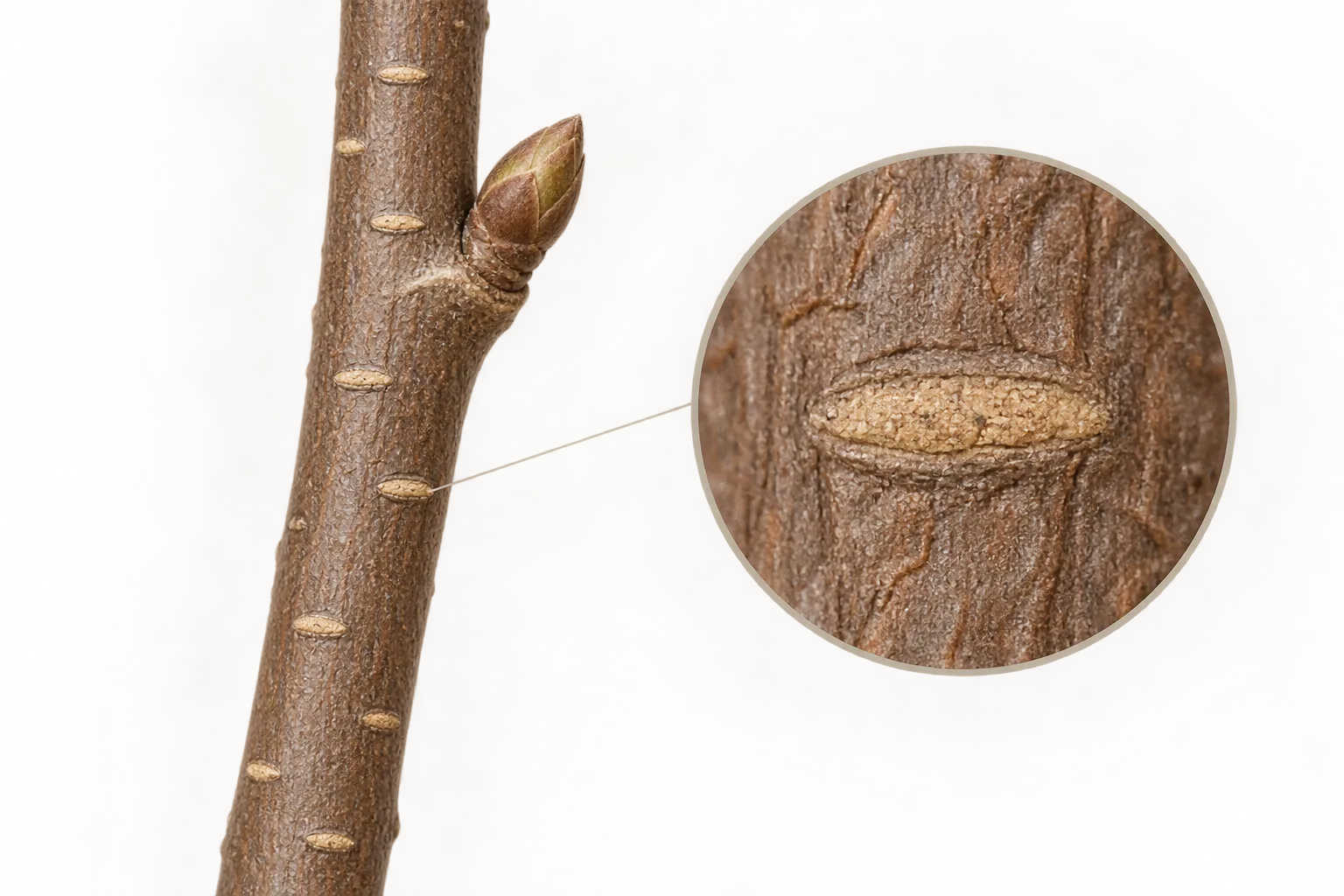
Why does the outside of a woody stem need gas exchange?
The outside of a woody stem has a protective tissue system often called the periderm. It includes tissues such as phellem, or cork, which help protect the stem and reduce water loss. It can also help the stem withstand rubbing and changing environmental conditions.
Woody stems contain living parenchyma cells, the cambium, and other living tissues that need energy. They respire by using oxygen and producing carbon dioxide. Once the ordinary epidermis has been replaced by periderm, the relatively loose cell arrangement and intercellular spaces in lenticel regions can provide a diffusion route through that protective layer.
This exchange is not a tube that actively pumps gases in and out. Gases move according to conditions such as concentration differences, tissue water status, temperature, and structure. A common teaching model is that oxygen may diffuse inward while carbon dioxide and some water vapor may diffuse outward, but the direction and amount of movement should not be treated as fixed at every moment.
For the broader roles of stems, see What do stems do?. For the relationship between a gas pathway and living-cell respiration, see Do plants breathe?.
A lenticel is not a large hole in the bark
From a distance, a lenticel can look like a small hole, so it is easy to imagine that the bark has been drilled through. A more accurate model is that a lenticel is a tissue region made of cells. Its cells are usually arranged more loosely than the surrounding phellem, leaving more intercellular air space through which gases can diffuse.
In plant anatomy, periderm formation is related to the phellogen, also called the cork cambium. The phellogen produces phellem, or cork, toward the outside and can form phelloderm toward the inside. A lenticel is a region of the periderm with a distinctive cell arrangement. You do not need to memorize all of these names first; the key idea is that a lenticel is a relatively loose, gas-permeable tissue region, not an empty tunnel.
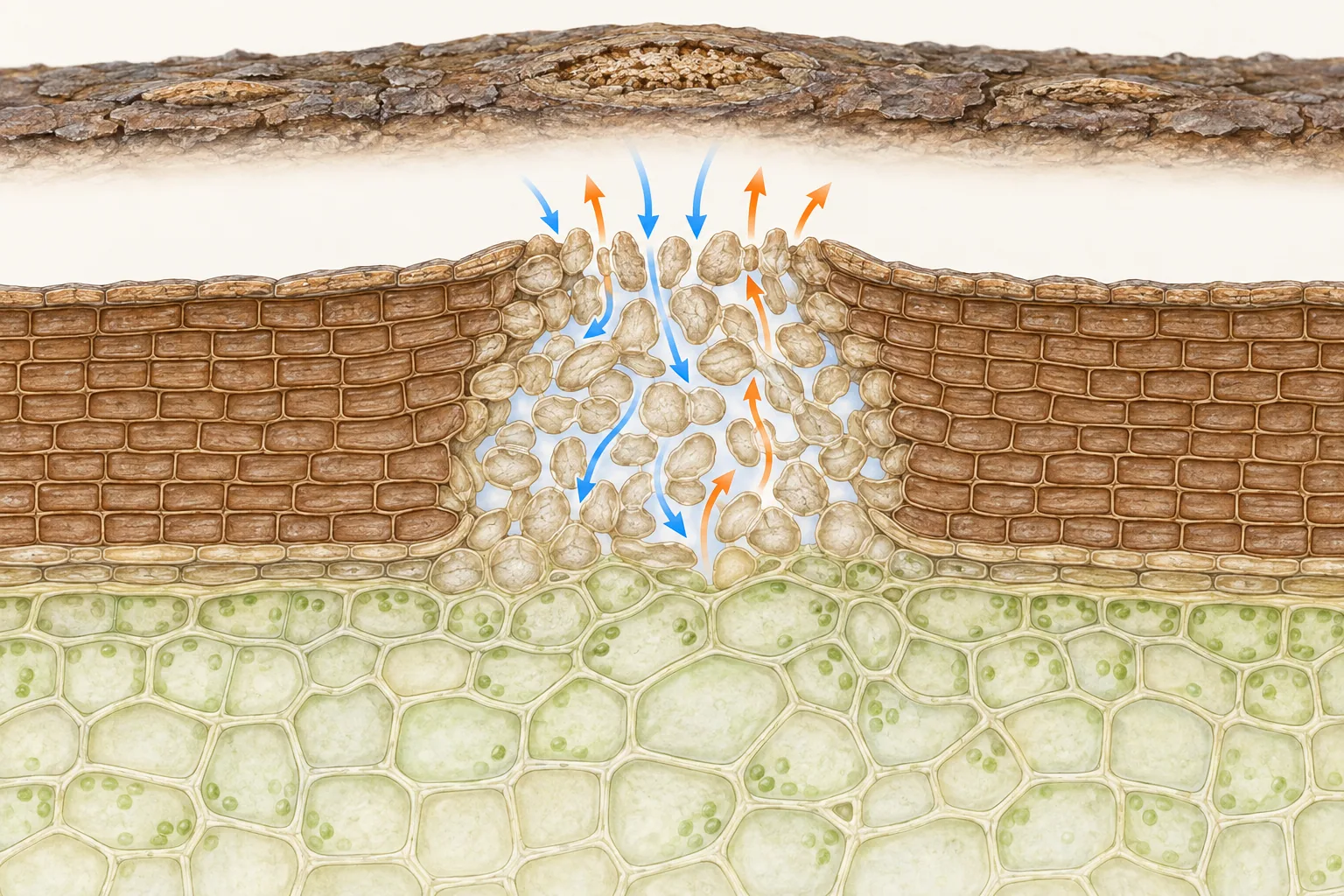
Different plants may also have complementary cells, sometimes called filling tissue, inside a lenticel. Some lenticels form a tighter closing layer at particular times. Saying that a lenticel is always an open hole, or a ventilation pipe running straight to the heartwood, makes the structure sound simpler and more uniform than it really is.
How are lenticels different from stomata?
Lenticels and stomata are both related to gas exchange, but they are not the same structure. The singular form is stoma; the plural form is stomata.
| Comparison | Lenticels | Stomata |
|---|---|---|
| Common location | The periderm surface of woody stems and branches; they can also occur on some other organs with periderm | Commonly the epidermis of leaves; they can also occur on young stems that still have an epidermis |
| Basic structure | A relatively loose tissue region with intercellular air spaces that forms a gas-diffusion route | Usually an adjustable opening surrounded by a pair of guard cells |
| Regulation | Not controlled by the same rapid guard-cell opening-and-closing mechanism; some lenticels have a closing layer, and permeability can vary with structure, season, and water status | Guard cells can change the size of the opening and regulate gas and water-vapor movement |
| What to look for | Cork-like dots, lines, or marks on the surface of a woody stem | A tiny opening on an epidermis, with guard cells around it when seen at the appropriate scale |
So when you see a small dot on a branch, do not call it a stoma simply because gas exchange is involved. A lenticel is a specialized tissue region in the outer tissues of a woody stem. A stoma is an adjustable opening in an epidermis. Their roles overlap, but their locations and control mechanisms differ. You can compare the two more closely in What are stomata?.
Is every dot on a branch a lenticel?
No. Lenticels are one clue used when observing woody twigs, but leaf scars, bundle scars inside leaf scars, buds, bud scars, wounds, and other bark structures can also look like dots or short lines.
It is more useful to examine a whole section of the twig. Are the marks scattered across the bark, or are they concentrated inside the scar left by an attached leaf? Do they repeat in a regular pattern of dots or horizontal or vertical short lines? Are nodes, internodes, or buds nearby? Enlarging one isolated mark is usually not enough to identify it.
This is why lenticels can contribute to tree identification without completing a species identification by themselves. A closer identification should also consider bud shape, leaf scars, bark texture, twig color, and other features. If all you have is a photo without species information, twig age, or scale, the safer wording is “the appearance may be consistent with a lenticel,” not a definite identification.
Lenticel appearance changes with the plant and twig age
On some woody plants, lenticels on young twigs look like small round dots. As a twig becomes thicker and its bark changes, the same general feature may appear as a horizontal line, a vertical stripe, or a less visible mark. Size, color, spacing, and visibility can all vary with species, twig age, position, and environment.
Do not treat one photograph as a fixed template for every plant. Do not automatically interpret a lenticel becoming larger, darker, or less visible as evidence that a plant is diseased, dehydrated, or oxygen-starved. Those interpretations require more information about the species, timing, environment, and condition of the whole plant. Lenticels are not health meters.
Research has examined enlarged lenticel tissue, closing layers, and changes in permeability under particular tree species or flooding conditions. These studies help explain how plants balance protection, gas supply, and water loss. They should not be turned into a diagnostic rule for a houseplant.
What to look for when observing a twig
When observing a woody twig at school, in a park, or near a potted plant, use a hand lens and notes instead of peeling or scraping the bark:
- First record whether the twig is soft green, partly woody, or covered by clear bark. Lenticels are mainly discussed here in relation to woody stems and branches with periderm.
- Look at the marks from a distance and then up close. Are they dots, horizontal short lines, vertical stripes, or one isolated wound? Note whether similar marks repeat across the same section of bark.
- Put the marks on the same observation sketch as the nodes, internodes, buds, and leaf scars. A small mark inside a leaf scar may be a bundle scar, so do not automatically call it a lenticel.
- Compare young and older twigs on the same plant. Record the visible differences, but do not use lenticel number or size to judge plant health, and do not peel the bark just to confirm an identity.
If the surface also has a rapidly expanding crack, an exudate, or another obvious abnormality, this introductory article cannot identify the cause. Keep an observation record and avoid treating different surface structures as if they were one thing.
Common confusions
-
✕ A lenticel is a hole in the bark that leads straight to the heartwood.
-
✓ A lenticel is a multicellular tissue region in the periderm. Its looser cell arrangement and intercellular air spaces form a gas-diffusion route; it is not a large cavity running through the bark.
-
✕ A lenticel is the tree’s lung or mouth.
-
✓ A lenticel provides a route for gases to pass through outer tissues. Living cells inside the stem carry out respiration; one surface structure is not the entire physiological process.
-
✕ Lenticels open and close with guard cells just like stomata.
-
✓ Stomata are usually regulated by guard cells. Lenticels are specialized periderm tissue regions, not the same rapid opening-and-closing mechanism; some have closing layers and seasonal changes in permeability.
-
✕ Every small dot on a branch is a lenticel.
-
✓ Leaf scars, bundle scars, bud scars, wounds, and other bark structures can also appear as dots. Consider position, pattern, and the whole twig together.
-
✕ More or larger lenticels mean that a plant is healthier.
-
✓ Lenticel appearance and density vary with species, twig age, and environment. They cannot be used as a health indicator by themselves.
-
✕ Lenticels absorb water like root hairs.
-
✓ Lenticels are mainly involved in the diffusion of gases and water vapor. Root water uptake, transport inside the stem, and lenticel gas exchange are different ideas.
Frequently Asked Questions
Are lenticels the same as stomata?
No. Both are related to gas exchange, but stomata are usually openings in the epidermis of leaves or other young surfaces and are regulated by guard cells. Lenticels are specialized tissue regions in the periderm of woody stems or branches. Their looser cells and intercellular spaces provide a diffusion route.
Are lenticels empty holes?
No. They are not large holes drilled through the bark. Lenticels are made of cells, and the cells in the lenticel region are relatively loosely arranged, leaving intercellular air spaces through which gases can pass. The magnified part of the teaching image is conceptual; real plants do not all have the same cell arrangement.
Why do woody stems need lenticels?
The periderm protects the outside of a woody stem and can reduce water loss, but living cells inside the stem still need oxygen and produce carbon dioxide. Lenticels provide a diffusion route through the outer tissues. The trade-off is that water vapor may also escape along this pathway.
Do lenticels open and close like stomata?
You should not apply the guard-cell opening-and-closing model directly to lenticels. Lenticels do not use the same type of rapid guard-cell regulation. Some have a closing layer, and their overall permeability can be affected by season, tissue structure, and water status. “Always wide open” and “completely unable to change” are both too absolute.
Is every small dot on a branch a lenticel?
No. A lenticel is only one possibility. Looking at a whole twig and comparing each mark with the positions and patterns of leaf scars, buds, and nodes is more useful than enlarging one dot. Without species and twig-age information, do not treat appearance alone as a definite identification.
Do lenticels occur only on trunks?
No. Introductory explanations often start with trunks and woody branches. Some roots, fruits, or underground organs that develop periderm may also have lenticels, but their forms and functional contexts can differ. They should not all be forced into one visual template.
Does a larger lenticel mean that a plant is diseased?
Not by itself. Lenticels naturally vary with species, twig age, position, and environment. Research on lenticel enlargement is often limited to particular species and conditions. A lenticel is not a single diagnostic indicator of pests, disease, or overall plant health.
How are lenticels related to plant respiration?
A lenticel is a route through the outer tissues, while respiration is the process by which living cells use organic materials to obtain energy. They are related, but a lenticel does not “breathe” by itself. It simply gives oxygen and carbon dioxide a possible route into or out of the stem. For a broader explanation, see Do plants breathe?.
Related Terms
- Lenticel: A specialized gas-exchange tissue region in the periderm of a woody stem or branch.
- Periderm: The protective tissue system that replaces the epidermis as a woody stem undergoes secondary growth.
- Phellogen (cork cambium): A lateral meristem that produces phellem and related periderm tissues.
- Phellem (cork): The outer part of the periderm, whose cells commonly contribute to protection.
- Phelloderm: Periderm-related tissue formed toward the inside by the phellogen.
- Complementary cells / complementary tissue: A relatively loose cell region often found in a lenticel, with more intercellular air space.
- Stoma (plural: stomata): A tiny opening, often in a leaf epidermis, whose size can be regulated by guard cells.
- Guard cells: Cells around a stoma that can change the size of its opening.
- Leaf scar: The connection mark left on a twig after a leaf falls away.
- Bundle scar: A small mark inside a leaf scar associated with the vascular connection that once led to the leaf.
- Secondary growth: Growth that increases the thickness of a stem or root and is often related to cambium and periderm formation.
Read Next
Evidence
References
These sources were used to check the plant-science concepts and gardening context in this article.
View sources and further reading (10)
- edis.ifas.ufl.edu — FR296
- cmg.extension.colostate.edu — GN 170 Identifying Trees and Shrubs.pdf
- academic.oup.com — 675330
- pubmed.ncbi.nlm.nih.gov — 39240190
- taiwania.ntu.edu.tw — 879
- rhs.org.uk — how plants breathe
- forschung.boku.ac.at — 15975
- lima.osu.edu — plant anatomy
- pressbooks-dev.oer.hawaii.edu — stems
- nickrentlab.siu.edu — Lecture14 Periderm.html