
A soft cap protects the growing root tip
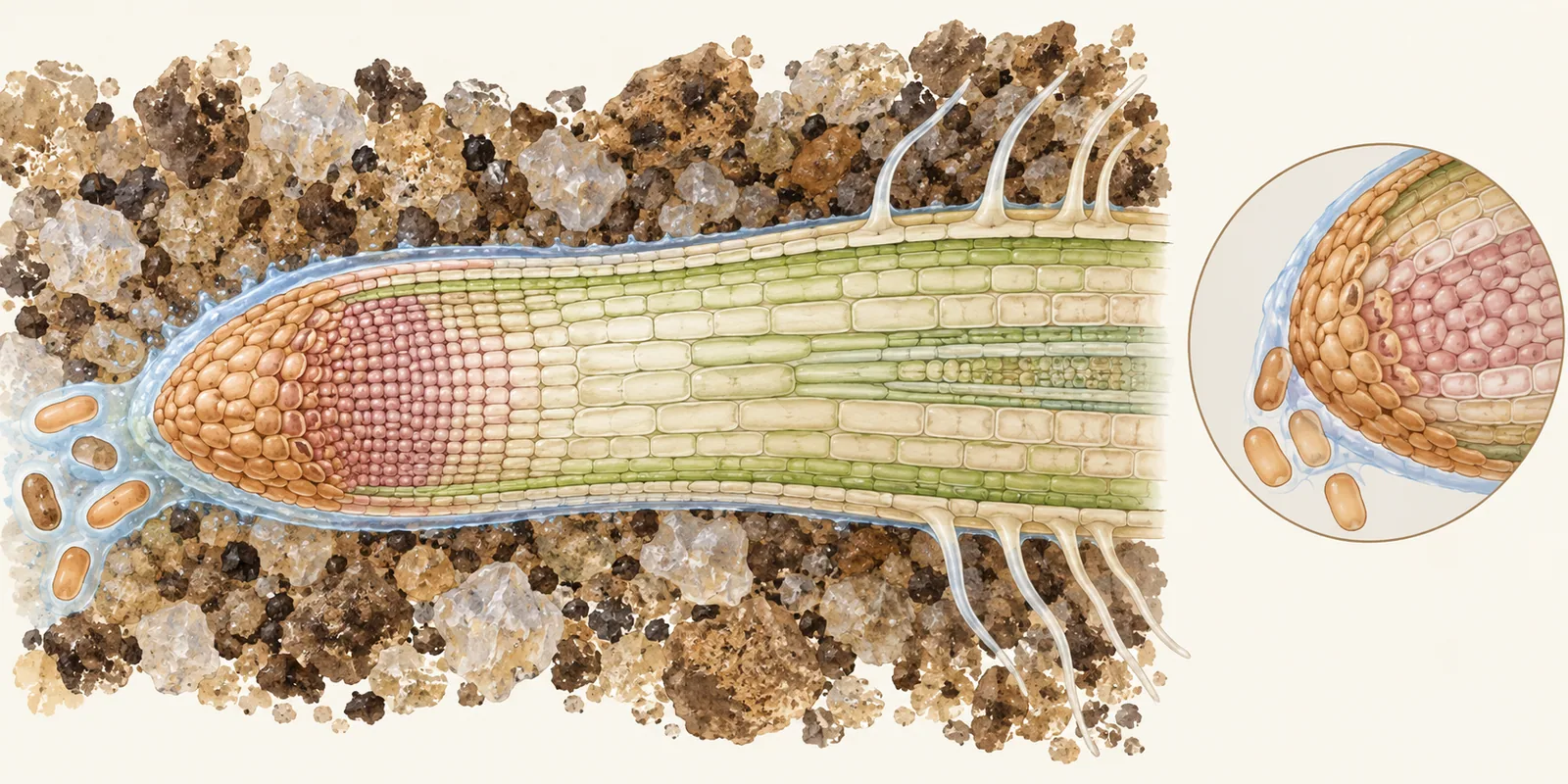
A root cap is a layer of cells at the very front of a growing root. It covers and protects the root apical meristem (RAM), the growing tissue that keeps producing new cells. This lets the root continue extending into soil or a potting medium even while its tip meets particles, small pores, and physical resistance.
The root cap is part of the root, not a hard shell attached to the outside. It is also not the same thing as the entire root tip. The cap is a dynamic tissue: outer cells may be released, shed, or die, while inner tissues keep supplying new cells. In that sense, the root tip has a protective front line that is continually renewed.
Some cells that leave the root cap are called root border cells. In some plants, these cells remain alive for a period after separating from the cap, so they should not all be treated as dead waste. The number and arrangement of root-cap layers, and the way cells are released, differ among plant species.
The root tip contains several neighboring zones
From the very front of the root back toward the rest of the plant, a useful beginner’s map is:
- The root cap faces soil particles and the resistance of the surrounding medium first.
- The root apical meristem and the zone of cell division are nearby. Cells continue dividing there and provide new root cells.
- In the zone of elongation, newly formed cells become longer. This helps extend the root tip forward.
- In the zone of maturation, also called the zone of differentiation, cells become more specialized. Root hairs commonly appear farther back in this region, increasing contact between the root and its surroundings.
These names describe a continuous pattern of development, not four perfectly separated blocks. Different sources may also describe a transition zone, and the boundaries can overlap in space and time. The important first idea is that the root cap protects the growing core, while cell division, elongation, and maturation describe what happens behind it. Root hairs are mainly associated with the more mature region, not with the protective cap at the very tip. You can compare their position and role in what root hairs are and why plants need them.
A root cap is renewed, not worn away once
The root cap does not stay in place because its outer cells are indestructible. In the growing root tip, meristematic tissues and root-cap initials continually contribute new cells for the cap and the root body. In a simplified view, newer cells begin closer to the inner growing region, gradually mature, and become part of the outer cap. Cells at the outside are then released, shed, or, in some tissues, removed through programmed cell death.
This balance of addition and loss helps the root cap maintain a broadly stable size while the root advances. It is not a single layer that is made once and then rubbed down. At the same time, there is no one universal shedding pattern for every plant. Some grasses and legumes are commonly studied for living root border cells, while Arabidopsis models show different border-like cell arrangements and programmed cell death patterns. These examples are useful reminders that a general root-cap diagram is a teaching model, not a species-wide blueprint.
Mucilage helps shape the root–soil interface
Root-cap cells can release a hydrated, polysaccharide-rich material called root cap mucilage, also known as mucigel. It is useful to picture it as a very thin, hydrated layer around the tip. Together with released cells at the interface, it can reduce some direct friction as the root tip moves past soil particles and can help the surface stay in contact with small spaces in the surrounding medium.
That does not make mucilage a magic drilling substance. Whether it changes friction or mechanical resistance depends on conditions such as soil or medium texture, pore space, water status, compaction, root-tip shape, plant species, and growth rate. Results measured in a particular maize or pea experiment should not be turned into one fixed percentage for every plant and every soil.
Mucilage is also not the force that pushes the root forward. The root apical meristem keeps producing cells, and cells in the zone of elongation become longer. Those growth processes extend the root, while the root cap and the root–soil interface help protect the leading tip and manage its contact with the medium.
How the root cap helps the root sense gravity
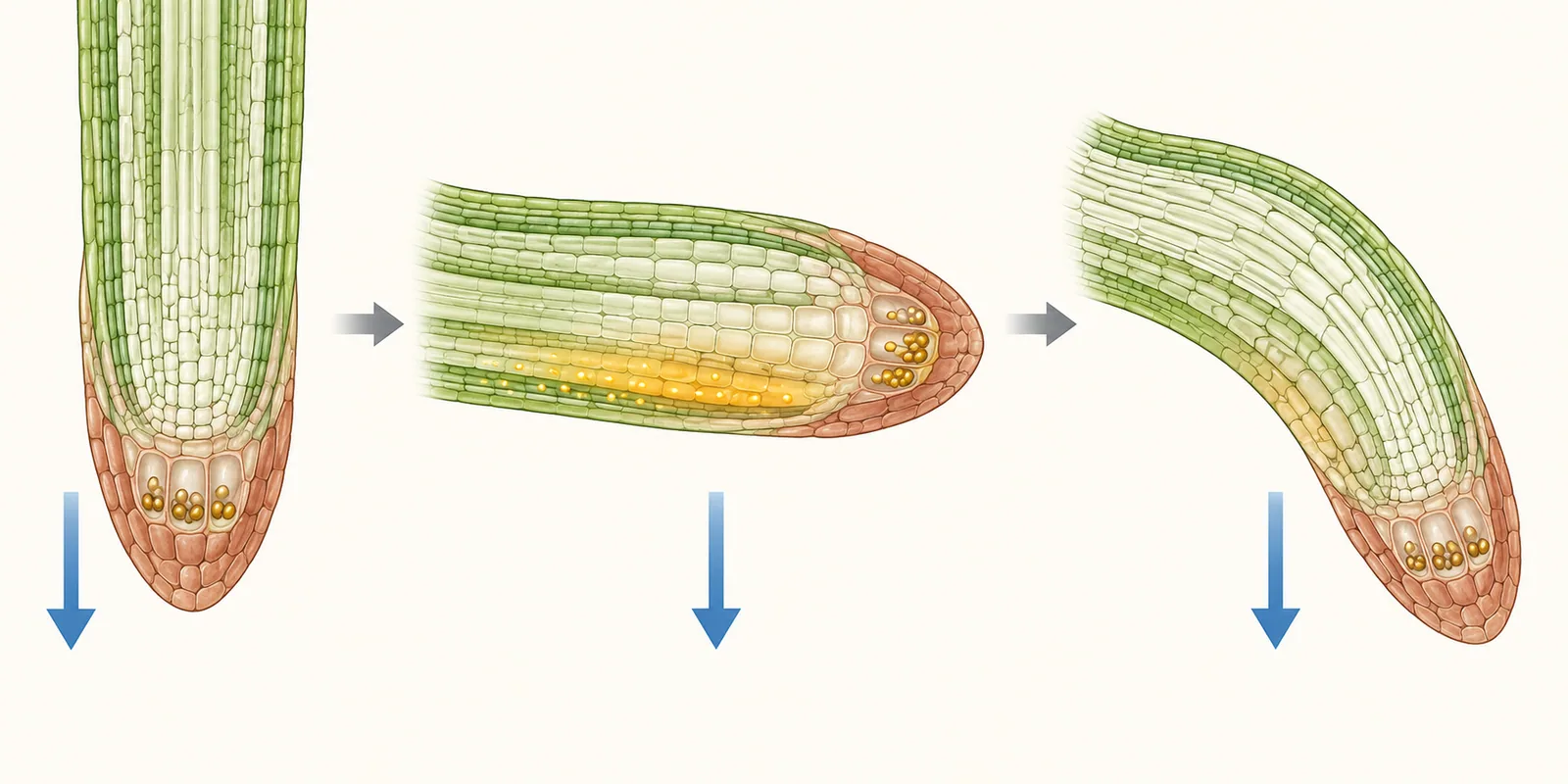
The root cap is not only a passive buffer. In many flowering-plant roots, central root-cap columella cells act as specialized gravity-sensing cells called statocytes. Inside these cells are starch-filled amyloplasts. When a root changes orientation, the dense amyloplasts can settle in response to gravity; in this gravity-sensing context they are often called statoliths.
That change in position starts signals that affect the distribution of the plant hormone auxin near the root tip. In a common simplified model, the signal affects the transition and elongation-related regions behind the cap (often grouped as the zone of elongation in introductory diagrams). Different rates of elongation on the two sides make the root bend toward gravity. Different sources draw the boundaries between these regions somewhat differently. The root cap supplies important directional information; it does not act like a shovel that physically pushes the root downward.
This is a simplified model of root gravitropism, not a claim that every detail of the pathway is settled or identical in every plant. The root cap is a major sensing location, but it should not automatically be described as the only possible site involved. Primary roots often show positive gravitropism, yet lateral roots can grow at different angles. Light, water, oxygen, touch, physical resistance, and the plant’s existing growth angle can also affect the final direction. For the wider picture, see how plants sense gravity.
What can gardeners observe?
On a young seedling or a newly emerged fine root, the tip is usually soft and difficult to identify precisely with the naked eye. With magnification, you can look for a rounded leading end, a region behind it where the root gradually becomes longer, and root hairs farther back where the tissue is more mature.
It is safer to record positions and changes than to assign every visible feature to one cause. If a root bends, do not immediately conclude that the root cap is damaged or that the root must grow straight down. Gravity, light, water, oxygen, resistance from the growing medium, the root’s original angle, and plant type can all contribute to what you see. A photograph without scale is also not enough to identify every microscopic zone with certainty.
Common mix-ups
-
✕ The root cap is the entire root tip, so every region behind it is also root cap.
-
✓ The root cap is at the very front. The root tip includes the cap and nearby growing regions, including the meristematic, elongation, and maturation or differentiation regions.
-
✕ The root cap is a permanent hard hat.
-
✓ It is living tissue that is continually renewed. Outer cells can be released, shed, or removed, while new cells are supplied from inner growing tissues.
-
✕ Every cell that leaves the root cap is dead waste.
-
✓ Some root border cells can remain alive for a time. Other plants or tissues show different border-like arrangements and programmed cell death patterns.
-
✕ The root cap and root hairs are both small structures mainly used for water uptake.
-
✓ The root cap mainly protects the tip, releases mucilage, and participates in environmental sensing. Root hairs usually occur farther back in the maturation or differentiation zone, where they increase contact with the surrounding medium.
-
✕ The root cap acts like a shovel and pushes the root downward.
-
✓ It helps sense gravity, while unequal growth on the two sides of the elongation zone produces the bend.
-
✕ A bent root proves that the root cap caused the problem.
-
✓ Root direction reflects several cues, including gravity, light, water, oxygen, medium resistance, and plant species.
Frequently Asked Questions
Is the root cap part of the root?
Yes. The root cap is the cell tissue at the very front of a root tip. It covers and protects the root apical meristem; it is not a separate part that sits outside the root.
Why does the root cap not become shorter as it rubs against soil?
Outer cells can be released or shed as the cap develops and as the tip meets the surrounding medium, but inner growing tissues keep supplying new cells. This ongoing turnover helps the cap maintain its protective role. The rate and pattern of replacement vary with the plant and its growth conditions.
Are all root-cap cells that separate from the root dead?
No. Some plants release living root border cells that can remain alive for a period after they leave the cap. Other species or tissues show border-like cell layers and programmed cell death. Cell release is not identical across all roots.
Does the root cap absorb water?
The root cap is not usually described as the main water-absorbing region. Root hairs are more commonly discussed in connection with contact and uptake farther back in the zone of maturation or differentiation. Root cap mucilage is a hydrated material at the root–soil interface; that does not make mucilage the same thing as root-hair water absorption.
What is the difference between a root cap and a root tip?
The root cap is the protective tissue at the very front. The term root tip or root apex usually refers to a broader end region that can include the root cap, the root apical meristem, and nearby zones of cell division, elongation, and maturation. Textbooks may draw the boundaries a little differently.
How does the root cap help a root grow downward?
Central root-cap columella cells can act as statocytes. Their starch-filled amyloplasts, often called statoliths in this context, change position with gravity. Signals then affect auxin distribution and growth in the transition and elongation-related regions behind the cap; unequal growth on the two sides makes the root bend toward gravity. Gravity provides directional information; it does not simply pull the root into a curve.
Do root hairs grow on the root cap?
Usually, root hairs appear farther back, in the more mature or differentiated part of the root. Root hairs are extensions of epidermal cells, whereas the root cap is the protective tissue at the leading end. The exact appearance and boundaries can vary among plants, but they are not the same structure.
Can you see a root cap with the naked eye?
Usually not clearly. The root cap is small and delicate, and its outer cells are continually renewed. A magnified view of a young root may show the overall rounded tip and the root-hair-free region near the front, but a photograph without scale cannot establish every microscopic boundary.
If a root tip is injured, can it always grow again?
There is no universal yes-or-no answer. A root tip contains several tissues, and the outcome depends on the extent of the disturbance, the plant species, and what happens during later growth. This article does not promise recovery from root-tip injury or provide a treatment prescription.
Related Terms
- Root cap: the cell tissue covering the front of a growing root tip and protecting the tissues behind it.
- Root tip / root apex: the broader region near the end of a root, which can include the root cap and several growing zones.
- Root apical meristem (RAM): meristematic tissue near the root tip that keeps producing new cells for root growth.
- Zone of cell division: the region where new root cells are continually produced.
- Zone of elongation: the region where newly formed cells become longer and help extend the root.
- Zone of maturation or differentiation: the region where cells become more specialized; root hairs commonly appear here.
- Root hair: a fine extension of an epidermal cell that increases contact between the root and its surrounding medium.
- Root border cells: cells released from the root cap that may remain alive for a time in the root–soil interface.
- Root cap mucilage: a hydrated, gel-like material released around the root cap; its effects depend on the plant and the surrounding conditions.
- Statocyte, amyloplast, and statolith: a gravity-sensing cell and its dense, starch-filled structure; an amyloplast is often called a statolith when discussed as a gravity-direction cue.
- Gravitropism: a growth response to the direction of gravity; primary roots often show positive gravitropism.
- Auxin: a plant hormone involved in cell elongation and directional growth responses.
Read Next
Evidence
References
These sources were used to check the plant-science concepts and gardening context in this article.
View sources and further reading (12)
- openstax.org — 23 3 roots
- content.ces.ncsu.edu — 3 botany
- academic.oup.com — 696325
- pmc.ncbi.nlm.nih.gov — PMC7601833
- pmc.ncbi.nlm.nih.gov — PMC4247041
- pmc.ncbi.nlm.nih.gov — PMC4986716
- pmc.ncbi.nlm.nih.gov — PMC4242191
- onlinelibrary.wiley.com — pce.12037
- pmc.ncbi.nlm.nih.gov — PMC7154840
- frontiersin.org — full
- fao.org — y2775c.pdf
- ncbi.nlm.nih.gov — NBK26922