
Find the petiole first, then look for stipules
A petiole is the stalk-like part of a leaf that connects the leaf blade to the stem. A stipule is a leaf-associated appendage that some plants produce near the leaf base or the base of the petiole. They occur close together, but they are not the same structure: the petiole connects and supports the blade, while stipules are additional structures that may or may not be present.
In everyday speech, “leaf” may mean the entire leaf organ. For a typical leaf with a petiole, start with three parts: the broad, expanded leaf blade; the petiole that connects it to the stem; and, in some plants, one or more stipules near the base. When you place that leaf back on the stem, you can also identify the node, internode, leaf axil, and axillary bud.
Here, leaf base means the part of the leaf near its attachment, while the base of the petiole means the end of the petiole closest to the stem. Different plants can shape this region differently, so these terms help locate structures rather than define one universal boundary line.
 Leaf blade Petiole Stem Stipules Axillary
bud
Leaf blade Petiole Stem Stipules Axillary
bud Select a part name above to explore its role.
The blade is the expanded part of a leaf
The blade is usually the most visible part and captures light. It is one part of a leaf: to find where the whole leaf attaches, follow it toward the petiole and leaf base.
Look at the broad green blade on the right of the main shoot.
The petiole belongs to the leaf and connects it to the stem
The petiole supports the blade away from the stem and connects the leaf's vascular tissues with the stem's transport system. It is part of the leaf, rather than a small stem; some leaves lack a distinct petiole.
Follow the right-hand blade down along the slender stalk joining the main stem.
The stem supports leaves, which attach near nodes
The stem is the axis supporting leaves, buds, and other organs. A petiole joins near a node; the stem section between two nodes is an internode, distinct from the petiole.
Look at the upright main axis on the left and where the petiole joins it.
Stipules sit near the leaf base, separate from the axillary bud
In this example, thin stipules occur on either side near the petiole base. Stipules occur in some plants and may be small, fused, or shed early; not every projection near a leaf base is a stipule.
In the enlargement, find the two thin structures near the petiole base. The thicker bud above the junction is an axillary bud.
The axillary bud lies in the leaf axil and may form a new shoot
The upper angle between petiole and stem is the leaf axil. Its axillary bud may develop into a side shoot or a flower-related structure under suitable conditions; it is distinct from the nearby stipules.
In the enlargement, find the thicker bud above the petiole, beside the stem.
A whole leaf can be understood through three nearby parts
The leaf blade is the broad, expanded part
The leaf blade, also called the lamina, is the flat, expanded part that most people picture when they hear the word “leaf.” It is usually the easiest part to see and is a major site of light capture and photosynthesis in green plants.
The blade is not always the same thing as the whole leaf. When you are trying to work out where a leaf begins and how it attaches to the plant, do not stop at the blade’s outline. Follow it toward the base and look for the petiole and the way the leaf meets the stem. For a broader introduction to leaf functions, see What do leaves do?.
The petiole connects the blade to the stem
The petiole is the stalk-like part of the leaf. Its length, thickness, and angle vary among plants. By holding the blade away from the stem, a petiole can help position the blade in space instead of leaving it pressed directly against the stem.
A petiole may look like a small stem, but it is part of the leaf, not a separate piece of stem. It can contain vascular tissues and help connect the leaf to the plant’s support and transport systems; those similarities do not change its position in plant morphology. Some leaves have no obvious petiole. These are called sessile leaves, meaning the blade is attached close to the stem without a distinct leaf stalk.
Stipules are present in some plants, not all
Stipules are usually described as leaf-associated, often leaf-like appendages near the leaf base, the base of the petiole, or a nearby node. They are often paired, but they may be absent, very small, fused to one another, fused with the petiole, or reduced into another form. Some fall off early, while others remain on the plant as the leaf matures.
Their shapes can vary widely. A stipule may look like a small scale or blade, or it may be modified into another structure such as a spine or tendril. These examples should be treated as forms that occur in some plants, not as a rule for every sharp or thread-like structure. In some plants, stipules may help protect young leaves or buds before they expand. That is a cautious general description: the form and function of stipules vary, so “protects the young leaf” is not a fixed function to assign to every stipule.
Where does the petiole meet the stem?
The stem has positions that are useful for reading a plant’s structure. A node is a region of the stem where leaves, buds, or other structures attach or arise. The stem segment between two nodes is an internode. A node is part of the stem; it is not part of the leaf blade or petiole. For a closer look at this stem framework, read What are nodes and internodes?.
The petiole usually joins the stem near a node. The upper angle or nearby space between a leaf and the stem is the leaf axil; when the leaf has a distinct petiole, this is the angle between the petiole and the stem. An axillary bud is a bud located in or near that axil. Under suitable conditions, it may develop into a side shoot or a flower-related structure, but it is not the same thing as a stipule. What Is a Plant Bud? Where Do New Shoots Come From? explains the position of buds in more detail.
It helps to keep the following sequence in mind:
- The leaf blade is the broad, expanded part that is easiest to see.
- The petiole connects the blade to the stem near a node.
- The base of the petiole is the end of the petiole closest to the stem.
- Stipules, if present, are leaf-associated structures near the leaf base or petiole base.
- The leaf axil is the upper angle or nearby space between the leaf and stem; when present, the petiole forms that angle.
- The axillary bud is the bud found in or near that axil.
- The internode is the stem segment between two nodes.
This sequence connects a single leaf to a section of stem rather than treating the leaf and stem as unrelated pieces.
Why are stipules easy to miss?
The first reason is simple: not every plant has obvious stipules. The second is that stipules vary in size, position, and persistence. Some are tiny, some are fused with another structure, and some fall off as the leaf matures. A mature branch may therefore show no obvious stipule even when a young leaf had one. A stipule scar can sometimes provide a useful identification clue, but it should be considered together with the petiole, leaf base, node, leaf axil, and other features rather than used as a stand-alone identification test.
A leaf sheath, ligule, or auricle is not automatically a stipule
Some plants have a leaf base that expands into a leaf sheath, a sleeve-like part that wraps around the stem. In grasses and similar plants, the junction between the sheath and blade may also include a ligule or auricle. These structures are especially familiar as identification features in Poaceae (the grass family). Some Cyperaceae (the sedge family) also have ligules, but their presence and form vary among groups; a ligule may be small or absent. Auricles are more often discussed as variable features of some grasses, and they are not present in every plant.
A ligule is a small membrane-like or tongue-like structure that may appear at that junction. An auricle is a small ear-like lobe that may project from the same area. Neither is present in every plant, and their names are not interchangeable with stipule.
Read the four panels in order. In the upper left, stipules, if present, sit near the petiole base. In the upper right, the sheath wraps the stem; a ligule may sit inside the sheath–blade junction, while auricles may project from its sides. The lower panels compare a simple leaf with a continuous blade and a pinnate compound leaf: the whole compound leaf attaches to the stem by one petiole, which continues into a rachis that bears the leaflets. A petiolule is visible only when a leaflet has a short stalk of its own. These are separate examples, not a checklist of structures present on every plant.
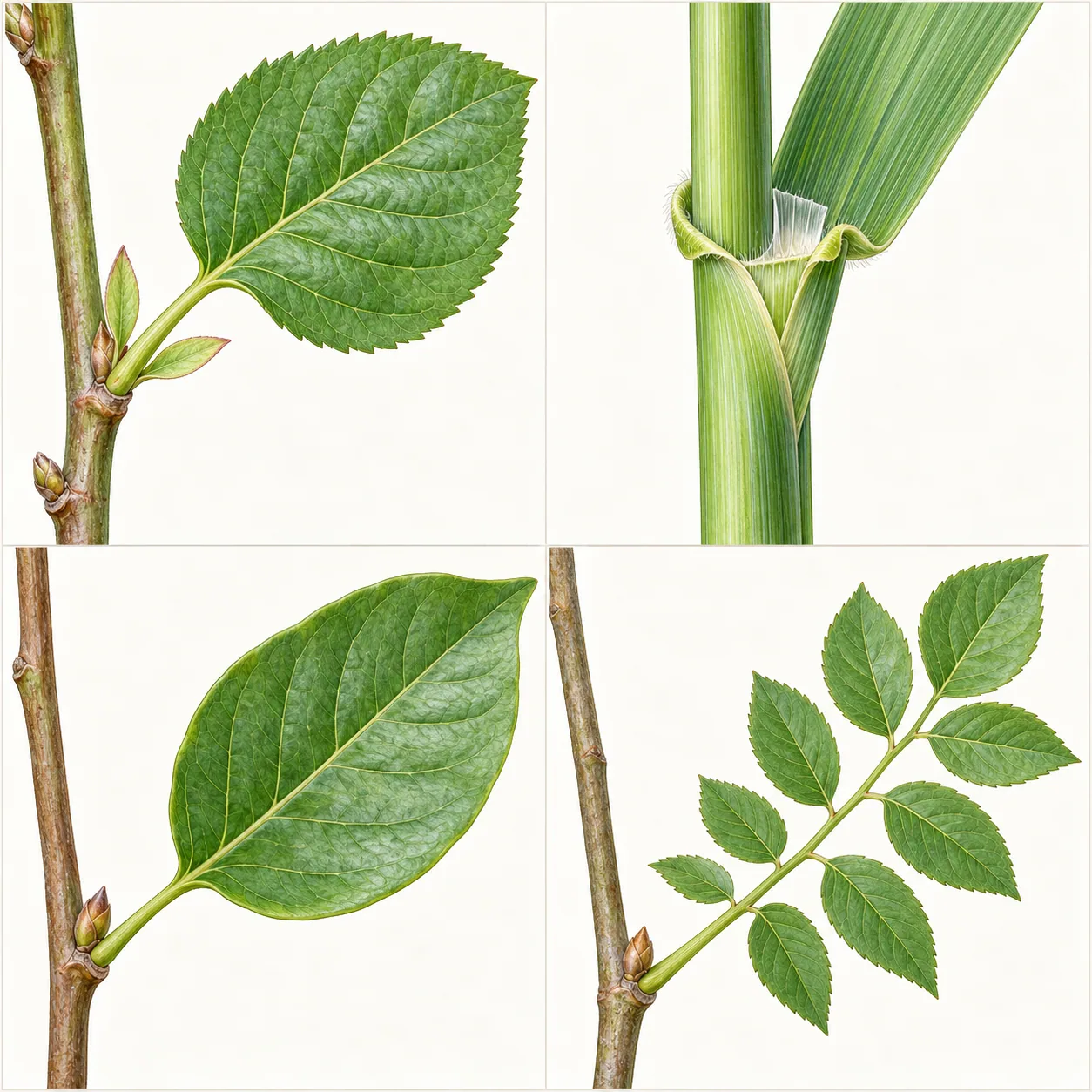
When you are making an initial observation, ask whether the structure is an appendage near the base of a petiole or a sheath-like part of the leaf base that wraps around the stem. For a grass or another plant with an unusual leaf base, use the terminology for that plant group rather than forcing every basal structure into the word “stipule.”
The petiole also connects the leaf to the transport system
The petiole is more than a small support. Vascular tissues such as xylem and phloem can continue from the stem through the petiole into the leaf. Inside the blade, the same transport network appears as the veins. This connection helps water reach the leaf and allows sugars and other organic materials made in the leaf to move to other parts of the plant. For the next layer of detail, read What do leaf veins do?.
Roots, stems, and leaves therefore work as a connected system rather than as three unrelated parts. The petiole is an easy-to-see connection point: it joins the blade to the stem and links the leaf to the plant’s support and transport routes. What do stems do? provides more stem context, while How Do Roots, Stems, and Leaves Work Together? puts the whole system back together.
The same position helps distinguish a whole leaf from a leaflet
Some plants have compound leaves that look like one leaf blade divided into many smaller pieces. In this case, do not count the small pieces alone. Find the base of the whole leaf and the one main point where its common petiole attaches to the stem.
Read the compound leaf from the stem outward: common petiole → rachis → petiolule → leaflet. The common petiole is the stalk of the entire compound leaf. It may continue into the rachis, the axis that bears the leaflets; when a leaflet is connected by a small stalk, that stalk is the petiolule. A compound leaf does not always show every level as a sharply separate segment, and not every leaflet has an obvious petiolule, but this sequence is a useful way to keep the attachment levels straight.
The leaflets are not normally treated as separate whole leaves with their own axillary buds. The leaf axil and axillary bud are generally associated with the base of the entire compound leaf, where the common petiole meets the stem. A bud may be too small, dormant, or hidden to see, so visibility alone is not an absolute test. The key question is where the whole leaf attaches to the stem, not whether each leaflet looks leaf-like.
A simple observation route for one plant branch
On a plant in a schoolyard, balcony, garden, or park, you can trace these relationships without picking the leaf or opening a bud:
- Start at the widest part of the leaf and follow the midrib or lower surface toward the base.
- Check whether the blade joins a distinct petiole. If not, record that it may be a sessile leaf.
- Follow the petiole down to the point where it joins the stem. That point is usually close to a node.
- Compare the stem segment below or above it with the next node to identify an internode.
- Look near the petiole base for paired, fused, reduced, or otherwise leaf-like stipules, while remembering that some plants have none or have already shed them. If the leaf base forms a sheath, also compare the sheath–blade junction for a possible grass-leaf ligule or auricle rather than calling it a stipule automatically.
- Look into the upper angle between the leaf and stem—or between the petiole and stem when a petiole is present—for a small axillary bud. It may be dormant, very small, or partly hidden.
- If the leaf is compound, first find the whole leaf’s stem-side attachment, then trace the common petiole, rachis, any petiolules, and leaflets where those levels are visible. Do not treat each leaflet as if it attaches directly to the stem.
Different plants expose these parts differently. If the stipule, ligule, auricle, or bud is too small to identify, do not force a label. Confirming how the blade and petiole—or the sheath when present—join the stem is already a useful observation. This route is for learning plant structure, not for species identification.
Common mix-ups
-
✕ The leaf blade is the whole leaf.
-
✓ In everyday speech, “leaf” may mean the whole organ. The leaf blade or lamina is the broad, expanded part within that organ; a whole leaf may also include a petiole and, in some plants, stipules.
-
✕ A petiole is just a small stem.
-
✓ A petiole can look stem-like and can contain vascular tissues, but it is the stalk-like part of a leaf. A stem forms nodes and internodes and supports leaves, buds, and other structures.
-
✕ The leaf base is always one sharp line between the blade and petiole.
-
✓ Leaf base is a broader term for the part of the leaf near its attachment. In this article, “base of the petiole” specifically means the end of the petiole nearest the stem, which keeps the two scales from being confused.
-
✕ The node, leaf axil, and axillary bud are the same small point.
-
✓ The node is a region of the stem, the leaf axil is the upper angle or nearby space formed by the leaf and stem (the petiole and stem when a petiole is present), and the axillary bud is the bud located in or near that space.
-
✕ Every leaf has a pair of stipules, and they are always easy to see.
-
✓ Stipules occur in some plants. They are often paired, but they may be absent, tiny, fused, specialized, or shed before the leaf is fully mature.
-
✕ A stipule is simply another leaflet beside the petiole.
-
✓ A stipule is a leaf-associated appendage near the leaf base. A leaflet is one of the smaller units of a compound leaf. Their positions, attachments, and relationship to the whole leaf must be considered together.
-
✕ Anything that wraps around the stem at the leaf base is a stipule.
-
✓ A sleeve-like basal part that wraps around the stem is usually called a leaf sheath. In a grass leaf, a ligule or auricle may occur at the sheath–blade junction; some sedges also have ligules, but these terms should not be swapped with stipule.
-
✕ Every leaflet in a compound leaf attaches directly to the stem.
-
✓ The whole compound leaf usually attaches to the stem through a common petiole. From the stem outward, the visible levels may be common petiole, rachis, petiolule, and leaflet; the axillary position is generally at the base of the whole leaf.
-
✕ If no axillary bud is visible, the structure cannot be a leaf.
-
✓ An axillary bud may be dormant, very small, covered by nearby tissue, or grouped with other buds. Not seeing it is a clue about visibility, not an absolute identification rule.
-
✕ Every spine or tendril is a modified stipule.
-
✓ Some stipules can become spines or tendril-like structures, but spines, thorns, prickles, and tendrils can have different origins. Sharp or thread-like shape alone is not enough to name the structure.
Frequently Asked Questions
What is the simplest difference between a petiole and a stem?
A petiole is part of a leaf and connects the leaf blade to the stem. A stem is the plant axis that forms nodes and internodes and supports leaves, buds, and other structures. A petiole may look like a small stem, but the two have different positions and identities in the plant body.
Do all leaves have a petiole?
No. Some leaves have no distinct petiole and are called sessile leaves. Other leaves have a base that expands into a leaf sheath. The important point is to look at how the leaf blade or leaf base attaches to the stem, not to assume that every leaf has the same outline.
Do all plants have stipules?
No. Stipules occur in some plants or leaf types, and they vary in size, shape, position, and persistence. A stipule may be tiny, fused, specialized, or shed early, so a mature leaf does not always make it easy to tell whether one was present.
Are stipules another small leaf or leaflet?
Not automatically. Stipules are leaf-associated appendages near the leaf base or petiole base. Leaflets are smaller units of a compound leaf. Their appearance can overlap, so use position, attachment, and the structure of the whole leaf rather than size alone.
What do stipules do?
In some plants, stipules may help protect young leaves or buds before they expand. Other stipules are reduced, fused, or specialized into different forms. Because their structures and functions vary, no single function should be assigned to every stipule.
Can stipules fall off?
Yes. Some stipules fall off as the leaf matures, while others remain. A stipule scar may sometimes be visible and can be a useful plant-identification clue, but it should be considered with other features rather than treated as proof by itself.
What is the difference between the leaf base and the base of the petiole?
Leaf base is the broader leaf region near the point of attachment. The base of the petiole is more specific: it is the end of the petiole closest to the stem. Different references may use “leaf base” at slightly different scales, so defining the terms before comparing them is helpful.
Is a leaf sheath the same as a stipule?
Usually not. A leaf sheath is a sleeve-like part of the leaf base that wraps around the stem. In a grass leaf, the sheath–blade junction may also have a ligule or auricle; some sedges also have ligules, but not all sedges do. A stipule is a different leaf-associated appendage near the leaf base or petiole base.
Where are the leaf axil and axillary bud?
The leaf axil is the upper angle or nearby space between the leaf and stem. When a leaf has a distinct petiole, it is the angle between the petiole and stem. The axillary bud is the small bud in or near that space. It may later develop into a side shoot or a flower-related structure, but it may also be dormant or too small to see.
Do compound leaflets have their own axillary buds?
Usually, the axillary bud is associated with the base of the entire compound leaf, where its common petiole meets the stem. The common petiole may continue into the rachis, and petiolules may connect individual leaflets to the rachis or common petiole. The leaflets are not normally treated as separate leaves with their own axillary buds. A hidden or very small bud can make direct observation difficult.
What is a sessile leaf?
A sessile leaf is a leaf without an obvious petiole. Its blade attaches close to the stem, although the leaf base may have other forms such as a sheath. “Sessile” describes the lack of a distinct leaf stalk; it does not mean the structure is not a leaf.
Key terms
- Leaf: The whole leaf organ, which may include a blade, petiole, and stipules when present.
- Leaf blade / lamina: The broad, expanded part of a leaf.
- Petiole: The stalk-like part of a leaf that connects the blade to the stem.
- Leaf base: The part of the leaf near its attachment to the stem or petiole.
- Base of the petiole: The end of the petiole closest to the stem.
- Sessile leaf: A leaf without a distinct petiole.
- Node: A region of the stem where leaves, buds, or other structures attach or arise.
- Internode: The stem segment between two nodes.
- Leaf axil: The upper angle or nearby space between a leaf and the stem; when present, the petiole forms that angle.
- Axillary bud: A bud located in or near the leaf axil.
- Stipule: A leaf-associated appendage near the leaf base or petiole base, present in some plants.
- Leaf sheath: A sleeve-like basal part of a leaf that wraps around the stem.
- Ligule: A membrane-like or tongue-like structure that may occur at the sheath–blade junction of a grass leaf; some sedges also have ligules, and their presence and form vary by group. The term has other botanical uses in other contexts.
- Auricle: An ear-like structure that may occur near the sheath–blade junction, especially as a variable feature of some grasses.
- Compound leaf: A single leaf whose blade is divided into multiple leaflets; the whole leaf still attaches to the stem as one leaf organ.
- Common petiole: The petiole of an entire compound leaf, connecting that leaf to the stem before it may continue into the rachis.
- Leaflet: One smaller unit of a compound leaf, not usually a separate whole leaf.
- Rachis: The axis of a compound leaf that bears leaflets, often beyond the common petiole.
- Petiolule: A small stalk that connects a leaflet to the rachis or common petiole, when such a stalk is present.
- Pseudostipule: An advanced descriptive term for a structure that looks stipule-like; position and developmental relationship matter more than appearance alone.
Related reading
Evidence
References
These sources were used to check the plant-science concepts and gardening context in this article.
View sources and further reading (16)
- openstax.org — 30 2 stems
- openstax.org — 30 4 leaves
- extension.oregonstate.edu — em 9904 vegetative plant parts
- content.ces.ncsu.edu — 3 botany
- extension.okstate.edu — how to identify common grasses
- powo.science.kew.org — general information
- botit.botany.wisc.edu — stipules.html
- eflora.sydney.edu.au — stipule
- pubs.ext.vt.edu — ANR 12.html
- open.lib.umn.edu — 3 1 leaves
- extension.umaine.edu — glossary
- ipm.cahnr.uconn.edu — identification of problem weeds in school landscapes
- psfaculty.plantsciences.ucdavis.edu — lab1.html
- labs.plb.ucdavis.edu — leafanat.html
- ask.ifas.ufl.edu — FR296
- doi.org — boad076