
They are different materials, not three versions of the same “soil”
Perlite, vermiculite, and akadama all appear in container growing media, but they are different materials, and no single medium can be declared “the best” without considering the plant and its growing environment. A useful first comparison is:
- Perlite often leans toward adding air space and supporting drainage.
- Vermiculite often leans toward holding water and retaining some nutrient ions.
- Akadama can hold and release water across pores inside and between its granules, so it may show both water-retaining and draining behavior.
Perlite is an expanded volcanic glass. Vermiculite is an expanded layered mineral. Akadama is a granular horticultural material commonly discussed in the context of weathered volcanic-ash soil; its properties can still vary with the source and product. The useful question is not which name sounds best, but what kind of spaces each material creates around roots.

The important comparison is the pore space around roots
Potting mix is not just a pile of particles. Pore space refers to the gaps between particles, which may hold water or air. Soon after watering, many pores hold water. As excess water leaves, some pores become filled with air again. Roots need water, but root cells also need oxygen, so a medium must be understood through the way water and air are distributed around the root zone.
Larger pores generally let excess water move more easily and allow air to return after drainage. Smaller pores generally hold water longer. However, water-holding capacity is not the same as plant-available water: roots cannot use every bit of water that a material retains with equal ease. Particle size, particle arrangement, pot height, compaction, and the other materials in the mix can all change the final balance.
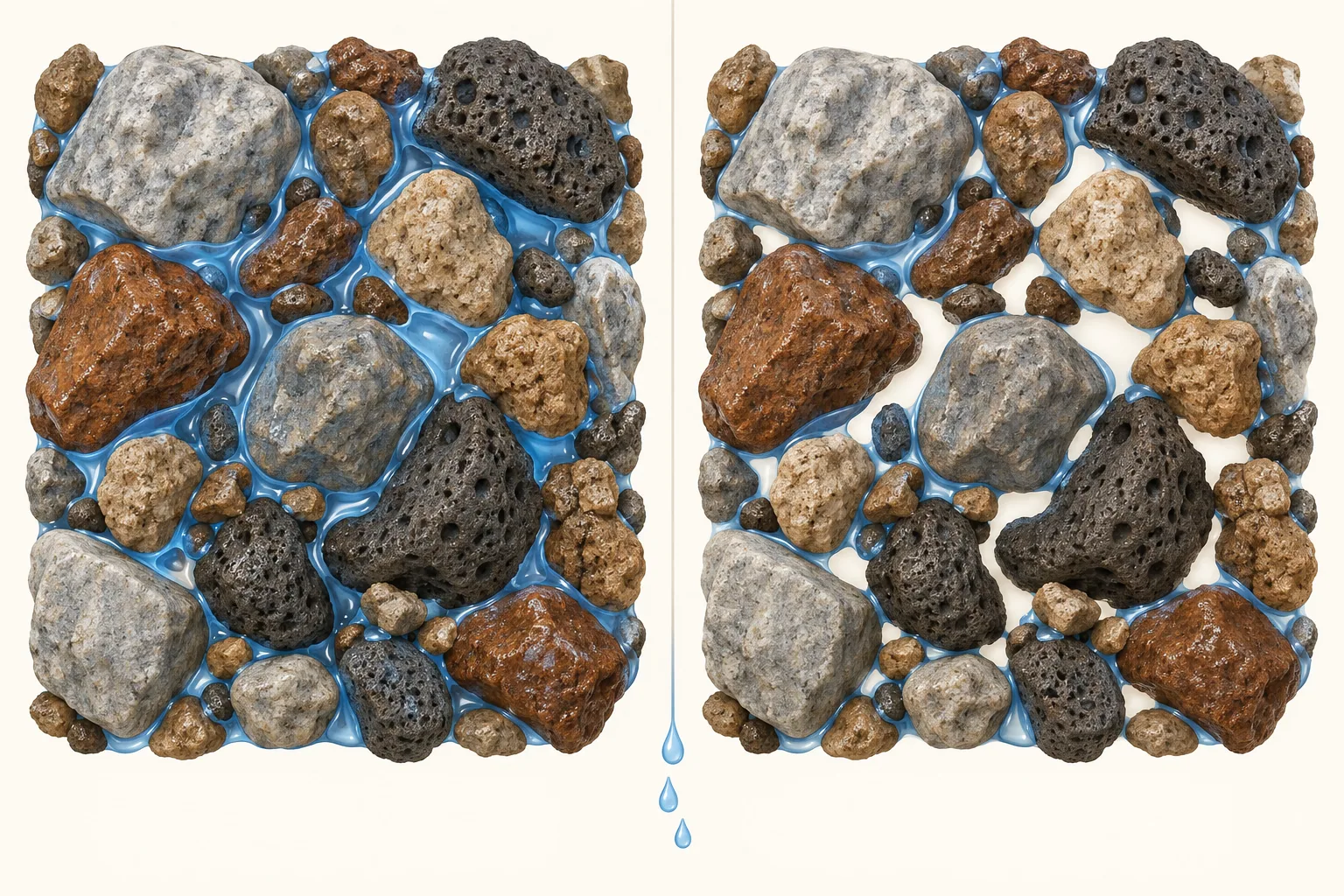
Water retention and drainage can happen at the same time: pores of different sizes hold some water while allowing excess water to move downward. For the shared concepts, see water retention and drainage and aeration in potting media. Root-zone aeration is about air supply and gas exchange in the medium, not simply how much wind moves around the leaves; why roots need air develops that distinction further.
Perlite: a material often used to keep air space open
Perlite is a hydrated, amorphous volcanic glass. When it is heated rapidly, water inside the glass turns to vapor and the material expands into low-density, porous particles. That is why horticultural perlite is usually light and white, with a texture that looks more like expanded rock than a plastic bead.
In a growing medium, perlite is often used to increase air-filled pore space and help excess water move through the mix. Air-filled pore space means the part of the pore space occupied by air after some excess water has drained. Perlite can still hold some water: water can remain on particle surfaces or in pores. Its typical role in a mix simply sits closer to the air-and-drainage side of the comparison.
Dry perlite may show fine particles, and some granules may float to the surface during watering. Its appearance can therefore change with its moisture state.
Vermiculite: a layered material that tends to hold water
Vermiculite is a group of hydrated minerals with a layered, mica-like structure. When heated, its thin layers expand into light, flake-like or accordion-like particles. The layered structure and particle surfaces usually give vermiculite a stronger water-retaining tendency than perlite. It can also adsorb or temporarily retain some positively charged nutrient ions.
Vermiculite does not simply make every container stay wet. It remains a porous material, and particles of different sizes can create air spaces. But as fine particles become more dominant, or as the medium becomes compacted, the pores can become smaller and the balance between water and air can change. Saying that vermiculite can retain some nutrients also does not mean that it is a complete fertilizer or supplies everything a plant needs.
This is why perlite and vermiculite should not be treated as fully interchangeable just because both are lightweight materials used in growing media. Their typical physical tendencies point in different directions.
Akadama: granular material with pores at more than one scale
Akadama, also called akadama soil, is easiest to misunderstand when it is treated as just a group of brown to reddish-brown granules. Research and horticultural soil references discuss it in the context of granular material derived from, or associated with, weathered volcanic-ash soil, including the Kanto loam context. It is not a single pure mineral, and it should not automatically be equated with an industrial lightweight aggregate.
The key teaching idea is that the space between akadama granules and the space inside an individual granule can behave differently. Larger spaces between intact granules can provide paths for water and air to move. Finer pores inside a granule can retain some water. This explains why akadama can be described as both draining and water-retaining: the descriptions refer to different locations and pore scales rather than contradicting each other.
Akadama’s source, particle size, and condition can change how its pores are arranged. If granules break down during use and fine particles increase, the medium’s structure may shift too. Research on a particular sample does not establish a universal durability period for every commercial product.
For how potting media may sink or become more compact over time, see Why does potting mix sink?.
A quick comparison
| Material | What it broadly is | Common physical tendency | What you should not infer directly |
|---|---|---|---|
| Perlite | Expanded volcanic glass | Light and porous; often used to increase air space and drainage | It holds no water at all, or that it is a complete potting mix |
| Vermiculite | Expanded layered mineral | Tends toward water retention and can retain some nutrient ions; it still has pores | It will make every container waterlogged, or that it is a complete fertilizer |
| Akadama | Granular horticultural material in a volcanic-ash soil context | Larger spaces between granules can move water and air, while finer internal pores can retain water | Every product has the same particle size, processing, durability, or physical properties |
The table gives you a direction, not a universal ranking. Even when two products use the same material name, different particle sizes and packing methods can create different pore distributions. Water emerging from a drainage hole shows that some water found an exit; other parts of the root zone may still have a different balance of water and air. For the role of drainage itself, see why potting media need drainage.
Material is only the starting point
The same material can behave differently in containers of different heights. Compaction can reduce larger pores. A surface that looks dry may sit above a moist center or bottom. Light, airflow, season, watering method, pot size, and pot material also change how quickly water leaves or remains in the medium. Does pot size affect roots? and does pot material affect how fast potting mix dries? explore two of those container variables.
When observing an existing potted plant, you can look together at whether excess water has a path out, whether the pot stays heavy, whether granules are breaking down or fine particles are increasing, and whether the surface differs from the center or bottom. These clues describe the medium’s current condition; no single clue determines the plant’s overall condition or sets a fixed watering schedule. If the surface is dry but the inside may still be moist, see why potting mix can be dry on top but still moist inside.
Common Mix-ups
- ✕ Perlite holds no water at all.
- ✓ Perlite can retain some water on its surfaces or in its pores, but it is commonly used to increase air space and support drainage.
- ✕ If vermiculite retains water, it will always make a potting mix waterlogged.
- ✓ Vermiculite tends to retain more water than perlite, but the result also depends on particle size, compaction, the container, and the rest of the medium.
- ✕ Akadama is simply a high-fired industrial clay aggregate.
- ✓ Akadama is discussed in a volcanic-ash soil and granular horticultural context; any additional processing must be checked for the specific material rather than inferred from the name.
- ✕ A medium that holds more water always gives a plant more usable water.
- ✓ Water-holding capacity, plant-available water, and oxygen in the root zone are related but different ideas.
- ✕ If water runs quickly out of the drainage hole, the root zone must be dry and suitable.
- ✓ Fast outflow describes one water pathway. You still need to consider pore space, pot shape, compaction, and moisture inside the container.
Frequently Asked Questions
Can perlite and vermiculite replace each other?
They should not be treated as fully equivalent. Both are porous mineral materials used in growing media, but perlite usually leans toward air space and drainage, while vermiculite usually leans toward water retention and some nutrient-ion retention. Particle size, compaction, and the rest of the mix still affect the result.
Does perlite hold no water?
No. Perlite is commonly used to increase air-filled pore space and help excess water move, but some water can remain on particle surfaces or in pores. “More draining” does not mean “zero water retention.”
Will vermiculite always make a potting mix too wet?
Not always. Vermiculite has a stronger water-retaining tendency than perlite, but the final water-and-air balance also depends on particle size, packing, container shape, and the other materials present. The material name alone cannot predict one identical result in every pot.
What is akadama: soil, stone, or fired clay?
Akadama is a granular horticultural material associated with weathered volcanic-ash soil. It is not expanded volcanic glass like perlite, and it should not automatically be treated as the same thing as an industrial aggregate.
Is akadama always kiln-fired and highly durable?
That cannot be assumed for every product. Source material, particle size, particle condition, processing, and use can affect how long the granular structure remains stable. Research on a particular sample does not establish a universal durability period for all products.
Why does particle size affect water retention and drainage?
Particle size changes the size and arrangement of spaces between particles. It can also change how many larger pores remain after the medium is packed. Finer structures often hold water longer, but the retained water is not automatically easier for roots to use; coarser structures often move water and air more readily, but may retain less water.
Which is best: perlite, vermiculite, or akadama?
There is no single best choice independent of the plant, container, light, airflow, watering conditions, and the rest of the growing medium. The useful skill is to describe the material through pores, water retention, drainage, and root-zone aeration rather than assign a universal recipe or ranking.
If water runs quickly out of the drainage hole, does that mean the medium is suitable?
Not necessarily. It means that some water found a fast route out. Other parts of the container may still hold water, have too little air-filled pore space, or be compacted; the surface and interior may also differ.
Are perlite, vermiculite, and akadama complete potting mixes or fertilizers by themselves?
No. In this comparison they are materials that can affect support, pore space, water behavior, and—especially for vermiculite—retention of some nutrient ions. A material’s ability to retain ions is not the same as being a complete fertilizer or a complete potting mix.
Related Terms
- Growing medium: Material, or a combination of materials, that supports roots and holds water and air in a container.
- Potting mix: A growing medium prepared for use in a container; it may contain several different materials.
- Pore space: Space between particles or within a particle that can be occupied by water or air.
- Air-filled pore space: The part of the pore space occupied by air after some excess water has drained.
- Root-zone aeration: The air supply and gas exchange available around roots within the medium.
- Water-holding capacity: The ability of a material or medium to retain water; it does not mean that all retained water is plant-available.
- Plant-available water: Water that roots can access under the conditions of the medium; it is not identical to total water retained.
- Particle size: The size range of the particles, which affects pore size, arrangement, and water-and-air movement.
Related reading
Evidence
References
These sources were used to check the plant-science concepts and gardening context in this article.
View sources and further reading (12)
- yardandgarden.extension.iastate.edu — potting media components and handling
- usgs.gov — perlite statistics and information
- usgs.gov — mineral resource month vermiculite 0
- aggie-horticulture.tamu.edu — growing media
- aggie-horticulture.tamu.edu — air water and media putting them all together
- ask.ifas.ufl.edu — EP623
- jstage.jst.go.jp — en
- jstage.jst.go.jp — ja
- hro.or.jp — q15.html
- cir.nii.ac.jp — 1050282813632913152
- ipm.ucanr.edu — soil properties and water availability to roots
- uaex.uada.edu — FSA 6098.pdf